

You have found the person you want, and they need a visa. If your business has never sponsored anyone, the process looks larger than it is. It becomes manageable once you see that it breaks into three applications, each doing one job.
This guide covers how to sponsor an overseas worker in Australia from the employer’s side: what you apply for, what it costs after the 1 July 2026 increases, how long it takes, and the obligations that follow. Our employer sponsored visa hub sets out every pathway.
What Changed on 1 July 2026
Anything predating this date will understate your costs.
| Item | Before | From 1 July 2026 |
| Subclass 482 visa charge | AUD 3,210 | AUD 4,015 |
| Subclass 186 and 494 visa charge | AUD 4,910 | AUD 6,140 |
| Core Skills Income Threshold | AUD 76,515 | AUD 79,423 |
| Specialist Skills Income Threshold | AUD 141,210 | AUD 146,576 |
Visa charges are set by the 2026 fee regulations. The income thresholds are indexed separately each 1 July, tracking average weekly earnings.
Most skilled visa charges rose about 25 percent. The levy, the nomination fees and the sponsorship charge did not change, which is what employers get wrong when budgeting from a mix of old and new sources. All three 482 streams share the same visa charge.
Several large firms publish AUD 79,499 as the new Core Skills threshold. It is wrong; it applies trending average weekly earnings of 3.9 percent instead of the published 3.8. The arithmetic settles it: 76,515 × 1.038 = 79,422.57.
The Three Applications, and Who Lodges Each One
Most first-time sponsors expect one form. There are three, in a set order.
One, the sponsorship. Your business applies to become an approved sponsor. About your company, not any particular employee.
Two, the nomination. A specific position for a specific person. Where most refusals happen.
Three, the visa. Your employee lodges their own, covering skills, English, health and character.
You lodge the first two; your employee lodges the third. Home Affairs decides the nomination before the visa, so a nomination that fails stops the visa application where it stands. That tells you where to put your effort.
Step One: Become an Approved Sponsor
A standard business sponsorship lasts five years and covers every worker you nominate in that period. You apply once, not once per hire.
Your business needs to be lawfully operating, carry no adverse information, and show a commitment to employing local labour. New businesses can be approved, so a short trading history does not rule you out. It costs about AUD 420, unchanged on 1 July 2026; our guide to sponsoring overseas skilled workers covers what the Department looks at.
All three can be lodged at the same time, which removes several weeks from the timeline.
Step Two: Nominate the Position
The nomination is where employer sponsorship requirements in Australia get specific, and it deserves most of your attention. Four things decide it.
The occupation has to be on the right list
More nuanced than most guides admit. The Core Skills Occupation List applies to the 482 Core Skills stream and to 186 Direct Entry. It does not apply to 186 Temporary Residence Transition, which has no occupation list at all; eligibility flows from the occupation on the employee’s existing visa. The 494 runs on the legacy lists. See our Core Skills stream guide and skilled occupation lists.
Home Affairs reads the actual duties against the ANZSCO description, and duties outweigh the job title you use internally. A role advertised as Business Development Manager, where the work is mostly operations, gets assessed as an operations role; write the position description against the ANZSCO tasks before you lodge. Our note on the move from ANZSCO to OSCA explains why migration still runs on ANZSCO.
The position has to be genuine
Home Affairs asks whether the role would exist regardless of who fills it, whether it is full-time and ongoing, and whether the duties match the size of your business. Support it with your organisational chart, financials and the position description.
The salary has to clear two separate tests
Earnings must satisfy both, and you pay whichever produces the higher figure.
The first is the Core Skills Income Threshold, now AUD 79,423, a floor across the whole program that indexes each 1 July. Roles paid at or above the Specialist Skills Income Threshold of AUD 146,576 can use the faster Specialist Skills stream.
The second is the annual market salary rate: what an Australian doing the same job in the same location would earn. Clearing one tells you nothing about the other. AUD 85,000 sits comfortably above the threshold and still fails if comparable roles in your city pay AUD 95,000. Evidence it with an equivalent employee’s payslips, the applicable Fair Work award classification, or recent ads for the same role and location.
You may need to advertise first
Labour market testing applies to the 482 and the 494, not the permanent 186. Two advertisements minimum, applications open for at least four weeks, nomination lodged within four months of that advertising. Each ad must be in English, commissioned or authorised by you, and state the position title, the skills or experience required, and your business name, or your recruiter’s. Where annual earnings fall below AUD 96,400, it must state the salary too.
Hold on to the four-month window. A great deal of commentary says six. The instrument says four.

| You may not have to advertise at all
Testing is waived for select positions: annual earnings of AUD 250,000 or more; intra-corporate transfers from an established overseas business; re-nominating an existing holder after a change in earnings or a restructure; an internationally recognised record of exceptional achievement; ANZSCO minor group 253 medical practitioners, excluding GPs; and 4111 paramedics. Nationals of certain free trade agreement countries are exempt under international trade obligations. A written submission replaces the advertising. The Specialist Skills stream is not exempt, a common and expensive misreading. |
Step Three, Your Employee’s Visa Application
Your employee handles this part, but knowing what they face keeps your timelines aligned: health examinations and police certificates, a skills assessment on some pathways, and English.
| The English requirement is not the same for the two visas
For the 482, Core Skills and Specialist Skills applicants need IELTS 5.0 in each of the four components, and since 13 September 2025 there is no overall band score requirement at all. Components may be achieved across resits. For the 186, the standard is Competent English: IELTS 6.0 in each component. Guides that quote 6.0 for the 482 are applying the permanent standard to the temporary visa, and it rules out candidates who are comfortably eligible. |
The 482 English requirement is waived for passport holders of the UK, USA, Canada, New Zealand and Ireland, for five years of study in English, and for guaranteed annual earnings of AUD 96,400 or more. Our English requirement guide and IELTS breakdown cover the details.
Expert Australian Migration Guidance
Navigating the complexities of your visa journey is easier with professionals. Start your Australian dream today.
Book ConsultationAsk for their document status early. An expired skills assessment, or one issued for a graduate visa, is the most common reason a well-built nomination sits waiting. If they are onshore, our bridging visa guide explains what covers them meanwhile.
Which Visa Should You Sponsor?
| Subclass 482 Skills in Demand | Subclass 186 Employer Nomination Scheme | |
| Type | Temporary | Permanent |
| Work experience needed | 1 year in the last 5 | 3 years for Direct Entry |
| English | IELTS 5.0 each component | IELTS 6.0 each component |
| Labour market testing | Required | Not required |
| Visa charge from 1 July 2026 | AUD 4,015 | AUD 6,140 |
| Nomination fee | AUD 330 | AUD 540 |
| SAF levy | AUD 1,200 or AUD 1,800 per year | AUD 3,000 or AUD 5,000, one-off |
| Leads to permanent residency | Yes, through the Temporary Residence Transition stream | Already permanent |
Many employers sponsor on a 482 first, then move the same employee to a 186 through the Temporary Residence Transition stream: two years of full-time work in Australia within the three years before applying, on a 457 or 482. It removes the skills assessment in most cases and gives you two years to be sure about the hire.
One widely misreported rule. A sponsored employee may stop working in the nominated occupation for you for up to 180 consecutive days at a time, capped at 365 across the visa. That is a grace period to find a new sponsor, not a licence to work elsewhere during it. Regional businesses should also look at the Subclass 494, and shortage sectors at the labour agreement stream or a DAMA.
What It Costs to Sponsor an Employee in Australia
Employer costs only. Your employee pays their own visa charge separately.
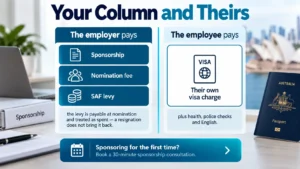
| Item | Amount |
| Sponsorship application | about AUD 420 |
| Nomination fee, 482 | AUD 330 |
| Nomination fee, 186 | AUD 540 |
| Nomination fee, 494 | Nil |
| SAF levy, 482, turnover under AUD 10 million | AUD 1,200 per year |
| SAF levy, 482, turnover AUD 10 million or above | AUD 1,800 per year |
| SAF levy, 186 or 494, turnover under AUD 10 million | AUD 3,000 one-off |
| SAF levy, 186 or 494, turnover AUD 10 million or above | AUD 5,000 one-off |
Confirm your own figures in the Home Affairs visa pricing tool before you lodge.
The Skilling Australians Fund levy is payable at nomination and refunded only in narrow circumstances, such as a visa refused on health or character grounds after nomination approval. A withdrawal or resignation will not usually produce a refund, so treat it as spent at lodgement. It is set by its own Act and does not move with the 1 July cycle.
How Long It Takes
Home Affairs publishes two numbers per visa: the time in which half of applications are decided, and the time in which ninety percent are. Percentiles, not a range. On the processing times tool in September 2026:
- Subclass 186 Direct Entry: 13 months for half, 21 months for ninety percent
- Subclass 186 Temporary Residence Transition: 14 months and 22 months
- Subclass 482 Core Skills: 4 months and 9 months
- Subclass 482 Specialist Skills: 15 days and 45 days
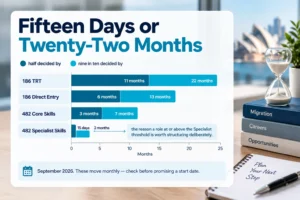
These move monthly, so check before you promise a start date. The Specialist Skills figures are why a role paid at or above AUD 146,576 is worth structuring deliberately.
The delay you control is the request for further information. Complete salary evidence and a properly drafted position description avoid that cycle.
What You Take On After the Grant
Sponsor obligations continue for the life of the sponsorship, and Home Affairs monitors compliance. You agree to:
- Pay no less than the nominated salary and the market rate
- Employ them only in the nominated occupation, which you can verify through VEVO; our VEVO guide explains how
- Keep records demonstrating compliance and provide them on request
- Notify Home Affairs of changes: address, ownership, or the employee ceasing work
- Cooperate with monitoring, including site visits
- Pay reasonable travel costs for them to leave Australia, if requested in writing
Ordinary record-keeping duties. They become a problem only when nobody is assigned to them, so give one person responsibility from the start. Failures here lead to sanctions and cancellation.
Five Things First-Time Sponsors Get Wrong
- Choosing the occupation from the job title. The duties decide the ANZSCO code, and the code decides the nomination.
- Treating the income threshold as the salary test. It is one of two, and the market rate frequently sits higher.
- Advertising after deciding to sponsor. Testing must be genuine and correctly timed, and check first whether you are exempt.
- Budgeting from a pre-July source. Visa charges rose about 25 percent on 1 July 2026; the levy and nomination fees held steady.
- Assuming the existing skills assessment counts. One obtained for a graduate visa does not support a Direct Entry nomination.
Sponsoring for the First Time
Sponsorship is a documentation exercise more than a legal one. We prepare first-time sponsorships end to end, and review files that have already had a request for further information. Meet the team who would handle yours, in Harris Park, Melbourne, or online.
Book a 30-Minute Sponsorship Consultation Send Us Your Situation in Writing
No registered migration agent can guarantee a visa outcome. Figures verified 10 September 2026. Verify any agent’s registration on the Register of Migration Agents