

Dreaming of a new life in Australia? You’re not alone. Each year, thousands of skilled professionals from around the world make that dream a reality, and their journey often begins with a single, critical question: Does Australia actually need my specific skills? You’ve likely heard that Australia is looking for people, but the immigration process can feel like an impossible maze. It’s not, and the map starts right here.
The answer to that question lies in a special set of government-curated lists. Think of the Australian Skilled Occupation Lists as the country’s official “Occupations list” for professions. To build its economy and fill critical gaps in areas like healthcare and technology, the government identifies specific jobs it needs to attract from overseas. If your occupation is on this list, it’s a clear signal that you are in demand.
Navigating the path to an Australian visa can seem complex, but understanding these lists simplifies the entire process. Confirming your job is listed is the essential first step in determining your General Skilled Migration Australia eligibility. It’s the green light that tells you to explore the next stages of your potential journey, long before you get into the details of points, paperwork, or formal applications.
This guide cuts through the confusion, providing a clear path to help you find your occupation for Australian migration, understand what the lists mean, and know exactly where to look.
Why Australia Has a “Job Occupation List” for Global Talent
Ever wondered why a country like Australia doesn’t just open its doors to anyone who wants to work there? The answer lies in a smart, practical approach to building its economy. The government doesn’t create random hurdles; instead, it maintains the Australian skilled occupation lists to pinpoint the exact skills it needs to fill critical gaps in its workforce.
Think of it this way: Australia has a national “Occupation list” for professions. If local industries can’t find enough software developers, mechanics, or aged care workers, those jobs are added to the list. This is fantastic news for you. Seeing your profession on a list means the government has officially recognised a shortage of your skills, actively signaling that people with your expertise are in demand.
This direct link to the economy also means the lists are constantly evolving. As industries grow and technology changes, so do Australia’s needs. A job that is in high demand today might be removed in a few years if the local workforce catches up, while entirely new roles can be added. It’s a dynamic system designed to keep the country’s economy balanced and growing.
But not all positions on this “Occupation list” are treated the same. Some are considered vital for the country’s long-term future, while others are needed to fill more temporary gaps. This distinction creates different types of lists, each offering a different kind of visa and opportunity.
Long-Term vs. Short-Term Lists: What’s the Difference for Your Visa?
Just as an Occupation list has essential staples and temporary wants, Australia’s skilled occupation lists are divided into two main types. This distinction is crucial because the list your profession falls under directly influences the type of visa you might be eligible for and how long you can stay. Understanding this difference is key to managing your expectations for a potential move.
First is the Medium and Long-term Strategic Skills List. Think of this as the list for Australia’s most critical and ongoing needs. Occupations here, like Registered Nurse, Civil Engineer, or Electrician, are considered vital to the country’s future. If your job is on this long-term list, it generally opens a clearer pathway to applying for permanent residency, allowing you to live and work in Australia indefinitely.
Want to dive deeper into which specific jobs are on the long-term list and how they connect to permanent visa options? Read our complete guide to the MLTSSL list.”
This list makes you eligible for the:
- Skilled Independent (Subclass 189) visa, allowing you to live anywhere in Australia permanently without a sponsor.
- Employer Nomination Scheme (Subclass 186) visa, if an Australian business sponsors your permanent stay.
- Temporary Graduate (Subclass 485) visa, providing post-study work rights for international students.
In contrast, the Short-term Skilled Occupation List targets more immediate, temporary gaps in the workforce. Professions on this list, which might include roles like a Cook or a Marketing Specialist, are still in demand, but the shortage isn’t seen as a long-term problem. As a result, being on this list typically leads to a temporary visa, allowing you to live and work in Australia for a set period, often two to four years.
You can use the STSOL to apply for the:
- Skilled Nominated (Subclass 190) visa, which requires a state or territory to nominate you for permanent residency.
- Skilled Work Regional (Provisional) (Subclass 491) visa, a five-year visa requiring you to live and work in a regional area.
Curious about exactly which professions are on the short-term list and how state nomination works? Check out our detailed STSOL guide.
So, what does this mean for you? The most important takeaway is a simple one:
- The Long-Term List: For jobs with lasting shortages, offering a more direct route to a permanent stay.
- The Short-Term List: For filling temporary gaps, usually leading to a temporary stay.
| Feature | Medium and Long-term Strategic Skills List | Short-term Skilled Occupation List |
| Purpose | For Australia’s most critical and ongoing needs (lasting shortages). | Targets immediate, temporary gaps in the workforce. |
| Visa Outcome | Generally opens a clearer pathway to applying for permanent residency (indefinite stay). | Typically leads to a temporary visa (set period, often two to four years). |
| Examples | Registered Nurse, Civil Engineer, Electrician. | Cook, Marketing Specialist. |
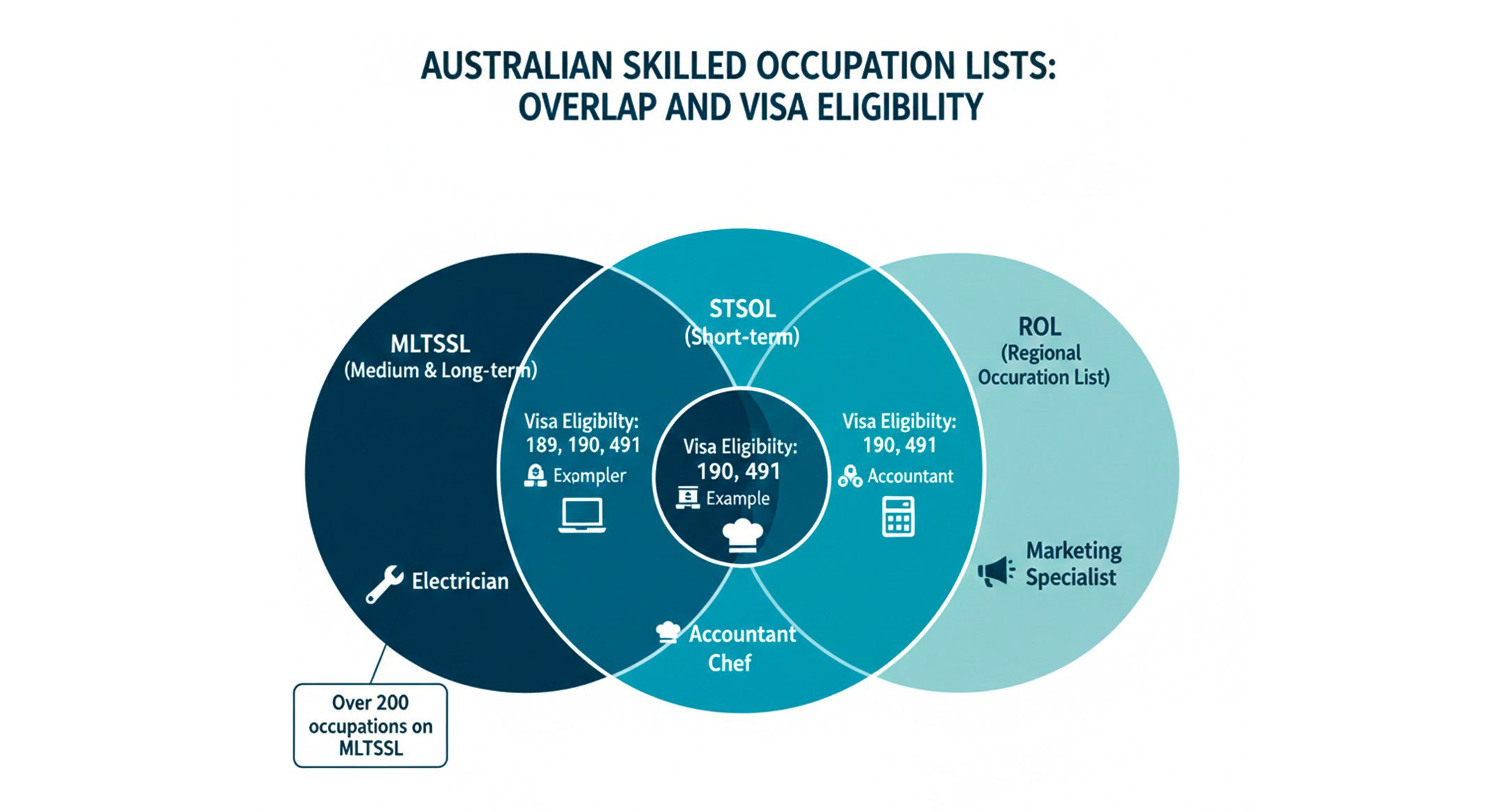
Beyond the standard long-term and short-term categories, Australia utilizes several specialized lists to target specific economic needs. Understanding which list your occupation appears on is the first step in identifying your eligible visa subclass:
The Core Skills Occupation List (CSOL)
The government recently introduced the Core Skills Occupation List (CSOL) as a cornerstone of the employer-sponsored migration system. This list primarily targets the Skills in Demand subclass 482 visa, specifically within the Core Skills stream. It also provides a direct pathway for the Employer Nomination Scheme Subclass 186 Direct Entry stream.
The Regional Occupation List (ROL)
The Regional Occupation List (ROL) drives economic growth in areas outside of Australia’s major cities. If you find your job on the ROL, you may qualify for the Skilled Work Regional (Provisional) (Subclass 491) visa. Additionally, this list supports the Skilled Employer Sponsored Regional (Subclass 494) visa for those with a regional job offer.
State and Territory Nominated Lists
Each Australian state and territory manages its own State/Territory Nominated List to address local labour shortages. These lists offer a vital pathway to the Skilled Nominated (Subclass 190) visa, which grants immediate permanent residency. They also provide eligibility for the Skilled Work Regional (Provisional) (Subclass 491) visa.
Summary of Visa Eligibility by List
To help you navigate the “maze,” the following table summarises the primary visa subclasses associated with each major occupation list:
| Occupation List | Primary Visa Subclasses | Stay Type |
| MLTSSL | 189 (Skilled Independent), 190, 482, 491, 186 | Permanent / Temporary |
| STSOL | 190 (Skilled Nominated), 491, 482 (Short-term) | Permanent / Temporary |
| CSOL | 482 (Skills in Demand), 186 (Employer Nomination) | Permanent / Temporary |
| ROL | 491 (Regional), 494 (Employer-Sponsored Regional) | Provisional (Pathway to PR) |
| State Lists | 190 (Skilled Nominated), 491 (Skilled Work Regional) | Permanent / Provisional |
Unlocking More Pathways: How State and Regional Lists Can Help You
Finding that your job isn’t on the main national lists can feel disheartening, but it’s far from the end of the road. Think of it this way: while the federal government has its national “shopping list,” each of Australia’s states and territories has its own, more specific list reflecting its unique local economy. This creates a whole new set of opportunities for skilled professionals.
Imagine the national lists are for skills the whole country needs, like more doctors or software developers. A state list, however, is much more targeted. For example, South Australia, with its world-famous wine regions, might have a high demand for winemakers. Western Australia, with its massive mining industry, might be actively seeking mining engineers. These professions might not be on a national list, but they are critical to the economy of that particular state.
This is where a process called “state nomination” comes in. If your occupation is on a state’s specific list, you may be able to apply directly to that state’s government. If you meet their criteria, they can essentially nominate you for a visa, telling the federal government, “We want this person’s skills here.” This nomination can significantly strengthen your visa application and open doors that would otherwise be closed.
Your search for an opportunity in Australia shouldn’t stop at the two main lists. You now have a whole new set of places to look: the individual occupation lists for each state and territory. As you search, you’ll notice that the job titles are very specific. A “chef” and a “cook” might seem similar, but in the world of Australian immigration, they are entirely different roles with different pathways.
Why “Chef” Isn’t Enough: Finding Your Official Occupation “Code”
In everyday life, titles like “chef” and “cook” might be used interchangeably. For Australian immigration, however, there are two completely distinct professions with different requirements, responsibilities, and visa pathways. This small difference highlights a massive point: your day-to-day job title might not be what the Australian government officially calls your profession.
To ensure fairness and consistency for applicants worldwide, the government uses a standardized system. Think of it like this: “car” is a general term, but “Toyota Camry” is a specific model. The immigration system needs a specific model for your job. It classifies every single skilled occupation with a precise title and a unique reference code, almost like a serial number for that profession. This ensures an “Accountant” from Dubai is assessed on the same detailed criteria as an “Accountant” from London.
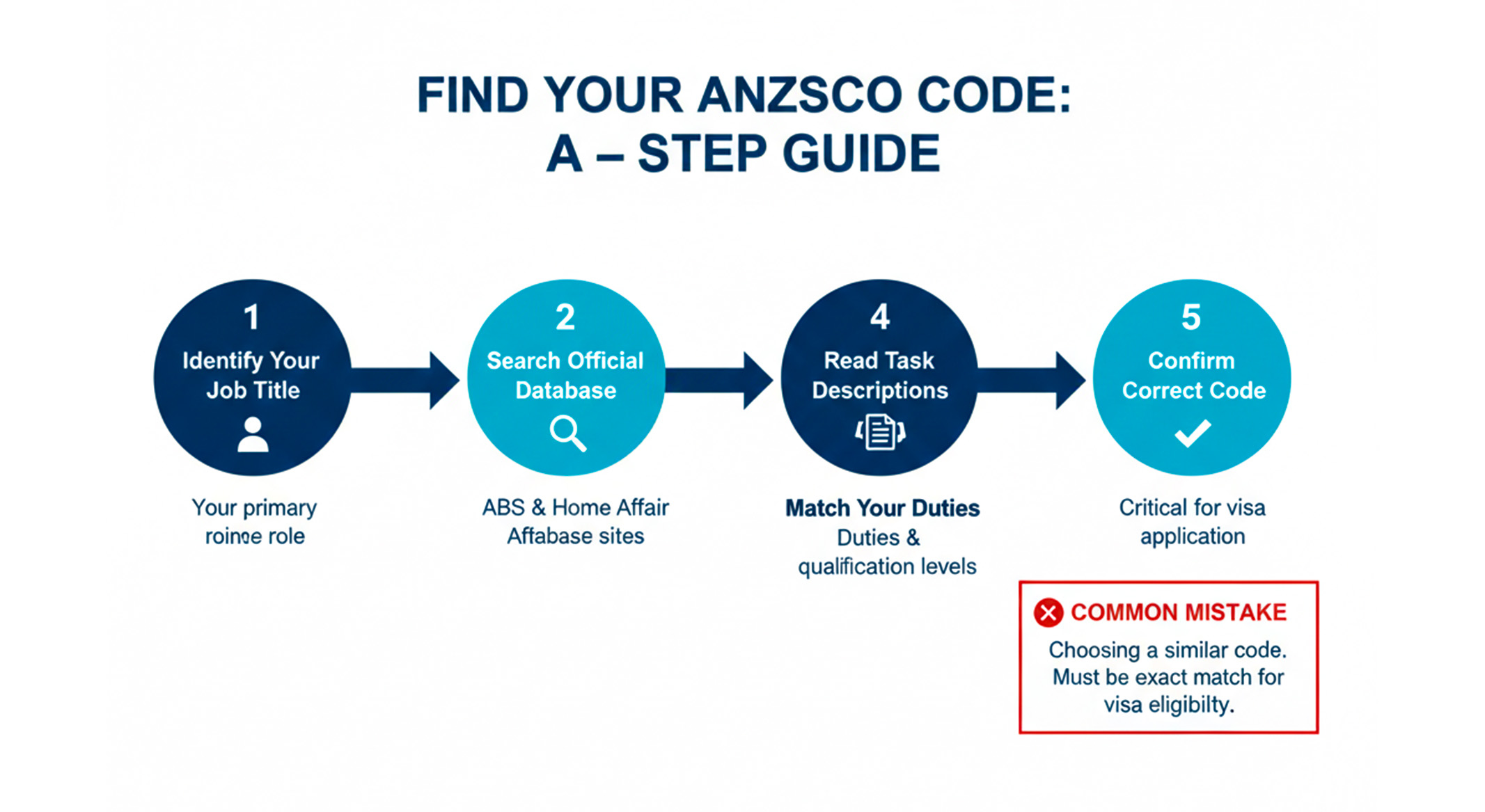
This official classification is far more than just a title. It comes with a detailed list of tasks and responsibilities that a person in that role is expected to perform. When you look for your occupation, you need to match your actual work experience and qualifications against these official task descriptions, not just the title. You might be called a “Project Lead” at your company, but in the Australian system, your duties might better match the official occupation of “Software Engineer” or “Construction Project Manager.”
Finding this exact match is arguably the most critical first step. Getting it wrong can mean you waste time and money pursuing a pathway you aren’t actually eligible for. So, before you can confidently say your job is on a skilled list, you first need to find your profession’s official title and code.
How to Check the Official Australian Skilled Occupation List: A Step-by-Step Guide
Now that you know your job has an official title, it’s time for the moment of truth: finding it on Australia’s skilled occupation lists. Thankfully, the government has created a straightforward online tool for this exact purpose. Instead of getting lost in confusing spreadsheets or outdated blog posts, you can go straight to the source. Using this tool is the most reliable way to find your occupation for Australian migration.
Navigating a government website can feel intimidating, but finding your profession is easier than you think. The entire process comes down to typing your job into a search box and seeing what comes up.
To make it simple, here is a step-by-step guide to check the lists yourself:
- Go to the official search page. Open your web browser and navigate to the Department of Home Affairs skilled list.
- Search for your profession. You will see a search bar. Start by typing in keywords for your job, such as ‘nurse’, ‘carpenter’, or ‘software developer’. You don’t need the official code yet; the tool will help you find it.
- Review the results. The tool will show you any matching occupations. The most important column to check is the one titled “List.” This tells you which, if any, of the skilled occupation lists your profession is on.
Seeing your profession appear on a list, especially the “Medium and Long-term” list, is a fantastic and exciting first step. It means the Australian government has identified a need for people with your exact skills.
However, simply being on the list isn’t a golden ticket. It’s more like an invitation to prove you meet the Australian standard for that profession. This verification process is official, non-negotiable, and has a name you’ll need to get familiar with: a “Skills Assessment.”
Your Job is on the List! What is a “Skills Assessment”?
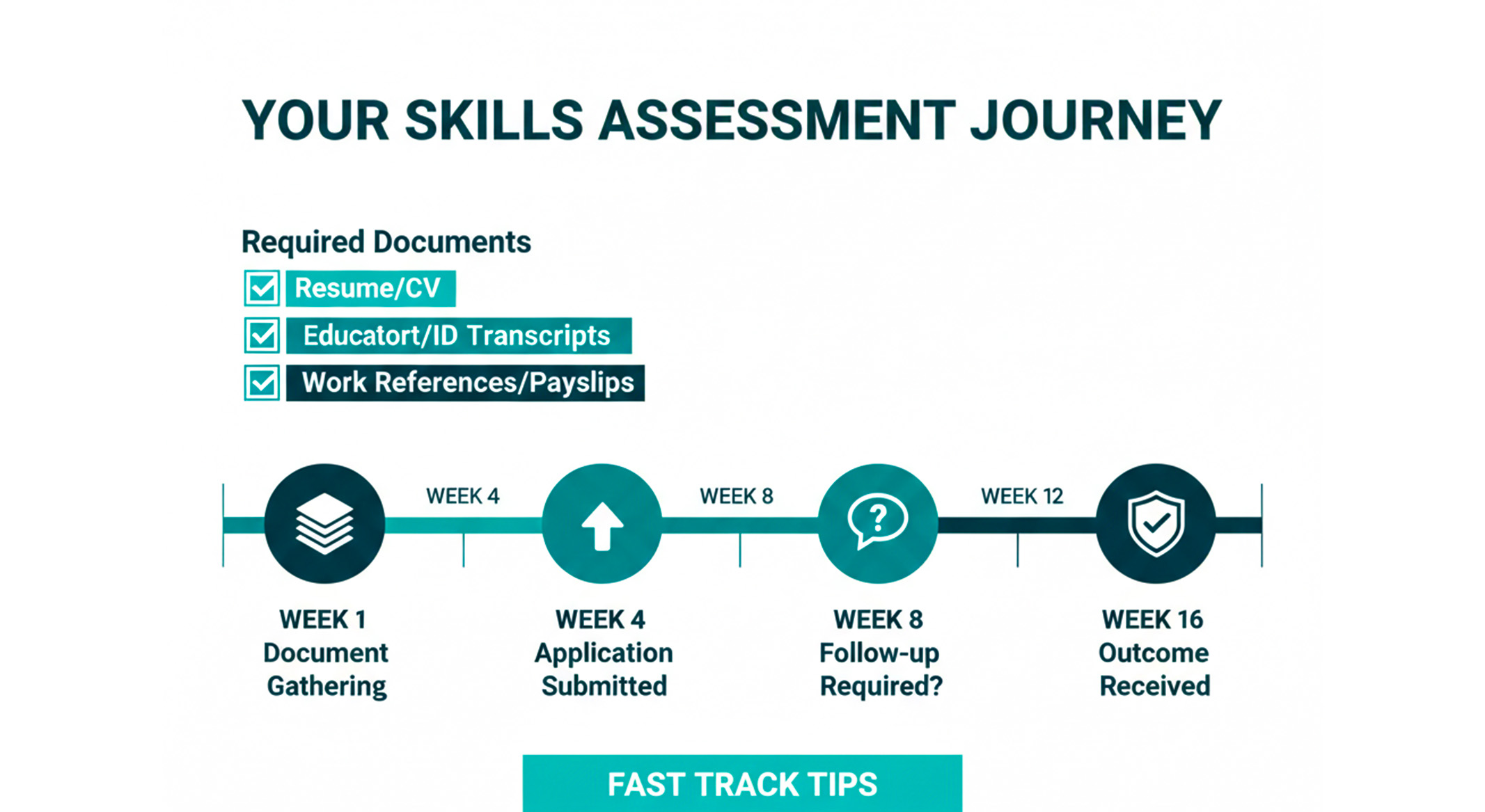
Finding your profession on an official list is a fantastic moment. It confirms Australia has a demand for your skills and is a key part of checking your skilled migration Australia eligibility. However, the government needs to be sure that your qualifications and experience meet their specific standards. Simply having the job title on your resume isn’t enough; you must have your skills formally verified. This official verification process is called a “skills assessment.”
Expert Australian Migration Guidance
Navigating the complexities of your visa journey is easier with professionals. Start your Australian dream today.
Book ConsultationThink of a skills assessment like getting your university degree officially recognised for use in another country. It’s an in-depth review where an authorised Australian body examines your educational certificates and proof of work experience. Their job is to confirm that your background is genuine and equivalent to the standards expected for that same profession in Australia. It’s the official stamp of approval that says you are, in fact, “skilled” by their definition.
This process isn’t handled by one single government department. Instead, Australia designates specific, independent organisations to be the experts for certain fields. These are called “assessing authorities.” For example, a nursing board will assess nurses, an engineering institute will assess engineers, and trade recognition bodies will assess electricians and carpenters. When you find your occupation on the government’s list, it also tells you exactly which authority you must apply to for your assessment.
Successfully passing your skills assessment is a non-negotiable requirement. Without a “positive” outcome from your assessing authority, you cannot move forward with your application for a skilled visa. It’s the foundational piece of evidence that makes applying for one of the Australian permanent residency occupations possible. Once you have that positive assessment in hand, you can then tackle the next major steps: understanding the “points test” and the process of receiving an “invitation to apply.”
After the Assessment: Understanding the “Points Test” and “Invitations”
With a positive skills assessment in hand, you’ve cleared a major hurdle. However, you don’t automatically apply for a visa. For most skilled visas, Australia uses a competitive, points-based system to select the best candidates. Think of it less like standing in a queue and more like trying out for a sports team.
This is where the “points test” comes in. The government awards points for various factors that make you a desirable candidate, such as your age, English language ability, and the years of skilled work experience you have. Younger candidates with superior English and extensive experience will naturally score higher. Many people search online for an Australian visa points calculator for my job to get a rough idea of where they might stand in this competitive process.
Once you know your potential points score, the next step is to formally signal your interest to the government. You do this by submitting a profile to a digital pool of candidates. This profile outlines your skills, your positive skills assessment, and your total points score. This isn’t a visa application; it’s you raising your hand and saying, “I’m skilled, I’m ready, and here’s why you should pick me.”
From this pool of candidates, the government then issues invitations to the highest-scoring individuals, asking them to formally apply for the visa. You must receive one of these “invitations to apply” before you can move forward. This is a key part of learning how to apply for a skilled visa in Australia; patience is crucial, as you must wait to be selected.
Some of these invitations come from the national government for candidates who can work anywhere, while others might come from a specific state or territory that particularly needs your occupation. These distinct pathways have different requirements, but both are designed to fill critical skill shortages across the country, paving the way for your potential new life in Australia.
Article You Must need To Read : Complete guide to General Skilled Migration Australia
What If My Job Isn’t on a Skilled List? Exploring Other Pathways
If you’ve searched the lists and come up empty, it’s easy to feel discouraged. But don’t lose hope. The skilled migration program is just one road to Australia, and finding your occupation not on a skilled list in Australia simply means you need to look at a different map. Many successful migrants arrive through pathways that don’t rely on the points test at all.
This brings us to another major pathway: employer sponsorship. Instead of the government selecting you from a pool, a specific Australian business chooses to hire and “sponsor” you because they need your unique skills. Think of it this way: while the skilled lists are the country’s general shopping list, sponsorship is when one company has a specific item they need to buy, and that item is you. Learning how to get sponsored for a visa in Australia involves actively searching and applying for jobs with companies that are willing to support your visa application.
Another long-term strategy to consider is studying trade course in Australia. By completing a qualification in a field that is in high demand, you not only gain a valuable Australian education but can also open up new migration pathways upon graduation. This is a longer and more expensive route, but for some, it’s the perfect way to align their skills with Australia’s future needs.
Ultimately, not being on a skilled list isn’t the end of your Australian dream; it’s a pivot. Your focus shifts from meeting broad government criteria to proving your direct value to an Australian employer. The question changes from “Does Australia want my profession?” to “Which company in Australia wants my skills?” Many of the jobs most in demand are found through this direct employer-led route.
Your 3-Step Action Plan to Begin Your Journey
You’ve gone from wondering if your skills are needed to understanding how the system works. The skilled occupation lists are the official starting point, and you now have a clear action plan. Use this checklist to begin your research and confirm your skilled migration Australia eligibility:
- Find Your Official Occupation: Use the official government search tool to see if your profession is on a long-term, short-term, or state-specific list. This is the single most important first step.
- Identify Your “Skills Assessor”: If your job is listed, the search tool will also show the name of the designated “assessing authority.” This is the organisation you’ll need to deal with later, so take note of its name.
- Understand the Full Picture: Remember, finding your job on a list is just Step One. Think of it as getting your ticket to the starting line. The next stages involve a skills assessment, a points test, and waiting for an invitation to apply.
You’ve taken the first, most crucial step in understanding how to apply for a skilled visa in Australia. The path to migration is a marathon, not a sprint, and you’ve just started it with clarity and confidence. Take your time, do your research, and know that you’re now approaching this journey from a place of empowerment.
Conclusion
Your journey to skilled migration doesn’t have to feel overwhelming. By understanding the Australian skilled occupation lists, you’ve just equipped yourself with the most critical piece of information: whether Australia officially needs your profession. This knowledge transforms what once seemed like an impossible maze into a clear, step-by-step pathway.
The beauty of Australia’s system is that it’s designed to be fair and transparent. The government has openly stated which skills it needs, and now you know exactly where you stand. Whether your profession is on the long-term list offering permanent residency, a state-specific list requiring nomination, or you’re considering employer sponsorship as an alternative, you have a roadmap to follow.
Don’t rush. Take time to research your specific occupation thoroughly, understand the requirements of your assessing authority, and plan your finances and timeline realistically. The Migration is a life-changing decision, and approaching it with patience and diligence will serve you far better than hasty decisions. Book your consultation with our Mara expert and start your journey in Australia.
Frequently Asked Questions
How often do the skilled occupation lists change?
The Department of Home Affairs typically updates the lists annually, often near the start of the financial year in July. However, they may release interim updates at any time to address urgent labor shortages.
Can I apply for a skilled visa if my job is only on the Short-term list?
You cannot apply for the independent Subclass 189 visa, but you can still qualify for state-nominated options. Focus your efforts on the Subclass 190 or Regional Subclass 491 visas, which accept short-term list occupations.
What if my job title at work doesn’t exactly match the titles on the list?
Your exact job title matters less than the specific duties you perform daily. You must prove that your official tasks align with the ANZSCO description for your nominated occupation.
Do I need a job offer before I can apply for a skilled visa?
You do not need a job offer for the independent 189 visa or most state-nominated 190 and 491 visas. However, you must have a confirmed offer if you apply for employer-sponsored visas like the Subclass 482.
How long does the entire skilled migration process take from start to finish?
The entire journey usually takes between 12 to 18 months, covering the skills assessment, EOI invitation, and final visa processing. This timeline varies significantly based on your points score and the specific visa subclass.