


The pass mark for a Subclass 189 Skilled Independent visa is 65 points. Your occupation’s real cutoff decides your outcome, and for some occupations it sits 30 points higher. For others, there is no cutoff at all, because no invitations were issued.
You can meet every published requirement and still wait two years in silence.
If your score falls below your occupation’s cutoff, you have three moves. Lift your points, hold your position when holding makes sense, or shift to a Subclass 190 or Subclass 491, where your skills assessment and English result still count, and the bar sits lower.
This article walks you through choosing between them, and by the end you have a straight answer. If you are still mapping the whole system, start with our General Skilled Migration overview and the PR pathway roadmap.
Why You Are Not Getting a 189 Invitation
SkillSelect ranks you. Every Expression of Interest for the skilled independent visa competes against every other EOI in the same occupation, and the Department of Home Affairs invites from the top down in the occupations it targets in that round. Our guide to General Skilled Migration walks through how the system fits together.
Three forces set the line.
Migration planning levels. The government allocates a fixed number of places to the skilled program each year and splits them across categories. In 2026–27 the program stayed at 185,000 places, but the composition shifted sharply — Skilled Independent rose from 16,900 to 21,090 places, while the Regional category fell from 33,000 to 14,110. A small allocation pushes your cutoff up regardless of how strong your profile looks. For the wider context, see our note on net migration to Australia and the state visa allocation breakdown.
Occupation demand. Nursing and teaching shortages run deep. ICT and accounting attract far more qualified applicants than the program has places — and in the last two rounds, those occupations were not invited at all. The same points test produces opposite outcomes.
Date of effect. When two people hold the same score, Home Affairs invites the one who reached that score first. Someone with your exact points moves ahead of you for that reason alone.
Home Affairs sends no refusal letter for a score that falls short. Your EOI sits in SkillSelect for its full two years while you refresh your inbox.
Treat that silence as data. It tells you exactly where you stand.
Where the rounds actually stand
As at 3 September 2026, no 189 round has been held in the 2026–27 program year. The most recent round was 4 June 2026. The 2025–26 year ran three rounds — 21 August 2025, 13 November 2025 and 4 June 2026 — issuing 26,887 invitations in total. Home Affairs publishes round dates and totals, but does not announce rounds in advance. We track each one as it lands in our SkillSelect invitation round updates.
What Score Does Your Occupation Actually Need?
| Where these numbers come from
Home Affairs publishes the date of each round and the total number of invitations issued. It does not publish a per-occupation points cutoff. Every occupation-level table in the migration industry, including this one, is compiled from invitation reports by applicants and practitioners after a round has run. Treat the figures below as a signal, not a threshold — the only official figures are the round totals on the SkillSelect invitation rounds page. |
| Points reported | Occupations — 4 June 2026 round |
| 65 | Most construction trades — carpenters, bricklayers, plumbers, electricians, plasterers, tilers, glaziers |
| 75 | Registered Nurse (Surgical), Registered Nurse (Critical Care), Secondary School Teachers |
| 80 | Registered Nurse (Aged Care), Midwives, General Practitioners, Physiotherapists, Occupational Therapists, Speech Pathologists, Solicitors, Management Consultants, welders and metal fabricators |
| 85 | Early Childhood Teachers, Architects |
| 90–95 | Electronics Engineers, Telecommunications Engineers, Biotechnologists. Some medical specialisations were reported as high as 100 |
| No invitations | Accountants, Auditors, Software Engineers, Developer Programmers, ICT Business Analysts, Chefs, Motor Mechanics, Civil Engineers, Mechanical Engineers — no reported 189 invitations in either the November 2025 or the June 2026 round, at any score |
Compiled from invitation reports following the 4 June 2026 round. Not published by the Department of Home Affairs.
Read your own row honestly. If you are unsure which list your code sits on, start with our guide to the Australian skilled occupation lists.
A Registered Nurse (Aged Care) at 80 points sits in a strong position. An Accountant at 90 points is not five points short — their occupation received no invitations at all, and no score would have changed that. A Software Engineer at 95 holds a score that would win comfortably in most occupations and still misses.
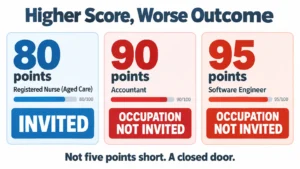
One occupation to be clear about, because the confusion is common: an aged care worker (ANZSCO 423111, Aged or Disabled Carer) is not on any of the skilled lists and has no 189, 190 or state-nominated 491 pathway at any score. Registered Nurse (Aged Care), ANZSCO 254412, is a different occupation at a different skill level, and it is the one being invited. See our note on the move from ANZSCO to OSCA for why occupation titles are shifting.
Being eligible and being invited are different things
Accountants, Auditors, Software Engineers, Developer Programmers and ICT Business Analysts all remain on the Medium and Long-term Strategic Skills List and remain eligible to lodge an EOI for the 189. They are simply not being selected in the Department’s targeted rounds. That distinction is where most stalled applications sit — and it is the reason chasing five more points does nothing for them. If that is you, read our visa pathways for IT professionals and the PR pathway for engineers.
Applicants lose a year here more than anywhere else. They measure themselves against the 65-point pass mark, or against a friend in a different occupation, when the only number that matters belongs to their own ANZSCO code.
Is 75 Points Enough for a 189 Visa?
For high-demand construction trades, yes, and comfortably — those codes cleared at 65 in June 2026. See how the pathway works for a carpenter.
For nursing and teaching, usually not on its own. Reported invitations sat at 75 for surgical and critical care nursing and secondary teaching, 80 for aged care nursing and midwifery, and 85 for early childhood teaching. Seventy-five is the floor of that range, not the middle.
For IT professionals and accountants, the question does not arise. Those occupations received no invitations in the last two rounds, so there is no score that would have worked.
For engineers, the answer turns on your specific code. Electronics and telecommunications engineers were reported as invited at 90 to 95. Civil and mechanical engineers were not reported as invited at all in June 2026.
Run your baseline in our Skilled Migration Points Calculator → (or the official Home Affairs calculator)
Option 1: Lift Your Points
Most people who feel stuck sit closer than they think — provided their occupation is being invited at all. If it is not, skip to Option 3. No number of extra points opens a closed door.
Five points carries you past a large block of competitors, because scores cluster in fives. Audit every lever below before you write off the 189. Applicants routinely miss at least one, and one of them is free. Our guide to maximising your points score and our step-by-step points calculation walkthrough go through each claim in detail.
| Lever | Points | Time needed | Rough cost |
| Single applicant, or partner is an Australian citizen or PR | +10 | None | Nil |
| English: Competent to Proficient | +10 | 4 to 12 weeks | Test fee plus prep |
| English: Proficient to Superior | +10 more | 2 to 6 months | Test fee plus coaching |
| NAATI CCL community language | +5 | 2 to 4 months | $814 test fee, plus prep |
| Partner skills assessment plus Competent English (partner under 45) | +10 | 2 to 4 months | Assessment plus test fees |
| Partner Competent English only (no age limit) | +5 | 4 to 8 weeks | Test fee |
| Professional Year | +5 | 44 weeks | $8,000 to $15,000 |
| Australian study requirement | +5 | Already earned or not | Nil if you qualify |
| Regional study | +5 | Already earned or not | Nil if you qualify |
| Specialist educational qualification (STEM research masters or PhD) | +10 | 2 years or more | Course fees |
The lever almost everyone misses
If you have no spouse or de facto partner, or your partner is already an Australian citizen or permanent resident, you claim 10 points for that alone. It is a separate category from partner skills points; it costs nothing, and applicants who married an Australian often never realise it is worth 10 points on the test.
Partner points, precisely
A partner who is an applicant on the same visa, under 45, with Competent English and a positive skills assessment in an occupation on the relevant list adds 10 points. A partner who is an applicant on the same visa with Competent English alone adds 5 points — and that 5-point category carries no age limit and no skills assessment requirement, which is the part most couples get wrong. Most couples skip partner points entirely because they assume only the primary applicant counts.
NAATI CCL: the cheapest five points on the board
Five points for a credentialled community language test, available in dozens of languages. The test fee is $814 from 1 July 2026; with preparation, budget $1,000 to $1,500. A Professional Year buys the same five points for roughly ten times the money — the ACS programme is the largest of them.
The trap
English moves fastest, and Superior English demands 8.0 in every band on IELTS — or the equivalent on PTE Academic. At 7.0 across the board, you can spend months and several sittings chasing that last band while rounds pass you by. Judge your real English level rather than your best band, and read our breakdown of the English language requirement for skilled migration and the IELTS scores you actually need for PR.
Every point you claim needs evidence at invitation. A claim you cannot prove turns into a refusal months later, after you have paid the charge — and an overstated claim is worse than a weak one. See how visa refusals and cancellations actually happen, and what counts as a bogus document. Our 189 document checklist covers what you need ready at invitation.
Watch your clocks — they are not all three years
English test results are valid for three years from the test date. Skills assessments are not uniformly three years. Three years is the Home Affairs ceiling and the default where an authority specifies nothing — but where the authority sets a shorter period, the shorter period governs. Several of the highest-volume authorities do:
| Assessing authority | Validity | Who this affects |
| ACS | 2 years | All ICT occupations — see our ACS assessment guide |
| AITSL | 2 years | Teachers, including early childhood |
| ANMAC | 2 years | Nurses and midwives |
| VETASSESS | 3 years | Renewable only before expiry — see our VETASSESS application guide |
| CPA Australia, CA ANZ, IPA | 3 years | Runs from the initial outcome, not from a later review |
| Engineers Australia | No expiry with EA | The three-year migration ceiling still applies — our EA tips |
| Trades Recognition Australia | 3 years | Trades, via the Job Ready Program |
If you are an ICT applicant, a teacher or a nurse, your assessment expires a full year before the general rule suggests. Our list of assessing authorities maps every occupation to its assessor, and recent ACS changes are worth a look if you are in ICT.
Option 2: Hold Your Position
Waiting earns its place sometimes.
Waiting works when:
- Your occupation is actually being invited, and your score sits within 5 points of its recent reported cutoff
- Your occupation’s reported cutoff has trended down over recent rounds
- You hold your current age band for at least another year
- You hold lawful status in Australia, or you sit offshore with no deadline
- You have a lever in progress that lands within a few months
Waiting fails when:
- Your occupation received no invitations in the last two rounds
- Your gap runs to 10 points or more with no lever available
- You turn 33, 40 or 45 within the year
- Your onshore visa expires before a realistic invitation arrives
- You have already held the same score for 12 months with no movement
Age points drop from 30 to 25 at 33, and from 25 to 15 at 40. At 45 you lose eligibility entirely — and Home Affairs measures your age on the date of invitation, not the date you lodged your EOI. If you are close to that line, read your visa options after you turn 45 before you commit to waiting.
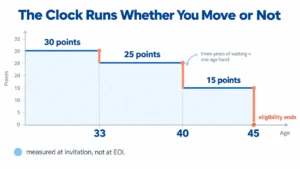
One more thing to price in. The Government signalled in the 2026–27 Budget that it intends to review the points test. Nothing has been legislated, no draft instrument has been published, and no commencement date has been confirmed, so treat it as a risk rather than a fact. But if the pass mark or the points allocation changes, waiting gets more expensive, not less. We keep a running summary of the year’s major visa changes.
Waiting costs you points. Build that cost into your plan.
Option 3: Switch to a 190 — or, More Carefully Now, a 491
Most people in this position move here, and they reach the same permanent residency. What changed in 2026–27 is which door is wider.
The Subclass 190 Skilled Nominated visa (Home Affairs criteria) grants permanent residency on the day of grant, exactly like the 189, and a state nomination adds 5 points. The Subclass 491 Skilled Work Regional visa (Home Affairs criteria) is provisional for five years, adds 15 points, and requires you to live, work, and study only in a designated regional area. Our full guides: 190 rules, lists and ROI and 491 benefits, requirements, and PR pathway.
Expert Australian Migration Guidance
Navigating the complexities of your visa journey is easier with professionals. Start your Australian dream today.
Book ConsultationRead the 2026–27 allocation before you choose
| Skill stream category | 2025–26 | 2026–27 | Change |
| Skilled Independent (189) | 16,900 | 21,090 | +24.8% |
| State/Territory Nominated (190) | 33,000 | 35,500 | +7.6% |
| Regional (491 and 191) | 33,000 | 14,110 | −57.3% |
| Employer Sponsored (186 and 494) | 44,000 | 58,040 | +31.9% |
| Total permanent Migration Program | 185,000 | 185,000 | Unchanged |
Source: Permanent Migration Program planning levels, Department of Home Affairs.

The 491 was, for several years, the widest door in skilled migration. In 2026–27 it is not. Regional places were cut by more than half, while state-nominated places grew and remain the largest single allocation of the three.
If you are choosing between the 190 and the 491 on the numbers alone, the 190 is now the stronger bet — and it costs you no regional residence obligation.
That does not close the 491. Fifteen points is still 15 points, states still nominate, and for an applicant 15 points short with a genuine willingness to live regionally it remains the most powerful single lever available. But it is a narrower door than it was last year, and anyone recommending it without mentioning that is working from last year’s map.
The three pathways, compared
| 189 Skilled Independent | 190 Skilled Nominated | 491 Skilled Work Regional | |
| Sponsorship | None | State or territory nomination | State or territory nomination, or eligible family sponsor |
| Points added | — | +5 | +15 |
| Visa type | Permanent | Permanent | Provisional, 5 years |
| Occupation list | MLTSSL | MLTSSL + STSOL | MLTSSL + STSOL + ROL |
| Where you live | Anywhere | Anywhere by law. You give the state an undertaking, not the Department a condition | Designated regional area — condition 8579 |
| Fee, primary applicant | AUD 6,135 | AUD 6,140 | AUD 6,140, plus AUD 630 for the later 191 |
| Points reality | 65 to 100 by occupation, and many occupations not invited at all | Set by each state; varies widely by occupation and jurisdiction | Set by each state, or by family-sponsored rounds |
| Citizenship | 4 years’ lawful residence including 12 months as a PR | Same | About 4 to 5.5 years from 491 grant — provisional time counts toward the 4 years |
Fees are the charges applying from 1 July 2026. Citizenship timing is the general residence requirement.
What carries over
You keep almost everything. Your skills assessment, your English result and your employment evidence all carry across to the 190 and the 491, subject to their validity periods. In most cases you lodge a fresh EOI on top of the same underlying file.
What changes
Your occupation list widens. The 189 draws only on the MLTSSL. The 190 adds the STSOL, and the state-nominated 491 adds the Regional Occupation List on top of that — all three are set out in the same legislative instrument. An occupation closed for the 189 often stays open somewhere under the 190. That one fact rescues a large share of stalled applications.
Your competition shrinks. One state ranks you against the people it actually wants, rather than every applicant in the country — and each state publishes its own criteria. Start with priority occupations in state nomination, then the state programs themselves: New South Wales, Victoria, and the 190 requirements set by Home Affairs and by each state.
About that “two years in the state”
This is widely misstated. The 190 is granted as a permanent visa and carries no condition requiring you to live in the nominating state. Legally, you may live and work anywhere in Australia from the day of grant.
The commitment is an undertaking you give the state at the nomination stage — two years in most jurisdictions, three in the Northern Territory. It is enforceable, if at all, as a matter between you and that state, not as a term of your visa.
That does not make it meaningless. The real exposure is truthfulness. If a decision-maker concluded you never genuinely intended to live in the state, that engages the incorrect-information provisions and can affect later applications — the same territory as visa cancellation. Circumstances genuinely changing after grant is a different matter entirely. If you do need to move, tell the nominating state and explain why.
What “regional” actually means
A designated regional area is everywhere in Australia except Sydney, Melbourne and Brisbane. Perth, Adelaide, the Gold Coast, the Sunshine Coast, Canberra, Newcastle, Wollongong, Geelong and Hobart all count. A great many people rule out the 491 because they picture the outback. Two of Australia’s five largest cities qualify — see our rundown of regional visa options and Australia’s most liveable cities.
Two details that matter. Condition 8579 refers to an area that was a designated regional area at the time your visa was granted, so a later change to the postcode instrument does not move your boundary. And working from a home office in a regional area for an employer headquartered in Sydney is compliant, provided you are paid in Australia and meet your tax obligations. Our guide to applying for a 491 covers the nomination step.
Getting from the 491 to permanent residency
The Subclass 191 (Home Affairs criteria) requires you to have held the 491 for at least three years, to have substantially complied with its conditions throughout, and to provide ATO notices of assessment for three relevant income years. Our comparison of the 190 and the 191 sets out how the two permanent outcomes differ.
| There is no minimum taxable income requirement for the 191.
The $53,900 figure repeated across much of the migration web comes from a 2019 announcement that was never given legal effect — no legislative instrument was ever made, and there is nothing to index. The notices of assessment are evidence of your residence and compliance; they are not measured against an earnings floor. |
The honest trade-off
If your occupation is being invited and you can reach its cutoff within a year, the 189 rewards the wait. No conditions, no state undertaking, no second application. Our complete 189 guide walks through the lodgement steps.
If your occupation received no invitations in the last two rounds, waiting for the 189 is not a strategy. Move to the 190.
If you are 15 points short and can genuinely live regionally, the 491 still works — with the caveat that there are far fewer regional places this year than last. For the full menu, see our guide to the best ways to get PR in Australia.
The expensive path runs straight through indecision. Three years spent hoping for a 189 that never arrives leaves you starting the 190 at 41 with fewer age points than you held at 38.
How to Decide, in Order
Work through these six checks in sequence. Stop at the first one that hands you a clear answer.
- Is your occupation on the MLTSSL? If it is not, the 189 closes to you regardless of your score. Check the current occupation lists — our plain-English version matches each list to the visas it opens — then move straight to the 190 or 491.
- Is your occupation being invited at all? A different question from the first. Accountants and ICT professionals are on the MLTSSL and received no 189 invitations in either of the last two rounds. If yours is in that group, this is a pathway decision, not a points decision — and no lever in Option 1 changes it.
- How big is your gap? Compare your score to your occupation’s recent reported cutoff, not the 65-point pass mark. Under 5 points signals a waiting problem. Over 10 signals a pathway problem.
- Which levers remain open to you? Work through every row of the table above, starting with the free one. Count the points, the months and the cost. A total that closes your gap inside a year justifies the effort — our guide to maximising your score has the detail.
- How much age runway do you have? If you cross 33, 40 or 45 inside your timeline, subtract those points from your plan before you commit to it. Turning 45 closes the skilled program entirely.
- Do you face a deadline? An expiring 485 or other onshore visa changes everything. A Bridging Visa A only helps once you lodge an actual visa application — an EOI grants you nothing. Check current visa processing times before you plan around a date.
If steps 1 to 4 leave you short, treat this as a pathway decision. Make it early and you keep more of your age points.
Get a Straight Answer on Your Score
Thirty minutes with one of our MARA-registered agents gives you your real points score, your occupation’s recent invitation history, the levers still open to you, and a recommendation on whether to hold or switch. We see clients in Harris Park, Melbourne and online.
If the 189 still works for you, we say so. If it stopped working two years ago, we say that too.
Book Your 30-Minute Strategy Session Get a Free Points Audit
More reading: common questions about skilled visas · complete guide to the 189 · General Skilled Migration PR pathway · best ways to get PR in Australia · PR pathway roadmap.
No registered migration agent can guarantee a visa outcome. You can verify any agent’s registration on the Register of Migration Agents maintained by the Office of the MARA. Note that Australian legal practitioners ceased dual registration as migration agents in March 2021, so an immigration lawyer will not appear on that register — verify them with the relevant state law society instead.