
Dreaming of the sunny shores and vibrant cities of Australia? For many skilled professionals, the path to making that dream a reality runs through a points-based system designed to invite people with the skills the country needs. This is the heart of Australian general skilled migration, and your journey begins with understanding your score.
The Australian government regularly invites candidates with the highest scores to apply for residency, which means a stronger score directly improves your chances. A PR points calculator Australia is a valuable first step, an unofficial tool that helps you estimate your score based on key personal and professional factors. Using one gives you a clear picture of where you stand right now, without any commitment or confusing paperwork.
This guide breaks down how that calculator works, explaining the most important ways you earn points from your age and English language ability to your education and work experience. You’ll learn not just what your score might be, but what it means and how you can improve it.
Not sure how to use a calculator? Check our step-by-step guide on How to Use the PR Points Calculator.
What Is the Australian Points Test and Why Does It Exist?
Australia is looking for skilled professionals to help grow its economy, and the skilled migration points test is how they find them. The government uses this system to identify and prioritize people whose skills in areas like healthcare, IT, and engineering are in high demand. It’s a straightforward way for Australia to invite candidates who can contribute from day one.
Instead of just meeting a minimum standard, you are ranked against other hopefuls in a competitive pool. While there might be a minimum entry score, only the applicants with the highest scores receive an offer. Your points total determines your rank in the queue, making the Australian immigration system a game of numbers.
A high score is your key to receiving an official invitation from the Australian government to apply for a visa. These invitations are sent out periodically to the highest-scoring candidates first. So, while a score of 65 points might make you eligible, aiming for a much higher score significantly boosts your chances of being selected.
The Easiest 30 Points: How Your Age Impacts Your PR Score
When calculating your Australian migration points, your age is the simplest place to start. Unlike work experience or qualifications, it’s a fixed number you don’t have to prove with complex documents. The Australian government awards points based on your age at the time you are invited to apply, favoring younger professionals who have a long career ahead of them.
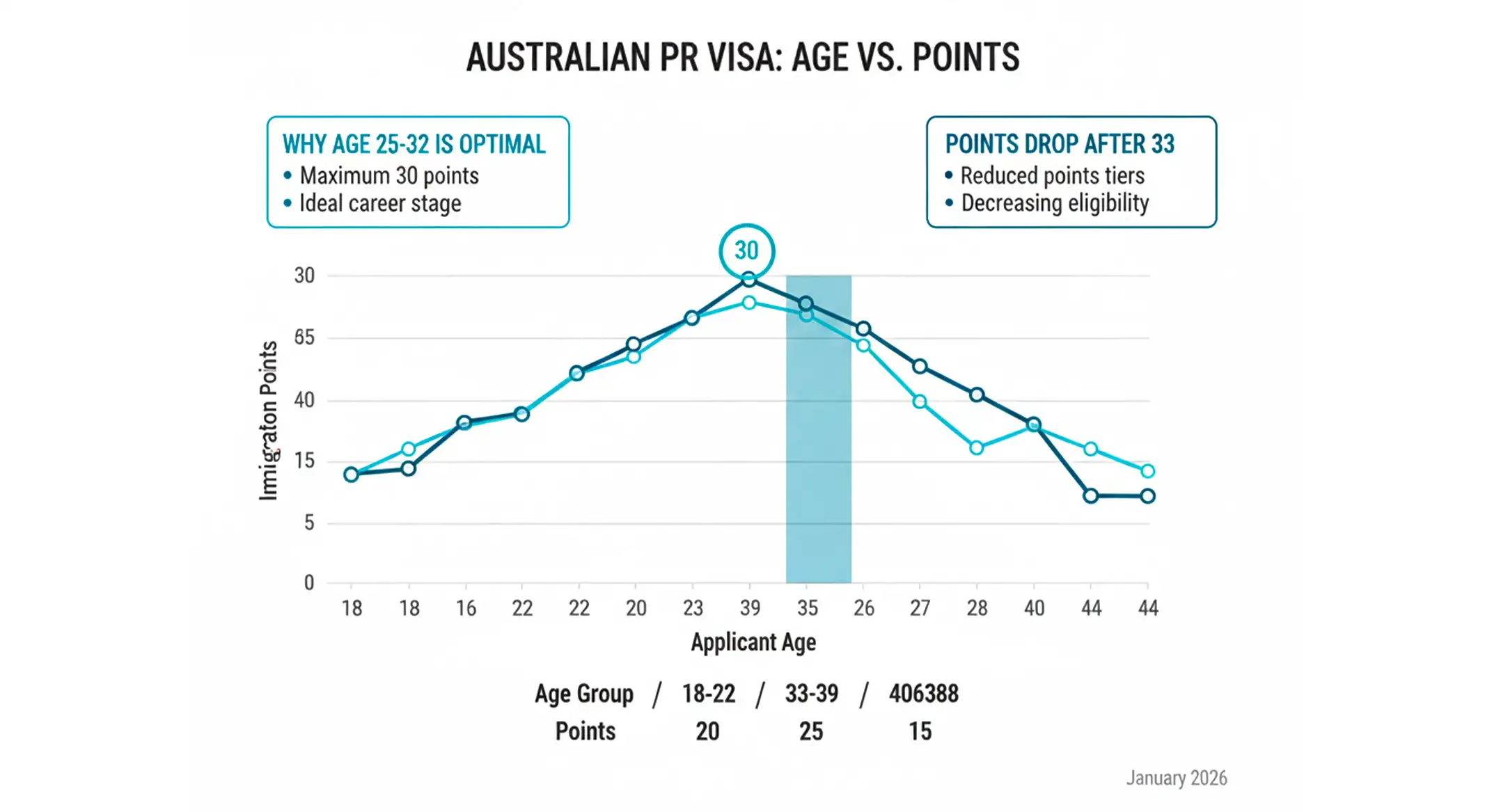
The key is to fall within the highest-scoring age bracket for Australian immigration. This sweet spot is between 25 and 32 years old, which lands you the maximum 30 points. As the list below shows, the points peak in this specific window.
- 18 to 24 years: 25 points
- 25 to 32 years: 30 points
- 33 to 39 years: 25 points
- 40 to 44 years: 15 points
The points you can claim begin to decrease once you pass your 33rd birthday. While this doesn’t close the door on your dream, it does make timing a factor in your skilled migration journey. While you can’t get younger, you have significant control over other categories, starting with your English language ability.
Unlocking Points with Your English Skills: From Competent to Superior
While you can’t change your age, your English language ability is one of the most powerful areas you can actively improve. The Australian government needs to see official proof of your skills, not just that you can speak the language. Your score on a formal test can have a massive impact on your total, making it a critical part of your strategy.
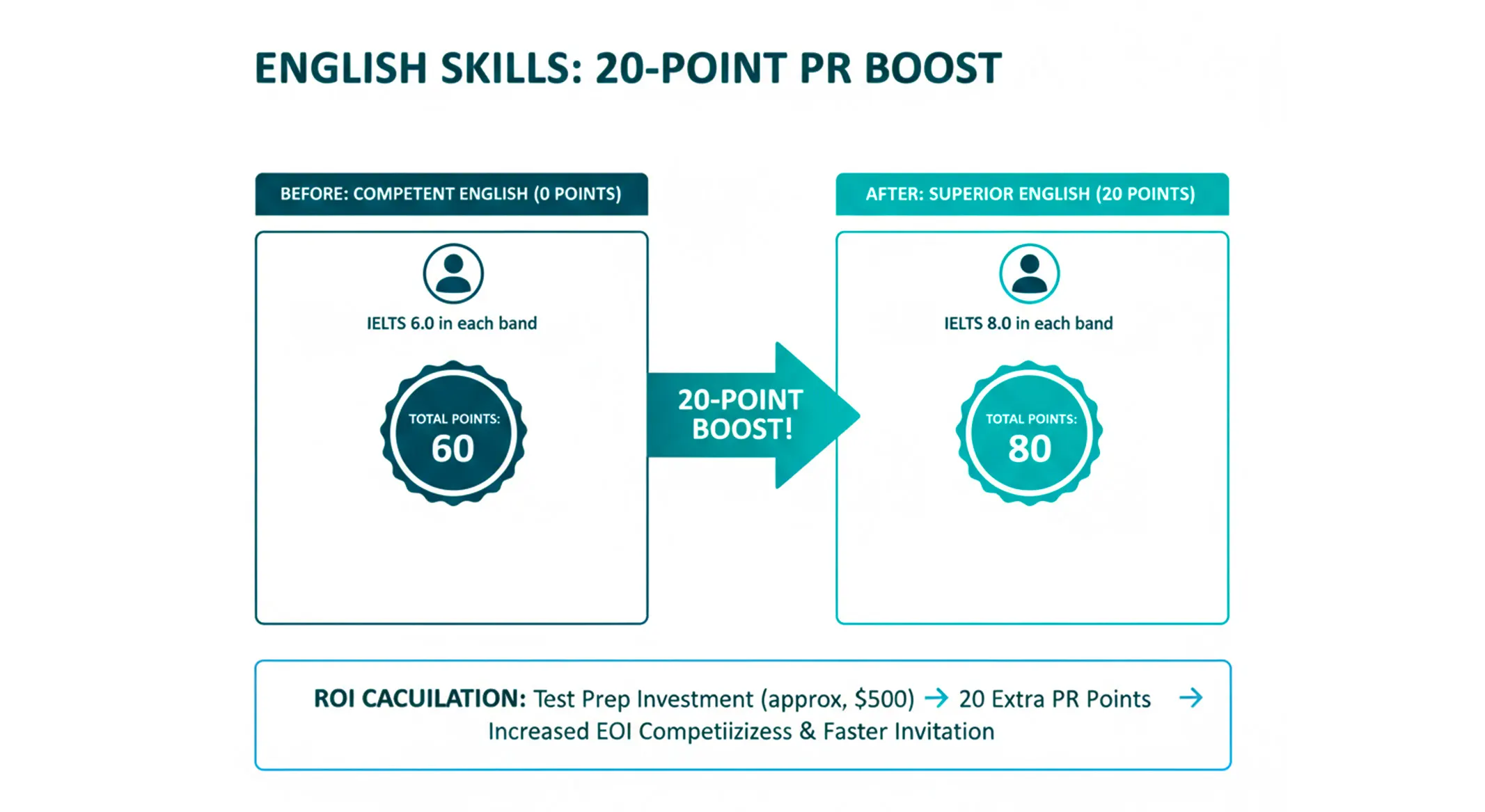
At the very minimum, you need to demonstrate what is called ‘Competent’ English to even be eligible. This is the entry ticket; it proves you can communicate effectively in an English-speaking country, but it adds zero points to your score. To actually increase your PR points, you must aim higher.
Achieving a ‘Proficient’ English score on a recognized test like IELTS or the PTE Academic exam will add a solid 10 points to your total. Pushing yourself further to achieve a ‘Superior’ score doubles that reward, giving you a massive 20 points. For many applicants, these 20 points are the key that unlocks their invitation to apply.
Investing time to prepare for your English exam is one of the smartest ways to strengthen your profile. After securing your English points, the next major area to consider is your professional background.
Turning Your Career into Points: How Work Experience is Assessed
After your English test, your professional history is the next major source of points. However, the Australian government isn’t just looking at how long you’ve worked; they are focused on skilled employment. This means the work experience you claim must be relevant to the specific professional occupation you’re being assessed for. For example, if you’re applying as an accountant, only your accounting roles will count, not a part-time job you held during university.
For many applicants, their career has been built outside of Australia. This overseas experience is highly valued, but you need at least three years of relevant work to start earning points. From there, the skilled migration points breakdown is tiered: three to four years of experience gives you 5 points, five to seven years will add 10 points, and having eight or more years of skilled experience nets you a maximum of 15 points.
If you’ve already had the chance to work in Australia in your skilled field, you’re at a significant advantage. The government places a higher value on this local experience, allowing you to claim points much faster. Just one year of skilled Australian work can earn you 5 points. This increases to 10 points for three years of experience and climbs to 15 points for five years.
When you calculate your migration points, remember that you claim points for either your Australian or overseas experience, whichever gives you a higher score. Alongside your career, your formal education is the other pillar of your professional profile.
How Your Degree or Diploma Translates into PR Points
Your professional profile is made of two key parts: your work experience and your education. As you might expect, the higher your level of education, the more points you can claim. A formal qualification is a clear signal of your expertise, making it a critical part of the skilled migration points test.
A Doctorate (PhD) from a recognized institution will earn you the highest possible score of 20 points. For most applicants holding a Bachelor’s or Master’s degree, you’ll be awarded 15 points. If your highest qualification is a diploma or a trade course certificate, you can claim 10 points. Remember, the system only considers your single highest qualification, so the points for different degrees don’t stack.
Having a qualification is great, but earning it in Australia can sometimes provide an additional advantage. To see how these rules work in practice, let’s calculate the score for a typical applicant.
Case Study: Calculating the Score for Maria, the Nurse
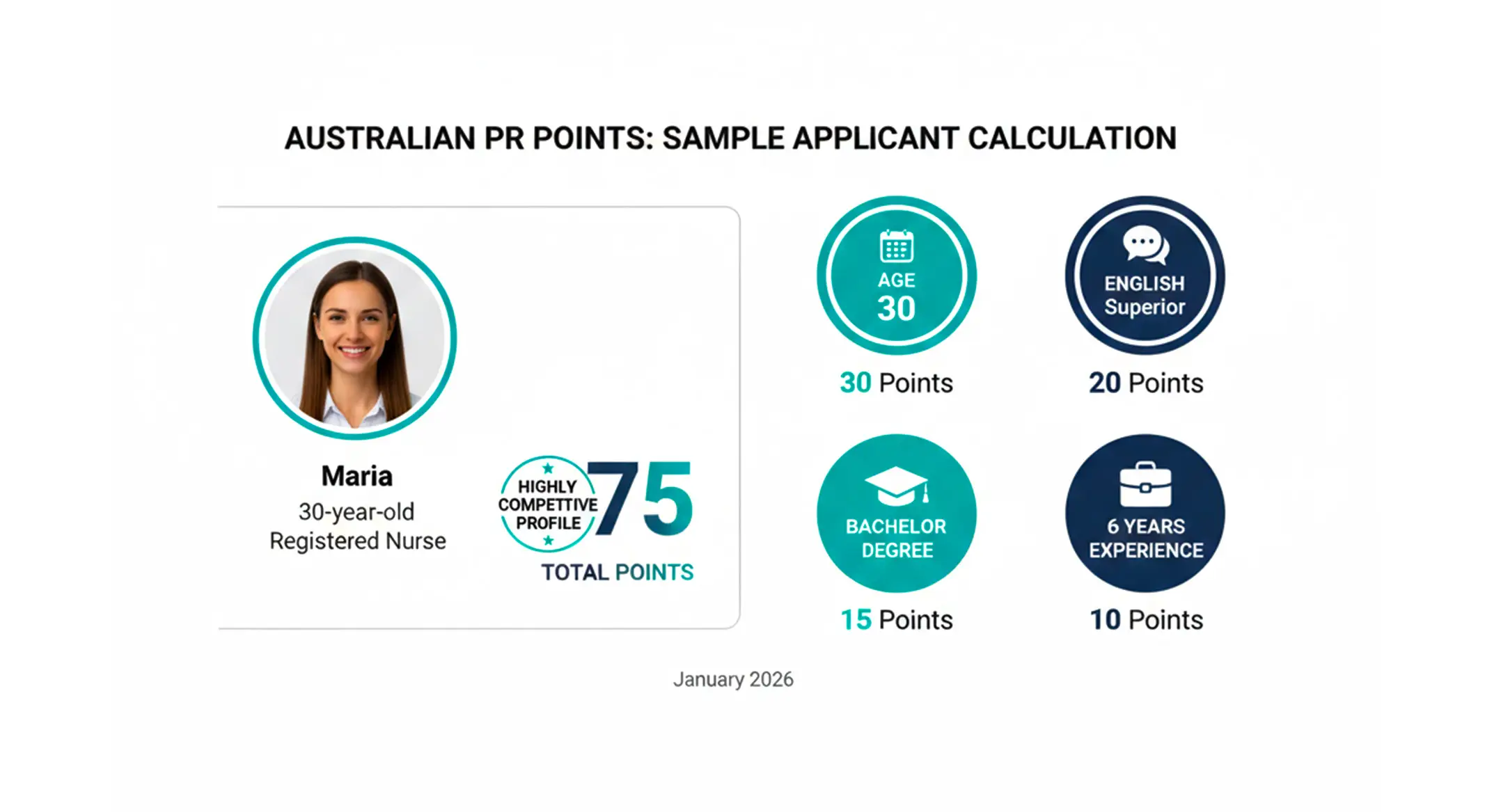
To see the skilled migration points test in action, consider the example of Maria, a registered nurse dreaming of a life in Australia. She is 30 years old, has a Bachelor of Nursing, six years of work experience from her home country, and has achieved a ‘Superior’ score on her English language test.
First, her personal attributes. At 30 years old, Maria falls into the highest-scoring age bracket, earning her a fantastic 30 points. Her ‘Superior’ English test result also nets her the maximum available, adding another 20 points. With these two categories alone, she has a strong foundation of 50 points.
Next, her professional qualifications. Maria’s Bachelor of Nursing degree gives her a solid 15 points for her educational background. Her six years of relevant overseas work experience as a nurse contribute an additional 10 points.
Putting it all together, Maria’s baseline score is impressive. Here’s the breakdown:
- Age: 30 points
- English Language: 20 points
- Education: 15 points
- Overseas Experience: 10 points
- Total Score = 75 points
A score of 75 puts Maria in a competitive position. But what if her score was lower, or what if she wanted to make it even stronger? In our example, Maria is a single applicant, but for many people, their partner’s skills can provide a significant boost.
The “Partner Points” Boost: How Your Partner Can Add Up to 10 Points
You don’t have to make the move to Australia alone, and including your partner in your application can help your profile. The skilled migration points breakdown offers a valuable opportunity to claim extra points based on your partner’s skills and English ability. This is one of the most common ways applicants find those few extra points that make all the difference.
To claim the full 10 points for partner skills, your partner must meet a few key conditions. They need to be under 45 years old, have their qualifications officially recognized for an occupation on the same skilled list as you, and prove they have at least Competent english. If the government recognizes their skills as valuable, you both get a reward.
If your partner doesn’t have a skilled occupation, there’s still good news. our partner can simply demonstrate Competent English, you can claim 5 bonus points. The system also awards 10 points if you are applying without a partner just like our nurse, Maria to ensure single applicants aren’t disadvantaged.
While partner points offer a fantastic boost, another powerful pathway exists. Some Australian states are actively looking for people with your specific skills and are willing to support your application through state nomination.
Expert Australian Migration Guidance
Navigating the complexities of your visa journey is easier with professionals. Start your Australian dream today.
Book ConsultationState Nomination: Your Secret Weapon for an Extra 5 or 15 Points
Sometimes, your base score might still leave you just shy of a competitive total. This is where state nomination comes in. Imagine an Australian state, like Western Australia or Tasmania, specifically telling the government they need more people with your exact skills. By “nominating” you, they are giving your application a massive thumbs-up, making you a top priority.
This nomination comes in two main forms. The first is for the Skilled Nominated visa (subclass 190). If a state nominates you for this visa, you are instantly awarded 5 bonus points. In return, there’s a moral obligation to live and work in that state for your first two years in Australia, helping to fill their skill shortages.
For a more substantial advantage, you can seek nomination for the Skilled Work Regional visa (subclass 491). This pathway brings skilled people to Australia’s regional areas.that is, areas outside Sydney, Melbourne, and Brisbane. Securing a nomination for this visa grants you an incredible 15 bonus points. Because this is such a significant boost, the commitment is stronger: you must live and work in a designated regional area for at least three years before you can apply for permanent residency.
State nomination is a strategic decision. You receive a game-changing number of extra points in exchange for a commitment to live and contribute to a specific part of Australia. There are also a few other niche boosters that can give your profile a final polish.
Niche Boosters: Specialist Education and Language Skills
Beyond state nomination, a couple of specialized pathways exist that can give your total a final push. If you are fluent in a language other than English, you could be sitting on an extra 5 points. The Credentialled Community Language (CCL) test assesses your ability to interpret conversations at a community level. The NAATI CCL test is worth 5 points, a welcome boost for bilingual candidates who can demonstrate their skills.
Another targeted pathway is for recent international graduates of Australian institutions. The Professional Year Program awards 5 points to those who complete a structured professional development course in their field. Typically available for accounting, IT, and engineering graduates, this year-long program combines formal learning with an internship, helping you adapt to the Australian workplace. It’s a fantastic way to gain local experience and add points at the same time.
Is Your Score “Good Enough”? Understanding 65 vs. 90 Points
After tallying up your points, you’re likely asking one simple question: Is it enough? The Australian government has set the pass mark at 65 points. Think of this as the minimum requirement to be considered, but it absolutely does not guarantee an invitation to apply for a visa. Compare different skilled visa pathways in our Complete general skilled migration Guide.
The reality is that for the highly sought-after Subclass 189 (Skilled Independent) visa, the competition is fierce. Because you are competing against a global pool of candidates without state sponsorship, the minimum points for subclass 189 visa invitations are often much higher than 65. In recent invitation rounds, successful candidates in fields like software development or engineering have often needed scores of 85, 90, or more.
This is where the visa type becomes critical. So, is 75 points enough for an Australian PR? For a 189 visa, it might be a long wait. However, for a Subclass 190 (State Nominated) visa, 75 points could be extremely competitive. If a state like South Australia has a shortage of your specific occupation, it may invite you with a lower score because your skills are in high demand there. This highlights the crucial difference between the 189 and 190 visa pathways; one is a global competition, the other is a targeted local need.
A “good” score is a moving target that changes based on your occupation, the visa you’re targeting, and government invitation rounds. A score that is too low for one pathway might be perfect for another.
From Calculator to Action: Your 3-Step Plan to Move Forward
You now have an understanding of how the points system works and a tangible starting point for your journey. Think of your estimated score not as a final grade, but as a strategic map that shows you the path forward and highlights your strengths. The key question is no longer “Am I eligible?” but “How can I increase my PR points score?”
You are in control. To keep the momentum going, here is a simple 3-step action plan:
- Calculate Your Estimated Score: Use an online PR point calculator to get your personal baseline.
- Identify Point-Boosting Opportunities: Pinpoint the easiest areas to gain points, like aiming for a higher English test result.
- Take Your First Official Step: Book your English test or begin your skills assessment. This is the first concrete move towards an application.
Conclusion
Understanding the PR points calculator is your first step toward Australian permanent residency, but knowledge alone won’t get you there. Every point matters in this competitive system, and the difference between 70 and 85 points could mean the difference between waiting years or receiving your invitation in months.
The good news? You’re not powerless. Whether it’s retaking your English test, gaining partner points, or exploring state nomination, multiple pathways exist to strengthen your profile. The skilled migration journey rewards strategic planning, not just wishful thinking.
Don’t navigate this complex system alone. The Migration Australia team specializes in maximizing points scores and identifying personalized pathways that match your unique profile. Book your consultation with Our migration experts will assess your eligibility, calculate your actual score, and create a customized action plan to fast-track your Australian PR.
Frequently asked questions
How to calculate PR points in Australia?
Calculate your total score by adding points for your age, English language proficiency, educational qualifications, work experience, and partner skills.
How many points do I need for Australian PR?
You need a minimum of 65 points to submit an Expression of Interest (EOI), though higher scores increase your chances of receiving an invitation.
Is 75 points enough for PR?
Yes, 75 points meet the eligibility threshold, but competitive occupations like IT or Accounting often require higher scores for a successful invitation.
Does state nomination give extra points?
Yes, state nomination boosts your total score. The 190 visa nomination adds 5 points, while the 491 regional visa nomination adds 15 points.
How to Calculate PR Points for Australia in 2026?
Review the current points table for 2026 and tally your scores across all categories, or use an online tool to sum them up automatically.
Where can I find a points calculator for Australia PR?
You can check your eligibility immediately by using The Migration Point calculator. It breaks down your score by age, skills, and education so you know exactly where you stand before submitting an Expression of Interest.