
Applying for an Australian Partner Visa is not only about proving love — it is about proving that your relationship meets strict legal definitions set by the Department of Home Affairs. Many applications are delayed or refused because applicants misunderstand which relationships actually qualify. In this comprehensive guide, we’ll walk you through the various types of relationships that qualify for a partner visa, delve into the essential requirements, and share some invaluable tips to help you prepare your application effectively.
The Partner Visa is typically granted in two stages: a temporary visa (subclass 820/subclass 309) and a permanent visa (subclass 801/subclass 100). Initially, applicants receive a temporary visa while their permanent visa is being processed. This two-step process ensures that relationships are genuine and ongoing before granting permanent residency.
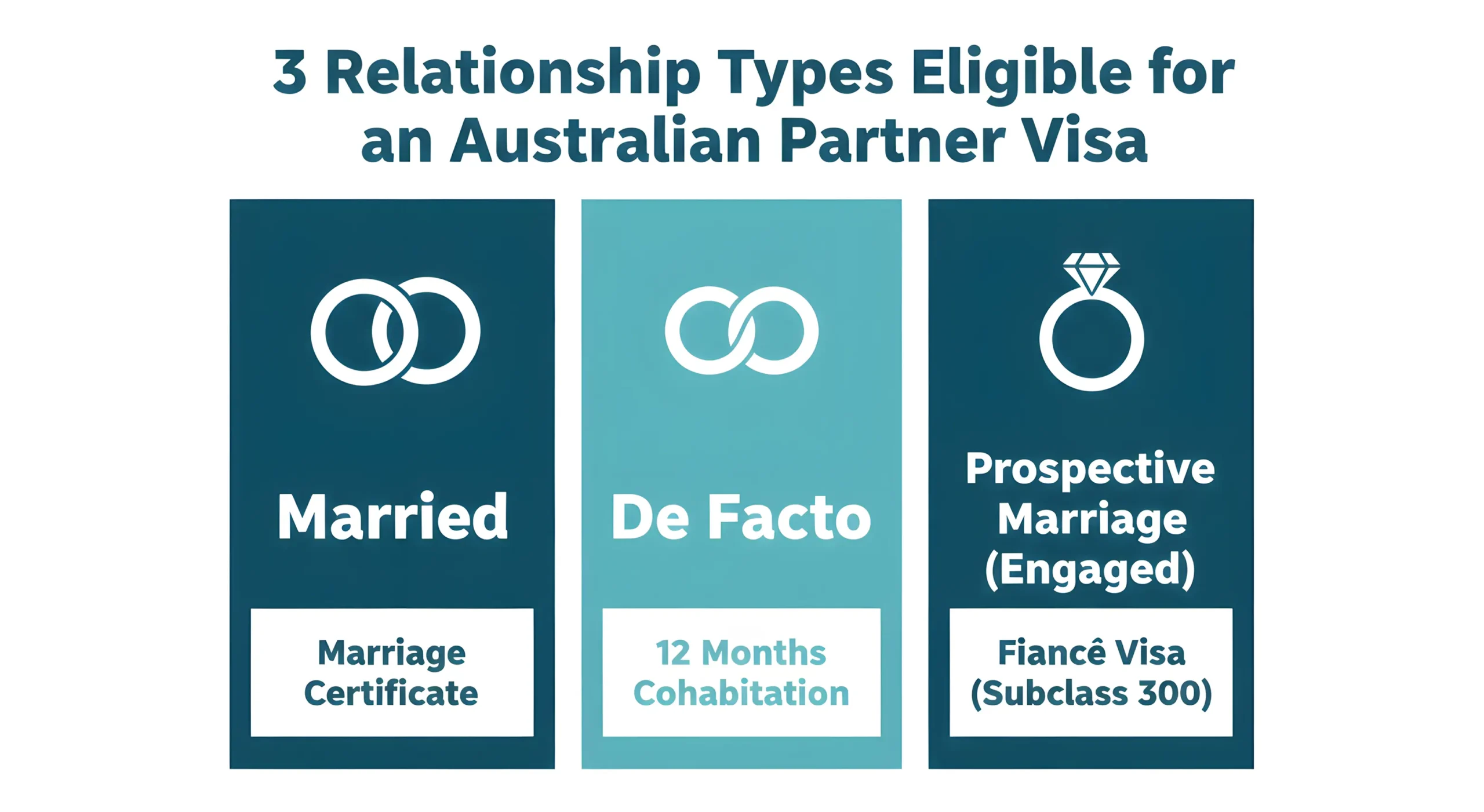
The good news is that it’s far less complicated than it seems. You might see official-sounding codes like Types of Relationships Eligible for Partner Visa, but that’s just internal government language. In practice, the entire system for an Australian relationship visa is built around just three core pathways for couples.
Are You Legally Married? The Most Straightforward Path to a Partner Visa
A marriage certificate isn’t the whole story, though. A crucial part of all partner visa requirements is proving your relationship is genuine and continuing. The Australian government needs to be confident that you have built a shared life and are committed to a future together, not just that you’ve completed the legal paperwork.
Being legally married is the most direct route to an Australian Partner Visa. But a marriage certificate alone is not enough.
What the Government Actually Needs to See
The Department of Home Affairs does not just want proof that you completed legal paperwork. It needs to be confident that you have built a genuine, shared life together and that you are committed to a future as a couple.
This means your application must go beyond the certificate. You will need to demonstrate your relationship across several areas:
- Financial: shared bank accounts, joint expenses, or combined assets
- Living arrangements: evidence that you live together or have done so
- Social: how you present yourselves to friends, family, and your community
- Commitment: long-term plans and knowledge of each other’s lives
Start With Your Official Marriage Certificate
Your first practical step is to locate your official marriage certificate. This is the legal document issued by a government registry or authority. It is not the decorative certificate from your ceremony.
This document is the foundation of your spouse visa application. Without it, you cannot move forward.
A Strong Start — But Not the Finish Line
Marriage gives you a clear, recognised starting point. It satisfies the relationship type requirement immediately. However, proving your relationship is genuine and continuing remains the most important and most scrutinised part of every application.
Living Together But Not Married? Understanding the ‘De Facto’ Relationship Category
What if you and your partner share a home, a life, and a future, but you haven’t tied the knot? For many couples, this is the modern reality. The Australian government recognises this through the ‘de facto’ relationship category. In simple terms, a de facto relationship is one where you and your partner are not married but live together on a genuine domestic basis, just like a married couple.
For a de facto relationship visa in Australia, the most important rule to understand is the 12-month requirement. To be eligible, the government generally expects you to prove that your de facto relationship has existed for at least 12 months.
This answers the common question of how long you have to be together for a partner visa when you’re not married. This period is designed to show a significant level of commitment.
This 12-month cohabitation rule is the main point of difference when considering a de facto vs a married partner visa in Australia. While it may sound strict, it’s simply the government’s way of measuring the commitment of unmarried couples. However, if you haven’t quite reached that 12-month milestone, there are important exceptions.
Exceptions to the 12-Month De Facto Requirement
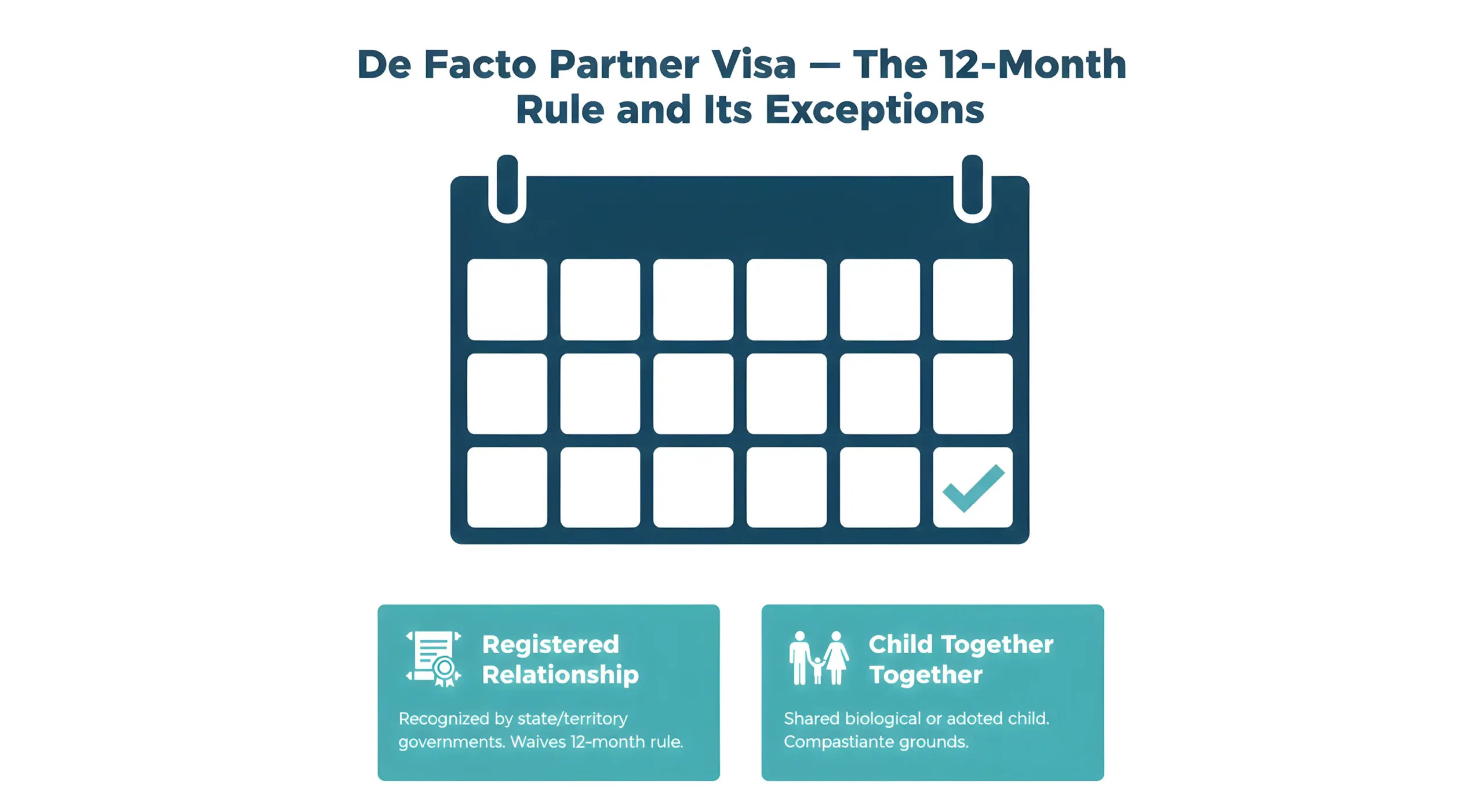
The 12-month cohabitation rule is not absolute. Two key exceptions can waive it entirely.
1. Registered Relationships
Registering your relationship with an eligible Australian state or territory government removes the 12-month requirement.
What is relationship registration?
- It is a formal, legal process
- It creates an official record of your commitment
- The government treats it as significant evidence of a genuine relationship
Why it matters for your visa:
- It can bypass the 12-month cohabitation rule entirely
- It strengthens your overall application
- It is recognised across Australian immigration law
If you have been together less than 12 months, registering your relationship in your partner’s state or territory should be your first step.
2. Having a Child Together
Having a child together is another way to waive the 12-month rule.
This applies if you:
- Have a biological child together
- Have an adopted child together
Why it matters:
- It demonstrates long-term, shared commitment
- The Department of Home Affairs views it as clear evidence of a genuine partnership
What If You Are Not Living Together Yet?
Some couples are not cohabiting because they plan to marry in Australia first. This is a different situation entirely. It does not fit the de facto pathway. Instead, there is a separate visa route designed specifically for you, the Prospective Marriage visa.
Engaged But Living Apart? The Prospective Marriage Visa Pathway
Not living together yet? Planning to marry in Australia? The Prospective Marriage Visa (Subclass 300) may be the right pathway for you.
This visa is commonly called a fiancé visa. It is designed specifically for couples who are committed to marriage but are not yet cohabiting, including couples living in different countries.
What Is the Prospective Marriage Visa?
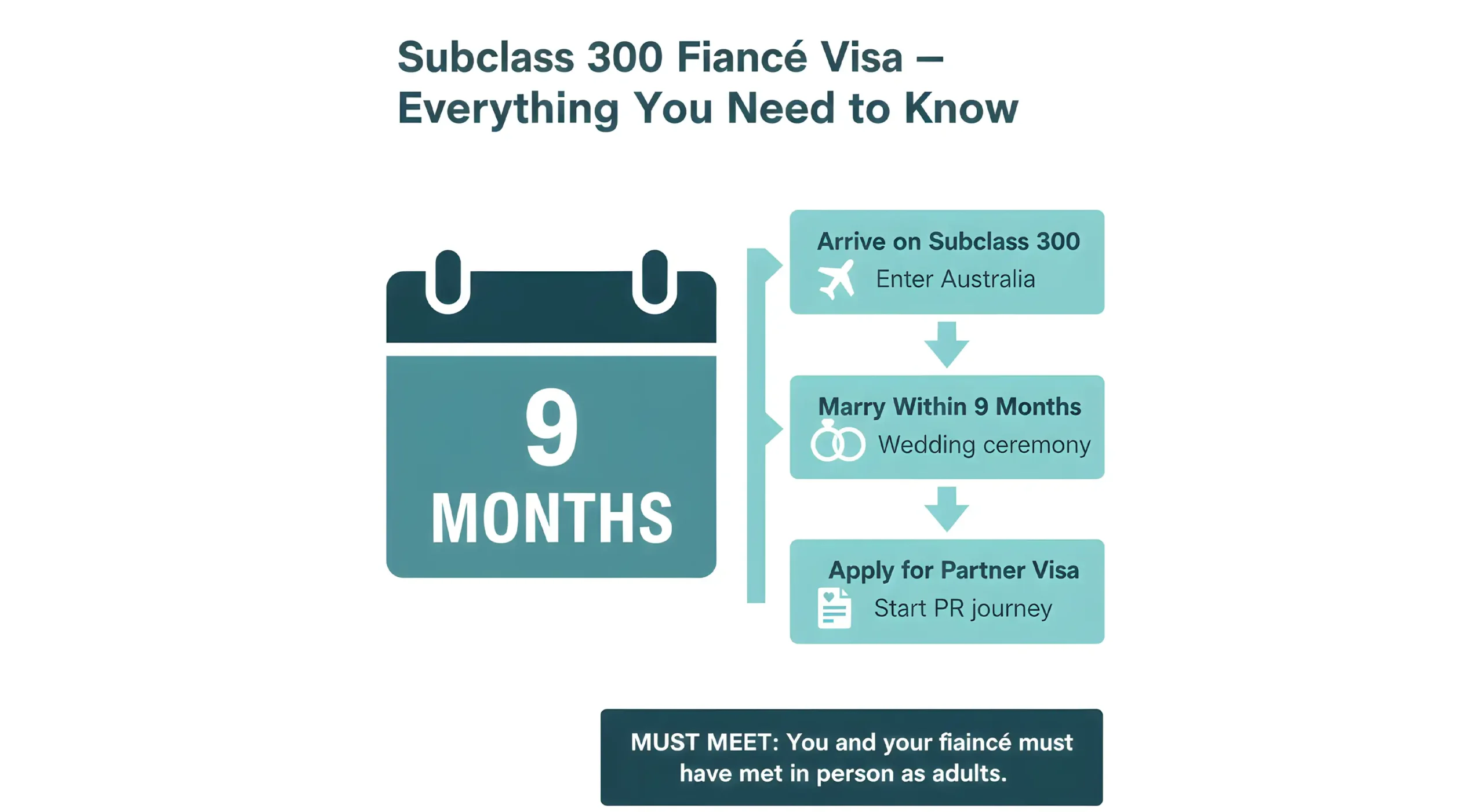
Unlike a de facto partner visa, this visa does not require you to have lived together. Its sole purpose is to bring your partner to Australia so you can marry here and begin your life together.
Key facts:
- It is a temporary visa
- It gives you nine months to enter Australia and get married
- After marrying, your partner can apply for a Partner visa to remain permanently
Think of it as a bridge. It gets you to your wedding. From there, you apply to make your stay long-term.
Who Is It For?
This visa suits couples who:
- Are engaged but living apart
- Are based in different countries
- Want to marry in Australia before settling here permanently
- Have not yet met the 12-month de facto requirement
The Must-Meet Rule
There is one non-negotiable requirement. You and your fiancé must have met in person, as adults, at least once before applying.
This rule exists for an important reason. The Department of Home Affairs needs to know your relationship has a real-world foundation, not just an online or long-distance connection with no face-to-face history.
A Two-Step Process
The Prospective Marriage Visa leads to a second application:
Expert Australian Migration Guidance
Navigating the complexities of your visa journey is easier with professionals. Start your Australian dream today.
Book Consultation- Step 1 — Your partner enters Australia on the Subclass 300 visa
- Step 2 — You marry within nine months, then apply for a Partner visa to stay permanently
This two-step process is structured for couples who want to celebrate their marriage on Australian soil before making it their permanent home.
Beyond the Label: How to Prove Your Relationship is ‘Genuine’
Whether you are married, de facto, or engaged, the Australian government wants to see more than just a certificate or a shared address. This is simply the official way of asking you to prove that your partnership is real, ongoing, and mutually supportive.
To get a complete picture of your life as a couple, the Department of Home Affairs looks at your relationship from four different angles. Successfully proving a genuine and continuing relationship means providing evidence across these key areas.
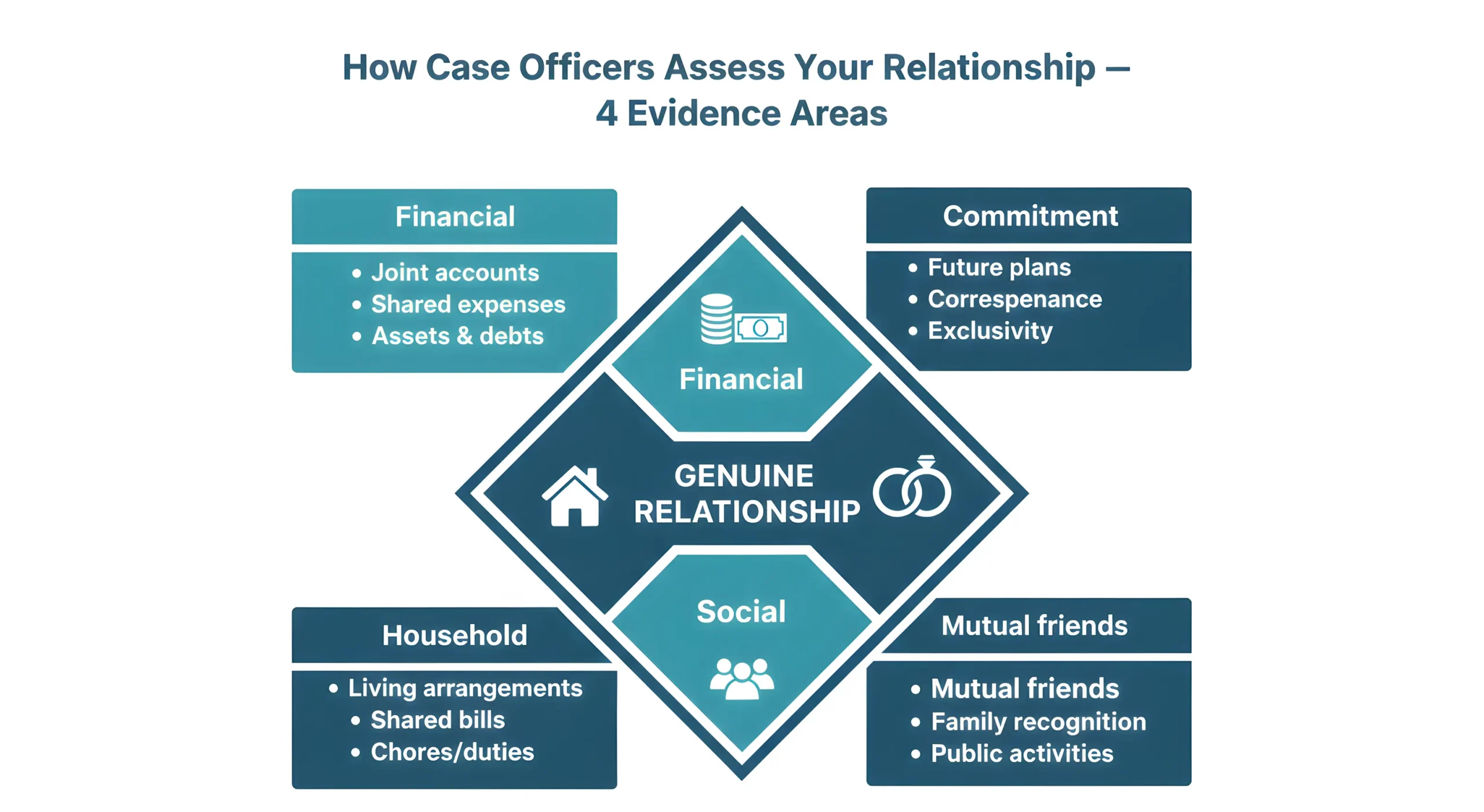
Here’s a simple breakdown of what counts as evidence for a partner visa:
- Financial Aspects: How you share your money and financial responsibilities. This could be a joint bank account, shared bills, or regular money transfers.
- Nature of the Household: How you live together and share domestic life. A joint lease, mail addressed to you both, or even statements from friends about your living situation all help.
- Social Context: How others in your community recognise you as a couple. This is where photos with family, joint travel itineraries, and wedding invitations addressed to you both become powerful proof.
- Nature of Commitment: How you demonstrate your long-term intentions. This can include knowing each other’s family backgrounds, making future plans together, or even having wills that name each other.
You don’t need to have overwhelming evidence in every single category. The goal is to provide a balanced story of your relationship by showing how you support each other and share a life, no matter which visa path you are on.
Putting It All Together: Which Path Is Yours?
After exploring the details, you can now pinpoint exactly where you stand. Clarifying your category is the first major step toward a successful application.
- Married Applicant: You are legally married, and your marriage is recognised in the country where it took place.
- De Facto Applicant: You are not married but live together like a married couple and can either prove 12 months of cohabitation or meet an exception (like registering your relationship or having a child together).
- Prospective Marriage Applicant: You are engaged and plan to travel to Australia to get married.
Knowing which of these three lanes you’re in provides the clarity needed to confidently begin preparing your application. Your immediate next move is to begin gathering proof of your life together. Start collecting photos, messages, and joint financial documents today, as this collection will become your most powerful tool.
For the official partner visa checklist and forms, your single source of truth is the Department of Home Affairs website. Taking this next step is the real beginning of your journey to applying for a partner visa in Australia and building your life together with confidence and a solid plan.
How The Migration Helps You In Partner Visa
The Migration is an Australian-based immigration and education consultancy specialising in partner visas and onshore applications. We understand that every relationship is unique. That is why we do not take a one-size-fits-all approach. Our consultants build an evidence strategy specifically aligned with what case officers look for, focusing on quality, structure, and clear explanation rather than volume alone.
From your first consultation to final submission, The Migration supports you in presenting your relationship confidently for an Australian Partner Visa. If you need help understanding relationships eligible for a Partner Visa in Sydney or guidance from a migration agent Harris Park, our Sydney office offers both in-person and Zoom consultations.
Applicants seeking expert advice from a migration agent Melbourne for partner visa eligibility in Melbourne can book a confidential consultation with our local consultants today. Your relationship deserves expert support. Let us help you get it right.
Conclusion
Understanding which relationship category applies to you is the foundation of a successful partner visa application. Whether you are legally married, in a committed de facto relationship, or engaged and planning to marry in Australia, there is a clear pathway available to you.
Each route has its own requirements. Each has its own evidence standards. But all three share one common thread: you must prove your relationship is genuine and continuing in the eyes of the Department of Home Affairs. The process can feel overwhelming. But with the right guidance, the right evidence strategy, and a clear understanding of your category, a successful outcome is absolutely achievable.
The sooner you start preparing, the stronger your application will be. Begin gathering your documents, photos, and financial records today. Ready to take the next step? Book your consultation with The Migration now and get expert guidance tailored to your relationship and situation.
Frequently Asked Questions
What types of relationships qualify for an Australian Partner Visa?
Three main relationship types qualify legally married couples, de facto couples (including same-sex), and engaged couples through the Prospective Marriage Visa (Subclass 300). Each pathway has its own eligibility requirements and evidence standards.
How long do you need to be in a de facto relationship before applying?
Generally, you need to prove at least 12 months of cohabitation. However, exceptions apply if you have registered your relationship with an Australian state or territory government, or if you have a child together.
Can same-sex couples apply for an Australian Partner Visa?
Yes. Australia fully recognises same-sex relationships across all partner visa categories. Same-sex de facto couples, married couples, and engaged couples are all eligible to apply under the same conditions as opposite-sex couples.
What evidence do I need to prove my relationship is genuine?
The Department of Home Affairs assesses your relationship across four areas: financial, household, social, and commitment. Evidence can include joint bank accounts, shared leases, photos, travel records, and statutory declarations from people who know you as a couple.
What happens after the Prospective Marriage Visa — do I need to apply again?
Yes. The Prospective Marriage Visa (Subclass 300) is temporary. After you marry in Australia within the nine-month window, you will need to lodge a Partner Visa application to remain in Australia permanently. It is a two-step process by design.