
If you are planning to study in Australia in 2026, your Confirmation of Enrolment (CoE) is one of the most important documents in your student visa journey. Without a valid CoE, most new Student visa (subclass 500) applications won’t even be considered, and you may miss out on a bridging visa or fall out of lawful status.
Many students in Sydney, Melbourne and across Australia only realise this when their application is treated as invalid or delayed because their CoE was never issued, was cancelled, or did not match their course details. We explain what a CoE is, how to apply for Confirmation of Enrolment in Australia, recent policy changes, and when to get professional help.
What is a Confirmation of Enrolment (CoE)?
A Confirmation of Enrolment (CoE) is an electronic document issued by a CRICOS‑registered Australian education provider to confirm that you have been offered and have accepted a place in an eligible course. It contains key details such as your course name, duration, start and end dates, and your student ID.
For migration purposes, the CoE is the main proof the Department of Home Affairs uses to confirm that you are genuinely enrolled in a course. In some university or agent documents, you may also see it written as “Confirmation of Enrollment”, but the meaning is the same.
Without a valid CoE, most Student visa (subclass 500) applications lodged in 2026 will not meet basic lodgement requirements.
Why Your CoE Matters for Your Australian Student Visa in 2026
As of 1 January 2025, policy changes confirmed that:
- Most new Student visa (subclass 500) applications lodged with or without Australia must include at least one Confirmation of Enrolment (CoE) at the time of application.
- Applications lodged with only a Letter of Offer can be treated as invalid, meaning they are not assessed.
- If a Student visa application is invalid because no CoE was provided, a bridging visa linked to that application may not be granted, which can affect your lawful stay in Australia.
These changes are particularly important for students already in Australia on another visa who are applying onshore for a new course in cities like Sydney or Melbourne. You generally need to have your CoE issued before lodging your Student visa application so that you stay compliant and avoid gaps in lawful status.
Eligibility and Requirements for Getting a CoE
Each education provider has its own process, but most students need to meet similar requirements before a CoE is issued.
You can usually get a CoE if you:
- Have received a Letter of Offer from a CRICOS‑registered institution
- Meet the academic entry requirements for your chosen course
- Satisfy the English language requirements (e.g. IELTS, PTE or equivalent, if required)
- Are you enrolling in a full‑time, registered course suitable for a Student visa (subclass 500)
- Have arranged Overseas Student Health Cover (OSHC) for the required period
- Can demonstrate financial capacity if requested by the provider
- Have signed the written agreement or acceptance form
Providers may refuse or delay issuing a CoE if:
- Required tuition fees or deposits have not been paid correctly or on time
- You have not accepted the offer or signed the written agreement
- Supporting documents (passport, academic records, English test results) are incomplete or inconsistent
- There are concerns about your ability to meet visa or course requirements
Documents Needed for a Confirmation of Enrolment
You will usually need to provide some or all of the following documents when applying for a CoE in Australia:
- Valid passport details
- Letter of Offer or unconditional offer from your institution
- Academic transcripts and certificates from previous study
- English language test results (if required)
- Overseas Student Health Cover (OSHC) policy details
- Proof of payment for your tuition deposit and any other required fees
- Contact details in Australia and overseas
- Additional documents requested by the provider (e.g. GTE/GSS or financial documents)
Having these ready before you accept your offer can reduce delays in getting your CoE issued.
How to Apply for Confirmation of Enrolment (CoE) in Australia: Step-by-Step
Follow these general steps if you are applying for a Confirmation of Enrolment in Australia:
1. Choose a CRICOS‑registered course and institution
- Research courses and providers that are registered on CRICOS and meet your study and migration goals.
2. Apply for your course and receive a Letter of Offer
- Submit your application with supporting documents. If successful, the institution will send you a Letter of Offer.
3. Review and accept your offer
- Carefully check the course conditions, fees and refund policies. Sign the written agreement or acceptance form if you wish to proceed.
4. Pay the required tuition deposit and arrange OSHC
- Pay the initial tuition deposit and any other upfront fees requested. Organise your Overseas Student Health Cover for the required visa period.
5. Provide any extra documents the provider asks for
- This may include updated passport details, financial evidence, English results or other documents to confirm your eligibility.
6. Wait for the provider to issue your Confirmation of Enrolment (CoE)
- Once payment and documents are finalised, the provider will generate your CoE. You will usually receive it by email, and it will also be recorded electronically.
CoE Processing Time in Australia
Processing time for a Confirmation of Enrolment can vary between providers and intakes, but many students receive their CoE within 1–7 days after all payments and documents are confirmed.
Delays are more likely when:
- You apply close to major intakes (e.g. February or July)
- Tuition payments take longer to clear
- Documents are incomplete or need further verification
If you are already in Australia, try to start this process early so you can lodge your Student visa (subclass 500) application with a valid CoE before your current visa expires.
Expert Australian Migration Guidance
Navigating the complexities of your visa journey is easier with professionals. Start your Australian dream today.
Book ConsultationCommon CoE Problems and How to Avoid Them
Some of the most common Confirmation of Enrolment problems include:
- CoE was not issued because tuition fees or deposits were not paid correctly or on time
- Incorrect course dates or campus details on the CoE, which can affect your visa period
- CoE cancelled due to non‑enrolment, non‑payment of fees, course withdrawal or breaches of provider rules
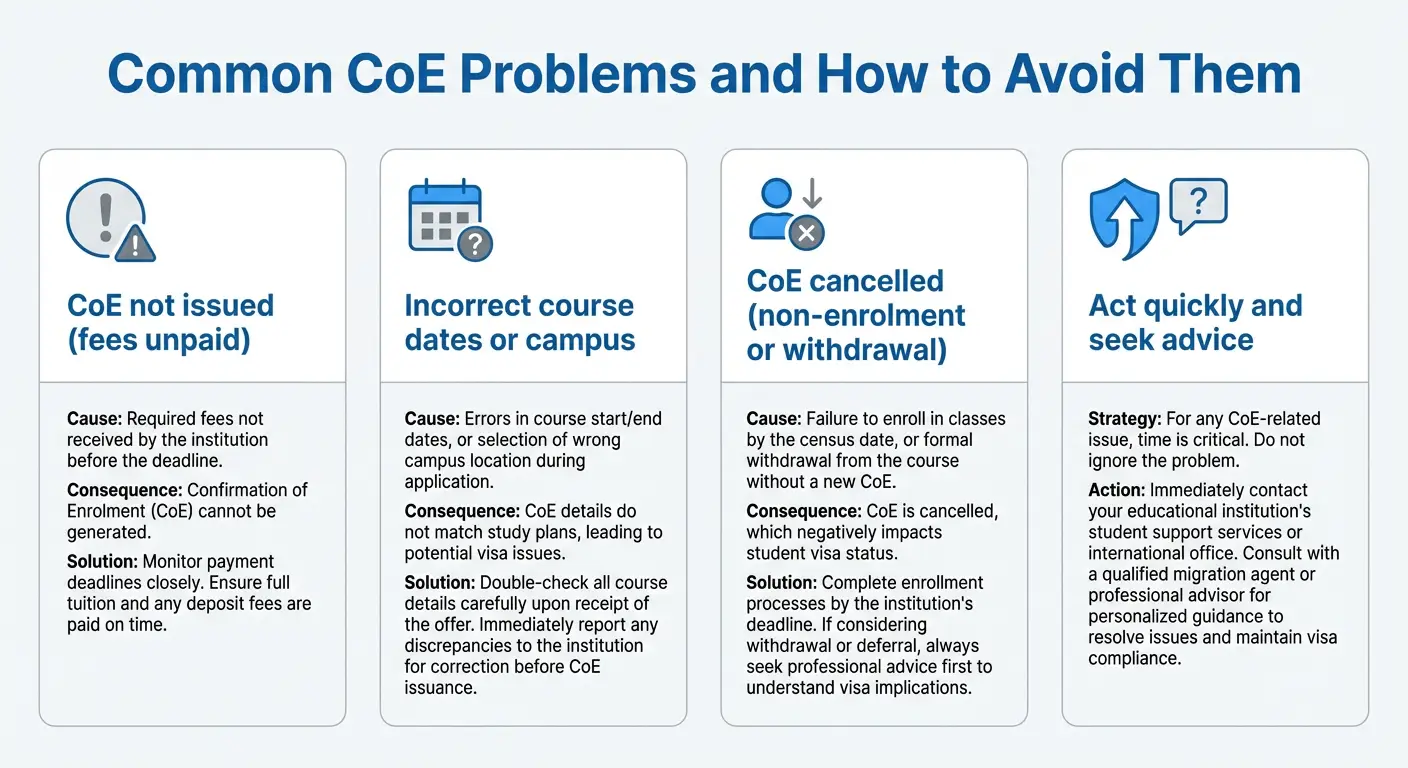
If your CoE is cancelled or you are told it may be withdrawn, it can have serious consequences for your visa status. For more details on what happens if your CoE is cancelled in Australia, see our dedicated guide on what happens if your CoE is cancelled and seek advice quickly.
Getting professional support early can help you understand your options and avoid rushed decisions that may affect your future visa applications.
When to Get Professional Help with Your CoE and Student Visa
The CoE and visa rules can be confusing, especially with changes introduced for 2025 and 2026. It can be sensible to speak with a registered migration professional when:
- You are changing courses or providers and are unsure how this affects your CoE and Student visa
- Your CoE has been delayed, refused or cancelled
- You are in Australia on another visa and want to stay to study in Sydney, Melbourne or another Australian city
- You are unsure how many CoEs you need or how course dates affect your visa expiry
The Migration team focuses on helping students understand their options, prepare stronger Student visa (subclass 500) applications and respond to problems with CoEs or enrolment.
Conclusion
A valid Confirmation of Enrolment (CoE) in Australia is now a non‑negotiable part of most Student visa (subclass 500) applications. As of 2026, lodging a visa application without a CoE can lead to an invalid application and may affect whether a bridging visa is granted.
Not sure if you have met all the requirements for your Confirmation of Enrolment (CoE)? Our migration team in Sydney and Melbourne can review your offer, fees and documents before you apply for your student visa. Book a consultation with The Migration to discuss your options.