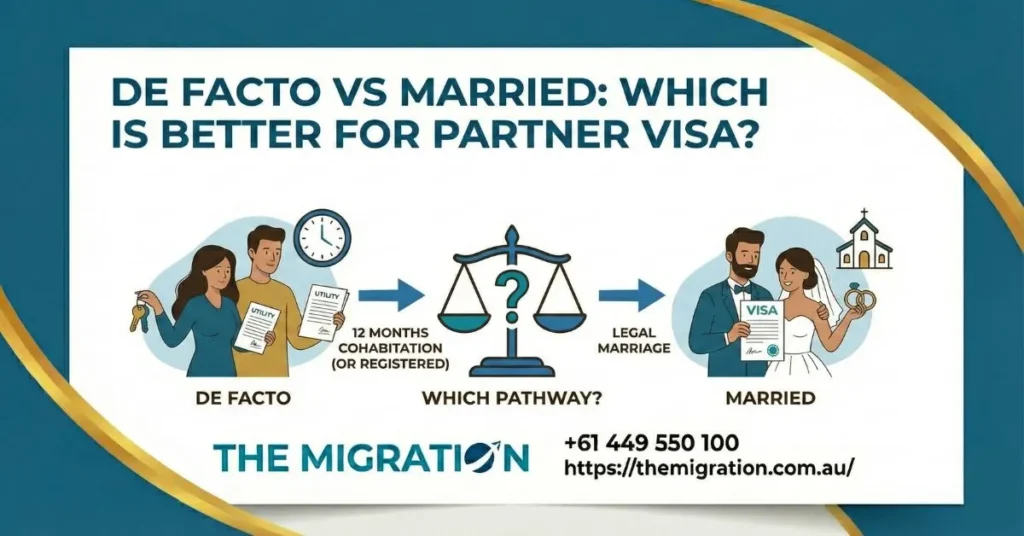
Both married and de facto couples apply for the same Australian Partner Visa subclasses (820/801 onshore; 309/100 offshore) and are assessed on identical four-pillar evidence criteria. The only material difference is that de facto applicants must prove 12 months of continuous cohabitation before lodging; married applicants are exempt from this requirement. Neither pathway carries a higher approval rate; the outcome depends entirely on the quality of your evidence.
Deciding between a de facto visa vs a partner visa in Australia? Your marital status does not determine whether you will be approved. Married couples and de facto partners apply for the same visa subclasses, Subclass 820/801 if you are onshore, or Subclass 309/100 if you are offshore, pay the same $9,365 application fee, and are assessed against identical criteria by the Department of Home Affairs.
Our immigration experts explain the real difference between a de facto partner visa and the married pathway, break down the four pillars of evidence every case officer uses, cover the prospective marriage visa vs partner visa comparison, and give you a clear decision framework for 2026. Whether you are married, in a de facto relationship in Australia, or weighing your options before you lodge, read this before making any application decisions.
What Is the Difference Between a De Facto and a Partner Visa in Australia?
The difference between a de facto relationship and the married pathway for an Australian partner visa comes down to one rule: de facto applicants must prove they have lived together continuously for at least 12 months before lodging their application, while married applicants are not required to meet this threshold.
Under Australian immigration law, both married and de facto couples apply for the same Partner Visa subclasses. The Department of Home Affairs defines a de facto relationship in Australia as a genuine, committed relationship between two people who live together as a couple on a domestic basis without being legally married.
Here is what is the same across both pathways:
- Identical visa subclasses Subclass 820/801 (onshore) or 309/100 (offshore)
- The same $9,365 application fee
- Assessment using the same four pillars of evidence (financial, household, social, commitment)
- A two-stage process: temporary visa first, then permanent visa
Here is what is different:
- De facto applicants must demonstrate 12 months of continuous cohabitation immediately before lodgement or qualify for a recognised exemption
- Married applicants are exempt from the cohabitation rule; the marriage certificate satisfies the relationship formation requirement at the point of lodgement
- De facto applicants who are still legally married to a previous partner are eligible, provided that the prior relationship has genuinely ended
What Is a De Facto Relationship Under Australian Visa Law?
A de facto relationship in Australia is a genuine, mutual commitment between two people who live together as a couple on a domestic basis but have not legally married. For visa purposes, the Department of Home Affairs requires this relationship to have existed for at least 12 months before the de facto partner visa application is lodged.
Three exemptions allow de facto applicants to bypass the 12-month cohabitation requirement:
- The couple has a dependent child together
- The couple is registered under an Australian state or territory relationship register
- The couple was unable to cohabit due to religious, cultural, or legal restrictions in their home country
Six Australian states and territories offer relationship registration, which legally satisfies the de facto relationship definition and removes the 12-month waiting period:
| State / Territory | Registration Fee | Processing Time / Requirements |
| ACT | No fee | Fastest option available |
| Queensland | $159 | Approximately 10 days (requires 6-month residency) |
| South Australia | $138 | Approximately 28 days |
| Victoria | $251.50 | 28 days or more |
| Tasmania | $226 | Both partners must be Tasmanian residents |
| NSW | $253 | Approximately 13 weeks (slowest) |
What Are the Four Pillars of Evidence for a Partner Visa?
Every partner visa application, whether married or de facto, is assessed against four pillars of evidence that determine whether your relationship is genuine, ongoing, and mutually committed. A marriage certificate alone is not sufficient; it only strengthens one of the four pillars.
Case officers are trained to identify imbalanced applications. Submitting 500 photographs but no financial integration will not produce an approval, regardless of your marital status. The four pillars of the partner visa assessment framework are:
1. Financial Pillar
- Joint bank accounts and shared savings history
- Combined bills, utilities, and ongoing financial commitments
- Joint ownership of property, vehicles, or investments
- Superannuation beneficiary nominations naming your partner
- Power of attorney, life insurance, or estate documents naming your partner
2. Household Pillar
- Joint residential lease or mortgage in both names
- Utility accounts registered at the shared address
- Mail and official correspondence addressed to both partners at the same property
- Shared responsibility for dependents, children, pets, or other household members
3. Social Pillar
- Photographs with mutual friends and family, not only selfies between the couple
- Joint travel records: bookings, boarding passes, hotel receipts, and itineraries
- Event invitations, attendance records, and social media presence showing you as a couple
- Statutory declarations (Form 888) from people who know you as a couple
4. Commitment Pillar
- A detailed relationship statement of at least 4–10 pages covering how you met, relationship milestones, daily life, and future plans
- Communication records: message history, video call logs, and emails spanning the relationship
- Wills, joint insurance policies, or estate planning documents
- Demonstrated mutual knowledge of each other’s family background, personal circumstances, and history
Married applicants gain a natural advantage in the commitment pillar through the marriage certificate itself. However, case officer decisions are based on the cumulative strength of all four pillars. A marriage certificate submitted alongside weak financial and household evidence has resulted in refusals. There are no shortcuts to a strong evidence base.
How Do You Prove a De Facto Relationship for a Visa in Australia?
To prove a de facto relationship for a visa in Australia, you need consistent, contemporaneous evidence across all four pillars that demonstrates you have been living together as a couple on a genuine domestic basis for at least 12 months.
The most common evidence gaps that lead to de facto partner visa refusals are:
- Financial imbalance: Photographs and social evidence without joint financial integration raise credibility concerns
- Inconsistent dates: Lease start dates, account opening dates, and stated cohabitation start dates must align across all documents
- Inadequate relationship statements: The 2,000-character online form is not a substitute for a full written statement. Case officers expect a document of 4–10 pages, typically taking 6–10 hours to write properly
- No Form 888 declarations: Independent third-party witness statements significantly strengthen de facto applications. Download Form 888 from the Department of Home Affairs
- Stale evidence: Failing to upload updated evidence during the processing period, which can span 12–29 months, can signal a relationship breakdown to the assessing officer
If you are building a de facto partner visa application and are unsure whether your evidence meets the threshold, speak with a partner visa migration agent at The Migration before you lodge.
Prospective Marriage Visa vs Partner Visa: Which Is Right for You?
The prospective marriage visa (Subclass 300) and the partner visa are not the same product. The Subclass 300 allows you to travel to Australia specifically to marry your sponsor, after which you must apply separately for the partner visa to remain in Australia permanently.
The prospective marriage visa is the appropriate pathway when:
- You are not yet married and intend to marry your Australian citizen or permanent resident sponsor in Australia
- You have been together for less than 12 months and are not eligible to register your de facto relationship in an Australian state or territory
- You are currently offshore, and your partner wants to bring you to Australia to marry onshore
The prospective marriage visa pathway involves two applications. Once you enter Australia on the Subclass 300 and marry within the 9-month visa period, you must then lodge a Subclass 820/801 partner visa application to remain in the country. This adds both time and cost compared to applying as an already-married or de facto couple.
Use the prospective marriage visa strategically — not as a default. If you can already demonstrate an eligible married or de facto relationship, a direct partner visa application is the more efficient pathway.
Which Is Faster, a Spouse Visa or a De Facto Partner Visa in Australia?
The spouse visa Australia and the de facto partner visa are processed in the same queue, assessed by the same case officers, and subject to identical processing timeframes. Your marital status does not give you a faster or slower result.
Expert Australian Migration Guidance
Navigating the complexities of your visa journey is easier with professionals. Start your Australian dream today.
Book ConsultationCurrent Department of Home Affairs processing benchmarks for Partner Visa Australia applications in 2025–2026:
- Onshore temporary visa (Subclass 820): 75% processed within 14–23 months; 90% within 23–29 months
- Offshore temporary visa (Subclass 309): Currently processing faster, 75% within 9–13 months
- Permanent stage (Subclass 801/100): Assessed two years after lodgement; decisions typically 5–9 months after eligibility
The Department currently holds approximately 98,000 pending partner visa applications against an annual allocation of 40,500 places. This backlog applies to all applicants regardless of relationship type.
The one indirect speed advantage of the married pathway: if you cannot yet satisfy the 12-month de facto cohabitation rule, getting married or registering your relationship allows you to lodge immediately, rather than waiting to accumulate the required cohabitation period.
Can You Apply for a Partner Visa Without Being Married?
Yes, you can apply for an Australian partner visa without being married, provided you meet the requirements for a de facto visa in Australia, specifically the 12-month continuous cohabitation rule or one of its recognised exemptions.
The requirements for a de facto visa in Australia are as follows:
- You have lived together continuously for at least 12 months immediately prior to lodging, or
- You are formally registered as a couple under an Australian state or territory relationship register, or
- You have a dependent child together, or
- You were unable to cohabit due to cultural, religious, or legal restrictions in your home country
Approval rates for de facto partner visa applications with comprehensive four-pillar evidence are comparable to those for married applications. The pathway is legally equivalent — what determines the outcome is the quality and consistency of your supporting documentation, not your legal relationship status.
Which visa is better, the De Facto or the Married Partner Visa Australia?
Neither the de facto visa nor the married partner visa is objectively better — both lead to the same permanent residence outcome, and approval rates reflect evidence quality rather than relationship type. The right choice depends entirely on your personal timeline, evidence base, and relationship circumstances.
Choose the Married Pathway If:
- You have been together for less than 12 months and are not eligible to register your de facto relationship in any Australian state
- Your relationship is long-distance, and proving continuous cohabitation is not feasible
- Your partner is offshore, and you plan to use the prospective marriage visa (Subclass 300) to bring them to Australia
- You want to lodge your application immediately without waiting to accumulate cohabitation history
Choose the De Facto Pathway If:
- You have 12 or more months of documented cohabitation and strong evidence across all four pillars
- You are not legally free to marry, for example, if you are still legally married to a previous partner
- You prefer not to marry and are eligible to register your relationship or meet another exemption
- You have been together for 3 or more years (or 2 or more years with dependent children) and may qualify for a simultaneous temporary and permanent grant
Common Mistakes That Lead to Refusal on Either Pathway:
- Submitting a relationship statement shorter than 4 pages — case officers expect 4–10 pages as a minimum
- Evidence that is heavy on photographs but lacks financial integration proof
- Dates and timelines that are inconsistent across submitted documents
- Failing to notify the Department of an address change during the processing period
- Social media profiles or online content that contradicts the relationship narrative in your application
- Not uploading updated evidence every 2–3 months during the processing period
How The Migration Helps with Your Partner Visa Australia Application
Because the Department of Home Affairs now applies rigorous real-time cross-checks across all partner visa applications matched against attendance records, address histories, and social activity, the margin for documentation errors has narrowed significantly. Having a MARA-registered migration agent review your application before lodgement is the most reliable way to avoid a refusal, a Request for Further Information, or a processing delay.
The Migration’s partner visa team operates from offices in Harris Park (Sydney) and Melbourne CBD, and provides end-to-end Australian partner visa services, including:
- Pathway Assessment: We confirm whether the de facto or married pathway is strategically stronger for your specific timeline and evidence base before you commit to an approach
- Four-Pillar Evidence Audit: We identify and close gaps in your financial, household, social, and commitment evidence before you lodge — not after a refusal
- Relationship Statement Coaching: We guide you through writing a compelling 4–10 page statement that meets case officer expectations and reflects your genuine relationship
- Spouse Visa Australia Requirements Checklist: We provide a complete, personalised document checklist so nothing is omitted at the time of lodgement
- Ongoing Case Management: We monitor your application throughout processing and ensure the Department receives current, updated evidence during the waiting period
- Refusal and Tribunal Appeals: If your application has been refused, we assess your prospects for review at the Administrative Review Tribunal and manage the appeal process
Book a consultation with a partner visa migration agent at The Migration to confirm which pathway is right for you and whether your current evidence is application-ready.
Making the Right Decision: De Facto vs Married Partner Visa Australia
There is no universally better option between the de facto visa and the married partner visa pathways in Australia. Both lead to the same permanent residence outcome. The married pathway removes the 12-month cohabitation requirement; the de facto pathway performs equally well when your evidence is comprehensive and consistent across all four pillars.
What determines your result is not whether you hold a marriage certificate; it is whether your documentation can prove a genuine, ongoing, mutually committed relationship to a case officer who is trained to look for inconsistencies. Married couples with weak evidence have been refused. De facto couples with thorough documentation have been approved without issue. The difference is always preparation.
If you are unsure which pathway applies to your situation, or if you want to confirm your evidence meets the current threshold before lodging, Book a consultation with the migration. A pre-lodgement review can save you months of delays and thousands of dollars in re-application costs.