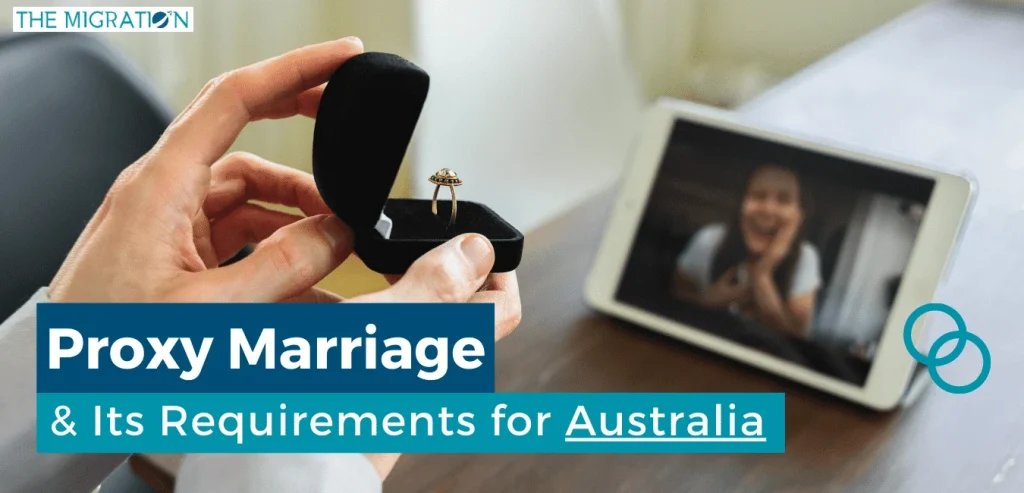
A proxy marriage is a legally recognised wedding ceremony in which one or both parties are absent, with a designated representative, the proxy, signing the marriage documents on their behalf. Australia does not conduct proxy marriages domestically, but will recognise a proxy marriage performed overseas if it was legally valid under the laws of the country where it took place and both parties gave genuine consent under the Marriage Act 1961. A valid proxy marriage may support an Australian partner visa application.
Proxy marriage, also known as marriage by proxy, absentee marriage, or marriage by representative, is a legal arrangement where one or both partners are physically absent from the wedding ceremony. Instead of attending in person, a designated proxy acts on behalf of the absent party and signs the marriage documents. Where both partners are absent and represented, this is called a double proxy marriage.
Australia does not prohibit its residents from entering into proxy marriages performed overseas. Under the Marriage Act 1961, a foreign marriage, including a proxy marriage, is recognised in Australia if it was legally valid in the country where it was solemnised and if both parties gave genuine, mutual consent without coercion or deception. This recognition extends to Islamic nikah by proxy, military proxy marriages, and other forms of ceremony-by-representative.
What Is a Proxy Marriage?
A proxy marriage is a wedding ceremony where one or both parties to the marriage are not physically present, and a third party, the proxy or marriage representative, attends and executes the legal formalities on their behalf. The absent party grants formal authority to their proxy, typically through a power of attorney or equivalent legal instrument recognised in the jurisdiction where the ceremony is held.
Proxy marriage is also known by the following terms:
- Marriage by proxy: the most commonly used legal term
- Absentee marriage: emphasises the physical absence of one or both parties
- Marriage by representative: used in some legal jurisdictions to describe the proxy’s role
- Proxy wedding ceremony: informal reference to the ceremony itself
- Double proxy marriage: where both parties are absent, and each is represented by a proxy
- Marriage without being present: colloquial description of the arrangement
A proxy marriage differs from an online marriage (conducted via video call on platforms such as Zoom or Skype) in that a proxy marriage involves a physical representative present at the ceremony venue, whereas an online marriage involves both parties participating remotely. The legal treatment of each under Australian law is different — online marriages are generally not recognised under the Marriage Act 1961.
Is Proxy Marriage Legal in Australia?
Proxy marriages cannot be conducted within Australia. Australian domestic marriage law under the Marriage Act 1961 requires both parties to be physically present at the ceremony. However, proxy marriages performed overseas are not prohibited from being recognised in Australia, provided they satisfy the legal validity and real consent requirements.
Under Section 88D of the Marriage Act 1961, a marriage solemnised outside Australia is recognised as valid in Australia if:
- The marriage was valid under the law of the country where it was solemnised (including proxy marriages performed in countries where they are lawful)
- Both parties gave genuine, mutual consent to the marriage
- Neither party was already married to another person at the time of the ceremony
- The parties were not within the prohibited degrees of relationship under Australian law
- Both parties were of marriageable age under Australian law
The proxy marriage laws that govern recognition in Australia, therefore, depend primarily on whether the marriage was lawfully conducted in the country of origin, and whether real consent was present on both sides.
What Are the Requirements for Proxy Marriage in Australia?
For a proxy marriage to be recognised in Australia, both the legal validity requirements of the overseas jurisdiction and the real consent requirements of the Marriage Act 1961 must be satisfied. Meeting one without the other is not sufficient.
Proxy Marriage Requirements: Legal Validity
- The proxy marriage was conducted in a country or jurisdiction that permits marriage by proxy under its domestic law
- The ceremony complied with all local procedural requirements, including the formal appointment of a proxy and registration of the marriage
- A valid proxy marriage certificate was issued by the relevant authority in that jurisdiction
- The marriage was properly registered in the country of origin
Proxy Marriage Requirements: Real Consent Under the Marriage Act 1961
- Both parties must have communicated and agreed to the proxy marriage arrangement beforehand
- Consent must not have been obtained through coercion, duress, or threats
- Consent must not have been obtained through deception about the identity of the other party
- Neither party can have been mentally incapacitated or unable to understand the nature and consequences of the marriage ceremony at the time
- No undue influence, physical, financial, or social, can have been present
A proxy marriage that meets the legal validity test in its country of origin but fails the real consent test under Australian law will not be recognised. This is particularly relevant for visa applications, where the Department of Home Affairs will scrutinise whether genuine mutual consent existed.
Is Proxy Marriage Recognised in Australia for a Partner Visa?
A proxy marriage may be recognised in Australia for partner visa purposes if it was legally valid in the country where it was performed and both parties gave genuine consent. However, the Department of Home Affairs assesses each proxy marriage individually; recognition is not automatic, and the application is subject to closer scrutiny than a standard marriage.
Proxy Marriage Requirements for a Partner Visa Application
- Certified proxy marriage certificate: The original or a certified copy of the marriage certificate issued in the country where the proxy marriage was conducted, with a certified NAATI translation if not in English
- Apostille or authentication: The marriage certificate must be apostilled or officially authenticated by the relevant authority in the country of issue to be accepted by the Department of Home Affairs
- Evidence of genuine relationship: The same four-pillar evidence framework (financial, household, social, commitment) applies to proxy married couples as to any other married applicants. A proxy marriage certificate alone does not establish a genuine relationship
- Evidence of personal contact: The Department may question whether the couple has met in person. Provide documentation of meetings, travel, and communication history
- Evidence of consent: Documentation demonstrating that both parties agreed to the proxy marriage arrangement beforehand, including correspondence, witness statements, or documentation from the officiating authority
Once a proxy marriage is accepted as valid, the partner visa application proceeds under the same subclasses as any other married couple, Subclass 820/801 (onshore) or 309/100 (offshore) and is assessed on the same four-pillar evidence standard. For a detailed breakdown of evidence requirements, see the Department of Home Affairs partner visa guidelines.
What Is a Double Proxy Marriage?
A double proxy marriage is a ceremony where both partners are absent, and each is represented at the ceremony by a separate proxy. Both proxies sign the marriage documents on behalf of their respective parties.
Double proxy marriages are legally permitted in very limited jurisdictions:
- Montana, USA: The only US state to permit double proxy marriage, historically used for military personnel deployed overseas who cannot travel to marry in person
- Paraguay: Permits double proxy marriages under certain circumstances for foreign nationals
For Australian recognition purposes, a double proxy marriage is assessed under the same framework as a single proxy marriage. The key questions are whether it was legally valid in the jurisdiction where it was conducted and whether both parties gave genuine consent. There is no additional prohibition under Australian law on double proxy marriages specifically.
What Is a Military Proxy Marriage?
A military proxy marriage is a proxy wedding ceremony available to active-duty military personnel who cannot be physically present due to deployment or operational requirements. The most widely known military proxy marriage jurisdiction is Montana, USA, which allows both single and double proxy marriages specifically for this purpose.
Key facts about military proxy marriage:
- Montana military proxy marriages are legally valid marriages under US law and are used by US armed forces personnel deployed internationally
- Military proxy marriages conducted legally in Montana have been recognised for immigration purposes in multiple countries, including visa applications in Australia
- The absent military party must provide documented authorisation for their proxy to act on their behalf
- Recognition in Australia is subject to the standard Marriage Act 1961 real consent and legal validity tests
Is a Nikah by Proxy Recognised in Australia?
A nikah by proxy is an Islamic marriage (nikah) conducted where one party is absent and represented by a designated wakeel (representative). Under Islamic jurisprudence, a nikah by proxy is permissible when the absent party appoints an authorised representative, genuine consent has been communicated, and the ceremony satisfies the standard nikah requirements.
Expert Australian Migration Guidance
Navigating the complexities of your visa journey is easier with professionals. Start your Australian dream today.
Book ConsultationFor Australian recognition purposes:
- A nikah by proxy conducted in a country where Islamic marriages are legally registered under civil law, such as Pakistan, may be recognised in Australia if the marriage was registered and is legally valid under that country’s domestic law
- A nikah by proxy conducted as a purely religious ceremony without civil registration will not be recognised under Australian law, as Australia only recognises civil marriages or religious ceremonies that comply with the civil registration requirements of the country where they occurred
- The real consent requirements of the Marriage Act 1961 apply in full; a nikah by proxy in which consent was not freely given will not be recognised, regardless of its religious validity
If you are relying on a nikah by proxy for an Australian partner visa application, the civil registration status of the marriage in the originating country is the critical factor. Seek advice from a MARA-registered migration agent before lodging.
Which Countries Allow Proxy Marriage?
Proxy marriage laws vary significantly by country and, in some cases, by state or province. Proxy marriage is permitted in a limited number of jurisdictions, and the specific procedural requirements differ in each.
Countries and Jurisdictions That Allow Proxy Marriage
- Pakistan: Proxy marriages are permitted and common, particularly where one party is working or residing overseas. Marriages are registered under the Muslim Family Laws Ordinance 1961.
- Montana, USA: The only US state permitting proxy marriage, both single and double proxy. Originally designed for military personnel. Widely used for immigration purposes across multiple countries.
- Paraguay: Permits double proxy marriages and is used by foreign nationals specifically for migration purposes.
- Mexico (some states): Certain Mexican states permit proxy marriage under specific circumstances; legal validity must be confirmed for each state individually.
- Various Islamic-law jurisdictions: Where civil law recognises nikah by proxy, proxy marriages are legally registered and potentially recognisable overseas.
Countries and Jurisdictions Where Proxy Marriage Is Not Permitted
- Australia (domestic ceremonies only, overseas proxy marriages may be recognised)
- United Kingdom
- Canada
- Most European Union member states
- Most US states (Montana is the principal exception)
Proxy marriage in Pakistan requirements for visa purposes are among the most commonly raised in Australian immigration contexts. Pakistani proxy marriages are legally valid where properly registered, but the Department of Home Affairs will still apply the real consent test and require certified documentation before recognising them for partner visa purposes.
How to Get a Proxy Marriage Certificate
A proxy marriage certificate is issued by the civil registration authority in the country where the proxy marriage ceremony was legally conducted. The process to obtain one varies by jurisdiction, but the general steps are consistent across most proxy marriage legal frameworks.
Steps to Obtain a Proxy Marriage Certificate
- Step 1 — Confirm the jurisdiction: Identify a jurisdiction where proxy marriage is legal and where the procedural requirements are achievable for your situation
- Step 2 — Appoint a proxy: Formally designate a trusted person as your proxy, typically by executing a power of attorney or equivalent legal instrument in that jurisdiction
- Step 3 — Satisfy local requirements: Comply with all local procedural requirements, advance notice periods, witness requirements, and registration documentation
- Step 4 — Conduct the ceremony: The proxy attends the ceremony and signs the marriage register or equivalent documents on your behalf
- Step 5 — Obtain the marriage certificate: Register the marriage with the relevant civil authority and receive the official proxy marriage certificate
- Step 6 — Authenticate for Australian use: Have the certificate apostilled or authenticated by the relevant authority for use in Australian immigration proceedings
- Step 7 — NAATI translation: Arrange a certified NAATI translation of the certificate into English if it is not already in English
The authentication and NAATI translation steps are mandatory for the Department of Home Affairs to accept the certificate in a partner visa application. An unauthenticated or untranslated proxy marriage certificate will be rejected at lodgement.
How The Migration Helps
Because proxy marriage applications are scrutinised more carefully by the Department of Home Affairs than standard married partner visa applications, and because the legal recognition of proxy marriage depends on jurisdiction-specific validity conditions that vary significantly, having a MARA-registered migration agent assess your proxy marriage before lodging a partner visa is the most reliable way to avoid a refusal or Request for Further Information.
The Migration’s partner visa team, operating from offices in Harris Park (Sydney) and Melbourne CBD, provides:
- Proxy Marriage Recognition Assessment: We confirm whether your specific proxy marriage, including nikah by proxy and Pakistani proxy marriages, meets the legal validity and real consent requirements for Australian recognition
- Document Authentication Guidance: We advise on the correct apostille or authentication process for your country of origin and ensure the certificate is accepted at lodgement
- Partner Visa Evidence Strategy: We help you build strong four-pillar evidence that demonstrates a genuine relationship, essential when the Department applies heightened scrutiny to proxy marriage applications
- Relationship Statement Coaching: We guide you through writing a detailed relationship statement that addresses the proxy marriage context and preempts case officer questions about consent and personal contact
- Refusal Review and AAT Appeals: If a partner visa application based on a proxy marriage has been refused, we assess your grounds for review at the Administrative Review Tribunal
If you are uncertain whether your proxy marriage will be recognised in Australia, or if you want to confirm your partner visa evidence is sufficient before lodging, speak with a MARA-registered migration agent at The Migration. Offices in Harris Park (Sydney) and Melbourne CBD offer face-to-face consultations.
Proxy Marriage in Australia: What You Need to Know Before Applying
Proxy marriage is a legally recognised arrangement in a limited number of jurisdictions, and Australia will acknowledge a foreign proxy marriage, including for partner visa purposes, where the marriage was legally valid in its country of origin and both parties gave genuine consent under the Marriage Act 1961.
The key risks are documentation gaps and consent questions. An unauthenticated certificate, an untranslated document, or a Department of Home Affairs concern about whether consent was freely given can result in a refusal regardless of whether the proxy marriage was technically valid. Partner visa applications built on proxy marriages require stronger supporting evidence, not less than standard married applications.
The Migration is registered under the Migration Agents Registration Authority (MARA). Book a consultation with a partner visa migration agent at The Migration before lodging a proxy marriage-based partner visa application.