

You’re ready to start your life in Australia with your partner, but the first step feels like hitting a wall of confusing numbers. You see terms like 820 vs 309 Visa, and it’s hard to know where to even begin. This initial confusion is common, but the choice is far more straightforward than government websites make it seem.
Those visa numbers aren’t different types of relationships; they are labels designed to answer one logistical question: Where will you be when you submit your application?
Your physical location is the primary factor that decides your path. In immigration terms, this is the difference between applying ‘onshore’ or ‘offshore’.
- If you are physically in Australia when you lodge your application (perhaps on a valid tourist visa or student visa), you are applying onshore. This is the path for the Subclass 820 visa.
- If you are outside Australia when you apply, you are applying offshore. This is the path for the Subclass 309 visa.
This isn’t a minor detail; your location dictates which visa you are eligible for. You cannot, for instance, apply for the onshore 820 visa while living in your home country. Understanding this rule is crucial to avoiding costly mistakes and delays.
The Onshore Path: How the Subclass 820 Visa Lets You Wait in Australia
If you and your partner are already together in Australia, perhaps you’re on a visitor or student visa, then the Subclass 820 visa is your designated path. This is the common route for those looking to switch from a temporary visa to a partner visa without having to leave the country.
The most significant benefit of this path is that you get to stay together. Instead of facing a long and often difficult period of separation, applying for the 820 visa allows you to remain with your partner and continue building your shared life while your application is being processed.
What happens when your current visa expires?
This is where a crucial element called a Bridging Visa comes in. It is automatically granted when you apply for the 820 visa and kicks in the moment your original visa ends, ensuring you remain in Australia lawfully.
The combination of the Subclass 820 application and its associated Bridging Visa is what makes waiting onshore possible. This powerful duo not only lets you stay together but often includes permission to work, turning a period of uncertainty into a productive time to settle into your new life.
What is a Bridging Visa? Your Permission to Stay and Work While You Wait
The Bridging Visa A (BVA) is an automatic safety net for the stressful possibility of your current visa expiring while you wait. When you lodge your Subclass 820 application, a BVA is granted at the same time, but it remains inactive. It only kicks in the moment your current tourist or student visa ends, seamlessly ensuring you remain in Australia lawfully.
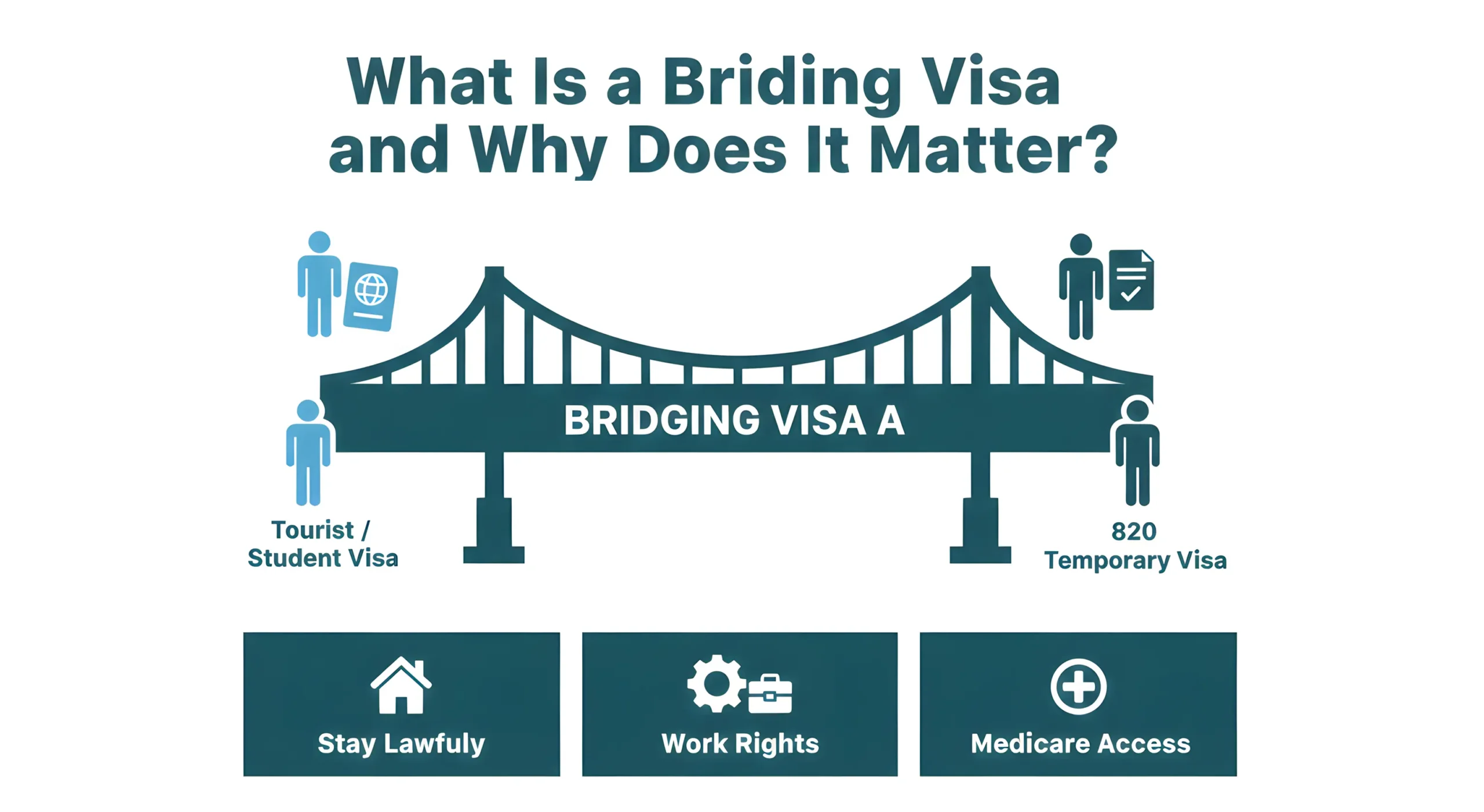
Its main purpose is to act as a legal placeholder, filling the gap between your old visa and the decision on your new one. This means you don’t have to worry about becoming unlawful or being forced to leave the country and separate from your partner.
Perhaps the most significant benefit is that the subclass 820 bridging visa conditions usually grant you full, unrestricted permission to work. This is a game-changer. Having full work rights on a temporary partner visa application means you can secure a job, support yourself, and begin integrating fully into Australian life, turning the waiting period from a time of limbo into a productive step toward your future.
Related Articles :
- Explain Australian Partner Visa Subclasses Onshore (820, 801), Offshore (309 & 100)
- Partner Visa Australia – Eligibility, Requirements & Application Process
The Offshore Path: Applying for the Subclass 309 Visa from Outside Australia
If you and your Australian partner are living abroad and planning your move down under, the Subclass 309 visa is the path designed for you. This is the dedicated Australian partner visa offshore pathway, meaning you must be physically outside of Australia when you submit your application.
However, there is a critical rule you must plan for: you must also be outside Australia when the visa is granted. The Department of Home Affairs legally cannot finalize your visa while you are visiting Australia, even on a separate tourist visa. This is a non-negotiable requirement of the offshore process.
Because this entire process happens while you are living overseas, there is no bridging visa involved; that ‘placeholder’ visa is an onshore-only mechanism. The practical reality of the 309 visa is that you must be prepared to wait for a decision in your home country or another country outside of Australia, which often means living separately from your partner.
The subclass 309 visa processing time can be significant, and this period of long-distance is a major emotional and logistical factor for many couples. It’s a crucial consideration when weighing the pros and cons of each visa pathway.
Comparison Table: 820 vs. 309
| Feature | Subclass 820 (Onshore) | Subclass 309 (Offshore) |
| Applicant’s Location | Must be in Australia at the time of application. | Must be outside Australia at the time of application. |
| Associated Permanent Visa | Subclass 801 | Subclass 100 |
| Bridging Visa | Usually granted a Bridging Visa A (BVA), allowing you to stay, work, and study while waiting. | No bridging visa granted. You must wait for the 309 to be granted before moving to Australia. |
| Processing Time (Approx.) | 16–24 months (50% to 90% of cases). | 14–24 months (50% to 90% of cases). |
| Cost (Base Fee) | From AUD 9,365 (covers both temporary and permanent stages). | From AUD 9,365 (covers both temporary and permanent stages). |
| Work & Study Rights | Full rights once the 820 is granted (and often while on the Bridging Visa). | Full rights once the 309 is granted and you enter Australia. |
| Medicare Access | Eligible upon lodging a valid application. | Eligible only after the 309 visa is granted and you arrive in Australia. |
820 vs 309 Visa: Weighing the Pros and Cons for Your Relationship
Deciding between these two paths often feels less like a legal choice and more like a personal one. The biggest factor isn’t a rule or a form, but a simple question: can you and your partner be apart while you wait? This is the core of the 820 vs 309 visa pros and cons.
The overwhelming advantage of the onshore 820 visa is that you get to stay together in Australia. Your bridging visa allows you to remain legally, work, and even access Medicare while a decision is made. For most couples, this ability to start building a life together immediately is invaluable.
In contrast, the Subclass 309 visa requires a significant period of separation. Because you must wait for the decision outside Australia, it can mean putting your shared life on hold. This emotional and logistical challenge is the primary downside for couples who must take the offshore pathway.
One factor that doesn’t influence the choice is the price. A common misconception is that one visa is cheaper, but the main government application cost of partner visa 820 and 309 applications is identical. Similarly, the relationship evidence for an Australian partner visa you must provide is fundamentally the same. The real difference isn’t in the application itself, but in your experience while you wait.
Expert Australian Migration Guidance
Navigating the complexities of your visa journey is easier with professionals. Start your Australian dream today.
Book ConsultationThe ‘Two-Step’ Journey: What Happens After Your First Partner Visa?
Getting your first visa is actually the first step in a two-part journey. It’s crucial to understand the difference between a temporary vs permanent partner visa Australia; both the Subclass 820 and 309 are temporary visas that let you live in Australia while you await the final stage.
Your initial application sets you on a specific track. If you start with the onshore Subclass 820 visa, you’ll later be assessed for the permanent Subclass 801 visa. In the same way, the offshore pathway from subclass 309 to 100 visa is the direct route to permanent residency for those starting outside Australia.
The best part is that you don’t have to start from scratch. About two years after you first applied, the government simply asks for updated evidence to confirm your relationship is still genuine and continuing.
Your Next Step: A Simple Checklist to Choose Your Partner Visa Path
You’re no longer staring at a confusing wall of numbers. You now understand that the most important factor is simply where you are right now. The once-daunting Subclass 820 vs 309 Partner Visa decision is now a clear signpost, and you hold the map.
To confirm your path forward, answer one final question:
- Are you physically IN Australia now? Your journey starts with the Subclass 820 (Onshore) visa.
- Are you physically OUTSIDE Australia now? Your journey starts with the Subclass 309 (Offshore) visa.
With this clarity, your immediate next step is to visit the official Department of Home Affairs website for the visa you’ve identified. There you will find the correct forms and fees to begin your visa application process. This single, confident decision is the foundation for your new life together in Australia.
Conclusion
Choosing between the Subclass 820 and Subclass 309 visa doesn’t have to be overwhelming. Your location determines your path: apply onshore and stay with your partner in Australia, or apply offshore and wait for your grant before making the move. Both visas lead to the same destination: permanent residency and a life together in Australia. The key is starting your application correctly the first time. Every day you delay costs you valuable processing time. Take action now, gather your evidence, and start building your future together. Your Australian life is closer than you think. You just need to take the first step.
Ready to get it right the first time? Book Your Consultation with the migration Today and let an expert guide you through every step of your partner visa journey.
Frequently Asked Questions
Q : Can I switch from a Subclass 309 to a Subclass 820 visa after I apply?
No, you cannot switch between the two once you lodge your application. Your location at the time of lodgement locks you into that pathway, so choose carefully before you apply.
Q: Do both partners need to be present when lodging the application?
No, only the visa applicant needs to meet the location requirement. Your Australian partner can live anywhere they sponsor you, regardless of where they are located.
Q: Can I travel outside Australia while my Subclass 820 application is pending?
Yes, but you must apply for a Bridging Visa B (BVB) before you leave. Without it, your Bridging Visa A becomes invalid, and you cannot re-enter Australia on it.
Q: Does a de facto relationship qualify for both the 820 and 309 visas?
Yes, both visas accept married and de facto partners. You must prove you have lived together in a genuine relationship for at least 12 months, or register your relationship officially.
Q: What happens if my relationship ends while my partner visa application is still processing?
You must notify the Department of Home Affairs immediately. The department will likely refuse your application, as the visa is based on your ongoing genuine relationship with your sponsor.