Planning your future in Australia with your partner is an exciting time, but the visa process can feel like a challenge filled with confusing terms and high stakes. This guide breaks down the Australian Partner Visa eligibility for 2026 into simple, manageable steps so you can move forward with confidence.
A partner visa isn’t a single event; it’s a two-part journey. The process grants a temporary visa first, allowing you to start your life in Australia. Then, typically after about two years, you are assessed for the permanent visa. This two-stage approach is key to navigating your application successfully.
This breakdown translates the official requirements into a practical roadmap, exploring what it means to have a sponsor, the evidence needed to prove your relationship is genuine, and the crucial differences between applying from inside or outside Australia. By the end, you’ll have the clarity to assess your situation confidently.
What Is the Australian Partner Visa?
The Australian Partner Visa remains a pathway for individuals to live, work, and study in Australia alongside their partners who are Australian citizens, permanent residents, or eligible New Zealand citizens. As of 2026, the program continues to focus on reuniting genuine couples without discrimination based on marital status, treating both married and de facto partnerships equally.
Subclass 820/801 (Onshore)
Temporary Partner Visa (Subclass 820): This first stage allows you to reside in Australia while your permanent residency is being processed. Most well-prepared applications in 2026 are seeing decision timeframes between 17 to 25 months.
Permanent Partner Visa (Subclass 801): You typically become eligible for this stage two years after the initial lodgement of your combined 820/801 application. This visa grants permanent residency, providing the same rights and benefits as your partner, including full Medicare access and a pathway to citizenship. In 2026, the permanent stage generally takes 7 to 13 months to process after reaching the eligibility date.
Subclass 309/100 (Offshore)
Temporary Partner Visa (Subclass 309): This is the first stage. It allows you to enter, live, work, and study in Australia temporarily while the permanent stage is being assessed.
Permanent Partner Visa (Subclass 100): This is the second stage. You are typically eligible for this permanent residency grant two years after you first lodged the combined application.
Who Can Apply for an Australian Partner Visa?
To apply for an Australian Partner Visa in 2026, you must be the spouse (married) or de facto partner of an Australian citizen, permanent resident, or eligible New Zealand citizen. Both you and your sponsor must generally be at least 18 years old and be able to prove that your relationship is genuine and continuing. Additionally, you must meet the Department’s strict health and character requirements and have no outstanding debt to the Australian government.
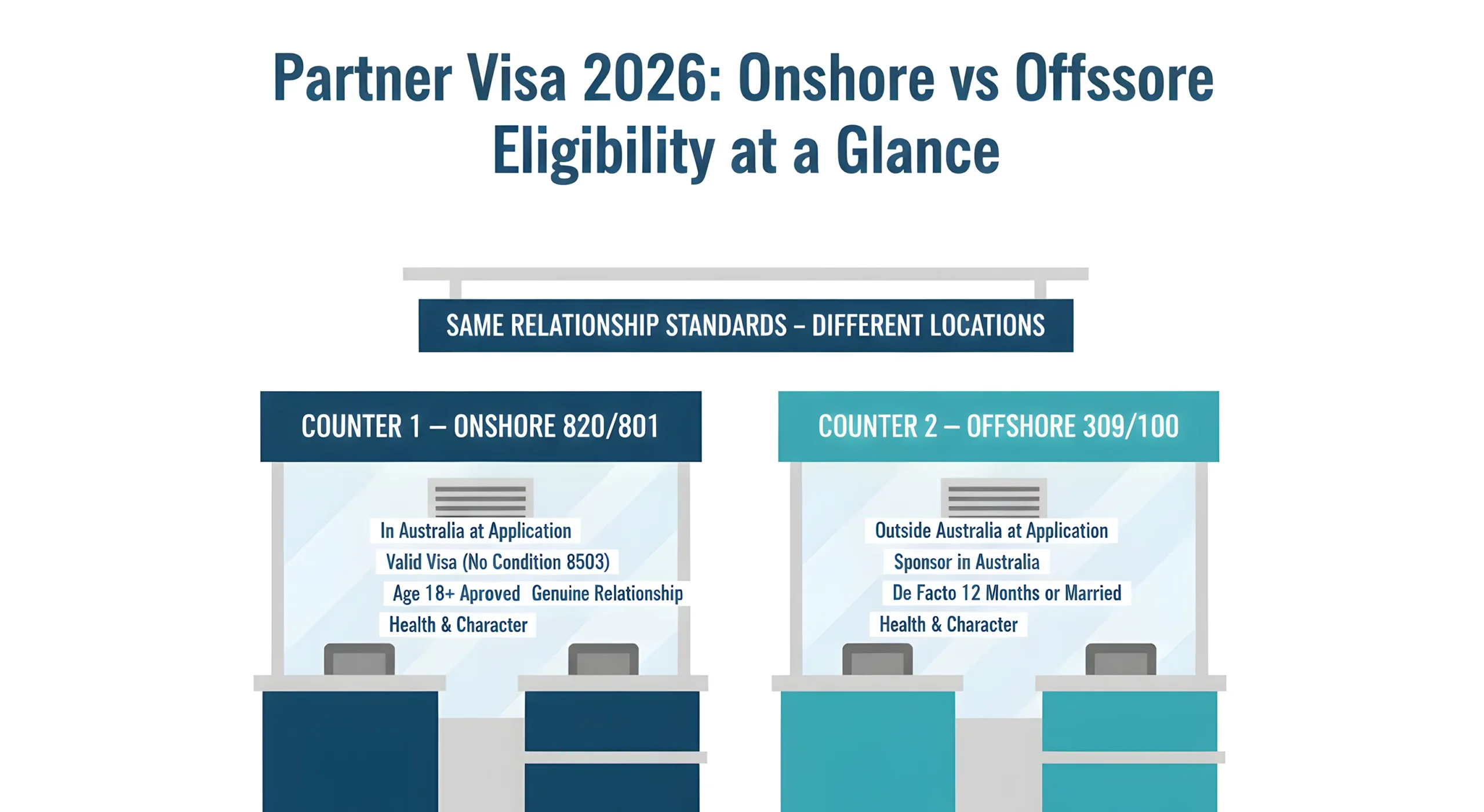
Applicant Eligibility Criteria Onshore (Subclass 820/801)
Visa History
- Must not have had a visa cancelled or application refused
- If you don’t hold a substantive visa, you must include:
- A completed online sponsorship form from your sponsor
- Evidence of your sponsor’s status (passport or birth certificate, not a driver’s licence or Medicare card)
- At least two statutory declarations (made within the last 6 weeks) confirming your relationship
- Evidence that declarants are Australian citizens/PRs or eligible NZ citizens
Location Requirement
- You must be in Australia when you apply
- All family members applying with you must also be in Australia
- Your visa must not have a condition preventing further stay (e.g., condition 8503)
Sponsorship
- You must have an approved sponsor at the time of application and throughout the visa period
- Your sponsor is typically your partner and cannot be changed
- Sponsor must be an Australian citizen, permanent resident, or eligible NZ citizen
Age Requirement
- Married applicants must be 18 or older
- De facto applicants must also be 18 or older
Relationship Requirements
- Must be the spouse or de facto partner of an Australian citizen, PR, or eligible NZ citizen
- De facto partners must have been in the relationship for at least 12 months before applying (exceptions apply)
Health & Character
- All applicants must meet Australia’s health and character requirements
Financial & Values
- Any debts to the Australian Government must be repaid or arranged before applying
- All applicants aged 18+ must sign the Australian Values Statement
Best Interests of the Child
- The visa may not be granted if it is not in the best interests of any applicant under 18
Applicant Eligibility Criteria Offshore (subclass 309/100)
Visa History
- Must not have had a visa cancelled or a previous application refused
- Immigration history will be reviewed as part of the decision-making process
- In some circumstances, you may still be eligible see Can I go to Australia for further guidance
Location Requirement
- You must be outside Australia when you submit your application
- All family members applying with you must also be outside Australia at the time of application
Sponsorship
- You must have an approved sponsor at lodgement and throughout your visa period
- Your sponsor is typically your partner (Australian citizen, permanent resident, or eligible NZ citizen)
- Your sponsor cannot be changed; the same person must sponsor you for 2 years after the temporary Partner visa (subclass 309) is granted
- Your sponsor should apply to sponsor you as soon as possible after you lodge
Age Requirement
- Married applicants must generally be 18 or older at the time of application
- De facto applicants must also be 18 or older
Relationship Requirements
- Must be the spouse or de facto partner of an Australian citizen, permanent resident, or eligible NZ citizen
- This requirement applies both at lodgement and at decision
- De facto partners must have been in the relationship for at least 12 months before applying (exceptions apply for humanitarian visa holders, registered relationships, or compelling circumstances)
- Forced marriage is a crime in Australia. Support is available if needed
Sponsor Eligibility Criteria
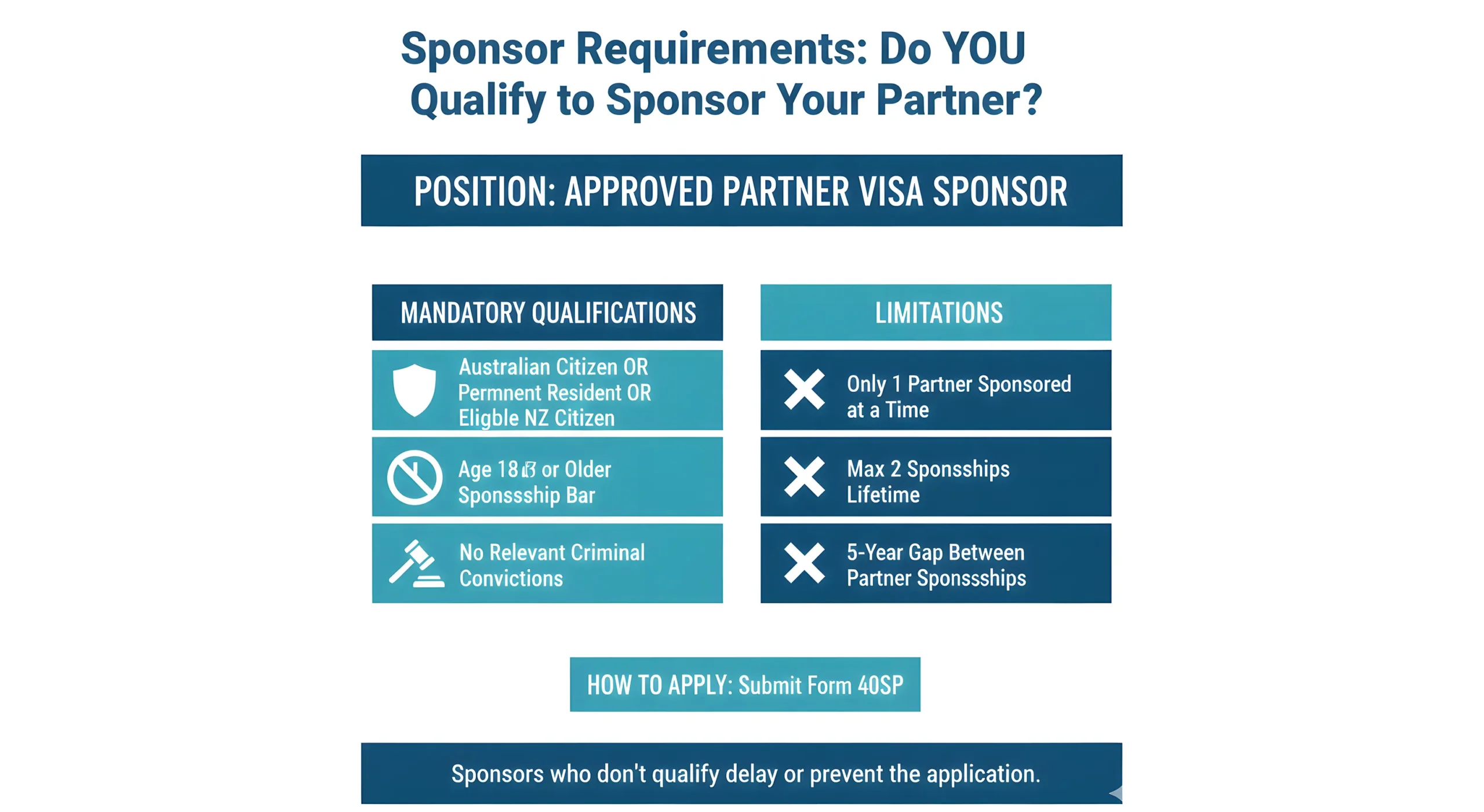
Be Suitable to Sponsor
- Must be an Australian citizen, Australian permanent resident, or eligible New Zealand citizen.
- Sponsorship must be approved by the Department.
- If you are a NZ citizen and do not meet the eligibility criteria, your partner may be eligible for a NZ Citizen Family Relationship visa (subclass 461).
Be the Right Age
- Must be 18 years or older to sponsor.
- If you are under 18 and married to the applicant, your parent or guardian may be able to sponsor you on your behalf.
Character Requirements
- Most sponsors must meet the character requirements to be approved.
- Sponsorship may not be approved if you:
- Have a significant criminal record relating to relevant offences
- Refuse to provide a police clearance
- Do not consent to disclosing convictions to the applicant
- Convictions that have been quashed, nullified, or pardoned are not included.
Measures for the Protection of Children
- Sponsorship may be limited or refused if the sponsor has been convicted of certain offences involving children.
Limitations on Sponsorship
Previously Sponsored or Held a Partner/Prospective Marriage Visa
- Sponsorship may be refused if:
- This is your third time sponsoring a Partner or Prospective Marriage visa
- You have sponsored another partner within the last 5 years
- You were sponsored as a partner within the last 5 years
- Exceptions may apply if:
- Your previous partner died or left the relationship, and you have young children
- You have been with your current partner for more than 2 years
- You or your partner has dependent children
Contributory Parent Visa Holders
- Sponsorship may be refused if:
- Your partner was your spouse or de facto partner before your Contributory Parent visa was granted
- It has been less than 5 years since that visa was granted
Woman at Risk (Subclass 204) Visa Holders
- Sponsorship may be refused if:
- You were granted a subclass 204 visa within the last 5 years, and
- On the date of the grant, you were divorced or permanently separated from the applicant, or the applicant was your partner but was not disclosed at the time
Forced Marriage
- A visa application may be refused if the relationship is found to be a forced marriage.
- Forced marriage is a crime in Australia.
- It occurs when one or both parties marry without freely and fully consenting through trickery, threats, pressure, or incapacity due to age or mental capacity.
Relationship Eligibility Requirements
What “Genuine and Continuing Relationship” Means
Legal Meaning
- Australian immigration law requires that your relationship must be genuine, meaning it is based on a real, mutual commitment between both partners
- The relationship must also be continuing, it must be ongoing and stable at the time of application and throughout the visa assessment process
- This applies to both married and de facto couples
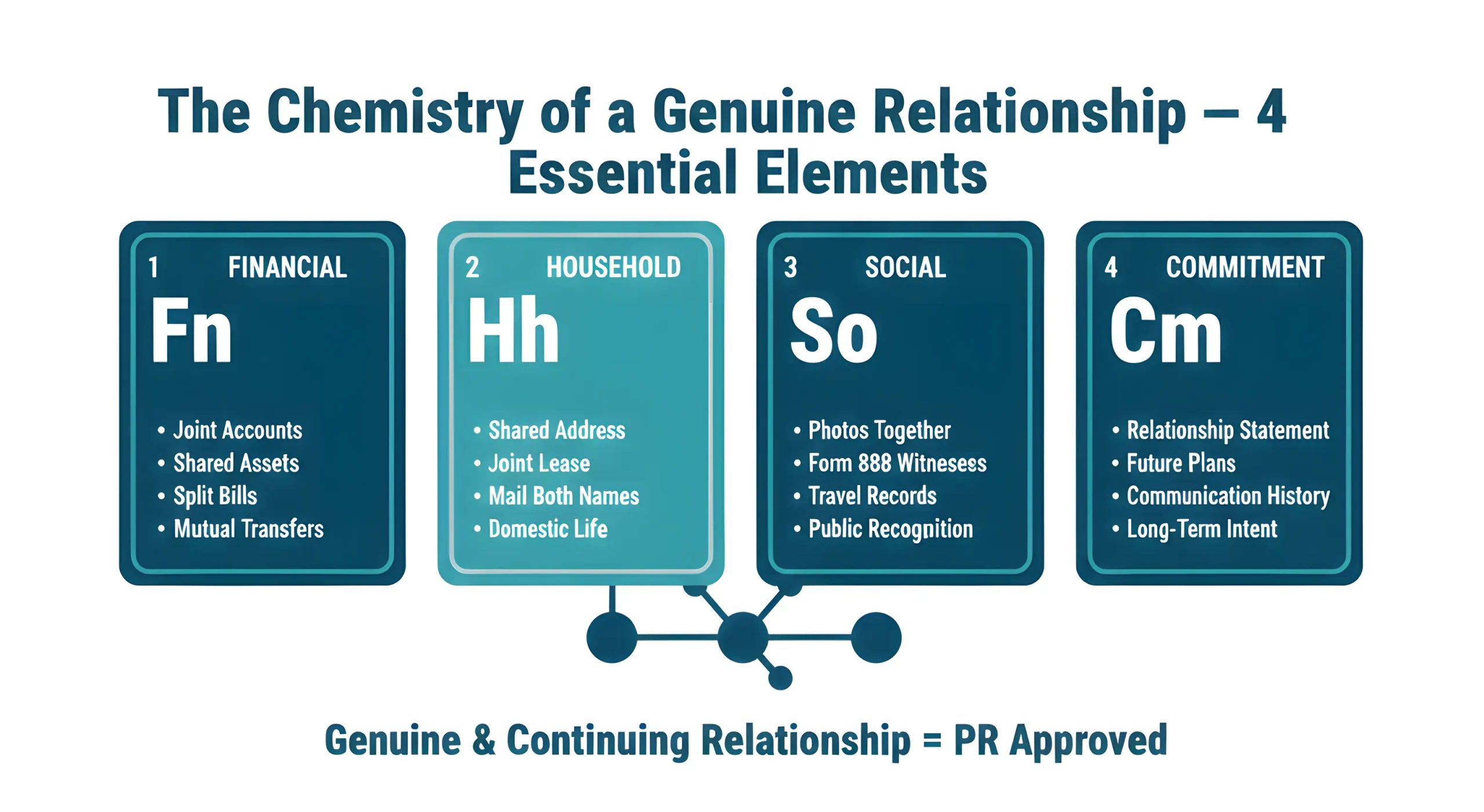
- The Department assesses the relationship across four key pillars:
- Financial aspects: shared finances, joint accounts, combined assets or liabilities
- Nature of the household: living arrangements, shared responsibilities, domestic duties
- Social aspects: recognition of the relationship by family, friends, and the community
- Commitment: long-term plans together, knowledge of each other’s personal lives, and future intentions
How a Case Officer Assesses Your Relationship
- Case officers do not make decisions based on a single document; they review the full picture of your relationship
- They look for consistency and corroboration across all evidence submitted
- Commonly reviewed evidence includes:
- Joint bank statements, leases, or mortgage documents
- Photos together over time showing the progression of the relationship
- Communication records such as messages, emails, or call logs
- Statutory declarations from friends or family who know the couple
- Travel records showing time spent together
- Case officers are trained to identify inconsistencies, gaps in evidence, or submissions that appear manufactured or staged
- They may request an interview with one or both partners to test the authenticity of the relationship
- Answers from both partners are compared, and significant discrepancies can raise serious concerns
The Four Mandatory Relationship Factors
1. Financial Aspect
The Department assesses whether a couple operates as a single financial unit. Strong evidence includes joint bank accounts used for daily expenses, shared assets like property or vehicles, and joint liabilities such as mortgages or loans. You should also provide evidence of shared household expenses, like utility bills or insurance policies naming each other as beneficiaries.
2. Social Aspect
This pillar proves the relationship is publicly recognised and not a secret. Key evidence includes Statutory Declarations (Form 888) from family and friends, joint travel records (tickets/itineraries), and photos of the couple at social events. Public recognition through joint invitations or shared memberships in clubs and community groups also carries weight.
3. Nature of the Household
Evidence must show that the couple shares a domestic life and does not live separately on a permanent basis. This includes joint lease agreements, mail addressed to both partners at the same residence, and a clear explanation of how household chores and responsibilities are divided. Shared responsibility for children or pets is also a strong indicator of a functional family unit.
4. Nature of Commitment
This focuses on the long-term and exclusive nature of the bond. Documentation includes marriage or relationship certificates, proof of regular communication during periods of separation, and knowledge of each other’s personal backgrounds. It also involves showing future plans, such as intentions to buy a home or start a family together.
Married vs De Facto Partner Visa Eligibility
If You Are Married
Beyond where you apply from, your legal relationship status is the next piece of the puzzle. For married applicants, the path is often the most direct. If you have a marriage certificate that is legally recognised in Australia, you meet the basic relationship definition. This is the first step, but you will still need to provide plenty of evidence that your marriage is genuine and ongoing.
If You Are in a De Facto Relationship
What if you’re not married? This is where the term de facto relationship becomes important. To apply as a de facto partner, you generally need to prove that you and your partner have been living together as a couple for at least 12 months immediately before you submit your application.
This “12-month rule” is a strict requirement. However, a powerful exception exists: if you formally register your relationship in an eligible Australian state or territory, the Department of Home Affairs may waive this 12-month living-together requirement.
How Long Must You Be in a Relationship to Be Eligible?
No Fixed Rule (Myth-Busting)
There is no universal minimum relationship length for married couples. Many people believe you must be together for years before applying. This is a myth. The law focuses on whether your relationship is genuine and continuing not how long you have been together.
Case-by-Case Assessment
Every application is assessed individually. A case officer reviews the full picture of your relationship. The quality and depth of your evidence matters more than time spent together. Strong, consistent evidence can support even a relatively new relationship.
Short Relationship Approvals
Short relationships can still be approved. You must demonstrate compelling and compassionate circumstances. Registered relationships also bypass the 12-month de facto requirement. Married couples face no minimum duration at all. The key is proving genuine commitment not length of time.
Partner Visa Eligibility Documents (Overview)
Identity documents
- Passports: Provide high-quality scans of the current bio-data page and include copies of any previous passports.
- Birth Certificates: Submit full birth certificates that clearly display the names of both parents.
- National ID Cards: Include copies of valid national identity cards if your country issues them.
- Proof of Name Change: Supply marriage certificates, divorce decrees, or deed poll documents if your current name differs from your original records.
- Passport Photos: Provide two recent, passport-sized photographs for the applicant and all included dependents.
- Sponsor Proof: Present evidence of the sponsor’s Australian citizenship, permanent residency, or eligible New Zealand citizenship, such as a passport or birth certificate.
Relationship evidence
- Relationship Statement: Write and sign a detailed personal account describing how you first met, how your relationship evolved, and when you began living together or getting married.
- Statutory Declarations (Form 888): Provide at least two Form 888 declarations from witnesses, preferably Australian citizens or permanent residents who can personally attest to the genuine nature of your relationship.
- Marriage Certificate: Submit an official marriage certificate if you are legally married to your partner.
- De Facto Evidence: Present proof that you have lived together for at least 12 months, such as joint lease agreements or household bills in both names, if you are applying as a de facto couple.
- Registered Relationship Certificate: Provide an official certificate from an Australian state or territory registry to legally recognise your relationship and waive the standard 12-month cohabitation requirement.
Common Reasons Partner Visa Applications Are Refused
In 2026, the primary cause for Partner Visa refusals is insufficient evidence across the four pillars, specifically when couples fail to provide verifiable financial or household records beyond simple photos. Applying too early is a critical error for de facto couples who lodge before meeting the 12-month cohabitation requirement without a valid registry or exemption. Additionally, sponsor issues, such as undisclosed criminal records or reaching sponsorship limits, can trigger automatic rejection. Finally, DIY application risks often involve minor document inconsistencies or missed Department deadlines, which case officers may use to refuse an application without requesting further information.
Expert Australian Migration Guidance
Navigating the complexities of your visa journey is easier with professionals. Start your Australian dream today.
Book Consultation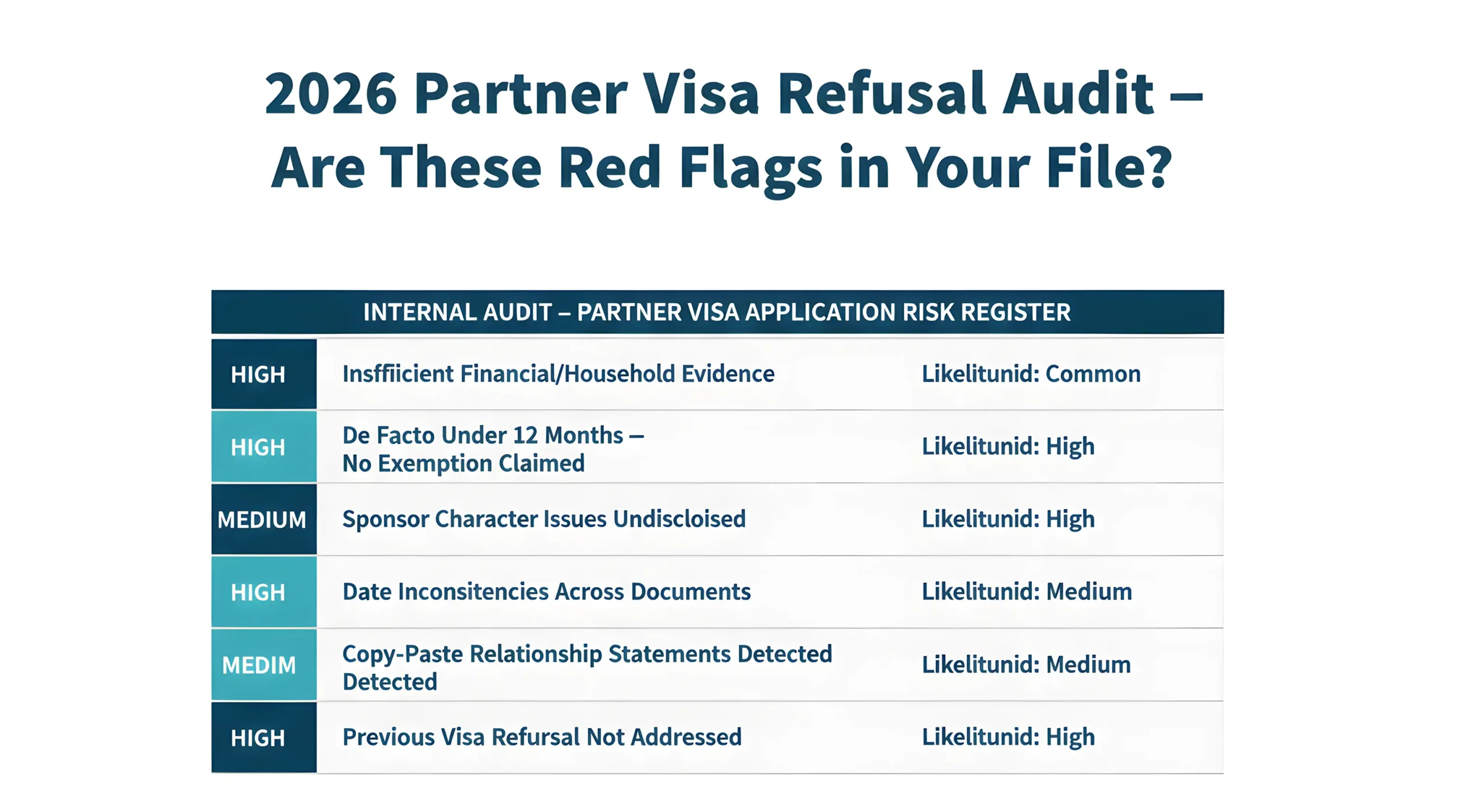
Can You Still Be Eligible If…?
Long-Distance Relationships
Distance does not automatically disqualify you. However, you must prove the relationship is genuine. Provide communication records, travel history, and statutory declarations. Show consistent contact over time. Case officers look for ongoing commitment despite the distance.
Short Relationships
A short relationship is not an automatic refusal. You may qualify if compelling and compassionate circumstances exist. Registered relationships can also bypass the 12-month requirement. Strong evidence of commitment can support your case.
No Joint Bank Account
Joint finances are helpful but not mandatory. You can substitute with other evidence. Shared bills, joint leases, or proof of financial support all count. Cover as many evidence categories as possible to compensate.
Cultural or Religious Differences
Cultural or religious practices may affect how you demonstrate your relationship. Case officers are trained to consider this. Explain any cultural context clearly in your application. Provide supporting statements from community or religious leaders if helpful.
Age Gap
An age gap alone will not cause a refusal. However, it may attract closer scrutiny. Focus on demonstrating genuine mutual commitment. Show shared history, future plans, and social recognition of your relationship.
Visitor Visa Applicants
Applying for a visitor visa is possible but complex. You must hold a substantive visa at the time of application. You must also show compelling reasons if you do not. Ensure your visa has no condition 8503 attached. Check your visa conditions on VEVO before applying.
How The Migration Helps With Partner Visa Eligibility
The Migration stands as a premier Australian-based consultancy, specializing in securing partner visas for onshore applicants through a high-touch, personalized approach. Rather than offering generic checklists, their specialists conduct in-depth eligibility assessments to craft a bespoke evidence strategy that aligns perfectly with current case officer expectations.
By focusing on the “four pillars” of relationship proof and mitigating potential risks early, they significantly enhance the likelihood of a successful grant. If you need partner visa eligibility advice in Sydney, The Migration immigration agent in Harris Park offers in-office and Zoom consultations; alternatively, applicants seeking partner visa eligibility assessment in Melbourne can book a confidential session with our Melbourne MARA consultant.
Conclusion
Understanding Australian Partner Visa eligibility is the foundation of a successful application. By now, you know the critical first decision onshore or offshore and how your relationship type shapes your entire pathway. You understand that a marriage certificate alone is never enough, and that building strong, consistent evidence across all four pillars is what truly convinces the Department of Home Affairs that your relationship is genuine.
Remember, this is a multi-year process. Every shared bill, photo, and future plan you document today becomes essential evidence at your second-stage permanent visa assessment. If your situation involves any complexities a previous visa refusal, a short de facto relationship, or prior sponsorship history professional guidance can make all the difference. Ready to take the next step? Book a consultation with our registered immigration agents today and get expert, personalised advice tailored to your unique situation.
Frequently Asked Questions For Partner Visa Eligibility
Q1: Who is eligible for the Australian Partner Visa?
Australian citizens, permanent residents, and eligible New Zealand citizens can sponsor. Applicants must be in a genuine married or de facto relationship, or be a fiancé applying via the Subclass 300 Prospective Marriage Visa.
Q2: What is the difference between onshore and offshore partner visa?
An onshore application (Subclass 820/801) requires the applicant to be in Australia on a valid visa at the time of applying. An offshore application (Subclass 309/100) is for applicants outside Australia. The key differentiator is physical location — eligibility and evidence requirements are largely the same across both pathways.
Q3: How long do I need to be in a de facto relationship before applying?
Generally, 12 months of cohabitation immediately before the application is lodged. If the relationship is formally registered in an eligible Australian state or territory, this requirement may be waived.
Q4: What evidence do I need for a partner visa?
Evidence across four pillars: financial, household, social, and commitment. Form 888 statutory declarations from Australian friends or family and a detailed relationship statement are also strongly recommended.