

Want permanent residency in Australia with an extra 5 points advantage? The Subclass 190 visa offers state-backed support for your PR dream. This 190 skilled visa is a permanent residence pathway that requires nomination from an Australian state or territory government. Unlike the General Skilled Migration 189 visa that demands complete independence, the Skilled Nominated visa partners you with a state government actively seeking to fill its skilled workforce gaps.
The 190 visa for Australia comes with powerful advantages. You’ll receive 5 crucial bonus points toward your points score, making PR achievable when 189 seems out of reach. This permanent resident visa Australia grants you the same full rights as 189 visa holders, complete Medicare access, family sponsorship capabilities, and citizenship eligibility after four years (one year as a permanent resident).
The key difference?
You must commit to living and working in your nominating state for just two years before gaining complete freedom to relocate anywhere in Australia.
Here’s the reality check: state nomination visa Australia pathways are intensely competitive in 2026. Each state operates its own occupation priority lists, points thresholds, and selection criteria that can change quarterly. New South Wales might prioritise IT professionals at 90+ points, while South Australia welcomes healthcare workers at 70 points for the same occupation. State nomination isn’t automatic; it’s earned through strategic alignment of your skills with specific state workforce needs and selection requirements.
To qualify for the 190 skilled nominated visa, you must first meet the foundational requirements of skilled migration. You need to be under 45 years old, have your occupation on the relevant skilled occupation list (MLTSSL or STSOL), obtain a positive skills assessment, demonstrate at least Competent English proficiency, and score a minimum of 65 points before the state’s 5-point bonus.
In this complete 2026 guide to the Skilled Nominated visa (subclass 190), we’ll decode the entire state nomination landscape. You’ll learn about eligibility requirements, the difference between subclass 189 and subclass190 how each state differs in occupation priorities and selection criteria, the strategic ROI of choosing the right state for your profile, the two-stage nomination and visa application process, realistic processing timelines, true costs, and the occupation lists that unlock different state pathways.
What is the Subclass 190 Visa in Australia?
The General Skilled Migration Visa Subclass 190 is one of the key pathways that allow skilled workers to live and work in Australia permanently. This visa is particularly attractive to those with skills in high demand within specific Australian states or territories, making it a valuable option for many prospective migrants.
Points-Tested System
You need at least 65 points to be eligible to submit an Expression of Interest (EOI) in SkillSelect.
If you have any confusion about the points system, check your points with our subclass 190 visa point calculator.
Key Benefits of the 190 Visa:
- Permanent Residency: From day one
- Pathway to Citizenship: Apply after 4 years in Australia (1 year as PR)
- Medicare Access: Full public healthcare coverage
- Work Freedom: After 2 years, can work/live anywhere in Australia
- Sponsor Family: Bring eligible relatives through family migration
- Study Rights: Access to domestic student fees
- Travel: 5-year travel facility, renewable
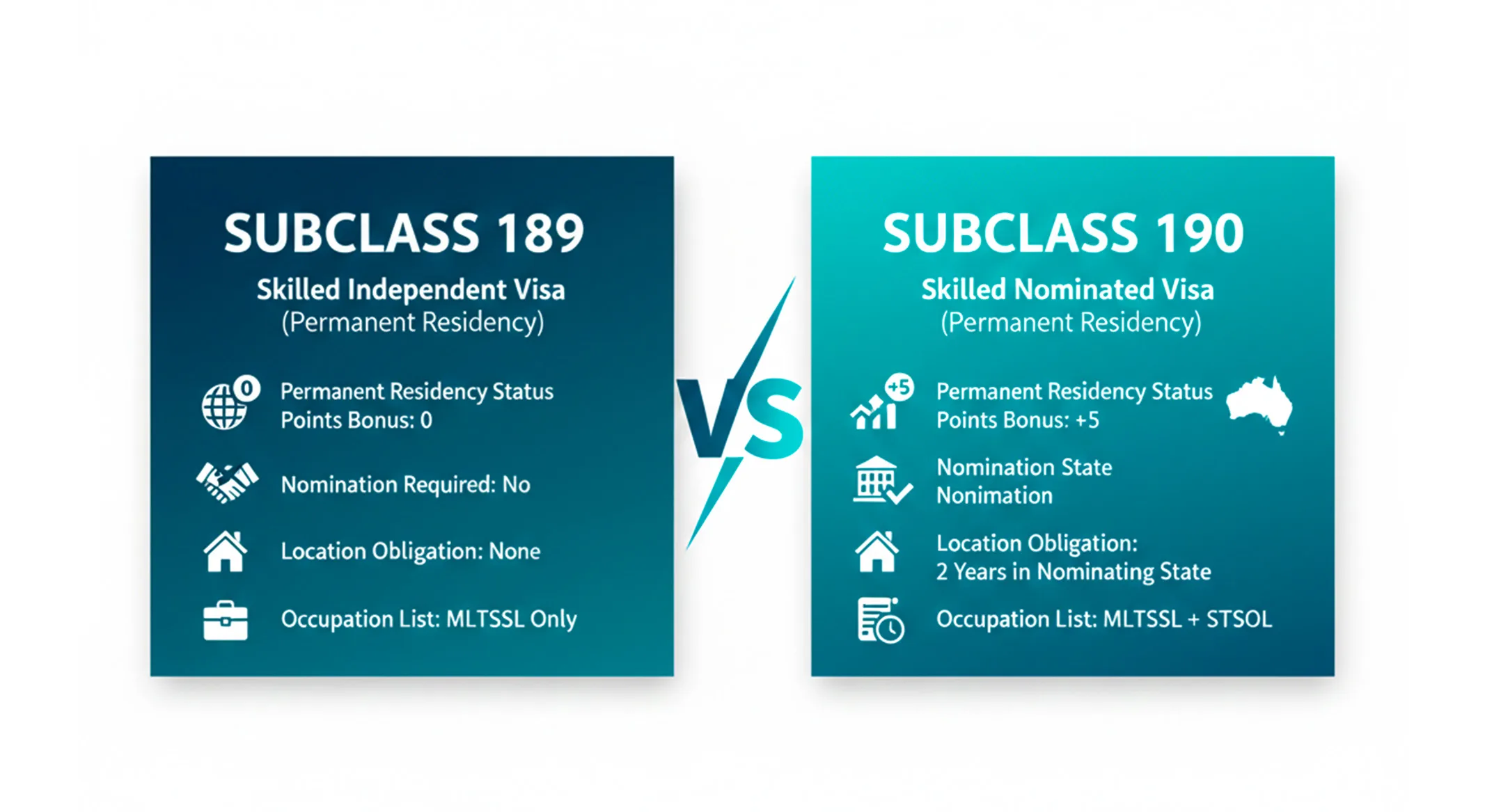
190 vs 189 Quick Comparison Table:
Here’s the comparison table between subclass 189 and 190 Australian visas.
| Feature | 189 visa | 190 visa |
| Type | permanent | permanent |
| Points bonus | 0 | +5 |
| Sponsor Required | No | State nomination |
| Residence Restriction | No | 2 years in state |
| Occupation list | MLTSSL only | MLTSSL + STSOL |
190 Visa Eligibility Requirements 2026
Snippet Answer (Target Featured Snippet): “To apply for the 190 visa, you must be under 45 years old, have a positive skills assessment in an eligible occupation, achieve Competent English, score at least 65 points (including 5 state nomination points), and receive state/territory nomination.”
Be nominated
You must have been nominated for this visa by an Australian state or territory government agency.
Age Requirement
- You must be under 45 to apply for the visa.
- You can still apply for the visa if you turn 45 after you apply.
- If you turn 45 after you submit your EOI but before you apply, you will not be invited to apply
English:
You must have at least competent English.
Skills Assessment:
Your occupation must be on the relevant list of eligible skilled occupations.
Occupation:
Must be on the MLTSSL and STSOL
Health requirement:
You and any family member who applies for the visa with you must meet health requirements.
character requirement:
You and family members aged 16 years and over who apply for the visa with you must meet character requirement.
State Nomination Requirements: Which State Should You Choose?
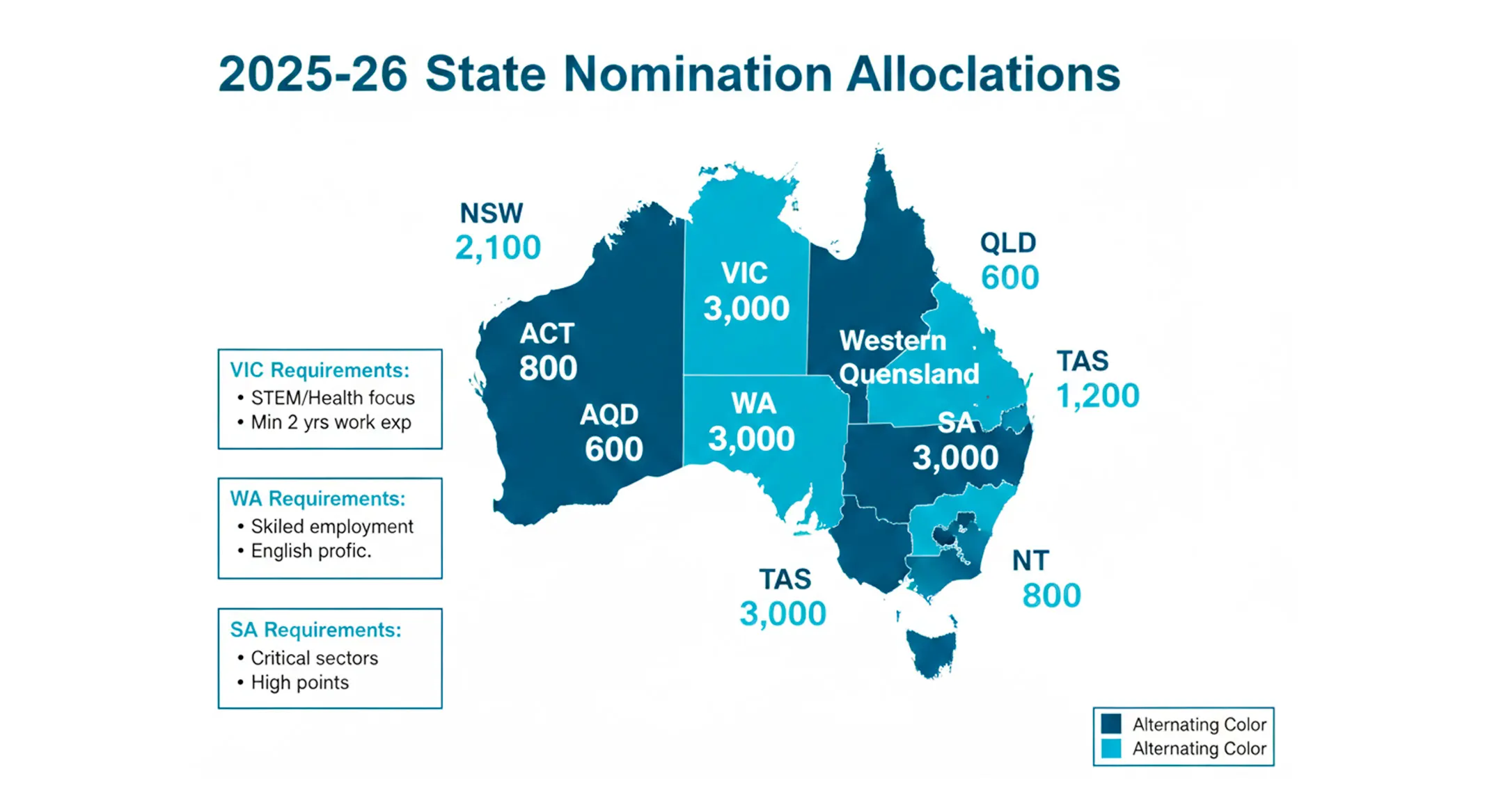
Each Australian state and territory sets unique nomination criteria, occupation priorities, and selection processes. You must choose the right state to maximize your success. Here is what you need to know for the 2025-26 program year.
New South Wales (NSW)
Allocation 2025-26: 2,100 places NSW requires you to be under 45, hold a valid skills assessment, and possess at least competent English. You must currently live in NSW for at least six months or work in your nominated occupation within the state. Interestingly, you do not strictly need a job offer to apply, which gives you flexibility.
Victoria (VIC)
Allocation 2025-26: 2700 places Victoria uses a Registration of Interest (ROI) system to select candidates. You must live in Victoria to qualify. While you do not strictly need a job to apply, holding skilled employment with a Victorian employer significantly boosts your ROI competitiveness and allows you to claim earnings. You must also hold a valid skills assessment and score at least 65 points in SkillSelect.
Australian Capital Territory (ACT)
Allocation 2025-26: 800 places The ACT uses the “Canberra Matrix” to rank applicants. To qualify as a Canberra Resident, you must live in the ACT for at least six months and work there for 26 weeks. Your employment must meet a minimum of 30 hours per week .You also need proficient English unless your occupation falls within specific skill levels.
Queensland (QLD)
Allocation 2025-26: 2,600 places Queensland offers pathways for graduates and skilled workers currently in the state. As a graduate, you must complete your qualification in Queensland and currently live there. If you apply as a skilled worker, you must provide evidence of six months of full-time skilled employment in your nominated occupation within Queensland.
Western Australia (WA)
Allocation 2025-26: 3,400 places WA offers two main streams: General and Graduate. For the General Stream, you typically need a six-month full-time employment contract in WA in your nominated occupation. If you apply through the Graduate Stream, you must complete a Certificate III or higher at a WA institution and study full-time on campus for two years.
Tasmania (TAS)
Allocation 2025-26: 1,200 places Tasmania offers several pathways for current residents. The Skilled Employment pathway requires you to work in the state for 9 to 15 months, depending on your occupation. Alternatively, the Skilled Graduate pathway invites you to apply after you complete two years of study in Tasmania. Long-term residents can also qualify if they live in Tasmania for three years and meet specific work requirements.
South Australia (SA)
Allocation 2025-26: 1,350 places South Australia requires you to hold an occupation on their specific list. You must meet all standard eligibility criteria and demonstrate a firm commitment to living and working in the state.
Northern Territory (NT)
Allocation 2025-26: 850 places The Northern Territory currently accepts onshore applications only. You must live in the NT for at least two consecutive years. Additionally, you must work full-time in your nominated or a related occupation for that entire two-year period to qualify.
Reference department of homes affair
Skilled Occupations for the 190 Visa
The Occupation Rule for Subclass 190:
- MLTSSL (Medium and Long-term Strategic Skills List) – All states accept
- STSOL (Short-term Skilled Occupation List) – Most states accept
Key Difference from 189:
- 189 visa = MLTSSL ONLY
- 190 visa = MLTSSL + STSOL (broader options)
- Each state has its own specific occupation lists within these categories
Top In-Demand Occupations by State (2026):
Healthcare
- Registered Nurses
- General Practitioners
- Surgeons
- Medical Practitioners
- Physiotherapists
Teaching (High Priority):
- Secondary School Teachers
- Early Childhood Teachers
- Special Education Teachers
Technology (VIC, NSW, ACT):
- Software Engineers
- ICT Business Analysts
- Developer Programmers
- Computer Network Engineers
Engineering (WA, QLD, SA):
- Civil Engineers
- Mechanical Engineers
- Electrical Engineers
- Mining Engineers
Trades (TAS, NT, Regional):
- Chefs
- Motor Mechanics
- Electricians
- Plumbers
The 190 Visa Application Process (Step-by-Step)
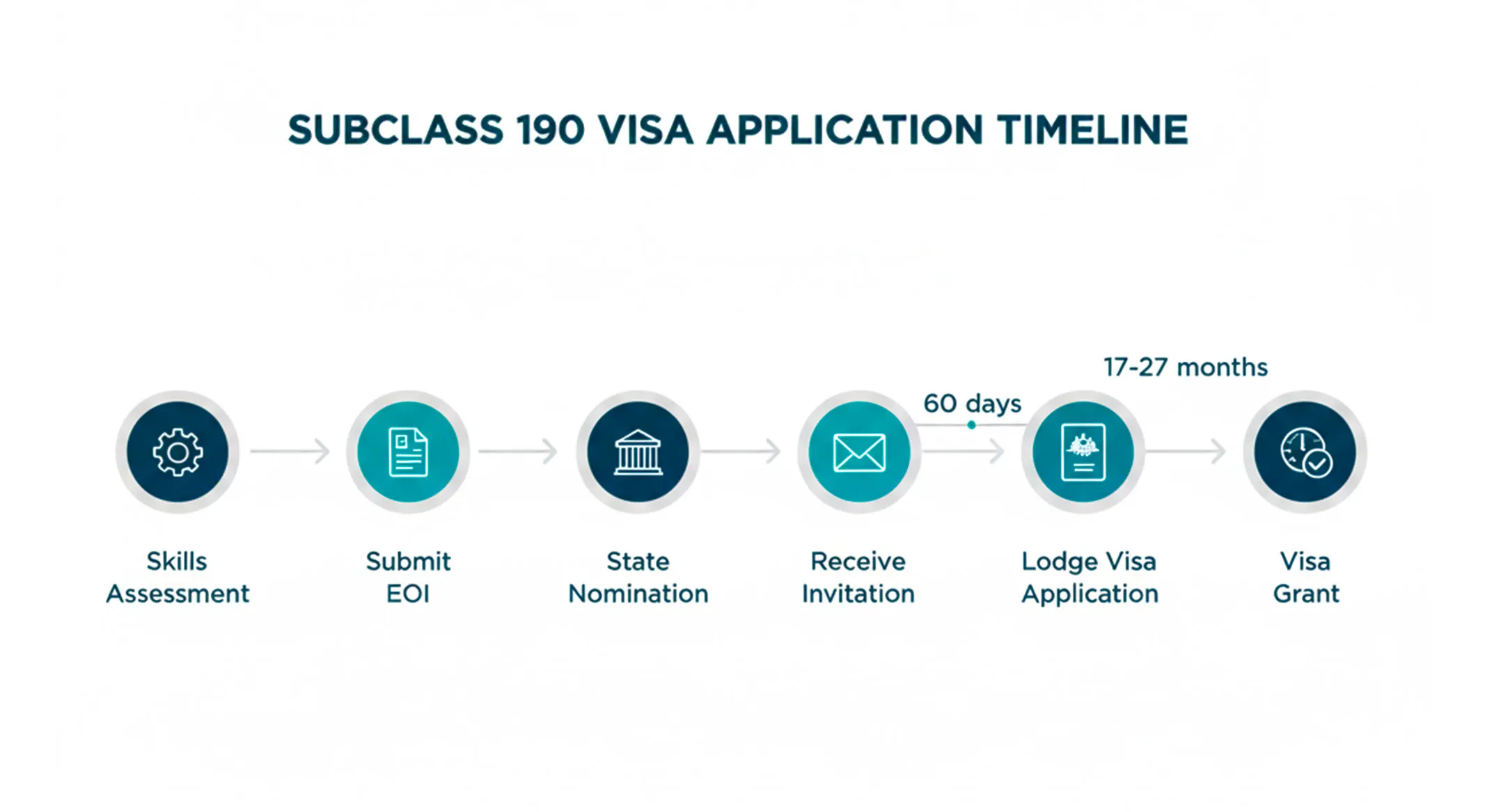
The 190 skilled nominated visa follows a clear pathway from skills assessment to visa grant. Here’s exactly what you need to do to navigate the skilled migration 190 pathway successfully.
Before you apply
You must submit an expression of interest (EOI) through SkillSelect
Before Submitting EOI:
- Check that your occupation is on the eligible skilled occupations list
- Get a skills assessment from the appropriate authority
- Organise health examinations
- Verify you can score minimum 65 points
- Gather all supporting documents
Submit EOI:
- Submit through SkillSelect
- Select Skilled Independent visa (subclass 190)
- Can submit from within or outside Australia
- Receive email confirmation
After EOI Submission:
- SkillSelect estimates your points (minimum 65 required)
- Update EOI if circumstances change
- Maintain lawful visa status if in Australia
- Wait for an invitation based on points and occupation availability
- Monitor for invitation
After receiving the invitation:
- Apply within 60 calendar days (non-extendable)
- Prove all EOI claims with evidence
- Demonstrate that you meet the points score and eligibility criteria
- Maximum two invitations allowed
- Must be under 45 years at the time of invitation
- Use a registered migration agent or legal practitioner if needed
Gather your documents
You will need to provide documents to support the claims you make in your EOI and show that you meet the other eligibility criteria.
Identity Documents:
- Current passport (photo and details pages)
- National identity card
- Proof of name changes (marriage/divorce certificates)
- Documents showing other names you’ve been known by
Relationship Documents:
- Marriage certificate
- Divorce documents
- Death certificates (if widowed)
- Separation documents or statutory declarations
- Explanation if partner/children not included
Character Documents:
- Australian Federal Police certificate (if spent 12+ months in Australia)
- Overseas police certificates (from all countries lived in 12+ months)
- Military service records or discharge papers (if applicable)
- Form 80 – Personal particulars for character assessment
- Form 1221 – Additional personal particulars information
English Language Proof:
- Competent English evidence at the time of invitation
Partner Documents:
- Identity documents and photos
- Character documents
- Marriage certificate (if applicable)
- De facto relationship evidence (12+ months or registered)
- Joint bank account statements
- Joint billing accounts
- Joint leases or mortgages
- Documents showing same address
- Functional English proof (unless exempt)
Dependants Under 18:
- Birth certificates showing both parents’ names
- Family book (if applicable)
- Adoption papers (if applicable)
- Form 1229 – Parental consent form
- Statutory declaration from non-migrating parent
- Identity document of consenting parent (passport/driver’s licence)
- Court orders (if applicable)
Dependants Over 18:
- Identity documents
- Documents about other relationships
- Birth certificate or adoption papers
- Form 47a – Details of dependent family member
- Proof of financial dependency (bank statements, transfers, receipts)
- Medical practitioner’s report (if aged 23+ showing disability)
- Functional English proof (unless exempt)
Skills Assessment & EOI Claims:
- Skills assessment certificate
- English language test results
- Employment evidence (Australian and/or overseas)
- Educational qualification certificates
- Australian study requirement proof
- Specialist education evidence
- Community language accreditation
- Regional Australia study proof
- Partner skills evidence
- Professional Year certificate
Specific Profession Documents:
- Medical practitioners: AHPRA registration certificate
- Barristers/Solicitors: Admission to practice certificate
Additional Forms:
- Form 956A (if appointing authorised recipient)
- Form 956 (if appointing migration agent/legal practitioner)
Document Preparation Requirements:
- Translate all non-English documents
- Use NAATI-accredited translators (in Australia)
- Include translator credentials (outside Australia)
- Scan/photograph in colour
- Ensure clear quality
- Save multi-page documents as single files
- No certification required
Apply for the visa
When you have your invitation, you can apply online. You can be in or outside Australia.
You have 60 days from the date of your invitation to apply for the visa.
Critical Requirement:
- Provide accurate information throughout the application
- Consequences apply if you can’t prove identity or provide false information
Access ImmiAccount:
- Log in to your SkillSelect account
- Click the ‘Apply for visa’ button
- You’ll be redirected to the ImmiAccount system
Log in to ImmiAccount:
- Create a new ImmiAccount OR log into existing account
- Use separate credentials (different from SkillSelect login and password)
Upload Documents:
- Attach all required documents to your application
Pay Application Charge:
- Pay the visa application charge
- Application will NOT be processed until payment is completed
Record Reference Number:
- Note your Transaction Reference Number (TRN)
- Keep this number for tracking your application
Visa outcome
If your visa is granted, you will know about
- Your visa grant number
- the date your visa starts
- Your visa conditions, if applicable
Read Article : General Skilled Migration Australia 2025-26: The Roadmap to Your Australian Dream
Subclass 190 Points Calculator: What Score Do You Need?
To be eligible for the 190 Skilled Nominated visa, you must score at least 65 points on the Australian immigration points test. The points calculator helps you determine your score based on factors such as age, English proficiency, skilled employment, educational qualifications, Australian study, and other criteria. You must be able to prove all the points claims you make in your Expression of Interest (EOI) when you submit your visa application, as SkillSelect will only invite candidates who meet the minimum 65-point threshold and whose skills are needed by state or territory governments.
The 65-Point Rule vs Reality:
Official Minimum: 65 points (including 5 state nomination points)
Expert Australian Migration Guidance
Navigating the complexities of your visa journey is easier with professionals. Start your Australian dream today.
Book Consultation- This means 60 points before state nomination
- State adds 5 points automatically
How to Boost Your Points Score:
Quick Wins (+5-10 points):
- Improve English from Competent to Proficient (+10)
- Complete Professional Year in Australia (+5)
- Gain NAATI accreditation (+5)
- Partner skills points (+5-10)
Medium-Term Strategies (+10-20 points):
- Gain additional work experience (every 3 years = +5)
- Complete higher education (Bachelor to Master = +5)
- Improve English to Superior (+20 total)
Long-Term Investment (+15-30 points):
- Study in Australia (+5 to +20 with STEM PhD)
- Work in Australia on eligible visa (+5 to +20)
- Complete Doctorate (+20)
Check how to use point calculator for your exact score.
190 Visa Processing Time and Costs 2026
Processing time:
The 190 skilled nominated visa processing time can vary from case to case. It depends on many factors like your occupation, which state nominates you, and how complete your application is.
| Visa Subclass | 50% | 90% |
| 190 Visa (State Nominated) | 17 month | 27 month |
Reference : Global Visa Processing Time Home Affairs
Cost Of Subclass 190 Visa:
| Visa subclass | Base application charges |
Additional Applicant 18+ |
Additional Applicant (Under 18) | Non-Internet Application Charge | Subsequent Temporary Application Charge |
| Skilled Nominated visa (subclass 190) | AUD4,910.00 | AUD2,455.00 | AUD1,230.00 | N/A | N/A |
Reference : Home Affairs Fee and Charges Of Visa
ROI Analysis: Is the 190 Skilled Nominated Visa Worth the Investment?
For skilled professionals pursuing permanent residency in Australia, the Subclass 190 Skilled Nominated Visa represents an excellent investment opportunity, assuming they satisfy the stringent points criteria and state nomination prerequisites. At a primary applicant cost of AUD 4,910 (excluding possible migration agent charges), this visa grants instant permanent residency status, offering unlimited employment and educational opportunities alongside eligibility for Australian citizenship in the future.
ROI Analysis: Costs vs. Benefits
ROI calculations fail when applicants only count the Visa Application Charge. A practical all-in cost model includes:
- Pre-lodgement costs: skills assessment, English test(s), translations/notarisation, state nomination fee(s) (where applicable).
- Lodgement + compliance costs: government charges, biometrics (if requested), medical exams, police checks.
- Execution costs: agent/legal support (optional), flights, initial accommodation, rental bond, car/transport, short-term income gap.
- Opportunity costs: time spent preparing documents, sitting exams, and waiting (especially if it delays other career moves).
Returns & Benefits:
-
- Permanent Residency: Immediate PR status.
- +5 Points: State nomination adds 5 points to the EOI score.
- Flexibility: No requirement to live in a regional area for the full duration, unlike subclass 491 regional visa
- Medicare: Full access to Australia’s public healthcare system.
- Family Inclusion: Ability to include spouse and children.
State and Territory ROI Requirements
ACT (Australian Capital Territory)
- ROI Required (ACT Matrix)
NSW (New South Wales)
- No ROI Required
- Direct application to Investment NSW required for Pathway 1 (Living and Working in Regional NSW)
- Direct application required for Pathway 3 (Regional NSW Graduate)
NT (Northern Territory)
- ROI Required
QLD (Queensland)
- ROI Required
- Small Business Owner Assessment Form required for 491 nomination under SBO Pathway
SA (South Australia)
- ROI Required
TAS (Tasmania)
- ROI Required
VIC (Victoria)
- ROI Required
WA (Western Australia)
- No ROI Required
When ROI is questionable
- Your plan relies on optimistic assumptions (salary, speed, nomination certainty) with little downside buffer.
- You face significant re-credentialing delays (regulated professions) that postpone earnings.
- You may not remain in the nominating state long enough to achieve your intended career outcome.
Conclusion
The 190 skilled nominated Visa is your smartest route to Australian permanent residency in 2026. It offers a reliable lifeline when the 189 visa feels out of reach. You gain immediate permanent status and a crucial 5-point nomination bonus. You also access a wider range of eligible jobs across both occupation lists.
Look past the initial visa fees and testing costs. Focus on the return. You secure full work rights, free healthcare, and a direct path to citizenship. The subclass 190 visa does not just buy you entry; it secures your future. Ready to start your journey? Don’t let complex state rules delay your dream. Get expert advice tailored to your profile. Book your consultation with our MARA expert agents.
Frequently Asked Questions (FAQs)
What is the difference between 189 and 190 visa?
The main differences are:
- 189 = No state nomination needed, live anywhere immediately
- 190 = Requires state nomination, must live in nominating state for 2 years
- 189 = 0 bonus points | 190 = +5 bonus points
- 189 = MLTSSL only | 190 = MLTSSL + STSOL (more occupations)
- Both lead to permanent residency
How to calculate 190 visa points?
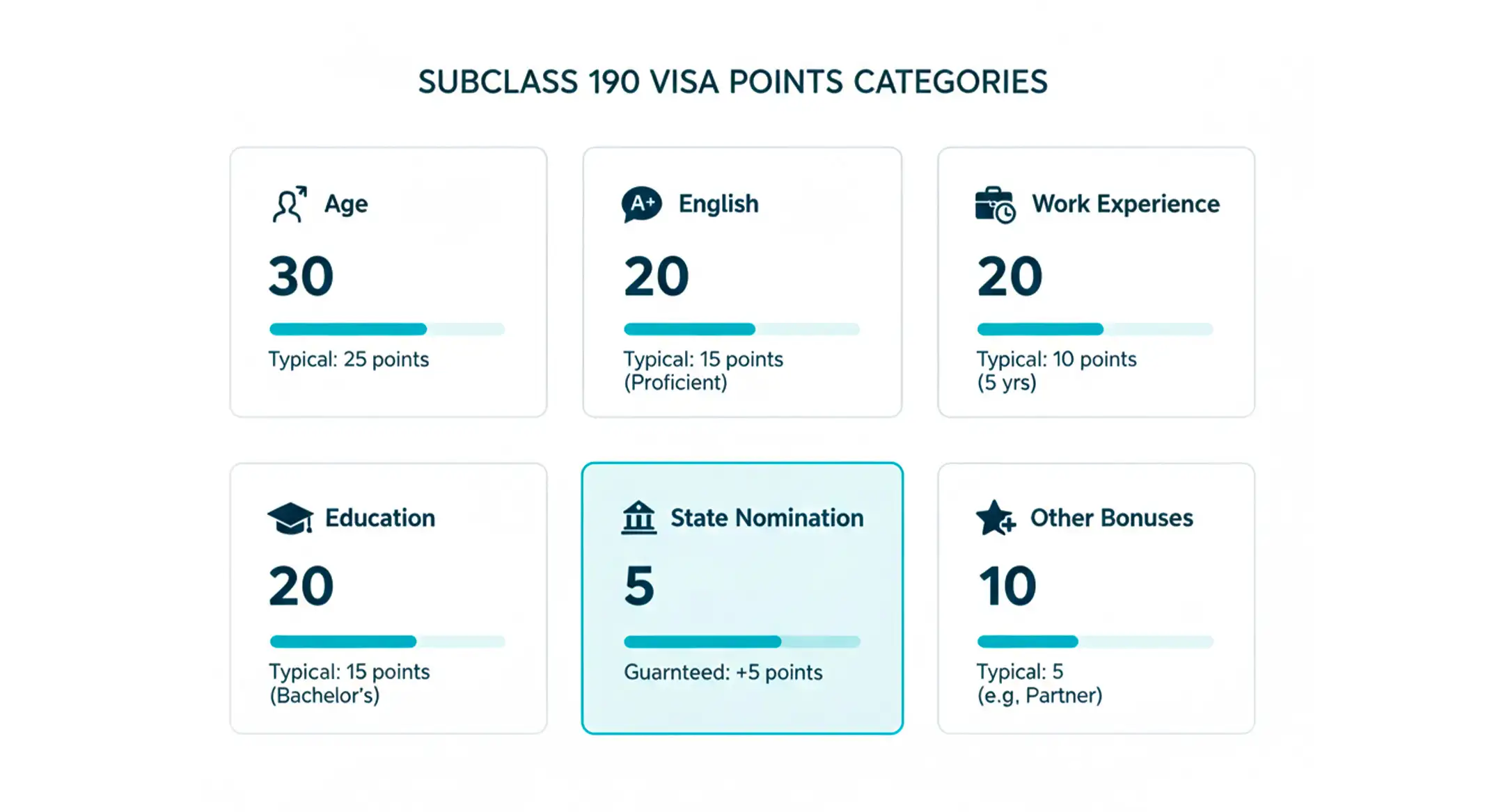
To calculate 190 visa points, add points from these categories: Age (up to 30 points), English (up to 20 points), Work Experience (up to 20 points), Education (up to 20 points), and State Nomination (automatic 5 points). You need a minimum 65 points total, including the 5-point state nomination bonus.
How long does Subclass 190 visa take?
The Subclass 190 visa takes 17-27 months total from EOI submission to visa grant. Total timeline varies by state, occupation, and application complexity.
Who is eligible for subclass 190 in Australia?
To be eligible for Subclass 190 visa in Australia, you must:
(1) be under 45 years old
(2) have a valid skills assessment in an eligible occupation
(3) achieve minimum 65 points including 5-point state nomination
(4) have Competent English
(5) receive state/territory nomination
(6) meet health and character requirements.
Can I move to a different state after getting the 190 visa?
Yes, you can move to a different state after getting the 190 visa, BUT you must live and work in your nominating state for at least 2 years first. After completing the 2-year commitment, you are free to live and work anywhere in Australia without restrictions.
Can my family members work on this visa?
Yes! All family members included on the visa receive:
- Full work rights from day one
- Unlimited hours of employment
- Can work for any employer
- Same rights as main applicant (except nomination obligations apply to main applicant)
What are the stages of a 190 skilled nominated visa application?
The Skilled Nominated Subclass 190 visa application has 7 main stages:
(1) Skills Assessment,
(2) Expression of Interest (EOI),
(3) State Nomination Application,
(4) Invitation to Apply,
(5) Visa Application Lodgement,
(6) Processing and Verification,
(7) Visa Grant. The total process takes 17-27 months.