

The 491 to 191 visa pathway is the permanent residence route built into your visa from the start. No new points test. No new skills assessment. No sponsor, and no age limit.
The list is short. Three years from your grant date, three income years evidenced by ATO notices of assessment, and compliance with your visa conditions.
One of those three is widely misreported. You’ll find pages quoting $53,900 a year, or $70,000, or some other figure. Home Affairs says something different, and it says it plainly.
Most readers here are at year three of a commitment they can’t undo. The real question isn’t how the pathway works. It’s whether something already went wrong.
Below: the 2026 rules, what changed on 1 July, what didn’t change at all, and where these applications come unstuck. If you’d rather have your own three years checked first, you can book a consultation.
What is the 491 to 191 visa pathway?
It’s the transition from a provisional regional visa to permanent residence through the Subclass 191 Permanent Residence (Skilled Regional) visa. Home Affairs sets three requirements, and that’s the whole list.
To apply for the 191, you must:
- Hold an eligible visa, a subclass 491 or a subclass 494, and have held it for at least three years before you apply.
- Provide notices of assessment issued by the Australian Taxation Office for three income years out of the five years of that eligible visa.
- Have complied with the conditions of the eligible visa for the whole period you held it.
Why are you seeing two different income answers?
Because Home Affairs publishes two pages, and they don’t read the same way. The page that governs 491 and 494 holders, the Regional Provisional stream page, states it directly:
“There is no minimum income requirement. You must provide notices of assessment issued by the Australian Taxation Office (ATO) for three income years out of the five years of your eligible visa.”
The older parent landing page still refers to having “a taxable income at or above a specific income threshold”. That sentence is where the confusion starts, and competitor pages have been copying a figure out of it for years.
If your accountant told you one thing and a migration forum told you another, neither of you was being careless. The source material contradicts itself.
What this means in practice
- The $53,900 figure is not a current threshold. It comes from an earlier version of the framework and is still being republished by pages that haven’t been updated.
- $70,000 and $79,423 aren’t the 191 test either. The $79,423 figure is the Core Skills Income Threshold, and it belongs to employer-sponsored nominations; more on that below.
- The real test is evidentiary, not financial. Home Affairs wants to see ATO notices of assessment, which means your tax returns need to have been lodged and assessed.
- ATO debt matters. If you owe the ATO money, it must be repaid or covered by an approved payment plan, and you should provide evidence of that.
So the question isn’t “did I earn enough”. It’s “do I have three assessed income years I can put in front of the Department”. Which raises the obvious follow-up.
Which three income years can you use?
You choose three from the five years of your eligible visa. That single sentence resolves a lot of quiet panic, because it means a weak year doesn’t automatically become your problem.
A 491 visa runs for five years, and the 191 visa asks for three income years out of that window. If one year was thin parental leave, an illness, a business downturn, or months of reduced shifts, you’re not required to submit that year as one of your three, provided you have three other assessed years inside the window.
Where it gets more involved is when the thin year can’t be avoided, or when records are incomplete. Those situations are assessed on their facts rather than refused on sight.

The situations people ask about most
- A late-lodged return. A year lodged late still produces a notice of assessment. The lodgement date and the assessment are separate things.
- A missing year. If no return was lodged for a year you need, that’s usually something to put in order before you lodge the 191, not after.
- Sole trader and ABN income. Contracting, farm work, transport, and care income all appear in a notice of assessment. How it’s presented matters more than what it’s called.
- Mixed income. Combined employment and business income across a year is normal in regional labour markets and is assessed as a whole.
Income is one clock. The date you’re allowed to lodge is a different one, and it’s the one people get wrong most often.
When exactly can you lodge your 191?
Three years from the grant date of your 491 visa, not from the day you first arrived, and not from the start of a financial year. Home Affairs is specific: you must have held the eligible visa for at least three years before you apply.
This is the question that comes up in almost every consultation about the subclass 191, usually phrased as “is it from the grant or from when I landed?” The gap between those two dates can be months.
A worked example
- 491 granted: 14 March 2023.
- First entered Australia: 2 November 2023, eight months later.
- Earliest 191 lodgement: 14 March 2026, three years from the grant date.
- The date that doesn’t count: 2 November 2026, which is what you’d get if you counted from arrival.
Which 491 visa conditions do you actually have to comply with?
Three conditions do the work, and they’re frequently mislabelled, including on pages that otherwise look authoritative. Here’s what each one actually requires.
The three conditions, correctly numbered
- Condition 8579: you must live, work and study only in a part of Australia that was a designated regional area at the time your visa was granted. This is the regional condition, and it’s the one people mean when they say “the regional rule”.
- Condition 8578: you must tell the Department about changes to your address, employer, position location, or education provider within 14 days.
- Condition 8580: you must provide evidence of your address, employer and study location within 28 days of a written request.
Read 8579 again and notice the timing built into it: the area has to have been designated at the time your visa was granted. If the postcode lists changed after your grant, that wording is what governs your situation. It’s also why “is my postcode still regional” is the wrong question; the right one is what the list said on your grant date.
A designated regional area covers everywhere in Australia except Sydney, Melbourne and Brisbane. Perth, Adelaide, Canberra, the Gold Coast, Newcastle, Wollongong, Geelong and Hobart all sit inside it.
The situations people are most reluctant to raise
Real life over three to five years is messier than a condition written in a regulation. These come up constantly:
- A contract in a metro area taken during a quiet season, while the family home stayed regional.
- Remote work performed from a regional address for an employer headquartered in a capital city.
- A partner working elsewhere for a period, or a child’s schooling in another location.
- An extended hospital stay, a caring period, or an interstate placement tied to training.
- A gap between jobs where no regional employment existed in your field.
None of these is automatically fatal. Condition 8579 isn’t intended to stop you leaving the region for holidays, work travel or training, and compliance is assessed on the specific facts rather than by a single test. What causes damage is discovering the issue for the first time in a decision record.
If something in that list sounds like your three years, a review before lodgement is the point at which it can still be addressed properly. Our MARA-registered agents (MARN 2518738) handle these conversations confidentially, and raising a grey area early is consistently the better position to be in. You can arrange a pre-lodgement file review and have your compliance history looked at in full.
Can you apply for another permanent visa while you hold a 491?
Not until you’ve held the 491 for three years. Home Affairs states it on the 491 application page: “You cannot apply for other permanent visas until you have held your subclass 491 visa for 3 years.”
Expert Australian Migration Guidance
Navigating the complexities of your visa journey is easier with professionals. Start your Australian dream today.
Book ConsultationThis matters because a lot of published advice says the opposite. You’ll see pages telling 491 holders they can lodge an employer nomination 186 at any time, or move to a 190 whenever they like. During your first three years, that isn’t right.
- Before three years: other permanent visa applications are closed to you. The 191 is the pathway your visa was designed around.
- After three years: other options open up, and a 190 becomes genuinely available. We compare them in our guide to the difference between the 190 and 191.
- Temporary visas sit outside that restriction, though they carry their own consequences for your regional compliance.
For most people at year three, the 191 remains both the cheapest and the most direct option. The cost comparison makes that obvious.
What does the 491 to 191 pathway cost in 2026?
The 191 costs a small fraction of the visa that got you here. Visa application charges were indexed on 1 July 2026, so any figure you saw last year is now out of date.
| Charge | Subclass 491 (provisional) | Subclass 191 (permanent) |
| Main applicant, base charge | From AUD 6,140 | From AUD 630 |
| Current as at | 21 September 2026 | 21 September 2026 |
Additional applicants are charged separately, and the amounts differ for adults and children. Because these charges index annually, check your exact total with the Home Affairs visa pricing estimator before you lodge rather than relying on any published table, including this one.
One 2026 addition worth knowing: eligible Pacific Island and Timor-Leste passport holders have qualified for a reduced visa application charge since 1 July 2026.
What happens if your 491 expires before the 191 is decided?
Lodging a valid subclass 191 application while you’re onshore and hold a substantive visa generally results in a bridging visa that keeps you lawful after your 491 ends. This is the question almost nobody publishes an answer to, and it’s the one that wakes people up at year four.
The maths behind the worry is real. A 491 runs for five years, and a 191 decision doesn’t arrive overnight.
What to expect while you wait
- Your status. A bridging visa A generally comes into effect when your 491 ceases, provided you lodged the 191 while holding the substantive visa onshore.
- Work rights. While your 491 is still valid, you continue under it. Once a bridging visa takes effect, your work rights follow that bridging visa’s conditions.
- Travel. A bridging visa A doesn’t include travel rights on its own. Leaving Australia without arranging the right permission first is how people get stranded mid-process.
- The regional condition. Don’t assume lodging releases you from 8579. Whether it still binds you depends on which visa you hold at that moment, so confirm before you move house.
That last point is the one to be careful with. Signing a city lease the week after lodging, on the assumption the regional rule is finished, is an avoidable and expensive mistake. For current timeframes, see our regularly updated Australian skilled visa processing times guide, and check the Home Affairs processing time tool for the figures applying to recently decided applications.

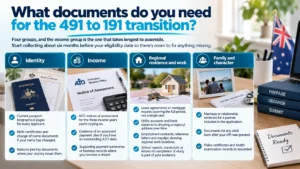
What documents do you need for the 491 to 191 transition?
Four groups, and the income group is the one that takes longest to assemble. Start collecting about six months before your eligibility date so there’s room to fix anything missing.
Identity
- Current passport biographical pages for every applicant.
- Birth certificates and change of name documents if your name has changed.
- National identity documents where your country issues them.
Income
- ATO notices of assessment for the three income years you’re relying on.
- Evidence of an approved payment plan if you have an outstanding ATO debt.
- Supporting payment summaries or business records where your income is mixed.
Regional residence and work
- Lease agreements or mortgage records covering the full period, not a single year.
- Utility accounts and bank statements showing a regional address over time.
- Employment contracts, reference letters and payslips showing regional work locations.
- School reports, transcripts or letters of completion if study is part of your evidence.
Family and character
- Marriage or relationship evidence for a partner included in the application.
- Documents for any child born after your 491 was granted.
- Police certificates and health examination records as requested.
What changed in 2026, and what didn’t?
The core of the 191 didn’t change at all in 2026: the three-year rule, the notices of assessment test, and the conditions all stand as they were. What moved were the numbers around the edges, plus one state nomination change that gets misread.
Changed
- Visa application charges were indexed on 1 July 2026, which is why older cost tables understate what you’ll pay.
- The Core Skills Income Threshold rose from AUD 76,515 to AUD 79,423 on 1 July 2026, and the Specialist Skills threshold from AUD 141,210 to AUD 146,576. These apply to subclass 482 and 186 nominations, not to the 191. They’re a common source of the income confusion.
- A reduced visa application charge became available to eligible Pacific Island and Timor-Leste passport holders.
- NSW closed 491 Pathways 1 and 3 for the program year once nomination places were allocated. That affects people trying to get a 491. It does not affect your ability to move from a 491 you already hold to the 191.
Didn’t change
- You still need three years holding the eligible visa, counted from the grant date.
- There’s still no minimum income requirement for the 191.
- You still provide notices of assessment for three income years out of five.
- Conditions 8579, 8578 and 8580 still apply exactly as they did.
Where 491 to 191 applications actually come unstuck
Refusals in this cohort cluster around four things, and three of them are fixable before you lodge. That’s the reason a review at year three is worth more than one at year four.
A date miscounted
- Counting three years from arrival, first entry, or a financial year instead of the grant date.
- Lodging a day or two early, which can be refused on timing regardless of how strong the rest of the file is.
Income years that can’t be evidenced
- A year with no lodged return, so no notice of assessment exists to submit.
- An ATO debt with no payment arrangement in place.
- Assuming a dollar figure applies and abandoning the application over a number that was never the test.
Thin regional evidence
- A single lease offered as proof of three to five years of regional living.
- Gaps in the address history that nobody explained, so the Department is left to interpret them.
- Work performed for a metro employer without the regional work location documented.
Changes nobody mentioned
- A separation, a new partner, or a baby born during the provisional years.
- A charge, a court matter, or a diagnosis that arose after the 491 was granted.
- A change of employer or address that condition 8578 required to be notified within 14 days.
Every item in that last group is assessed rather than automatically fatal. Bringing it forward early is what keeps it manageable.
Conclusion
The 491 to 191 visa pathway is narrower and more forgiving than the internet suggests. Three years holding your visa from the grant date, three income years evidenced by ATO notices of assessment, and compliance with conditions 8579, 8578 and 8580. There’s no minimum income requirement, no new points test, and no skills assessment waiting at the end.
What the pathway does demand is accuracy about dates and completeness about evidence. Most of the refusals in this cohort trace back to a miscounted date or an income year that couldn’t be documented, both of which are visible well before lodgement.
If you’d like your eligibility date confirmed and your three years reviewed before you lodge, book a consultation with our MARA-registered agents (MARN 2518738). You can also check your standing for other skilled options with our points calculator, or read our guide to the difference between the 491 and 190 if you’re weighing what comes after your three years.