
Your job has ended. Your visa was tied to it. That is a frightening position to be in, and it is also a survivable one.
The rule that decides what happens next is condition 8607. It gives you up to 180 consecutive days to find a new sponsor, move to another visa, or leave Australia. That is three times what you would have had before July 2024, and it is more room than most people realise they have. You can read the condition itself in Schedule 8 of the Migration Regulations.
There is one catch, and most guides bury it. So here it is first, and then the plan, day by day.
| Read this before you count anything
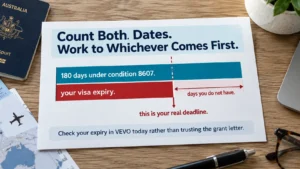
The 180 days only run while your visa is still valid. Condition 8607 attaches to the visa, so it cannot outlast it. If your 482 visa expires in 90 days, you have 90 days, not 180. Count both dates and work to whichever falls first. Check your expiry in VEVO today rather than trusting your memory of the grant letter. |
What Changed on 1 July 2024
That is the date the Migration Amendment (Work Related Visa Conditions) Regulations 2024 commenced. It rewrote conditions 8107, 8607 and 8608, and it did three things for you. The period went from 60 days to 180. A cumulative ceiling of 365 days now applies across the life of the visa. And interim work became legal, whereas before you could not work at all until a new nomination was approved.
It covers visas granted from that date and visas people already held. Days you spent between sponsors before 1 July 2024 do not count toward the 365.
Day 0, The Day Your Employment Ends
Your 482 visa does not cancel itself. It stays valid, and the clock under condition 8607 starts on the day you stop working for your sponsor.
Write that date down. Every deadline in this article counts from it, and every agent and employer you speak to will ask you for it.
Your sponsor has to tell the Department that your employment ended within 28 days, under their sponsorship obligations. That duty sits with them rather than with you, though it is worth confirming they did it, because a nomination left open on the system creates confusion later.
Day 1 to Day 7: The Five Things to Do This Week
One, gather your separation paperwork. You need a termination or resignation letter showing the end date, your final payslip, and your employment reference. A new sponsor will ask for all three, and so will the Department.
Two, check your visa conditions in VEVO. Confirm your expiry date and your recorded conditions rather than working from memory. Our guide to the VEVO system explains how to read what it returns.
Three, work out your real deadline. Count 180 days from your last day of employment, then compare that date with your visa expiry. Put the earlier of the two in your calendar and treat it as immovable.
Four, start earning if you need to. During the period after your employment ends, you may work for other employers, including in occupations that are not on your most recently approved nomination. That means you can take interim work to pay rent while you look for a sponsor. Read the next paragraph before you do.
Five, tell your family. Your timeline affects any partner and children who hold visas as your dependants, because their work and study rights follow your status.
| Interim work keeps you solvent, and it costs you permanent residency time
Since 29 November 2025, under the Migration Amendment (Skilled Visa Reform Technical Measures) Regulations 2025, only employment performed for an approved work sponsor counts toward the two years the 186 Temporary Residence Transition stream requires. Casual or unrelated work during your gap keeps the rent paid and it does not move you closer to permanent residency. Take the work if you need it, and understand that every month in the gap is a month your PR clock stands still. |
Day 8 to Day 30: Finding a Sponsor Who Can Nominate You
This stretch decides the outcome, and the mistake people make is applying for jobs instead of approaching employers who can sponsor. An employer can nominate you only if they already hold approved sponsorship or can obtain it. Three questions tell a real prospect from a dead end.
Does the business already sponsor workers?
An employer with approved sponsorship can lodge a nomination quickly. An employer who has never sponsored must become an approved sponsor first, which adds weeks to your timeline and costs them a separate application charge.
Is your occupation on the list that applies to them?
The Core Skills stream draws on the Core Skills Occupation List. If your occupation sits outside it, the Specialist Skills stream may reach you on salary, or the labour agreement stream may still cover the role, because an agreement can name work that no national list carries.
Can they meet the salary and market rate rules?
The new role has to satisfy the income threshold for its stream and pay the market rate for the position. An employer who cannot do both cannot nominate you, however willing.
Our guide to how employers sponsor overseas workers is worth forwarding to any employer who is willing but unsure where to start.

Ask us whether an employer can nominate you →
Day 31 to Day 90: The Nomination
Once an employer agrees, what follows is a fresh nomination rather than a transfer of the old one. People search for a 482 visa transfer to a new employer, and the word transfer misleads them. Nothing moves across. Your new employer lodges a new nomination against the same visa you already hold.
What it costs the employer
The employer pays a nomination charge of AUD 330, plus the Skilling Australians Fund levy, which they pay per year of the nomination and which scales with the size of the business. Small businesses under AUD 10 million turnover pay AUD 1,200 a year, and larger businesses pay AUD 1,800. Anyone searching for the cost of a 482 transfer is usually surprised that you pay nothing here, because your employer cannot lawfully pass sponsorship costs on to you.
What you need ready
Keep your passport, your grant letter, your employment history and your evidence for the new occupation in one folder before the employer asks.
When you can start work
You may work for the new employer while the Department decides the nomination. Confirm the position against your own circumstances first, because the permission has limits and the consequences of misreading it fall on you rather than on the employer.
Day 91 to Day 150: The Decision Point
If no sponsor has emerged by the halfway mark, widen the search rather than pressing harder in the same direction. A second pathway usually needs lead time that you will not have at day 170.
Consider another visa. A partner visa, a student visa, a skilled independent or state nominated pathway, or a 186 nomination if you already hold the work history for it. Each of these takes weeks of preparation before you can lodge.
Look at a different employer-sponsored option. Regional employers under the subclass 494, or an employer covered by a labour agreement, reach occupations and concessions that the standard streams do not.
Expert Australian Migration Guidance
Navigating the complexities of your visa journey is easier with professionals. Start your Australian dream today.
Book ConsultationPlan a departure on your own terms. Leaving on your own terms, with your record clean and the option to return, is a materially better outcome than a cancellation. Our guide to how visa cancellation works explains what is at stake.
Book a call while you still have options →
Day 151 to Day 180: The Exit Ramp
In the final month, either your new employer lodges a nomination or you lodge a different visa application. Those are the two outcomes that keep you lawful, and they protect you through different machinery.
A nomination lodged within the 180 days lets you keep working for that employer while the Department decides it, even if the 180 days expires before the decision arrives. The lodgement date is what secures this, so lodging on day 170 protects you and lodging on day 190 does not.
A substantive visa application lodged onshore before your 482 ceases generally puts you on a bridging visa when the 482 ends, which keeps you lawful while the new application is decided. The work rights attached to that bridging visa depend on which one you are granted.

Day 180 and Beyond: What Breach Actually Means
If the 180 consecutive days run out with no nomination lodged and no other visa applied for, you stop complying with condition 8607.
Breaching a visa condition gives the Department grounds to consider cancellation under section 116 of the Migration Act. Cancellation is not automatic, and it is also not something to test. A cancelled visa affects your ability to hold another Australian visa for years afterwards, and our guide to how a condition breach unfolds sets out the sequence. If the Department does cancel, review rights at the Administrative Review Tribunal run to short deadlines that cannot be extended.
What You Can and Cannot Do During the 180 Days
| Action | Position |
| Stay in Australia | Yes, while your visa remains valid. The visa expiry, not the 180 days, is the outer limit. |
| Work for another employer | Yes, including in occupations outside your nominated one, under the rules that began on 1 July 2024. |
| Work while a new nomination is processed | Yes, provided the nomination was lodged within your 180 days. |
| Count that work toward your 186 | No, unless the employer is an approved work sponsor. This changed on 29 November 2025. |
| Run your own business | Treat this as outside the permission and take advice first, because the wording covers work for other employers. |
| Leave and re-enter Australia | Yes, while your visa is valid. Check the travel facility in VEVO before you book. |
| Keep your family on the visa | Yes, because their status follows yours. |
Positions as at 18 September 2026. Confirm your own circumstances before acting on any row.
Your Workplace Rights Did Not End With Your Job
Unpaid wages, unpaid entitlements and unlawful dismissal are matters for the Fair Work Ombudsman, and your visa status does not remove that protection.
If your job ended through exploitation, sham contracting or underpayment, the Workplace Justice stream of the subclass 408 Temporary Activity visa may let you stay in Australia to pursue the claim. It exists for workers who would otherwise choose between their wages and their visa. Raise it early, because it takes preparation and it sits alongside your 180 days rather than extending them.
The 365-Day Cap Nobody Mentions
The 180 days is a single-period limit. A separate cumulative limit of 365 days applies across the whole life of your 482 visa.
That matters if this is your second gap. Someone who spent four months between sponsors in 2025 has already used a third of the allowance, and the remainder is what they have left for the rest of the visa. Count both numbers rather than the current one alone. Days before 1 July 2024 do not count toward the 365, so an older gap does not follow you.
Does Changing Employers Reset Your Path to Permanent Residency?
This is the question that causes the most anxiety, and the answer has changed recently, so treat older articles on it with care.
The Temporary Residence Transition stream of the subclass 186 generally requires two years of work in your nominated occupation. Since 29 November 2025, only work performed for an approved work sponsor counts toward those two years. Practitioners still read the question of whether time with an earlier sponsor carries across to a new nominating employer differently from one another, and the honest position is that it depends on your occupation, your dates and your nomination history.
What is settled is the part that affects you this month. Interim work during your gap, for an employer who is not an approved sponsor, adds nothing to your two years. Ask someone to check your own count rather than relying on a general rule, because the answer decides whether you take an available job now or hold out for one in the same occupation. If the 186 looks out of reach, our guide to the ways to get permanent residency in Australia and the PR pathway roadmap set out what else is open.
Check what my 482 to 186 timeline looks like →
Talk to Someone Before the Clock Runs Down
Bring us your last day of employment, your grant letter, and your occupation. Our MARA-registered agents will tell you the exact date your period ends, which employers can realistically nominate you, what it costs them, and whether your permanent residency timeline survives the change. We see clients in Harris Park, Melbourne, and online.
Book a Consultation Ask a Question First
No registered migration agent can guarantee a visa outcome. Verify any agent on the Register of Migration Agents.