
Waiting for an Australian partner visa can feel like your life is on hold. You’ve found your person, and you’re not just asking for a number you’re asking for a timeline for your life. Your goal is to be in that faster group. While many factors affecting partner visa processing times are out of your hands, the quality of your application is not.
Instead of relying on outdated forums, you should always refer to the official page for global visa processing times partner information. A strong, complete application gives a case officer everything they need, placing you on the fastest possible path to starting your future together.This guide will show you how to interpret the official data and aim for a faster outcome.
On the Department of Home Affairs website, you won’t see one number. You’ll see a range, like “5 to 21 months.” This percentile-based system is confusing, but here’s how to read it: the first number (5 months) is for the fastest 25% of applications, the flawless, decision-ready ones.
The second number (21 months) marks the point by which 90% of all applications, including complex or incomplete ones, are finalised. Decoding these official Department of Home Affairs processing updates is the first step to managing your expectations.
Onshore vs. Offshore: Why Your Application’s Location Is a Major Timing Factor
The two main paths are known as “onshore” and “offshore,” and they have very different implications for your life together.
If your partner is already in Australia on another valid visa (like a student visa or visitor visa), you’ll apply for the onshore partner visa (Subclass 820/subclass801). The huge advantage here is that once you apply, your partner is typically granted a Bridging Visa.
This special visa ‘bridges’ the gap, allowing them to stay, work, and access Medicare in Australia while the application is processed. This means you can continue building your life together without being separated by borders.
In contrast, if your partner is outside Australia, you’ll use the offshore partner visa (Subclass 309/subclass 100). For this visa, your partner must remain overseas until the first stage of the visa is granted. This often means a challenging period of long-distance separation, which is a key difference to factor into your plans. The official Subclass 309 processing time directly impacts how long you’ll be apart.
Regardless of your starting point, it’s a two-stage journey. You first receive a temporary visa (the 820 or 309). Then, after about two years, the Department of Home Affairs will assess you for the permanent visa (the 801 or 100). This design confirms the relationship is still genuine and ongoing before granting permanent residency.
Onshore Partner Visa Processing Time (Subclass 820/801)
The onshore pathway is a two-stage process where applicants apply for both the temporary and permanent visas simultaneously.
- Subclass 820 (Temporary): Approximately 50% of applications are finalised within 17 months, while 90% are decided within 24 months.
- Subclass 801 (Permanent): After becoming eligible (usually two years after the initial 820 application), 50% are processed in roughly 7 months, and 90% within 13 months.
The estimated visa processing time is based on official data published by the Australian Department of Home Affairs.
Offshore Partner Visa Processing (Subclass 309/100)
Offshore applicants must be outside Australia when they apply and when the provisional visa is granted.
- Subclass 309 (Provisional): Approximately 50% of applications are processed within 16 months, while 90% take between 23 months.
- Subclass 100 (Migrant/Permanent): Once the two-year eligibility mark is reached, 50% of these permanent grants are finalised in about 10 months, and 90% within 21 months.
Estimated visa processing times are sourced from the Australian Department of Home Affairs.
Key Factors Influencing Wait Times
- Completeness: “Decision-ready” applications with front-loaded health and police checks generally experience fewer delays.
- Complexity: Cases involving dependents, prior visa refusals, or complex relationship histories often require more detailed assessments.
- Direct Permanent Grant: In some instances, such as long-term relationships (3+ years, or 2+ years with a child), the permanent visa (801 or 100) may be granted immediately after the temporary stage, bypassing the two-year wait.
The ‘Decision-Ready’ Secret: Your Best Strategy to Avoid Unnecessary Delays
Beyond your location, the single greatest influence you have on your visa timeline is the quality of your submission. This is where the concept of a “decision-ready” application comes in. Imagine giving a case officer a puzzle that’s already solved versus a box of scattered pieces. A decision-ready file is so complete and well-organised that the officer can see the full picture of your genuine relationship immediately, without having to search for missing links or question your evidence.
Request For Further Information
When an application has gaps or unclear information, the case officer must issue a formal “Request for Further Information” (RFI). This isn’t just a quick email; it officially pauses the processing of your application. Your file is effectively taken out of the active queue and put on hold while you gather and submit the required documents. This stop-start cycle is a common answer to the question, “Why is my partner visa taking so long?”
Ultimately, avoiding an RFI is the most effective way to help speed up your partner visa application. Each request can add weeks, and sometimes months, to your overall wait time. By focusing on building a comprehensive case from day one, you empower the case officer to make a faster, more streamlined decision. The following section will provide a practical partner visa decision-ready checklist to help you do just that.
Your Practical ‘Decision-Ready’ Checklist for a Stronger Application
Building a decision-ready application comes down to showing, not just telling. To assess your relationship as genuine, case officers look for evidence across four key areas of your shared life. Think of these as the four pillars supporting your entire case. A comprehensive partner visa decision-ready checklist covers each pillar, helping to paint a clear and convincing picture that can positively influence your Australian partner visa timeline.
Your goal is to gather balanced partner visa evidence across these four distinct pillars:
- Financial Aspects: This shows how you share financial responsibilities.
- Nature of the Household: This proves you share a home.
- Social Aspects: This demonstrates that others recognise you as a couple.
- Nature of the Commitment: This speaks to your long-term future.
Addressing each of these areas thoroughly leaves little room for doubt, helping the case officer make a confident and often faster decision. If you want to learn more about these four pillars, read our guide Partner Visa Evidence: What Documents You Must Provide
Why Is My Partner Visa Taking So Long? 3 Common Roadblocks Explained
The primary driver is case complexity. An application for a couple married for ten years with no dependents is often simpler to assess than one for a new relationship or one including children from previous partners. These unique factors require more detailed examination, naturally extending the timeline.
One of the most common factors affecting visa processing times is a ‘Request for Further Information’ (RFI). This is simply a formal notice from your case officer asking for more evidence or clarification. Think of it as a pause button on your application; the clock stops until you provide a complete response. Responding quickly and thoroughly is the single most effective way to get your application moving again.
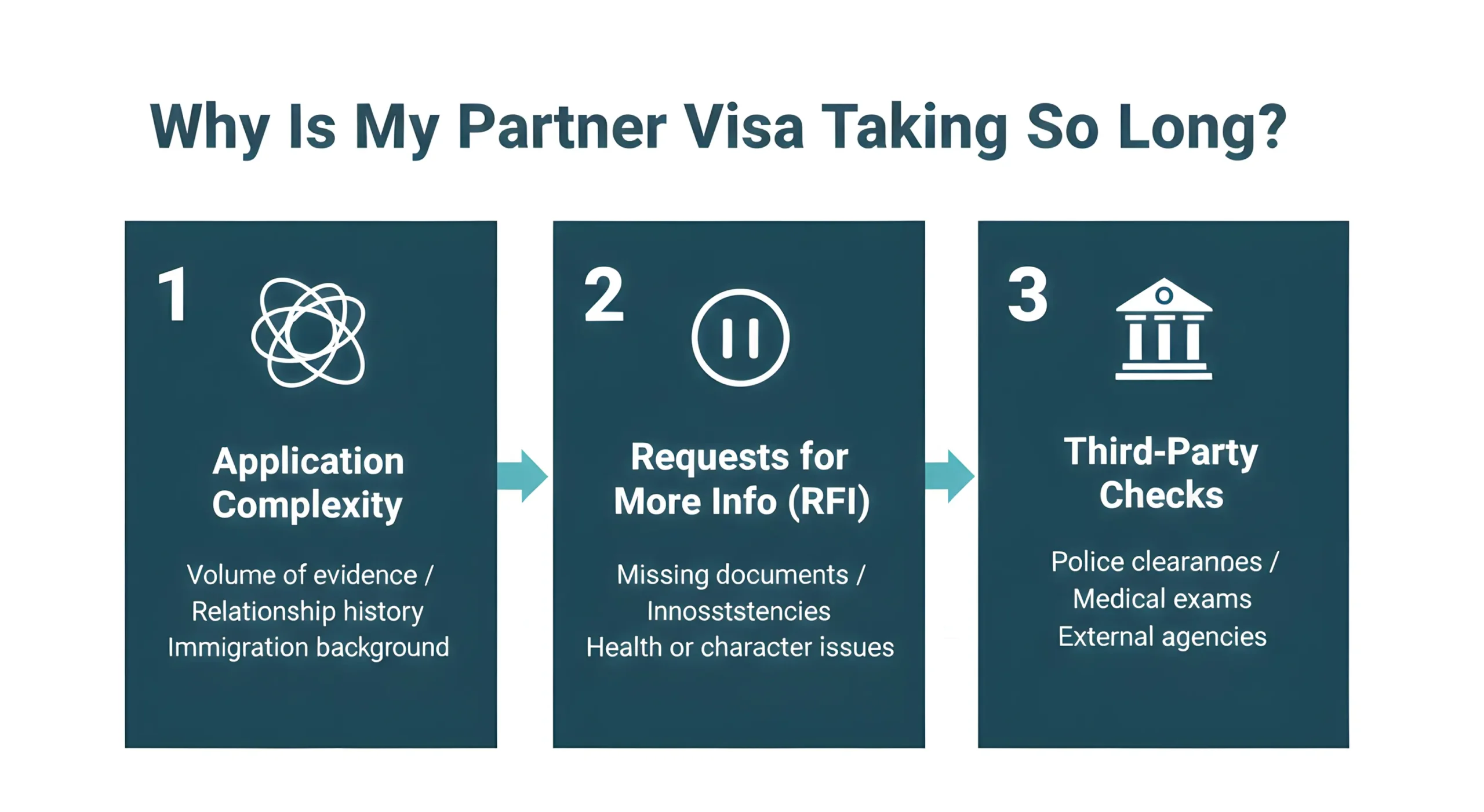
Beyond your application file, delays can also come from mandatory external checks. Your health and character assessments are often handled by other government bodies or designated doctors, both in Australia and overseas. The Department of Home Affairs has no control over how long these third parties take. This variability is a key reason why the final Subclass 801 processing time or Subclass 100 processing time can be unpredictable.
These roadblocks case complexity, RFIs, and external checks help demystify the wait. While some factors are out of your hands, knowing what they are can reduce anxiety. This brings us to the next big question: how can you keep an eye on things without driving yourself crazy?
Expert Australian Migration Guidance
Navigating the complexities of your visa journey is easier with professionals. Start your Australian dream today.
Book ConsultationRead Article :
Partner Visa Australia – Eligibility, Requirements & Application Process
How to Check Your Partner Visa Status Without Stressing Out
Once your application is submitted, your ImmiAccount becomes your official window into the process. Knowing how to check your partner visa application status is straightforward: simply log in and view your submitted application. Next to its details, you’ll see a status. While it’s tempting to refresh this page daily, it’s crucial to understand what these statuses mean and, more importantly, what they don’t. This knowledge is key to managing the long wait without unnecessary anxiety.
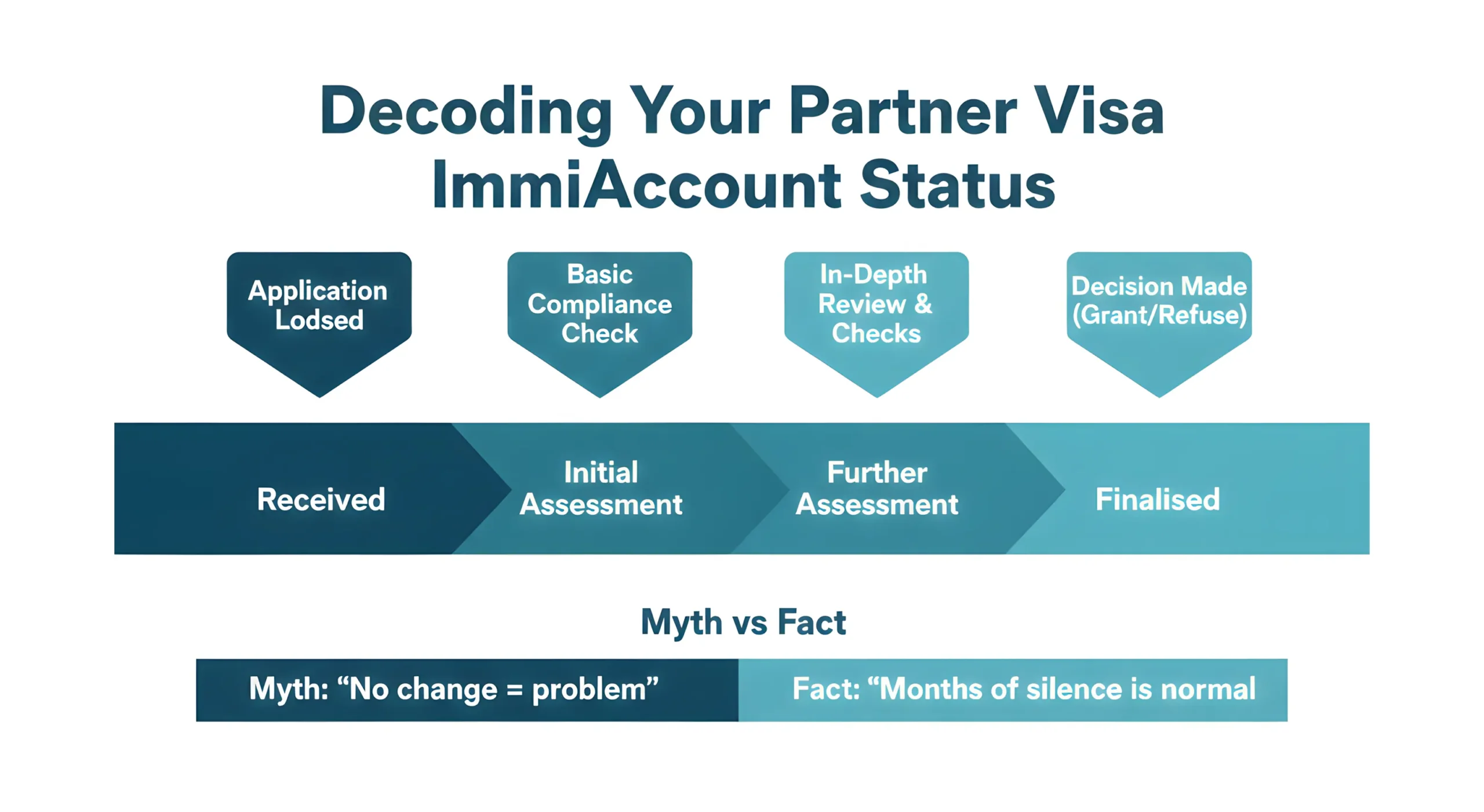
Your application will move through a few key stages. Initially, it will be marked as ‘Received,’ confirming it has entered the queue. At some point, this may change to ‘Initial Assessment’ and later ‘Further Assessment.’ These sound active, but they often just mean a case officer has opened your file. The status doesn’t update in real-time as they work. The final step is ‘Finalised,’ which indicates a decision has been made and your partner visa grant notification time has arrived.
Here is the most critical piece of advice: your status will likely stay on ‘Further Assessment’ for the vast majority of your wait. It is completely normal for months—or even over a year—to pass with no change. This silence is not a red flag. The ImmiAccount partner visa progress display is not a live tracker. Accepting that the display is not a live tracker can help you resist the urge to constantly check, allowing you to focus instead on what you can control in your visa journey.
Your Path Forward: Taking Control of Your Partner Visa Journey
The waiting game for a partner visa can feel overwhelming, but you are not just a passive observer. The official processing times are a guide, not a destiny, and your actions have a direct impact on your journey. This knowledge is your first and most important tool for taking control of the visa process.
Your power lies in preparing a comprehensive, decision-ready application from the very beginning. By providing clear, organised evidence and responding immediately to any requests for information, you give your case officer everything they need to make a decision smoothly. This proactive approach helps you navigate the queue efficiently and gives you the best chance at a positive and timely outcome.
Finally, remember that receiving your temporary visa is a huge milestone. While you will need to provide updated evidence for the permanent stage in about two years, the hardest part of the wait is over. You can now plan your future together in Australia with confidence, knowing your new life has already begun.
How The Migration Help You In Partner Visa
Navigating the partner visa process alone is overwhelming. The paperwork is complex. The evidence requirements are detailed. And the stakes are high. The Migration is an Australian-based immigration and education consultancy. We work with couples at every stage of the partner visa journey. Our immigration agent team understands how case officers assess applications.
We don’t offer one-size-fits-all advice. We take time to understand your relationship, your history, and your circumstances. Then we create a strategy that fits. If you’re worried about your partner visa application in Sydney, The Migration offers confidential consultations to help you move forward with clarity. Applicants in Melbourne can book an appointment in-office or Zoom session with our team. We support couples across Australia and overseas. Whether you’re just starting or already mid-process, we’re here to guide you every step of the way.
Conclusion
The partner visa processing time in Australia can feel long and uncertain. But you are not powerless. A complete, decision-ready application is your strongest tool. It helps case officers move faster and reduces the risk of an RFI. It gives you the best chance of a smooth outcome. Every couple’s case is different. That’s why a personalised risk assessment matters.
Don’t guess whether your application is strong enough. Know it. Book your consultation with our MARA agents today. The Migration’s registered Mara agents will review your case, strengthen your evidence, and help you lodge with confidence.
Frequently asked Questions Partner Visa Process Time
Q1. What is the current partner visa processing time in Australia?
Processing times vary. For the Subclass 820, 50% of applications are finalised within 17 months and 90% within 25 months. For the Subclass 309, 50% take around 16 months and 90% around 23 months. Always check the Department of Home Affairs website for the most current figures.
Q2. Can I speed up my partner visa application?
You cannot pay to fast-track a partner visa. However, a “decision-ready” application — complete with health checks, police clearances, and strong relationship evidence across all four pillars — can reduce unnecessary delays significantly.
Q3. What happens if my partner visa application is refused?
A refusal is serious. It stays on your immigration record and can affect future applications. If you receive a refusal, you may be able to apply to the Administrative Appeals Tribunal (AAT). Acting quickly is essential. Contact a registered migration agent immediately.
Q4. What is an RFI, and how does it affect my processing time?
An RFI (Request for Further Information) is a formal pause in your application. Your file is put on hold until you respond. Each RFI can add weeks or months to your wait. Submitting a complete application from day one is the best way to avoid one.
Q5. Do I need a migration agent for a partner visa application?
You are not legally required to use an agent. However, partner visas are among the most document-heavy and scrutinised visa types in Australia. A registered migration agent (MARA agent) can identify risks, strengthen your evidence, and help you avoid costly mistakes especially if your case involves complexity such as prior visa refusals, dependents, or a short relationship history.