
Applying for a partner visa is one of the most document-intensive processes in Australian immigration. Every claim you make must be backed by real, verifiable partner visa evidence. Immigration officials cannot simply take your word for it. They need proof, need documents and need a story that makes sense.
Case officers are trained to spot inconsistencies, gaps, and manufactured evidence. A poorly prepared application can lead to delays, bridging visa complications, or outright refusal.
The good news is that strong evidence is buildable. You don’t need a perfect relationship history. You need an organised, honest, and well-explained one. This guide breaks down exactly what partner visa evidence looks like across all four legal categories. It covers married couples, de facto partners, long-distance situations, and more. Whether you’re lodging onshore or offshore, this resource will help you understand what’s required, what’s optional, and what mistakes to avoid before you submit.
What Is Partner Visa Evidence?
Partner visa evidence is any material that supports your claim of being in a genuine relationship. Legally, it refers to documents, statements, and records that demonstrate your relationship meets the requirements set out in Australian migration law. It is not simply a collection of photos or love letters. It is structured, verifiable information that a case officer can assess objectively.
Many applicants confuse documents with proof. A document is something you submit to a bank statement, a lease agreement, or a photograph. Proof is what that document establishes when viewed in context. A single bank statement is a document.
A two-year history of shared transactions, joint bills, and mutual transfers becomes proof of financial interdependence. The difference matters. One document alone rarely proves anything. A pattern of documents tells a convincing story.
How Case Officers Assess Partner Visa Evidence
In 2026, Case Officers from the Department of Home Affairs assess partner visa applications with a focus on authenticity, continuity, and credibility. Rather than simply ticking boxes on a checklist, they conduct a holistic evaluation to see if the overall “picture” of your relationship reflects a genuine commitment to a shared life.
1. Timeline Consistency
Officers scrutinise dates to ensure they align across all forms, statutory declarations, and supporting documents.
- Cross-Checking: They verify that key milestones, such as when you met, moved in together, or became serious, match in both partners’ statements and third-party witness forms.
- Document Alignment: Financial records, travel itineraries, and utility bills are expected to chronologically support the narrative you provide.
- Red Flags: Conflicting dates are a major red flag that can severely undermine the credibility of your entire application.
2. Relationship Progression
Case officers look for a logical evolution in the relationship rather than a sudden “dump” of recent evidence.
- The “Maturity” Test: They seek evidence that the relationship has matured, showing a transition from casual dating to a committed partnership.
- Interdependence: This includes showing how you have gradually combined your personal, social, and financial lives over time.
- Stability: Consistency in evidence over months or years is prioritised over a high volume of documents from only the last few months.
3. Red Flags & Contradictions
Anything that disrupts a clear, honest narrative can trigger closer scrutiny or refusal.
- Vague Statements: General or rehearsed answers in personal statements that lack specific details about daily life or future goals can raise doubts.
- Social Media Mismatches: Officers may check public social media profiles; a relationship status that contradicts your application (e.g., still listed as “Single”) can be problematic.
- Living Apart: Long periods of separation without clear explanations or evidence of continued emotional and logistical support are viewed as high-risk.
- Limited Scope: Over-reliance on one pillar (like photos) while neglecting others (like financial or household ties) suggests a lack of genuine integration.
4. Why Copy-Paste or Random Uploads Fail
Case officers manage high volumes of applications and prefer clear, “decision-ready” files.
- Lack of Personal Narrative: Standard templates or “copy-paste” relationship statements fail to convey the unique emotional bond and individual circumstances that prove genuineness.
- Witness Authenticity: Giving witnesses a script for their Form 888 makes them feel unnatural; officers value genuine, independent observations.
- Administrative Burden: Disorganised uploads forced officers to hunt for information, making them more likely to request further details or find reasons to refuse a weak case.
Must Read :
- Partner Visa Australia – Eligibility, Requirements & Application Process
- Australian Partner Visa Eligibility – 2026 Detailed Breakdown
The Four Legal Categories of Partner Visa Evidence
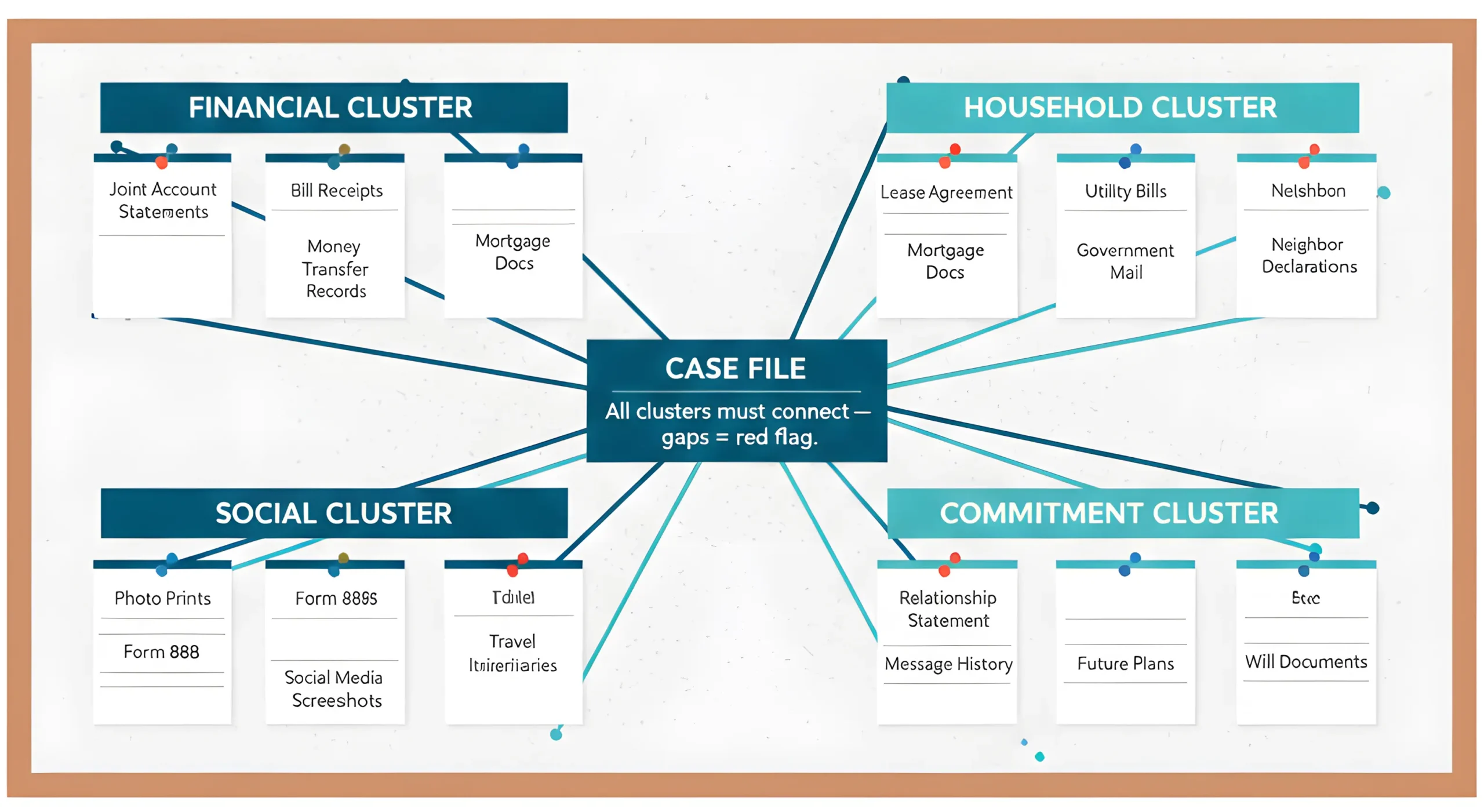
Financial Aspects of the Relationship
More than just showing who pays for dinner, this is about demonstrating financial ‘interdependence.’ When you build a life together, your finances naturally start to merge. Sharing costs and making financial decisions as a team is powerful evidence because it proves you’re in a combined, committed relationship, not just two individuals dating.
For immigration officials, the clearest joint financial evidence shows a shared financial life over time. You don’t need every item on this list, but aim to provide strong examples from different periods of your relationship.
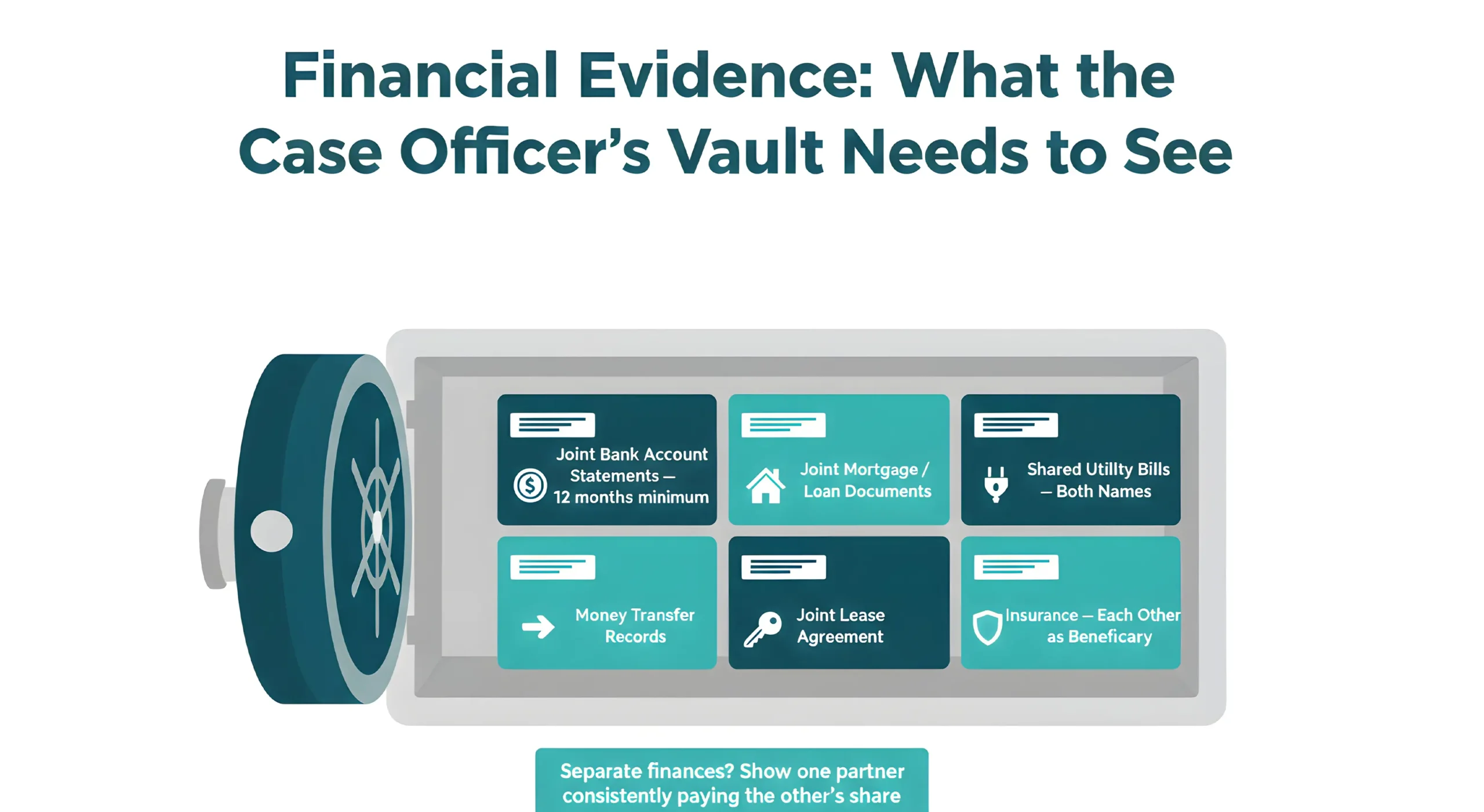
- Joint bank account statements showing regular use by both partners.
- Joint loan or mortgage documents for a property, car, or other major asset.
- Proof of money transfers between you, especially if they are regular and have notes like “for rent” or “groceries.”
- A joint lease or rental agreement with both names listed.
- Major joint purchases, like receipts for furniture or appliances.
- Shared bills, such as electricity, internet, or insurance policies, in both names.
If you keep your finances separate, you can still prove you share financial responsibilities. For example, provide individual bank statements showing one partner regularly transferring their share of the rent to the other. Or, show receipts where you took turns paying for significant household expenses, flights for a shared holiday, or other large costs. The goal isn’t to prove you’re wealthy; it’s to prove you operate as a single financial unit.
Nature of the Household
Moving from bank statements to your front door, this is about proving you share a home. Immigration officials want to see that your day-to-day lives are physically intertwined, a concept often called ‘cohabitation.’ This is fundamental proof of a de facto relationship or marriage because it demonstrates a shared domestic life.
Convincing proof of living together officially links both of you to the same address over time. While a joint lease is powerful, it’s not the only way to build your case.
Here’s what counts as strong evidence:
- A joint lease or tenancy agreement with both names.
- Utility bills (gas, electricity, internet) in both names, or separate bills for different utilities sent to the same address.
- Official mail from different sources (like banks, doctors, or government agencies) is addressed individually, but shows you both receive mail at the same home.
- Driver’s licenses or other government-issued IDs showing the same address.
If your name isn’t on the lease or major bills, you can build a mountain of smaller evidence. Gather any official mail addressed to you at that location, think bank statements, phone bills, letters from your doctor, or even online shopping delivery confirmations. The more pieces of mail from different, reputable sources you can provide over a period, the stronger your proof becomes.
Social Aspects of the Relationship
Beyond your shared home, immigration officials need to see that your relationship is recognized in your community. This pillar is about providing “social proof” that you are known to friends, family, and the public as a committed couple. The goal is to demonstrate that your relationship isn’t a secret, but an open and acknowledged part of your lives.
This social proof is often easier to collect because you already have most of it. You’re looking for items that place you together at specific times and with other people. This kind of digital evidence is becoming increasingly important.
A strong evidence checklist for this category includes:
- Photos together at different events and with different groups of friends and family.
- Invitations to parties, family gatherings, or weddings are addressed to you both.
- Proof of joint travel, like flight itineraries, hotel bookings, or tour reservations in both names.
- Screenshots of social media showing your relationship, such as your relationship status, tagged photos, or celebratory posts from others.
When using photos or social media, context is key. It’s more powerful to show a handful of pictures from different occasions over time, a friend’s birthday, a family holiday, a casual weekend, than 50 photos from a single vacation. Each piece of evidence should help tell the story of a public, genuine, and ongoing relationship.
Commitment to Each Other
Proving a future plan might sound abstract, but it’s about documenting the conversations and decisions you are already making as a team. Are you engaged or planning a wedding? Have you discussed having children or buying a pet together? Even researching neighborhoods to live in, making retirement plans that include each other, or naming one another as a beneficiary on your life insurance are powerful indicators of commitment.
Your personal relationship statements become your most powerful tool here. While documents like a lease agreement prove a fact, your written statements are where you explain the meaning behind all your evidence.
This is your opportunity to tell the story of how you met, detail the key moments that defined your bond, and, most importantly, share your dreams for the future. It transforms a collection of documents into a compelling narrative about two people planning a future together.
Partner Visa Evidence for Married Couples
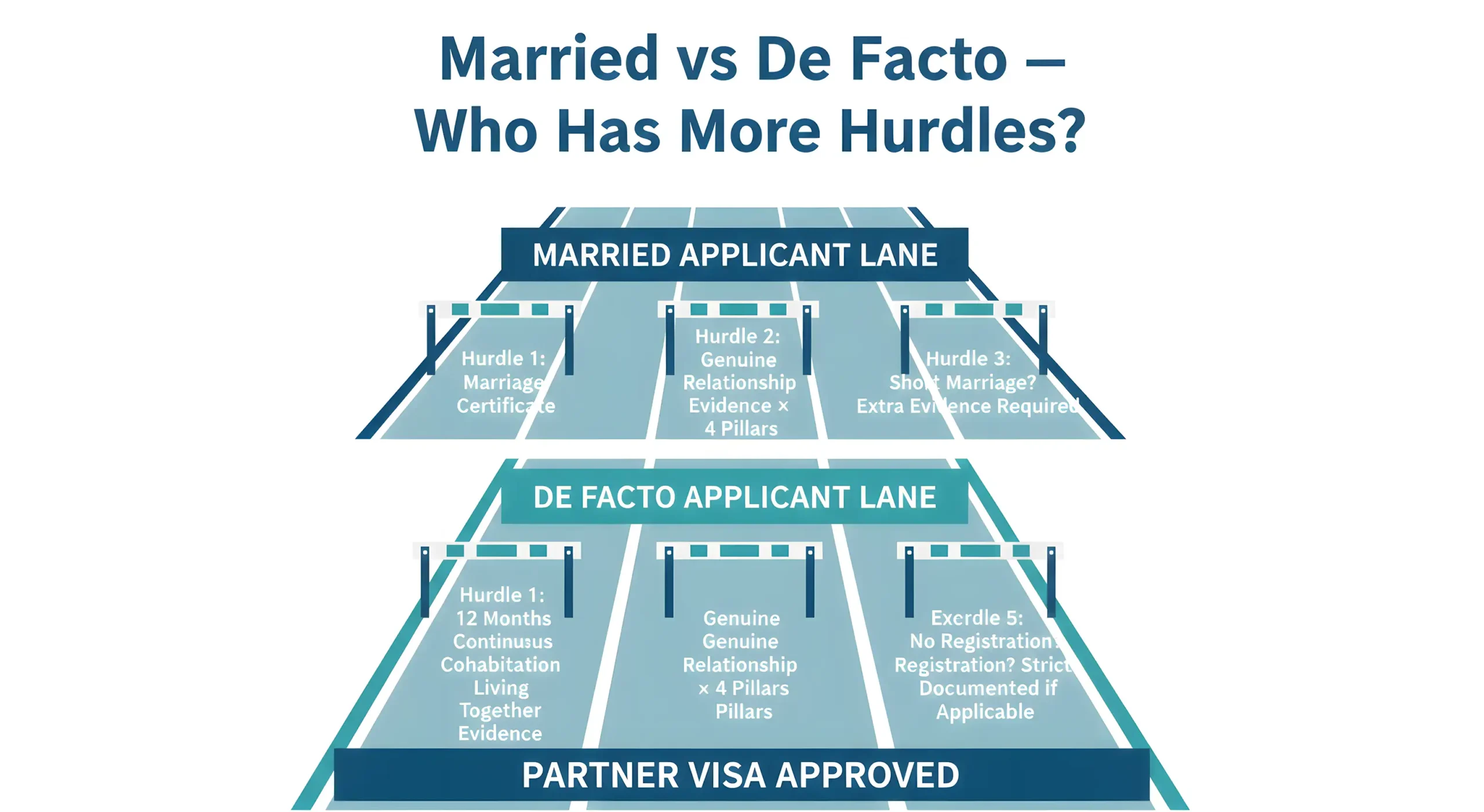
Being married does not automatically guarantee a partner visa approval. A marriage certificate proves a legal union. It does not prove a genuine and continuing relationship. Case officers still need to see evidence that your marriage is real, ongoing, and built on a shared life.
Marriage Certificate
Your marriage certificate is the foundation of your application. It must be an official, government-issued document. If it is not in English, a certified translation is required. This document establishes legal validity but nothing more. Everything else in your application must build on it.
Relationship Before and After Marriage
Case officers want to see how your relationship developed. Evidence of your relationship before marriage, such as messages, photos, travel history, and meeting records, adds important context. Evidence after marriage shows the relationship has continued and grown. Both periods matter equally.
Short Marriages
A short marriage raises more scrutiny. Case officers look more carefully at the circumstances and progression of the relationship. Strong communication history, early financial integration, and credible statutory declarations become especially important in these cases.
Cultural Marriages
Arranged marriages and culturally traditional unions are recognised under Australian migration law. However, they require additional context and explanation. A relationship statement outlining your cultural background and how your relationship developed can help a case officer understand your situation clearly and fairly.
Expert Australian Migration Guidance
Navigating the complexities of your visa journey is easier with professionals. Start your Australian dream today.
Book ConsultationPartner Visa Evidence for De Facto Relationships
De facto relationships come with an additional legal requirement that married couples don’t face. You must prove you have lived together in a genuine de facto relationship for at least 12 months before lodging your application. This is known as the 12-month rule. It is not optional. Without meeting this threshold, your application may be refused before a case officer even reviews your evidence.
The 12-Month Rule
The 12 months must be continuous and immediately before your application date. Casual dating, long-distance visits, or time spent together without cohabiting does not count. Case officers look for evidence that you were living together as a couple during this period. Gaps in cohabitation can raise questions. If there were legitimate reasons for time apart, you must explain them clearly and support them with documentation.
Living Together Proof
Proving cohabitation is one of the most important aspects of a de facto partner visa application. Strong evidence includes a joint lease or mortgage in both names, utility bills showing the same address, mail and government correspondence sent to a shared address, and statutory declarations from people who can confirm you lived together. Evidence from multiple sources across the full 12-month period is far more persuasive than a single document.
Relationship Registration
Some Australian states and territories allow de facto couples to register their relationship officially. A registered relationship certificate is powerful evidence. In many cases, it can substitute the 12-month cohabitation requirement entirely. Registration is available in New South Wales, Victoria, Queensland, South Australia, Western Australia, Tasmania, and the Australian Capital Territory. If you are eligible, registering your relationship before lodging can significantly strengthen your application.
Exceptions to the 12-Month Rule
Not every applicant must meet the 12-month rule. There are recognised exceptions. If you have a dependent child together, the 12-month requirement may be waived. If your relationship is registered under a state or territory law, the requirement may also not apply. Compelling circumstances beyond your control may also be considered in limited cases. These exceptions are assessed individually and must still be supported by strong evidence of a genuine relationship. Meeting an exception does not reduce the overall evidence standard it simply removes one specific barrier to eligibility.
Partner Visa Evidence Checklist (2026)
Use this checklist as a starting point. Every relationship is different, so not every document will apply to your situation. Focus on submitting what is relevant, well-organised, and clearly explained.
Identity Documents
- Valid passport (all pages, including expired passports if relevant)
- Birth certificate
- National identity card (if applicable)
- Change of name document (if applicable)
- Divorce or death certificate from any previous marriage or de facto relationship
Relationship Evidence
Financial
- Joint bank account statements (minimum 12 months)
- Shared utility bills or rent receipts
- Joint loan or mortgage documents
- Insurance policies naming each other as beneficiaries
- Evidence of money transfers between partners
Household
- Joint lease or mortgage agreement
- Utility bills showing the same address for both partners
- Correspondence from government agencies sent to the shared address
- Statutory declarations from landlords or neighbours confirming cohabitation
Social
- Photographs taken together over time with dates and captions
- Travel records and shared itineraries
- Social media is showing public recognition of the relationship
- Wedding or event invitations addressed to both partners
- Form 888 statutory declarations from two Australian citizens or permanent residents
Commitment
- Personal relationship statements from both partners
- Communication history (messages, call logs, emails)
- Evidence of future plans (property, children, relocation)
- Wills or superannuation beneficiary documents naming each other
Sponsor Documents
- Sponsor’s valid Australian passport or citizenship certificate
- Sponsor’s permanent residency evidence (if applicable)
- Sponsor’s birth certificate
- Evidence of the sponsor’s previous visa sponsorships (if any)
- Sponsor’s police clearance (if required)
- Form 40SP Sponsorship for a Partner to Migrate to Australia
Health and Character Documents
- Health examination results from an approved panel physician
- Chest X-ray results (if required based on country of origin)
- Police clearance certificates from every country lived in for 12 months or more since age 16
- Court or sentencing documents (if applicable)
- Medicare enrolment or health insurance evidence (for onshore applicants)
How Much Evidence Is Enough?
There is no official document count for a partner visa application. More files do not mean a stronger case. Quality always outweighs quantity. A well-explained joint lease agreement carries far more weight than fifty unorganised photographs. Case officers are looking for a believable, consistent pattern, not a large folder of random uploads.
Strong evidence is recent, verifiable, and spans multiple categories. Weak evidence is isolated, unexplained, or concentrated in only one area. The most effective approach is timeline-based. Show how your relationship started, how it developed, and where it stands today. A clear progression across financial, household, social, and commitment categories tells a complete and convincing story that is difficult to question.
Common Partner Visa Evidence Mistakes That Cause Refusals
Small mistakes in your partner visa evidence can have serious consequences. Inconsistent dates are one of the most common problems. If your relationship statement says you met in March but your earliest photo is dated December, a case officer will notice. Every date, timeline, and detail must align perfectly across all documents.
Fake or manufactured evidence is treated as fraud. Suddenly opened joint accounts with no transaction history, backdated letters, or coached statutory declarations are red flags that can result in permanent refusal and future visa bans.
Too much irrelevant data creates confusion and weakens your case. Submitting hundreds of unexplained screenshots or duplicate documents buries your strongest evidence. Every document you include should serve a clear, specific purpose.
How The Migration Helps You Prepare Strong Partner Visa Evidence
Preparing partner visa evidence is not just about gathering documents. It is about presenting them in a way that meets case officer expectations. That requires experience, strategy, and a deep understanding of how applications are assessed.
The Migration is an Australian-based immigration and education consultancy specialising in partner visas and onshore applicants. Our consultants build evidence strategies tailored to your relationship, your circumstances, and your timeline. Every application is guided by three core principles: quality, structure, and explanation.
If you need help preparing partner visa evidence in Sydney, The Migration offers in-office and Zoom consultations. Applicants seeking partner visa evidence support in Melbourne can book a confidential session with our consultants to review their evidence and identify any gaps before lodging.
Conclusion
Your evidence decides everything. It is the difference between approval and refusal, between being with your partner and facing months of uncertainty. No amount of hope or genuine love replaces a well-prepared, strategically organised application.
There is no universal checklist that works for every couple. A long-term de facto relationship requires different evidence than a short marriage. A long-distance relationship needs different support than a couple living together. Your evidence strategy must reflect your unique circumstances, not a generic template copied from an online forum.
Getting this right the first time is always better than responding to a refusal. Professional guidance helps you identify gaps, strengthen weak areas, and submit with confidence. If you’re unsure whether your partner visa evidence is strong enough, getting expert advice before lodging can prevent costly refusals. Book your consultation with our Mara expert.
Frequently Asked Questions
Q1.What is the best evidence for a partner visa?
The best evidence spans all four legal categories: financial, household, social, and commitment. Joint bank accounts, shared leases, statutory declarations, and consistent communication records carry the most weight. Quality and consistency matter more than volume.
Q2.What evidence is needed for a partner visa in Australia?
You need documents that prove a genuine and continuing relationship across financial, household, social, and commitment aspects. This includes joint bank statements, utility bills, photos over time, and personal statements. Evidence must be consistent, organised, and clearly explained.
Q3.What documents do I need for a partner visa?
Core documents include identity documents, your partner’s sponsorship documents, joint financial records, shared address evidence, travel history, and statutory declarations. Health and character documents are also required. A structured checklist tailored to your relationship type is strongly recommended.
Q4.What evidence is needed to prove a de facto relationship?
You need proof of living together for at least 12 months, shared finances, joint household responsibilities, and social recognition of your relationship. Registered relationship certificates can substitute the 12-month requirement in some states. Evidence must show the relationship existed before the application date.
Q5.Can weak evidence cause a partner visa refusal?
Yes, weak or inconsistent evidence is one of the most common reasons for partner visa refusals. Case officers need a clear, believable pattern across multiple categories. Gaps, contradictions, or last-minute manufactured documents raise serious red flags and can result in refusal.