Planning a future in Australia with the person you love is an exciting dream, but the partner visa process can be terrifying. A single question often loops in your mind: what if it gets refused? Here’s a fact that might surprise you: most partner visa refusals aren’t because the relationship is fake. They are rejected because the application failed to tell the right story to the person deciding your future.
Everything in your application boils down to proving your relationship is “genuine and continuing.” This is the government’s formal way of asking for hard evidence that your partnership is real and you intend to stay together. It isn’t enough for you and your family to know you’re a committed couple; you must prove it on paper to a case officer who has never met you.
To assess your bond, the Department of Home Affairs looks for proof across four distinct pillars of your shared life. Think of your application as a strong table. For it to stand up to scrutiny, it needs all four legs. If one leg is weak or missing, the whole thing can collapse. This guide turns anxiety into a clear action plan by breaking down this framework into simple, manageable steps, showing you exactly how to build an application that tells your love story, loud and clear.
What Does a Partner Visa Refusal Mean?
A partner visa refusal means the Department of Home Affairs has assessed your application and determined that you do not meet the legal requirements for the visa at that point in time. It is a formal decision, not a permanent ban, and in most cases, you have the right to seek a review.
It’s important to understand the difference between a refusal and a cancellation. A refusal occurs before a visa is granted; your application is rejected during assessment. A cancellation, on the other hand, happens after a visa has already been granted, usually because of a change in circumstances or a breach of visa conditions.
The immediate consequences of a refusal can be serious. If you are onshore, your Bridging Visa may cease, putting your right to remain in Australia at risk. You may also face departure obligations or restrictions on future applications.
Beyond the legal implications, a refusal carries a devastating emotional and financial toll. Couples face the uncertainty of being separated across borders, while thousands of dollars spent on application fees, documents, and legal support may feel lost. The stress of an uncertain future together can place enormous strain on even the strongest relationships.
Read Article :
Partner Visa Australia – Eligibility, Requirements & Application Process
How Common Are Partner Visa Refusals in Australia?
A case officer reviews your application like a detective, and inconsistency is the number one clue that something might be wrong. This is one of the most avoidable yet common reasons for partner visa refusals. Imagine your relationship statement says you moved in together in January, but your joint lease is dated for June.
Or a friend’s statement says they attended your engagement party in 2024, but your photos from the event are time-stamped 2025. These small mismatches create big doubts, forcing the case officer to question which version of your story is true.
Strengthening your partner visa application
The simplest way to avoid this trap is to create a “master timeline” before you submit. This isn’t a government form; it’s your own private checking tool for strengthening your partner visa application. On a single document, list the key dates of your relationship: when you met, when you became exclusive, when you moved in together, and other major life events. Before you upload any document, a bank statement, a photo, or a friend’s declaration, check its date against your master timeline.
Think of your personal written statements as the guide that walks the case officer through your evidence. These narratives are your best chance to provide context, so they must align with your timeline. Your partner visa relationship statement tips should focus on this: use your statement to explain the evidence, not contradict it.
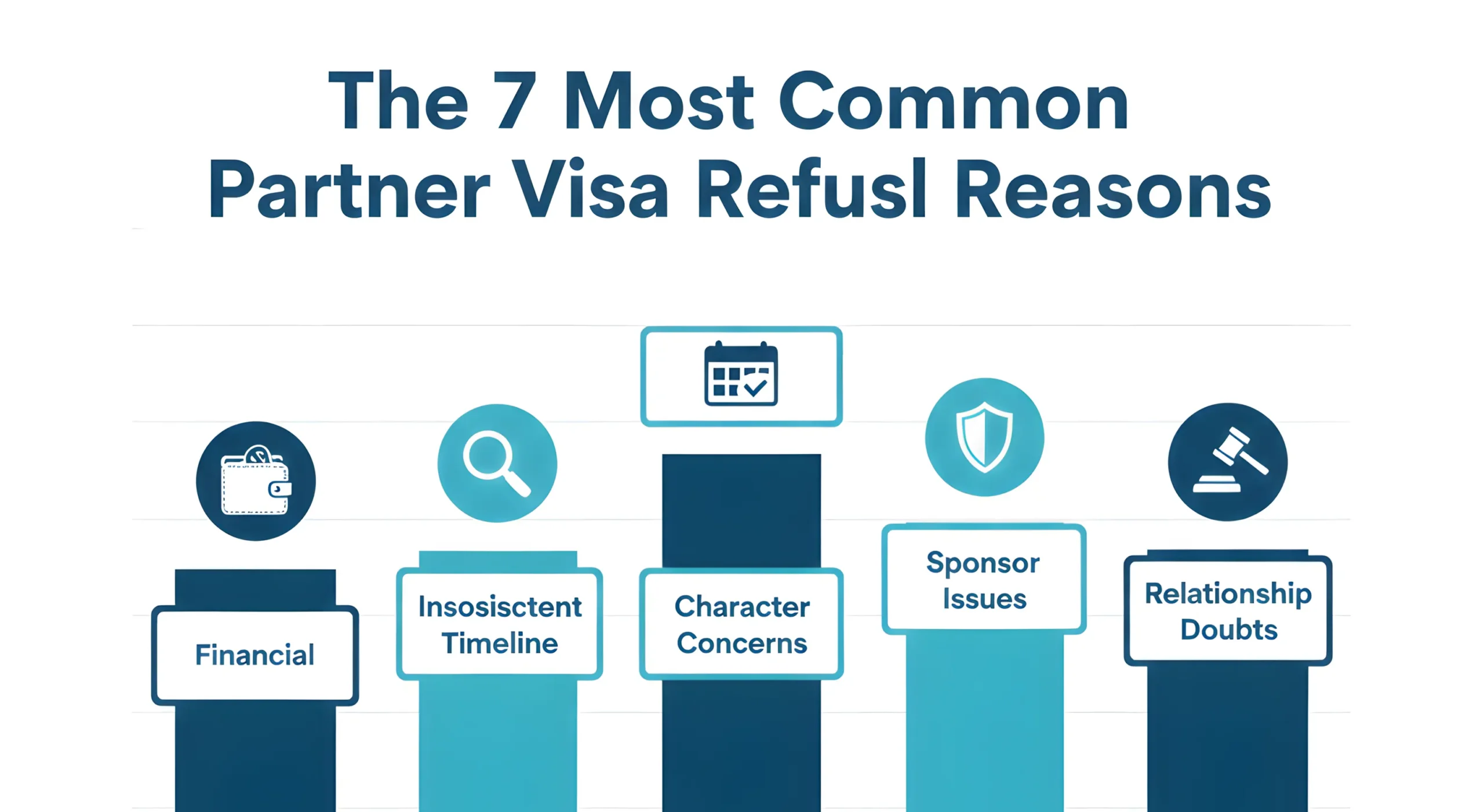
Top Partner Visa Refusal Reasons
Below is the top partner visa refusal that can lead your partner visa to refusal
1. Insufficient or Weak Relationship Evidence
One of the most common reasons for a partner visa refusal is weak relationship evidence. Many applicants believe submitting more documents means a stronger application. It doesn’t. A case officer values quality over quantity. 10 well-explained, relevant documents outweigh 50 random ones with no context.
A strong application tells a clear story. Missing timelines leave gaps in that story, making even genuine relationships look unconvincing. Worse, some applicants attempt to manufacture evidence at the last minute, which case officers are trained to detect.
Common examples that raise red flags:
- No shared finances: no joint accounts, shared bills, or financial interdependence throughout the relationship
- Last-minute joint accounts: opening a shared account days before lodgement looks calculated, not genuine
- Generic statutory declarations: statements like “they are a loving couple” with no specific detail or personal anecdotes
- Missing relationship timeline: no clear documentation of how the relationship developed over time
- Inconsistent evidence: documents that contradict each other or don’t align with your relationship history
2. Relationship Not Considered Genuine or Ongoing
Even if your relationship is real, the Department of Home Affairs must be legally satisfied that it is genuine and ongoing. This is one of the most subjective and most dangerous refusal grounds.
Legally, “genuine” means your relationship must demonstrate mutual commitment across four areas: financial, social, household, and commitment to each other’s well-being. It’s not enough to simply be in love. You must prove it with evidence that stands up to scrutiny.
Key risk areas include:
- Short relationships: relationships under 12 months are viewed with greater skepticism, particularly for de facto partners who haven’t yet met the cohabitation requirement
- Convenience relationships: if the relationship appears to exist primarily for visa purposes, the case officer will flag it. Inconsistent answers, lack of shared history, and minimal integration into each other’s lives are common red flags
- Long-distance relationships: without strong evidence of regular communication, visits, and future plans, distance can make a relationship appear less committed than it truly is
A case officer is trained to identify relationships that don’t add up. If your application can’t prove the relationship is real and continuing, it won’t succeed.
3. Inconsistent or Contradictory Information
Inconsistencies are one of the fastest ways to trigger a refusal or a character concern. Case officers cross-check every detail across your forms, statements, and documents.
Common inconsistencies that raise red flags:
- Form vs statement mismatches: dates, locations, or relationship details that differ between your visa form and personal statements
- Different addresses or dates: conflicting information about when you met, moved in together, or started your relationship
- Sponsor and applicant contradictions: when both parties give different answers about the same events or experiences
Consistency isn’t optional. One contradiction can cast doubt over your entire application.
4. Schedule 3 & Unlawful Stay Issues (Onshore Applicants)
If you are applying onshore and have been unlawful or held a Bridging Visa B at any point, Schedule 3 criteria apply to your application, and they are strict.
Key issues include:
- Schedule 3 is an additional set of legal criteria that onshore applicants must meet if they were not holding a substantive visa at the time of application
- Why onshore refusals happen, many applicants don’t realize that their visa status at lodgement directly impacts their eligibility
- Misunderstanding Schedule 3 waivers, a waiver exists, but is rarely granted without compelling, well-documented circumstances
5. Sponsor-Related Refusal Reasons
Many applicants focus entirely on their own eligibility, forgetting that the sponsor is assessed just as closely. A partner visa can be refused because of the sponsor, not the applicant.
Key sponsor-related refusal reasons include:
- Sponsorship limits: Sponsors are generally limited to two partner visa sponsorships in a lifetime
- Previous sponsorships: a history of sponsoring multiple partners raises credibility concerns with the Department
- Character issues: sponsors with convictions related to family violence, child abuse, or certain criminal offences may be automatically disqualified
6. Health & Character Grounds for Refusal
Beyond proving your love story, every visa applicant must also pass Australia’s standard health and character requirements. These are non-negotiable hurdles. The health requirement ensures you won’t pose a high cost to the public health system, while the character test involves police checks from every country you’ve lived in. A serious medical condition or criminal record can be major reasons for partner visa refusal, even if your relationship evidence is perfect.
Perhaps the most severe landmine is Public Interest Criterion 4020. This rule means that if you provide a bogus document or false and misleading information, your visa will be refused.
More importantly, it can lead to a three or ten-year ban on being granted most other Australian visas. This covers everything from a fake bank statement to lying about your relationship history. For a Public Interest Criteria 4020 partner visa issue, the consequences are drastic and can stop your Australian dream for years.
If you find any difficulty in this partner visa process, book your consultation with our MARA experts
7. Poorly Prepared DIY Applications
Many applicants upload documents without a clear strategy. They include random photos, bank statements, and messages, but with no explanation of what they prove. A case officer won’t connect the dots for you. You have to do it for them.
Expert Australian Migration Guidance
Navigating the complexities of your visa journey is easier with professionals. Start your Australian dream today.
Book ConsultationWithout a structured approach, even genuine couples get refused. The case officer follows a checklist. If your application doesn’t speak their language, it fails. Not cover letters. No relationship timeline. None statutory declarations. Just a pile of documents that tells no story.
DIY applications often look genuine but read incomplete. That gap is exactly where refusals happen.
Don’t let a preventable mistake cost you your visa. Read our Partner Visa Document Checklist and make sure your application tells the right story.
H2: Real-Life Scenarios Where Partner Visas Get Refused
Understanding where applications commonly fail can help you prepare a stronger case. These are real situations that raise red flags for case officers:
- Long-distance couples: relationships maintained across borders often lack evidence of shared daily life, cohabitation, and future commitment, making them harder to prove genuine
- Cultural or religious differences: where family or cultural traditions mean couples live separately before marriage, this can be misread as a lack of genuine commitment without proper explanation
- Age gaps: Significant age differences aren’t disqualifying, but they attract additional scrutiny and require stronger supporting evidence
- Visitor visa to partner visa: transitioning from a visitor visa to a partner visa onshore raises concerns about the applicant’s original intention when entering Australia
- Previous visa refusals: any prior refusal history must be declared and directly addressed, as undisclosed refusals can seriously damage credibility
What to do if your partner visa is refused?
Your first step is to understand that you have an option to appeal.
This appeal takes place at the Administrative Appeals Tribunal (AAT), a second chance to have your case heard by a fresh, independent decision-maker.
The partner visa refusal appeal process is a complete reassessment of your case. Crucially, you can often provide new and updated evidence that has developed since you first applied, strengthening your claim for an Administrative Appeals Tribunal (AAT) partner visa approval.
The most critical thing to understand is that you are on a strict clock. You only have a limited number of days to lodge your appeal before the opportunity is lost forever.
The complexity and tight deadline are why many people immediately seek help from a migration agent for a partner visa appeal. While appealing is a vital option, avoiding refusal in the first place is always the better path.
How The Migration Helps You Avoid Partner Visa Refusal
Most partner visa refusals are preventable. The problem isn’t your relationship. It’s the strategy behind your application. At The Migration, we are an Australian-based immigration and education consultancy. We specialize in partner visa risk assessment. Our focus is simple refusal prevention, not damage control. We think the way case officers think. We build your application around their decision-making framework, not guesswork.
Before you lodge, we identify the gaps in your evidence. We analyze your relationship history, your documents, and your circumstances. Then we create a clear strategy that tells your story the right way.
If you’re worried about a partner visa refusal in Sydney, Our Immigration agent provides confidential consultations. Applicants concerned about partner visa refusal in Melbourne can book an in-office or Zoom session.
Our services include partner visa refusal risk assessment, evidence gap analysis, strategy before lodgement, and refusal prevention planning. We help you get it right the first time.
Conclusion
Most partner visa refusals are preventable. A genuine relationship is not enough on its own. Strategy matters more than the number of documents you upload. A well-structured, honest, and consistent application will always outperform a rushed one, no matter how real your love is.
Every case is different. Your relationship history, visa status, sponsor background, and evidence all shape your risk level. What worked for someone else may not work for you. Applying blindly without understanding how a case officer reads your file is the biggest risk you can take. If you’re unsure about the strength of your application, professional guidance before lodging can help you avoid a costly partner visa refusal. Book your consultation with our Mara agents today.
Frequently Asked Questions About Partner Visa Refusal
Q1: Why would a partner visa be refused?
The most common reasons include insufficient evidence of a genuine relationship, failure to meet eligibility requirements (such as the 12-month de facto rule), providing false or inconsistent information, sponsor ineligibility, or not satisfying health and character requirements. Missing even one key document or performing poorly in an interview can also lead to refusal.
Q2: What makes a partner visa complex?
Partner visas are complex because they require proving the genuineness of a relationship across four areas: financial, social, household, and commitment, all with supporting documentation. Additional complications arise from Schedule 3 requirements, sponsor eligibility rules, long processing times (often 10–11+ months), and the two-stage temporary-to-permanent visa process.
Q3: Can I stay in Australia while my partner visa is being processed?
Yes, if you apply onshore, you are typically granted a Bridging Visa A (BVA), which allows you to remain in Australia lawfully while your application is being assessed. If you need to travel outside Australia during this time, you must apply for a Bridging Visa B (BVB) before departing.
Q4:Can a sponsor be refused for a partner visa?
Yes, a sponsor can be refused if they have a history of family violence, have sponsored multiple partners in the past, have certain criminal convictions, or are currently in debt to the Australian government. The Department of Home Affairs assesses sponsor suitability as a separate but critical part of the application process.