

One page says $53,900 a year. The next says there’s no minimum at all. Your accountant isn’t sure.
You’re not missing something. Both answers are live right now, and nobody has told you which one expired.
So here it is. The 191 visa income requirement has no dollar figure. Home Affairs said so on 21 June 2023, and its subclass 191 page still says so today. What you provide instead is three ATO notices of assessment from three of the five years you held your 491 or 494.
The $53,900 is a real number. It was just never yours. It came from a 2019 announcement, borrowed from a different visa, and it stopped being current anywhere in July 2023.
Not sure which three of your years to use? A MARA-registered migration agent can look at your five years and tell you where you stand before you lodge anything. Book your consultation with The Migration.
How much do you need to earn for the 191 visa?
There’s no amount you have to hit. As at 10 September 2026, the Department of Home Affairs states plainly that there is no minimum income requirement for the subclass 191 visa. What it asks for is evidence, not earnings.
That sounds too simple after everything you’ve read. It’s still what the department’s own page says.
The “You must” list on the Home Affairs subclass 191 regional provisional page has three lines on it:
- hold an eligible visa for at least three years
- provide notices of assessment issued by the Australian Taxation Office for three income years out of the five years of your eligible visa; there is no minimum income requirement
- have complied with the conditions of the eligible visa you hold or have held
Read that middle line again. The words “there is no minimum income requirement” are printed in the requirement itself. They are not our summary of it. They are the department’s own words, sitting in the list of things you must do.
So the test is a paperwork test. Can you produce three ATO notices of assessment from your five years? If yes, that part of your application is met. The amounts printed on them do not have to clear a line.
Which raises the obvious question. If that’s true, where on earth did $53,900 come from?
Why do so many pages still quote $53,900?
Because Home Affairs did announce that exact figure on 3 October 2019, and most of the pages written back then were never updated. The announcement was real. It simply never became law.
If you started your 491 around that time, you would have read it everywhere. Agents quoted it. Forums repeated it. It shaped how a lot of people planned their working years in the region, and it is still sitting on pages nobody has revisited since.
Here’s the part almost nobody explains. $53,900 was never a 191 number in the first place.
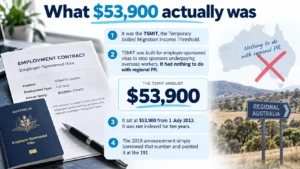
What $53,900 actually was
- It was the TSMIT, the Temporary Skilled Migration Income Threshold.
- TSMIT was built for employer-sponsored visas to stop sponsors underpaying overseas workers. It had nothing to do with regional PR.
- It sat at $53,900 from 1 July 2013. It was not indexed for ten years.
- The 2019 announcement simply borrowed that number and pointed it at the 191.
So the figure you’ve been carrying around was a salary floor for a completely different program. It was picked up, quoted for the 191, and then left behind when the rules were finalised.
And the number it was borrowed from didn’t stay still either.
What replaced $53,900, and when did it change?
The TSMIT was lifted to $70,000 on 1 July 2023, and its successor threshold now sits at $79,423 from 1 July 2026. The $53,900 figure hasn’t been current anywhere in Australia’s migration system for more than three years.
This matters more than it looks. When someone quotes $53,900 at you today, they are not quoting an old 191 rule. They are quoting an old version of a rule that belonged to another visa.
The full trail of the number, date by date
| Date | What happened |
| 1 July 2013 | TSMIT set at $53,900 for employer-sponsored visas. Then frozen for a decade. |
| 3 October 2019 | Home Affairs announces the 191 pathway will use a $53,900 income figure. |
| 16 November 2022 | The 191 regional provisional stream opens. The first applicants can lodge. |
| 21 June 2023 | Home Affairs confirms there is no minimum income requirement for the 191. |
| 1 July 2023 | TSMIT rises from $53,900 to $70,000. The old figure stops applying anywhere. |
| 1 July 2026 | The successor threshold, now the Core Skills Income Threshold, sits at $79,423. |
| 10 September 2026 | Home Affairs 191 page still reads: there is no minimum income requirement. |
Two things fall out of that table:
- $53,900 was never law for the 191. It was announced, then dropped, and it never became a rule you had to meet.
- It isn’t current for any visa either. The threshold it came from moved to $70,000 in 2023 and $79,423 in 2026.
Look at the gap between rows four and five. Home Affairs settled the 191 position nine days before the old threshold was replaced. Most pages on the internet were written before both events and never touched again.
That’s the mechanical reason you keep seeing two answers. But there’s a legal reason underneath it, and it’s the part that actually settles the argument.
Why does the law still mention an income amount if there isn’t one?
Because the rule for the 191 was written as an empty box, and nobody ever filled it in. The regulation refers to an income amount that a Minister may set later. No Minister has set one.
If you’ve ever pasted the legal wording into a search bar and come away more worried, this is why. The clause does mention income. It just doesn’t contain a number.
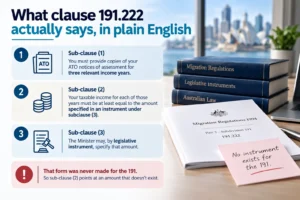
What clause 191.222 actually says, in plain English
- Sub-clause (1): you must provide copies of your ATO notices of assessment for three relevant income years.
- Sub-clause (2): your taxable income for each of those years must be at least equal to “the amount specified in an instrument under subclause (3)”.
- Sub-clause (3): the Minister may, by legislative instrument, specify that amount.
A legislative instrument is a short legal document that fills in the blanks in the main rules left open. Think of it as the form that carries the number.
That form was never made for the 191. So sub-clause (2) points at an amount that doesn’t exist. A requirement to earn “at least the specified amount” cannot bite when nothing has been specified.
That is exactly the reasoning Home Affairs gave on 21 June 2023. Its words were that there is no minimum income requirement for the subclass 191 visa, because there is no legislative instrument in place specifying a minimum income threshold for this visa.
Notice what that sentence does. It doesn’t say the requirement was abolished, or repealed, or reduced. It says the number was never put in place. That’s a different thing, and it explains why the clause still reads the way it does.
So the law is settled. Why does your search still return a contradiction?
Why does one page on Google give you both answers at once?
Because most pages about the 191 were written before June 2023 and were never updated. Migration content ages badly, and nobody goes back to fix a page that still gets traffic.
That would be annoying enough on its own. It gets worse than that.
We checked the Australian search results for this topic on 10 September 2026. The page sitting at position two above almost every migration firm in the country opens with a June 2023 update stating there is no minimum income requirement for the 191. Further down that same page, it tells you that you must show earnings of at least $53,900 per year for three years.
Both answers. One page. No date on the second one.
So when you say two answers are circulating, you’re not misreading anything. Some readers are getting both contradictory answers in a single visit, which is why the confusion never resolves itself no matter how many pages you open.
How to date-check any 191 page in about thirty seconds
- Look for a date. If the page has no published or updated date, treat the figure on it as unverified.
- Check for the words “legislative instrument.” A page that explains the mechanism has usually been reviewed since 2023. A page that just states a number has not.
- Scroll the whole page, not just the top. The correction is often at the top, and the outdated figure is further down.
- Finish on the department’s page. The Home Affairs “You must” list is the version that decides your application.
Once you accept, there is no dollar figure; a better question takes its place. If they’re not checking the amount, what are they checking?

If nobody is checking the amount, what are they checking?
Three things: that you have three notices of assessment, that those three years are years you actually held the visa, and that you don’t have an unresolved ATO debt sitting behind them. The amounts on the notices are not measured against a threshold.
This is the shift most people find hard. You spent three years thinking about how much you earned. The department is thinking about whether the documents exist.
Which of your five years actually count
- The income year must have ended before the date you apply. A year still running doesn’t count yet.
- You must have held your 491 or 494 for all or part of that income year. Part of a year is enough.
- You choose three out of five. You are not asked to hand over all five years.
- Amended notices of assessment count too, and the clause specifically mentions them.
That “all or part” wording is worth ten minutes of anyone’s time. If your visa was granted in March, that whole financial year can still be a relevant income year, even though you only held the visa for a few months of it. People rule out their first year for no reason.
The ATO line almost nobody covers
- The Home Affairs 191 page asks that if you or any family member owes money to the ATO, you provide evidence you have cleared it or set up an approved payment plan.
- It frames this as a way to prevent processing delays, not as a ground for refusal.
- It covers family members included in the application, not only you.
- A payment plan is treated as an acceptable answer. You don’t have to clear the balance in one go.
An outstanding ATO balance is a normal thing to sort out, and it’s simpler to handle before lodgement than to explain later. As at September 2026, Home Affairs is working through applications lodged around January and February 2026, so it’s worth tidying up early.
If you’d like your income years and your ATO position looked at together, that’s a single conversation rather than two. Book your consultation with a MARA-registered agent.
All of which is fine if your years look tidy. Most people reading this are worried about one year that doesn’t.
Does one low-income year matter?
A low year may not matter at all, because you choose which three of your five years to submit. If year two was your weak one, and your other four years are complete, you simply don’t use year two.
We hear a version of this at our Harris Park office almost every week. Someone opens with a number they’re ashamed of. “I only earned $41,000 that year.” They have already decided the answer is no before anyone has looked at anything.
Expert Australian Migration Guidance
Navigating the complexities of your visa journey is easier with professionals. Start your Australian dream today.
Book ConsultationTwo things are usually true. The number isn’t measured against a threshold. And it often isn’t even one of the three years they need to use.
The situations people apologise for that are usually fine
- Parental leave. A year at home with a new baby is a normal life event, not a compliance problem.
- Illness or injury. Months out of work reduce your income. They don’t erase the year.
- A downturn in your industry. Common in farm work, hospitality, and transport, and outside your control.
- Part-time or seasonal work. The 191 asks for notices of assessment, not full-time hours.
- Study or retraining. A year of reduced work while you are upskilling is still a relevant income year.
- Starting a business. First-year losses are ordinary and well understood by the ATO.
There is a caveat, and it’s an honest one. Your income history sits alongside your regional compliance history. If your low year came about because you left the designated regional area to find work, the income isn’t the issue; the movement is, and that’s a separate conversation about your visa conditions.
That’s a real risk, and it deserves proper advice rather than a paragraph on a website. It is also assessed on the facts of your situation, not dismissed automatically.
The harder version of this problem isn’t a low number. It’s no number at all.
What if you’re missing a notice of assessment for one year?
You get the tax record in order before you lodge, not after. A missing or late notice of assessment is a sequencing problem, and sequencing problems have solutions that refusals do not.
This is the conversation people find hardest to start. Some worry that raising a tax gap makes it worse. It doesn’t, and it’s a very ordinary thing to bring to an appointment.
The good news is that this is one of the more fixable parts of a 191 file. Tax records can usually be brought into order, and there is no rule against taking the time to do it.
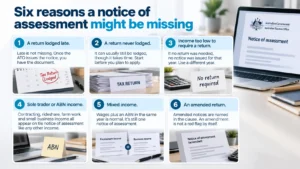
Six reasons a notice of assessment might be missing
- A return lodged late. Late is not missing. Once the ATO issues the notice, you have the document.
- A return never lodged. It can usually still be lodged, though it takes time. Start before you plan to apply.
- Income too low to require a return. If no return was needed, no notice was issued for that year. Use a different year.
- Sole trader or ABN income. Contracting, rideshare, farm work, and small business income all appear on the notice of assessment like any other income.
- Mixed income. Wages plus an ABN in the same year is normal. It’s still one notice of assessment.
- An amended return. Amended notices are named in the clause. An amendment is not a red flag by itself.
You can check which years the ATO has actually issued a notice through your myGov account, linked to ATO online services. The ATO explains what the document is and how to view it on its notice of assessment page. Doing this early gives you room. A gap found eighteen months out is just an item on a list.
If you’re reading this and recognising your own file, the useful step is a review of your five years before anything is lodged. Book your consultation with a MARA-registered agent, MARN 2619480, and find out which three years actually work for you. The conversation stays confidential.
Could a minimum income be introduced later?
It could, because the power to set one still exists. Sub-clause (3) lets a Minister specify an amount by legislative instrument at any time, and that door has never been closed.
We’d rather tell you that than pretend the position is permanent. It isn’t.
What that means in practice is straightforward:
- Your application is assessed against the rules as they stand on the day you lodge.
- No instrument is in place as at 10 September 2026. There is no amount to meet today.
- If an instrument were ever made, it would be published, dated and reported widely. It would not appear quietly.
- There’s no benefit in delaying a lodgement you’re already eligible for, to satisfy a figure that isn’t part of the test.
So the practical answer is a calm one: lodge when you’re eligible and your documents are complete. There’s nothing to be gained by holding off for a number that isn’t there.
Which brings us to what actually costs people this visa.
What do people usually get wrong about the income years?
The paperwork around the earnings, and the dates around the paperwork. The money itself is almost never the problem.
The files that need extra work on this pathway are rarely the weak ones. They’re usually solid three-year histories with a document missing or a year miscounted.
The seven we see most often
- Ruling yourself out over the $53,900. People delay lodging, or don’t apply at all, because of a figure that was never law. It’s the most common one on this list, and the simplest to put right.
- Submitting the wrong three years. Choosing your highest-earning years instead of your most complete ones. Completeness is what’s being tested.
- Writing off your first year. Assuming a part-year doesn’t count, when “all or part” of the income year is enough.
- Lodging with two notices and a third on the way. It’s worth waiting until the third notice has actually been issued.
- Ignoring an ATO balance. Yours or a family member’s. It slows the file down at a point where months matter.
- Counting three years from arrival instead of from the grant date. A separate trap, and a costly one. Our guide to the 491 to 191 pathway walks through the timing.
- Trusting an undated page. Including a page that quotes a firm dollar figure with no source and no date beside it.
Every item on that list can be sorted out before you lodge. That’s the whole reason to look at your file early rather than late.
If more than one of them describes your situation, that’s an ordinary starting point rather than a bad one. Book your consultation, and we’ll work through your five years with you.
How The Migration helps you check your five years
The work that matters on this visa happens before anything is submitted. That’s where we focus.
A pre-lodgement review of your file looks at the five years you’ve actually lived, not the five years the brochure describes:
- Your eligibility date, counted from the grant date of your 491 or 494, with the arithmetic shown to you.
- Your five income years, mapped out, so you can see which three are complete and which carry a gap.
- Your notices of assessment, checked against what the ATO has actually issued.
- Any ATO balance, yours or a family member’s, and what to do about it before you lodge.
- Your regional compliance history, discussed openly, including the parts you’re worried about.
Our advice is given by a MARA-registered migration agent, MARN 2619480. You can verify that registration yourself on the MARA public register, and we’d encourage you to check any agent you speak to the same way.
We see this cohort constantly at our Harris Park office in Sydney, and we speak with 491 and 494 holders in regional New South Wales, Victoria, South Australia and Queensland. The question in this article is the one we’re asked more than any other on the subclass 191 visa. Nobody has been embarrassed by their answer yet.
So what should you do about the $53,900?
Delete it from your planning. As at 10 September 2026, there is no 191 visa income requirement expressed as a dollar amount, and the figure you keep seeing belonged to a different visa program that moved on from it in July 2023.
Count your notices of assessment instead. Three, from any three of your five years, with the visa held for all or part of each one. That’s the test.
If you’re missing one, you have a task rather than a problem, and it’s a task with a deadline you can still control. If you’ve been holding off on lodging because of a number, you’ve been waiting for something that was never coming.
Get your five years reviewed before you lodge. In one sitting, a MARA-registered agent MARN 2619480 will confirm your eligibility date, map your income years, and tell you honestly where the risk sits in your file. Book your consultation with The Migration.