
Suppose you hold a passport from a Pacific Island country or Timor-Leste. You may pay a much lower Australian visa charge than everyone else in the queue.
From 1 July 2026, the standard Student visa (subclass 500) charge rose to AUD 2,500. The Temporary Graduate visa (subclass 485) rose to AUD 5,750. People from the Pacific and Timor-Leste were left out of that rise. You keep the older, lower charge. It moves each year by CPI only.
We know how this lands. You’ve read a fee table online, added up the numbers, and quietly decided Australia is out of reach. Then someone tells you that the number you saw might not be yours at all. It’s confusing. The official pages don’t spell it out in one place.
So here is the plain version. The lower charge is tied to the passport you hold. Not to where you live. Not to where you apply from. It covers the main applicant, and it flows down to family members named in the same form. You don’t apply for it, and it isn’t a discount code. It’s simply a different rate in the fee rules.
What Is the Pacific and Timor-Leste Visa Cost Concession?
It is a lower visa application charge (VAC) set aside for citizens of listed Pacific Island countries and Timor-Leste. Where it applies, you pay the Pacific-regional rate, not the standard rate. Across a family, the gap can run to thousands of dollars.
Australia has priced the region lower for several years. What changed on 1 July 2026 is the size of the gap. Charges across dozens of subclasses jumped that day. Pacific and Timor-Leste applicants were held at the old rate. The savings grew overnight, and nobody in the region had to lift a finger.
The reason is policy, not kindness. Australia has been building closer study and work ties with its neighbours through the Pacific Engagement Visa (subclass 192) and the PALM scheme. Pricing people out of student and graduate visas would cut against that.
The obvious next question is whether your country is on the list.
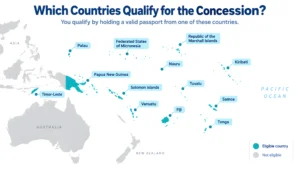
Which Countries Qualify for the Concession?
Thirteen countries sit in the Pacific Island and Timor-Leste group. You qualify by holding a valid passport from one of them.
Pacific Island and Timor-Leste Countries
- Federated States of Micronesia
- Fiji
- Kiribati
- Nauru
- Palau
- Papua New Guinea
- Republic of the Marshall Islands
- Samoa
- Solomon Islands
- Timor-Leste
- Tonga
- Tuvalu
- Vanuatu
ASEAN Countries: A Second, Smaller Cut
There is a second group for ASEAN member states. It is not as generous. For the Student visa, eligible ASEAN citizens pay AUD 2,050 rather than AUD 2,500. The ASEAN group covers:
- Brunei, Cambodia, Indonesia, Laos and Malaysia
- Myanmar, the Philippines, Singapore, Thailand and Vietnam
The Timor-Leste Detail Most People Miss
Timor-Leste is an ASEAN member. For visa charges, it is still counted in the Pacific group. That matters, because the Pacific rate is lower.
- A Timor-Leste passport holder is charged the Pacific-regional rate.
- Being counted as ASEAN elsewhere does not change the fee.
- If an agent or college quotes you the ASEAN figure, ask them to check again.
Which Visas Does the Lower Charge Apply To?
The cut is biggest on the study and post-study path: the Student visa (subclass 500) and the Temporary Graduate visa (subclass 485). Lower rates also show up in parts of the skilled and employer-sponsored range. There, the amount shifts by subclass and stream.
| Visa | Charge before 1 July 2026 | Standard charge now | Pacific / Timor-Leste position |
| Student (subclass 500) | AUD 2,000 | AUD 2,500 | Held at the old lower rate, CPI-adjusted |
| Temporary Graduate (subclass 485) | AUD 4,600 | AUD 5,750 | Lower rate applies |
| Student-eligible ASEAN citizens | AUD 2,000 | AUD 2,050 | Separate, smaller cut |
What This Means in Practice
- A Fijian or Timorese student is not hit by the AUD 500 student rise.
- The savings stack when you move from a 500 to a 485: two charges, both lower.
- ELICOS and non-award students also sit outside the rise.
- For skilled and sponsored visas, the rate depends on the subclass. Check it rather than guess.
Your exact figure shifts with your subclass, stream, and family size. So price your own case. Don’t borrow someone else’s number.
How Do You Get the Lower Charge Applied?
You don’t apply for it. The Department sets the Pacific-regional charge from the passport listed in your form, at the moment you lodge. Your job is to put the right passport in front of them, and to make sure the form is valid.
Expert Australian Migration Guidance
Navigating the complexities of your visa journey is easier with professionals. Start your Australian dream today.
Book Consultation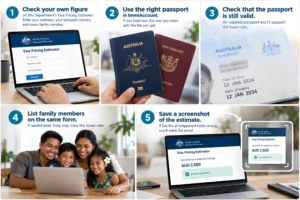
Steps to Take Before You Lodge
- Check your own figure on the Department’s Visa Pricing Estimator. Enter your subclass, your passport country, and every family member.
- Use the right passport in ImmiAccount. If you hold two, the one you enter sets the fee you get.
- Check that the passport is still valid. An expired passport won’t support the lower rate.
- List family members on the same form. If added later, they may miss the lower rate.
- Save a screenshot of the estimate. If the fee at lodgement looks wrong, you’ll want the proof.
What Happens If the Wrong Amount Is Charged
- Paying too little can make the form invalid. In law, it may count as never lodged.
- An invalid form does not hold your place. It does not protect your visa status either.
- Paying too much means asking for a refund. Refunds are slow and need proof.
- Either way, you lose weeks you may not have if your current visa is running down.

What the Lower Charge Does Not Cover
Only the visa application charge drops. Every other cost stays at the normal rate. That gap is what breaks most budgets.
Costs That Stay the Same
- Health checks: usually AUD 400–700 per person, more if tests are repeated.
- Police checks: from about AUD 42 for an Australian one, plus any overseas ones.
- NAATI translations: roughly AUD 39–89 per document or page.
- Overseas Student Health Cover: needed for the whole student visa period.
- Biometrics, courier costs and English test fees: all charged in full.
Schemes That Work on Different Rules
- The Pacific Engagement Visa (subclass 192) is a ballot-based permanent visa. It has its own process and its own fees.
- The PALM scheme is employer-led work mobility. It is not the same thing as a lower charge.
- Genuine student rules, money evidence, and English levels don’t change. A lower fee doesn’t soften the bar.
Knowing what isn’t covered helps. Knowing where people lose the lower rate helps more.
Mistakes That Cost People the Lower Rate
Most losses come down to paperwork, not who you are. These are the ones we see again and again.
- Lodging on the wrong passport. Dual nationals often enter on the one they travel on, not the eligible one.
- Assuming Timor-Leste is charged as ASEAN. It isn’t, and the gap is real money.
- Trusting an old fee table. Anything from before 1 July 2026 is out of date.
- Adding a spouse or child after lodgement. Name everyone from the start.
- Reading PR into it. The 500 and 485 are temporary visas. A lower fee changes the cost, not the path.
- Letting the passport lapse partway. Renew early and tell the Department.
Most people want a second opinion at this stage, and that’s fair. Getting the charge wrong at lodgement is one of the few slips that can sink a strong case on a technicality. Our MARA-registered agents (MARN 2518738) in Harris Park, Sydney can check your passport position and confirm the right fee before you lodge book a session with a registered agent.
Conclusion
The cost concession for Pacific Island and Timor-Leste applicants is rare good news in a year of rising visa fees. Thirteen countries qualify. It follows your passport, lands on its own at lodgement, and flows to family named on the same form. Timor-Leste sits in the Pacific group, not the ASEAN group. Worth holding on to, because the rates differ.
What it won’t do is cut your health, police, translation, or health cover costs. It doesn’t lower the bar you have to meet either.
Before you lodge, get your number confirmed. Speak with a MARA-registered migration agent at The Migration to check whether the Pacific-regional rate fits your subclass, price your full case, and lodge it right the first time.