There is no single labour agreement occupation list. Ten industry agreements exist, each with its own occupations; thirteen Designated Area Migration Agreements cover named regions with their own lists, and a company-specific agreement carries whatever occupations that one business negotiated. So the occupations open to you depend entirely on which agreement covers your employer, and that is the first thing to establish.
This article names all ten industry agreements and all thirteen DAMAs, shows the occupations each covers, and explains how to work out which one applies to you.
The Ten Industry Labour Agreements
An industry agreement already exists, so an employer in that sector can nominate without negotiating anything new. Terms sit in a template published by the Department of Home Affairs, and the concessions are the same for every employer using it. An agreement runs for five years from the date it takes effect.
| Industry agreement | Occupations it covers | What the template actually gives you |
| Aged Care | Aged or Disabled Carer, Nursing Support Worker, Personal Care Assistant | Reduced income threshold of AUD 51,222 and lower English. No age concession |
| Fishing | Deck Hand, Fishing Hand, Master Fisher, Ship’s Engineer, Ship’s Master, Ship’s Officer, Seafood Process Worker | Lower English, plus salary and age concessions in regional categories only |
| Meat | Skilled Meat Worker, covering slaughterers and meat boners or slicers | Salary and age concessions in regional categories only |
| Dairy | Senior Dairy Cattle Farm Worker, Dairy Cattle Farm Operator | Salary and age concessions in regional categories only |
| Pork | Senior Stockperson (Piggery) | Salary and age concessions in regional categories only |
| Horticulture | About 31 occupations across growing, packing and supervision | 90 percent of the income threshold, age under 50, lower English, non-monetary benefits counted |
| Restaurant (Premium Dining) | Chef, Cook, Cafe or Restaurant Manager, Trade Waiter | No salary concession. Lower English and age under 55 |
| Minister of Religion | Minister of Religion, Religious Assistant | Non-monetary benefits counted toward salary, with an exemption for those under a vow of poverty |
| Advertising | Advertising Specialist, Graphic Designer, Copywriter, Multimedia Designer, Web Developer | No salary, English or age concession. An AUD 85,000 earnings floor for permanent nominations |
| On-hire | Occupations on the Core Skills Occupation List | Stricter than standard. Earnings 20 percent above the income threshold, plus extra experience |
Read from the current template before you build a case around a concession. Note that the Home Affairs industry labour agreements page no longer lists the ten inline, so the templates are the evidence.
| Not every industry agreement is a discount
Two of the ten make things harder. Advertising gives no salary, English or age concession at all, and imposes an earnings floor of AUD 85,000 for permanent nominations. On-hire requires earnings 20 percent above the Core Skills Income Threshold, plus two years of experience beyond what ANZSCO asks. An employer reaching for a labour agreement expecting relief will find none in either. |

The column cannot show two further things. The primary industry agreements, meaning fishing, meat, dairy and pork, gate their concessions by location: the 90 percent salary discount reaches Category 3 regional locations only, and the age concession applies to Categories 2 and 3. And the Core Skills Income Threshold of AUD 79,423 from 1 July 2026 applies unless the agreement expressly varies it. The Skilling Australians Fund levy applies to these nominations as it does to standard ones.
The aged care agreement has a condition nobody writes about
The Aged Care Industry Labour Agreement carries the largest concessions on this page: an income threshold of AUD 51,222 against the standard AUD 79,423, and English as low as IELTS 4.5 overall for a culturally and linguistically diverse provider. It also carries a requirement no other agreement has. The employer must enter a Memorandum of Understanding with the relevant union before the agreement takes effect, then consult every six months and let the union run an induction meeting within seven days of a worker starting.
That MoU is the step that stops most aged care employers, not the paperwork. Our notes on becoming an aged care worker and the PR pathway for aged care workers cover the worker’s side.
The Thirteen DAMAs and Where They Operate
A Designated Area Migration Agreement is a labour agreement for a region rather than an industry, and it works in two tiers. A local authority negotiates a five year head agreement, then employers in that area seek the authority’s endorsement and sign their own agreement underneath it. DAMA occupation lists run far wider than the national lists, which is why regional employers reach for them.
| DAMA | State | Designated area authority | Status |
| Northern Territory | NT | MigrationNT, Department of Trade, Business and Asian Relations | NT DAMA III executed March 2025 |
| Adelaide City Technology and Innovation Advancement | SA | Skilled & Business Migration, Department for Industry, Innovation and Science | Expires 30 September 2026 |
| South Australia Regional | SA | Skilled & Business Migration | Expires 30 September 2026 |
| Western Australia | WA | Department of Training and Workforce Development | Statewide, absorbing the regional WA agreements |
| The Goldfields | WA | City of Kalgoorlie-Boulder | Ends 31 December 2026 |
| South West | WA | Shire of Dardanup | Closes to new applications 30 October 2026 |
| Pilbara | WA | RDA Pilbara | Active, no published end date |
| East Kimberley | WA | East Kimberley Chamber of Commerce and Industry | Active, no published end date |
| Far North Queensland | QLD | Cairns Chamber of Commerce | Active |
| Townsville | QLD | Townsville Enterprise Limited | Active |
| Goulburn Valley | VIC | Greater Shepparton City Council | Covers Greater Shepparton, Moira and Campaspe |
| Great South Coast | VIC | Warrnambool City Council | Covers six local government areas |
| Orana | NSW | Regional Development Australia Orana | Reaches well beyond Orana; see below |
Thirteen is what Home Affairs publishes as at 18 September 2026, on a page last updated 5 November 2025. Several agreements have moved since.
| Four of the thirteen are on a countdown
South Australia’s two agreements were extended only to 30 September 2026 while the state negotiates a new five-year statewide DAMA. In Western Australia, the four regional agreements are folding into the statewide WA DAMA: the Goldfields runs to 31 December 2026, with the WA DAMA taking over from 1 January 2027 and at least 500 places a year guaranteed, and the South West expires 14 December 2026 and closes to new applications on 30 October 2026. If you are an employer in either state, the date matters more than the list. |
Orana reaches most of inland New South Wales. Despite the name, it covers the Orana, Central West, Southern Inland, Murray and Riverina regions. Employers outside Dubbo read the title and stop reading, which is the most common reason a viable NSW sponsorship never starts.
Tasmania and the ACT have no DAMA. Migration Tasmania says it is exploring one. Until it lands, employers there use the standard program or an industry agreement.
Each DAMA publishes its own occupation list and its own concessions, and they differ considerably. Age limits commonly run to 55 against the standard 45, salary concessions commonly sit at 10 percent of the income threshold, about AUD 71,481 on the current figure, and several reduce English and work experience requirements. Most carry a permanent residency pathway after two or three years, and South Australia cut its pathway to two. The current details sit on the Home Affairs DAMA page, and our guide to the DAMA visa explains how the regional pathway works in practice.
One restriction is worth noting. From 1 July 2025, South Australia stopped accepting DAMA nominations where an industry agreement already covers the occupation, so aged care employers there use the aged care agreement or PALM instead.
Company Specific and Project Agreements
Where no industry agreement reaches a business, and no DAMA covers its region, an employer can request a company-specific agreement. The occupations, the salary floor, the English level and the skills assessment rules are all negotiated for that one business.
Two things before an employer goes down this road. The negotiation takes months and can approach a year, and the Department expects evidence of a genuine shortage the standard programs cannot fill. Checking the industry list and the DAMA map first takes an afternoon.
Expert Australian Migration Guidance
Navigating the complexities of your visa journey is easier with professionals. Start your Australian dream today.
Book ConsultationHow to Find Out Which Agreement Covers You
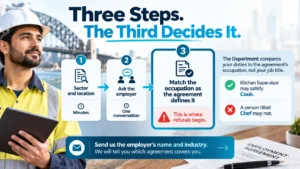
Step one, identify the sector and the location. The ten sectors above all have national agreements. An employer outside those sectors sitting in one of the thirteen designated areas should look at the DAMA next.
Step two, ask the employer directly. Employers who already hold or sit under an agreement know their agreement number, and Home Affairs publishes the list of current labour agreements. Employers who have never sponsored often do not know whether their industry has one, which is the most common reason employers never start a viable sponsorship.
Step three: match the occupation as the agreement defines it. This decides the nomination, and it is where most refusals begin. The agreement names an occupation, and the Department compares that name to the duties you actually perform, not the job title on your contract. A Kitchen Supervisor may well satisfy the Cook occupation, and a person titled Chef may not, depending entirely on the work. Our note on the move from ANZSCO to OSCA explains why migration still runs on the older classification.
Ask us which agreement covers your employer
Why the Occupation Match Matters More Than the List
Reading a list takes minutes. Proving your role is the occupation the agreement names takes evidence.
Under the 482 labour agreement stream, the agreement replaces parts of the standard Skills in Demand rules. It can name occupations no skilled list carries, set a different salary floor, lower the English requirement, and change or waive the skills assessment. Your eligibility comes from a legal document written for one employer or one industry, and the occupation named in it is the gateway. If it is not there, no amount of evidence helps. If it is, the case rests on matching your duties to it properly.
That is also why this pathway reaches people the skilled occupation lists leave out. Personal care workers, slaughterpersons, dairy hands and fishers rarely appear on the Core Skills Occupation List, and the program exists because the national lists cannot name every job the economy relies on.
Find Out Which Agreement Names Your Occupation
Send us the employer’s name and industry, or the agreement itself if you have it. Our team will confirm whether your occupation is covered, which concessions apply to you, and what the process costs. We see clients in Harris Park, Melbourne, and online.
Book a consultation Ask about your occupation
No registered migration agent can guarantee a visa outcome. Verify any agent on the Register of Migration Agents, maintained by the Office of the MARA.