
Australia consistently ranks among the world’s top study destinations, attracting over 700,000 international students each year. From world-class universities to diverse cultural experiences and strong post-study work rights, Australia offers a compelling pathway for students pursuing a global education. Yet beneath the opportunity lies a set of real, often overlooked challenges that can significantly impact academic performance, mental health, and overall well-being.
Whether you are preparing to apply for a Student Visa (Subclass 500) or have already arrived in Australia, understanding what lies ahead helps you plan strategically rather than react under pressure. From complex documentation and strict admission requirements to financial management, cultural adjustment, and homesickness, every international student faces a unique set of hurdles on their journey.
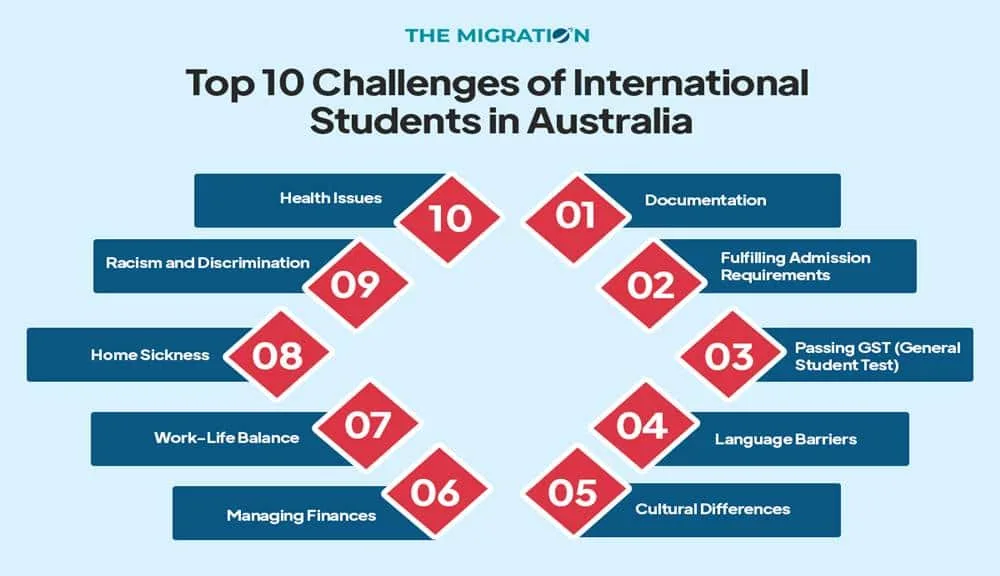
This guide breaks down the top 10 challenges of international students in Australia with evidence-based, practical strategies to overcome each one. If visa complications arise at any stage of your studies, The Migration’s registered migration agents are available to provide expert guidance every step of the way.
What Are the Top 10 Challenges International Students Face in Australia?
The most common challenges international students face in Australia are documentation complexity, meeting admission requirements, language barriers, cultural adjustment, financial pressure, maintaining work-life balance, homesickness, racism and discrimination, health management, and academic performance stress. These challenges vary in intensity depending on a student’s country of origin, language background, financial circumstances, and institution, but nearly every international student encounters some combination of them throughout their time studying in Australia.
1. How Complex Is the Documentation Process for International Students in Australia?
The documentation process for international students in Australia is one of the most demanding administrative challenges of the entire student visa journey, and a single missing or incorrect document can result in a visa refusal from the Department of Home Affairs, delaying enrolment by an entire semester or more. Because document requirements differ by institution, visa type, and country of origin, errors are far more common than most applicants expect.
Key Documents Required for a Student Visa (Subclass 500)
- Valid passport with at least six months of validity beyond your intended stay in Australia
- Confirmation of Enrolment (COE) from your registered Australian institution
- Genuine Temporary Entrant (GTE) statement: a written explanation of your reasons for studying in Australia
- Academic transcripts, educational certificates, and relevant qualifications
- English language proficiency results (IELTS, PTE Academic, TOEFL, or equivalent)
- Evidence of sufficient financial capacity to cover tuition fees and living costs
- Overseas Student Health Cover (OSHC) policy from an approved Australian provider
- Health examination results and police clearances as required by the Department of Home Affairs
Working with a registered migration agent before submitting your student visa application significantly reduces the risk of refusal due to documentation errors or incomplete submissions.
2. Why Are Australian University Admission Requirements So Challenging for International Students?
Australian universities and vocational institutions set highly specific academic and English language entry requirements that many international students find difficult to meet without thorough preparation, making admission approval the critical first gate in the entire student visa process. The Confirmation of Enrolment (COE), which is mandatory for a Student Visa 500 application, cannot be issued until the institution is fully satisfied that all entry requirements have been met.
Common Admission Hurdles International Students Encounter
- Minimum English proficiency score thresholds that vary by course level, institution, and faculty
- Academic prerequisite subjects not covered in the applicant’s home country curriculum
- Recognition and evaluation of foreign qualifications and transcripts by Australian institutions
- Competitive entry for high-demand programs, including medicine, law, engineering, and nursing
- Portfolio, interview, or audition requirements for creative and performing arts programs
- Foundation or pathway program requirements for students who do not meet direct entry standards
If you are uncertain whether your existing qualifications meet Australian entry standards, seeking guidance from an education counsellor or migration agent early can save you significant time and application costs.
3. How Do Language Barriers Affect International Students in Australia?
Language barriers remain one of the most persistent challenges for international students in Australia, affecting everything from classroom participation and academic writing to forming friendships and navigating daily life, even for students who performed well on formal English proficiency tests. Australian accents, regional idioms, colloquial expressions, and the rapid pace of university lectures create comprehension gaps that no test preparation can fully anticipate.
Practical Strategies to Overcome Language Barriers
- Enrol in university-run academic English or English for Academic Purposes (EAP) programs before your degree commences
- Join campus conversation clubs, language exchange programs, and multicultural student groups
- Immerse yourself in Australian media news broadcasts, podcasts, and films to build familiarity with local accents and expressions
- Attend your lecturers’ and tutors’ office hours regularly to clarify course content and academic expectations
- Request lecture recordings where available so you can revisit and reinforce what you have covered
- Use dictionary and translation apps as learning tools, not permanent substitutes for comprehension
4. How Do Cultural Differences Impact International Students Studying in Australia?
Cultural differences can create significant friction for international students in Australia, shaping how they interact with peers, respond to authority, approach group assessments, and interpret social situations in ways that are rarely discussed during the pre-departure phase. Students from high-context communication cultures, where meaning is conveyed indirectly, often find Australia’s direct communication style confronting, while students accustomed to hierarchical academic environments may find the informal Australian classroom culture disorienting.
Ways to Navigate Cultural Adjustment More Effectively
- Attend cultural orientation sessions offered by your university during the first week of enrolment
- Join both culturally specific student associations and broader multicultural groups to balance community with integration
- Familiarise yourself with Australian academic norms around group work, academic integrity, deadlines, and peer feedback
- Seek peer mentoring from senior international students who have already navigated the same cultural adjustment
- Be patient with yourself, cultural adjustment is a gradual process that typically takes six to twelve months
5. How Do International Students Manage the High Cost of Living in Australia?
Managing the cost of living in Australia is one of the most significant practical challenges international students face, as they are generally ineligible for government financial assistance available to domestic students and must fund both their tuition and daily living entirely from personal savings, family support, and permitted part-time work. With average living costs ranging from AUD $20,000 to $27,000 per year, depending on the city, in addition to tuition fees, budgeting is not optional for international students; it is essential.
Money-Saving Strategies for International Students in Australia
- Research and apply for university scholarships, faculty grants, and external bursaries well ahead of your enrolment date
- Choose on-campus student accommodation or shared housing arrangements over private rentals to significantly reduce costs
- Cook meals at home regularly and meal prep in bulk rather than relying on takeaway or campus dining
- Use an ISIC card or a university-issued student concession card for discounts on public transport, entertainment, and retail
- Track all spending using a budgeting app and review your budget weekly
- Use your Student Visa 500 work entitlement (up to 48 hours per fortnight during study periods) to earn supplementary income
- Open an Australian bank account immediately upon arrival to avoid international transaction fees on everyday purchases
6. How Do International Students Balance Study, Work, and Life in Australia?
Maintaining work-life balance is a genuine and ongoing challenge for international students in Australia, who often juggle full-time study, part-time employment, household responsibilities, and social obligations while simultaneously adapting to an entirely new environment. The financial pressure to earn while studying, combined with the academic pressure to perform, creates a cycle of stress that, without proactive management, can erode both academic results and mental health over time.
Strategies to Achieve a Sustainable Work-Life Balance as a Student
- Build a weekly schedule that explicitly blocks time for study, work, self-care, exercise, and social connection
- Set realistic academic goals each semester rather than pursuing perfection across every subject simultaneously
- Limit work hours to the visa-permitted maximum and reduce shifts during high-assessment periods rather than letting work commitments override study
- Incorporate regular physical activity into your weekly routine, even short daily walks, and meaningfully reduce stress levels
- Access your university’s student counselling service early, before stress becomes unmanageable
- Use task management and calendar apps to prioritise assessment deadlines and avoid last-minute cramming cycles
7. How Do International Students Deal With Homesickness in Australia?
Homesickness is an almost universal experience for international students in Australia, particularly in the first three to six months of arrival, when the initial excitement of a new environment gives way to the weight of distance from family, familiar foods, and long-established routines. Left unaddressed, homesickness can deepen into social withdrawal and depression, significantly affecting both mental health and academic engagement, making it one of the most personally challenging obstacles of the international student experience.
Proven Ways to Manage Homesickness as an International Student
- Schedule regular video calls with family and close friends back home, but set healthy boundaries to avoid over-reliance that prevents local integration
- Recreate familiar comforts: cook meals from home, celebrate your cultural festivals, and connect with local communities that share your background
- Build genuine friendships on campus by joining clubs, study groups, and community volunteering activities
- Allow yourself to acknowledge and process the distance without guilt. Homesickness is a natural emotional response, not a sign of weakness
- Access your university’s international student support office for peer networks, cultural programs, and counselling referrals
8. How Does Racism and Discrimination Affect International Students in Australia?
Racism and discrimination remain a documented challenge for some international students in Australia, occurring across social, academic, and workplace settings and significantly impacting mental health, academic confidence, and sense of belonging in ways that are often invisible to those who have not experienced them. While Australia’s multicultural population and anti-discrimination legislation provide important legal protections, experiences of racial bias, microaggressions, and overt discrimination are still reported by a meaningful number of international students each year.
Expert Australian Migration Guidance
Navigating the complexities of your visa journey is easier with professionals. Start your Australian dream today.
Book ConsultationHow to Protect Yourself and Respond to Discrimination in Australia
- Report incidents to your university’s equity and inclusion office or student ombudsman. Most institutions have formal investigation processes and take complaints seriously
- Contact the Australian Human Rights Commission if the matter requires escalation beyond the institutional level
- Seek peer support through your institution’s international student support centre or relevant cultural student associations on campus
- Document all incidents with dates, locations, and detailed descriptions before submitting any formal complaint
- Know your legal rights: Discrimination based on race, ethnicity, nationality, or religion is unlawful in Australia under the Racial Discrimination Act 1975
9. What Health Challenges Do International Students Face in Australia?
International students in Australia face a distinct set of health challenges that are often more complex than those encountered by domestic students, due to the unfamiliar Australian healthcare system, mandatory Overseas Student Health Cover (OSHC) requirements, and the cumulative physical and psychological toll of adapting to a new country. Poor health directly undermines academic performance and can jeopardise student visa conditions if attendance requirements are affected by prolonged illness or unaddressed mental health issues.
How to Manage Your Health Effectively as an International Student
- Understand your OSHC policy thoroughly before you arrive, know what is covered, how to submit a claim, and which hospitals and GPs are in your provider’s network
- Register with a General Practitioner (GP) near your campus immediately upon arrival, rather than waiting until you are unwell
- Use your university’s on-campus health and counselling services for routine checkups, immunisations, and mental health support
- Prioritise consistent sleep, balanced nutrition, and regular physical activity; these form the foundation of both physical and academic resilience
- Access mental health support proactively; many universities offer low-cost or bulk-billed psychological services for currently enrolled students
- Speak to your student advisor if a health condition is affecting your attendance. Universities have formal provisions for students managing medical circumstances
10. How Does Academic Pressure Affect International Students in Australia?
Academic pressure is a significant and frequently underestimated challenge for international students in Australia, who often carry expectations from their families, sponsors, and themselves that exceed those placed on domestic students, while simultaneously managing language, cultural, financial, and logistical obstacles that their local peers do not face. The gap between what students expected university study to involve and the reality of independent research, critical analysis, and time management under pressure can be deeply disorienting, particularly in the first semester.
Strategies to Manage Academic Pressure and Perform Consistently
- Attend all academic skills workshops and orientation sessions offered by your university at the start of each semester
- Use academic support services, writing centres, library research support, and subject-specific tutoring proactively at the beginning of a course, not reactively when a deadline is near
- Create a semester study schedule that distributes workload evenly, rather than front-loading or cramming before assessment periods
- Communicate with your lecturers and tutors early if you are struggling — Australian academics are generally accessible and supportive when approached with honesty
- Break large assessments into smaller milestone tasks to avoid the paralysis that comes with complex, open-ended assignments
- If serious academic difficulties persist, speak to your student advisor about available options, including extensions, special consideration, or adjusted course loads
How Can International Students Successfully Overcome These Challenges in Australia?
International students can successfully overcome the challenges of studying in Australia by combining deliberate pre-arrival planning with consistent, proactive use of the institutional support systems available once enrolled. The students who perform best are not those who avoid difficulty, but those who identify the right resources early and seek help before problems escalate.
Build a Strong Support Network From Day One
- Connect with your university’s international student office and student union during orientation week
- Join at least one social or cultural student group within your first month on campus
- Identify a peer mentor from your faculty or the broader international student community
- Establish relationships with two or more academic staff members you feel comfortable approaching for academic guidance
Plan Your Finances Thoroughly Before You Arrive
- Calculate the total cost of living for your specific city and institution, including one-off arrival expenses such as bond, bedding, and transport
- Build a detailed month-by-month budget before your visa is granted and review it quarterly
- Research part-time work opportunities relevant to your field of study before you land in Australia
- Confirm that your OSHC policy covers the full duration of your Student Visa 500 before departure
Make Full Use of Every Campus Resource Available to You
- Library research services and academic writing support centres
- On-campus health, counselling, and mental health services
- Career services for part-time employment and internship placement
- Student legal services for tenancy, workplace, and consumer disputes
- Student financial hardship funds and emergency relief programs were available
How The Migration Helps International Students Navigate the Australian Student Visa Process
Many of the challenges international students face in Australia, from visa application errors and COE complications to course change notifications and post-study pathway planning, stem directly from immigration complexity that is difficult to navigate without professional support. The Migration is a registered Australian migration agency with offices in Harris Park, Sydney and Melbourne CBD, and our team of registered migration agents has assisted students from dozens of countries in successfully obtaining and maintaining their Student Visa 500.
Why International Students Trust The Migration
- Registered Migration Agents (RMAs): All advisers are registered with the Migration Agents Registration Authority (MARA), ensuring every piece of advice is legally compliant and professionally accountable
- End-to-end student visa support: From initial eligibility assessment through to COE guidance, GTE statement preparation, and formal lodgement with the Department of Home Affairs
- Student Visa 500 extensions and institution changes: Expert support when your circumstances change, including course extensions, provider transfers, and visa renewals
- Post-study visa pathway planning: Strategic guidance for the Temporary Graduate Visa (Subclass 485) and skilled migration pathways for graduates
- Visa condition compliance advice: Clear guidance on enrolment attendance requirements, permitted work hours, and course progress obligations to keep your visa in good standing
To speak with one of our migration agents about your student visa situation or post-study options, contact The Migration today. Our team is ready to assist you.
Conclusion
The challenges of being an international student in Australia are real, layered, and sometimes overwhelming, but they are also well-documented and navigable with the right preparation and support structure in place. From documentation complexity and admission hurdles to financial pressure, cultural adjustment, academic stress, and everything in between, each challenge outlined in this guide has a clear, practical pathway through it.
The students who thrive in Australia are not those who avoid difficulty; they are those who anticipate it, seek help early, and make consistent use of the institutional and professional resources available to them. If any aspect of your Student Visa (Subclass 500) application, enrolment process, or post-study plans requires expert immigration guidance, The Migration’s registered agents are available to assist. Book a consultation with our team and take the next step in your Australian education journey with confidence.
You may also find these related guides helpful:
Frequently Asked Australian Student Visa Interview Questions and Answers
Can I Travel Home During Semester Breaks on a Student Visa 500? (2026 Guide)