

Your 485 Temporary Graduate visa has expired. You have three pathways to stay in Australia legally:
- Get employer-sponsored: via the Subclass 482 or 186 visa
- Apply through skilled migration: via a points-based 189, 190, or 491 visa
- Return to study: via a Student Visa (Subclass 500) to buy time and boost your points
Each pathway has strict deadlines. If you have not yet lodged a new application, every day without action risks unlawful status, loss of work rights, and a three-year re-entry ban.
Australia’s 2026 migration program continues to prioritise skilled workers across healthcare, engineering, education, and technology. Your Australian work experience, local qualifications, and English proficiency are genuine assets under the current points system. The opportunity is real, but the window is time-sensitive.
This guide outlines your realistic pathways to remain in Australia and provides a complete understanding of the 485 visa expiry. We cover work-sponsored visas, state-nominated permanent residency, and further study options. Whether you want to work, live, or settle permanently, a clear plan exists. Let’s explore your move.
Understanding Your 485 Visa Expiry Date and Grace Period
Missing your visa expiry date can lead to immediate deportation and a three-year ban from Australia. It is really important to understand your 485 visa Expiry Date. In the section below, you will know everything.
How to Check Your 485 Visa Expiry Date
Knowing your exact expiry date prevents legal disasters. Do not guess. Use official government tools to confirm your status.
- VEVO System Walkthrough: Use the Visa Entitlement Verification Online (VEVO) system. Enter your passport details and your Visa Grant Notice number. The system shows your current visa status and the precise expiry date.
- ImmiAccount Instructions: Log in to your ImmiAccount. Locate your 485 visa application. View the “Grant Letter” in the attachments. This document lists the “Must Not Arrive After” date or the specific expiry period.
- Warning Signs: Check your email for notifications from the Department of Home Affairs. Monitor your visa length if you moved from a regional area. Check your passport’s validity, as a nearing passport expiry can complicate renewals.
Grace Period Myths: What Happens the Day After Expiry
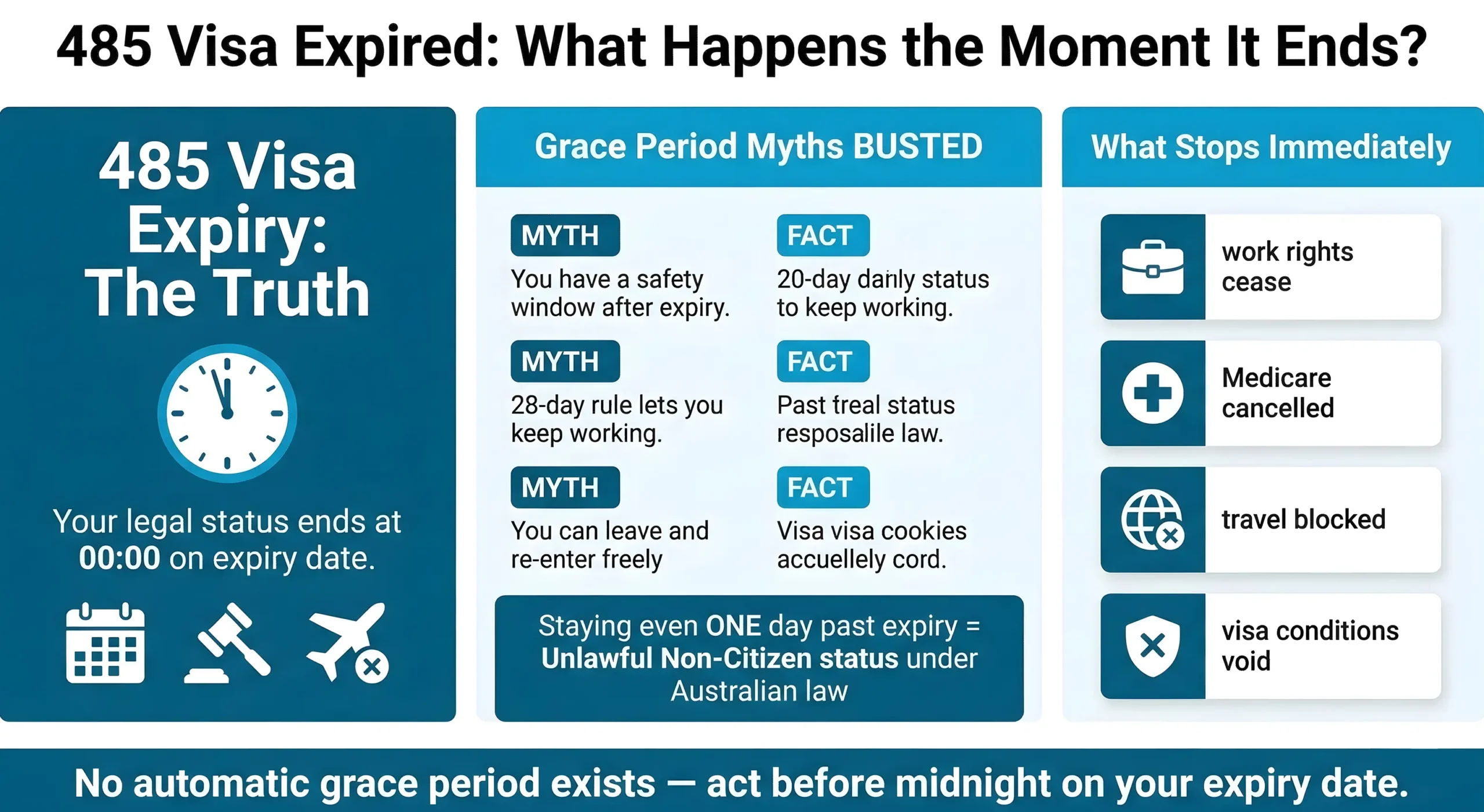
Many migrants believe they have a “safety window” to pack their bags. This is a dangerous misconception.
- No Automatic Grace Period: Australia does not grant an automatic “grace period” for 485 holders. Your legal status ends at midnight on the expiry date.
- Unlawful Stay Consequences: Staying even one day past your expiry makes you an “unlawful non-citizen.” This status triggers a three-year re-entry ban (Exclusion Period) for most temporary visas.
- The 28-Day Rule: A specific “28-day rule” exists for some student visa applications. However, this rule is a last resort. It does not allow you to work. It only provides a narrow path to apply for a new visa while still in the country.
What You Cannot Do Once Your 485 Visa Has Expired
Expiry strips you of your Australian privileges instantly. You must act before the clock hits zero.
- Work Rights Cease: You must stop working immediately. Employers face heavy fines for hiring unlawful workers. Your payroll system will likely flag your status.
- Medicare Coverage: Most 485 holders lose Medicare access. You become responsible for all medical costs. Private health insurance often cancels automatically once the visa expires.
- Travel Restrictions: You cannot re-enter Australia if you leave after your visa expires. If you are inside the country, you cannot depart and return without a valid visa.
- Bridging Visa Importance: You need a Bridging Visa A to stay legally while the Department processes a new application. Apply for your next visa before the 485 expires to trigger this protection.
Related Article: Complete Subclass 485 visa Requirements 2025-2026
Immediate Action Steps When Your 485 Visa Expires (Or Is About to Expire)
You must act fast to stay in Australia legally.
Option 1: Apply for a Bridging Visa (If Eligible)
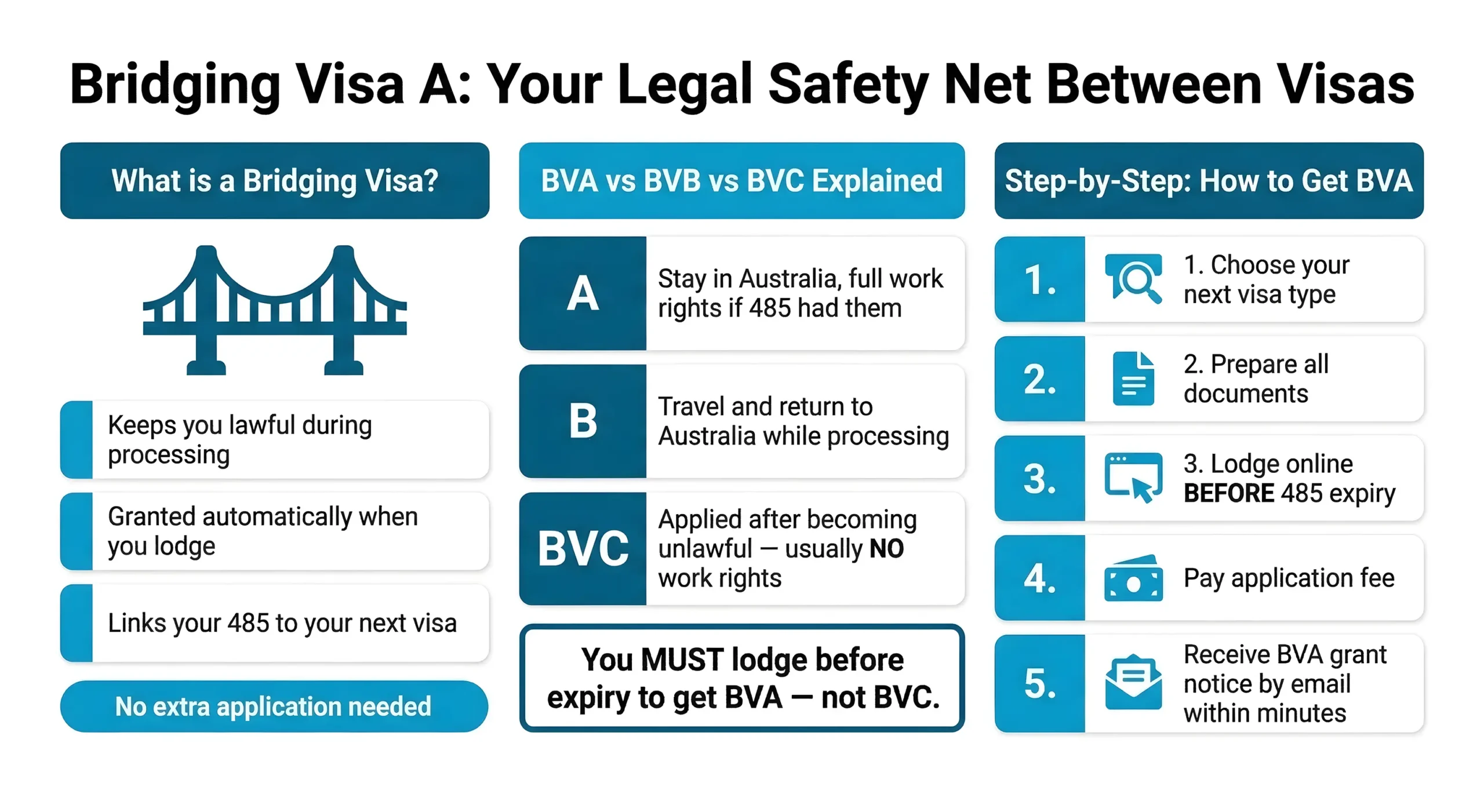
A bridging visa acts as a temporary link between two substantive visas. It keeps you lawful while the Department of Home Affairs processes your new application.
- Bridging Visa A, B, C Distinctions: A Bridging Visa A usually grants full work rights and allows you to stay. A Bridging Visa B lets you travel and return to Australia. A Bridging Visa C applies if you lodge an application while already unlawful; it generally offers no work rights.
- Eligibility Criteria: You must lodge a valid application for a new substantive visa while you still hold your 485 visa. The system grants the bridging visa automatically upon receipt of your application.
- Maintaining Lawful Status: The bridging visa starts the moment your 485 visa ends. It protects you from deportation during the processing period.
- Application Timeline: You must lodge your new visa application before your 485 visa expires. Missing this deadline by even one minute prevents you from getting a BVA.
Option 2: Lodge a Substantive Visa Application
A “substantive visa” is any visa that is not a bridging visa. You must choose the right one to trigger your stay.
- Substantive Visa Examples: Common choices include the Student Visa (500), the Skilled Nominated Visa (190), or the Employer-Sponsored Visa (482).
- Importance of Timing: Lodging before expiry secures your work rights and travel options. Lodging after expiry limits your choices significantly and may trigger strict “no further stay” conditions.
- Automatic Bridging Visa: Most online lodgements generate an immediate Bridging Visa A. You receive a grant notice via email within minutes of paying your application fee.
Emergency Measures: If Your Visa Has Already Expired
If your visa expired yesterday, you are in a legal crisis. You must move immediately to minimize the damage.
- Section 48 Bar Implications: Section 48 of the Migration Act may “bar” you from applying for most visas while you are in Australia. This often forces you to leave the country to lodge a new application.
- Limited Visa Options: You may only be eligible for a Bridging Visa E. This visa allows you to stay temporarily to make travel arrangements, but it usually forbids work.
- 35-Day Timeframe: You may have up to 35 days to apply for certain visas under “compelling and compassionate” circumstances. This window is very narrow and difficult to navigate.
- Seek Urgent Help: Contact a registered migration agent or immigration lawyer immediately. They can help you request a BVE and avoid detention or a long-term re-entry ban.
Skilled Migration Visas Leading to PR
Here’s the skilled Migration visas that can lead you to get a PR in Australia.
Pathway 1: Employer-Sponsored Visas
If you are currently working in Australia, your employer may be your fastest route to staying legally and long-term.
Subclass 482 (Temporary Skill Shortage)
The most accessible employer-sponsored option in 2026. Your employer must be an approved sponsor, and you need a minimum of two years of relevant work experience. The visa grants up to four years of stay, with processing times currently averaging two to six months. Your occupation must appear on the relevant skilled occupation list. This visa can later transition to permanent residency via the Subclass 186.
Subclass 186 (Employer Nomination Scheme)
Subclass 186 is a direct permanent residency pathway. You need at least three years of full-time work experience in your nominated occupation and must be under 45 years of age at the time of application. The Temporary Residence Transition stream, the most common route for 485 holders, requires you to have worked for the same employer for at least two years on a 482 visa. Processing times range from six to eighteen months.
Subclass 494 (Skilled Employer Sponsored Regional)
Designed for workers in designated regional areas. Offers a five-year temporary visa with a direct pathway to permanent residency via the Subclass 191 after three years. Regional sponsorship can be easier to secure than metro-based sponsorship, making this a practical option for those open to relocating.
Pathway 2: General Skilled Migration (Points-Based)
No employer required. These visas are based on a points test; you need a minimum of 65 points to be eligible to submit an Expression of Interest (EOI) through SkillSelect. In practice, most invitations in 2026 are going to candidates scoring 80 to 90 points or above, depending on the occupation.
Expert Australian Migration Guidance
Navigating the complexities of your visa journey is easier with professionals. Start your Australian dream today.
Book ConsultationPoints are awarded across: age (maximum 30 points for ages 25–32), English proficiency (up to 20 points for Superior English), skilled employment (up to 20 points for Australian experience), qualifications (up to 20 points for a Doctorate), and additional factors including partner skills, regional study, and Professional Year completion.
Subclass 189 (Skilled Independent)
A permanent visa with no state nomination or employer required. Invitation cut-offs in 2026 remain highly competitive; most invited applicants hold 85 to 95 points. Healthcare workers (nurses, GPs, specialists), engineers, and ICT professionals currently receive the majority of invitations. Processing time after invitation: approximately six to twelve months.
Related Article: your complete guide to the 189 visa Australia
Subclass 190 (Skilled Nominated)
State or territory nomination adds 5 points to your score and results in a permanent visa. You must commit to living and working in the nominating state for a minimum of two years. Each state publishes its own occupation list and nomination requirements, which are updated regularly. In 2026, states including Victoria, South Australia, and Tasmania are actively nominating across a broader range of occupations than the federal 189 list. Processing time: six to twelve months post-nomination.
Subclass 491 (Skilled Work Regional)
In subclass 491, State or family nomination to live and work in a designated regional area. Nomination adds 15 points, a significant advantage for applicants sitting between 65 and 80 points. The visa lasts five years. After three years of living and working regionally, you can apply for the permanent Subclass 191. Processing time: four to nine months post-nomination.
Pathway 3: Further Education
Returning to study extends your legal stay and can meaningfully increase your points score, making a skilled migration visa achievable where it previously was not.
Master’s or PhD
A Master’s degree by research or a Doctorate adds up to 20 points under the qualifications category. Completing postgraduate study in Australia also contributes to Australian study bonus points. A two-year Master’s program on a Subclass 500 Student Visa buys time while your SkillSelect score improves.
Professional Year Program
Available to graduates in Accounting, ICT, and Engineering. The program runs for approximately 44 weeks and adds 5 points to your skilled migration score upon completion. It also includes a structured internship component, directly improving local employability. In 2026, Professional Year completion remains one of the more reliable ways to cross the points threshold for a 190 or 491 invitation.
How the Migration helps
Navigating visa pathways alone is overwhelming, especially under a deadline. The Migration is a specialist immigration consultancy that guides you from uncertainty to a clear, actionable plan. Our registered migration agents assess your occupation, points score, and work history to identify your strongest visa pathway.
We handle every document, form, and submission to minimise errors that cause costly delays. If your visa is about to expire, we act fast to secure your Bridging Visa and protect your legal status immediately. From state nomination strategy to employer sponsorship support, we manage the entire process so you can focus on your future, not the paperwork.
If you’re worried about your 485 Visa Expired in Sydney, The Migration provides confidential consultations in-office or via Zoom tailored to your specific situation and timeline.
Applicants concerned about 485 Visa Expired in Melbourne can book an in-office or Zoom session with our registered migration agents at a time that suits them.
Conclusion
A 485 visa expiry is not the end of your Australian journey; it is a transition point that demands swift, informed action. Whether you pursue employer sponsorship, a points-based skilled visa, or return to study, every pathway requires planning and professional guidance.
The worst outcome is waiting until it is too late. Unlawful status, re-entry bans, and Section 48 bars are real consequences that can permanently alter your migration future. Australia values skilled migrants. Don’t navigate Australia’s complex visa system alone. Our registered migration agents are ready to assess your options and build a clear plan. Book your consultation with the migration today and take the first step toward securing your future in Australia.