

Yes, you can migrate to Australia without a job offer in 2026. Australia’s migration program includes several visa categories — most notably the General Skilled Migration (GSM) program — that do not require employer sponsorship. Instead, they assess your skills, qualifications, age, English level and points score to determine your eligibility.
However, these pathways are competitive, and the rules change frequently. Whether you can realistically move to Australia without a job offer depends on factors such as your occupation, work experience, qualifications, family situation and migration history.
This guide covers everything you need to know, including:
- When it is realistically possible to migrate without a job offer
- The main skilled migration visas that do not require employer sponsorship
- Other pathways including study, family, partner and working holiday visas
- How the points test works and what score you actually need
- Common reasons applications fail (and how to avoid them)
- When it is worth speaking with a registered migration agent
Is It Really Possible to Move to Australia Without a Job Offer?
In many cases, yes — it is possible to move to Australia without a job offer, but it is not available to everyone.
Australia’s migration program includes several visa categories that do not require employer sponsorship. Instead, they are based on your skills, qualifications, points score or family relationships, and sometimes on state or regional nomination rather than a specific employer.
However:
- You still need to meet strict eligibility criteria, and
- You may need to compete with other applicants for a limited number of invitations.
For skilled workers, the main pathway is the General Skilled Migration (GSM) program, which uses a points test and does not require you to hold a job offer at the time of application. For others, family, partner, study and working holiday pathways can provide options.
If you are unsure whether you qualify, a tailored assessment from a registered migration agent can help you understand what is realistic before you invest time and money.
Skilled Migration Visas That Don’t Require a Job Offer
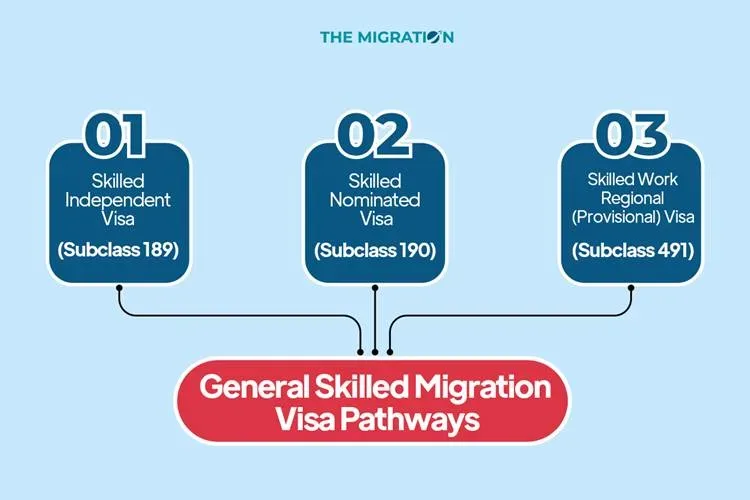
Australia’s General Skilled Migration program is designed for skilled workers who want to live and work in Australia without employer sponsorship. The key visas in this program are:
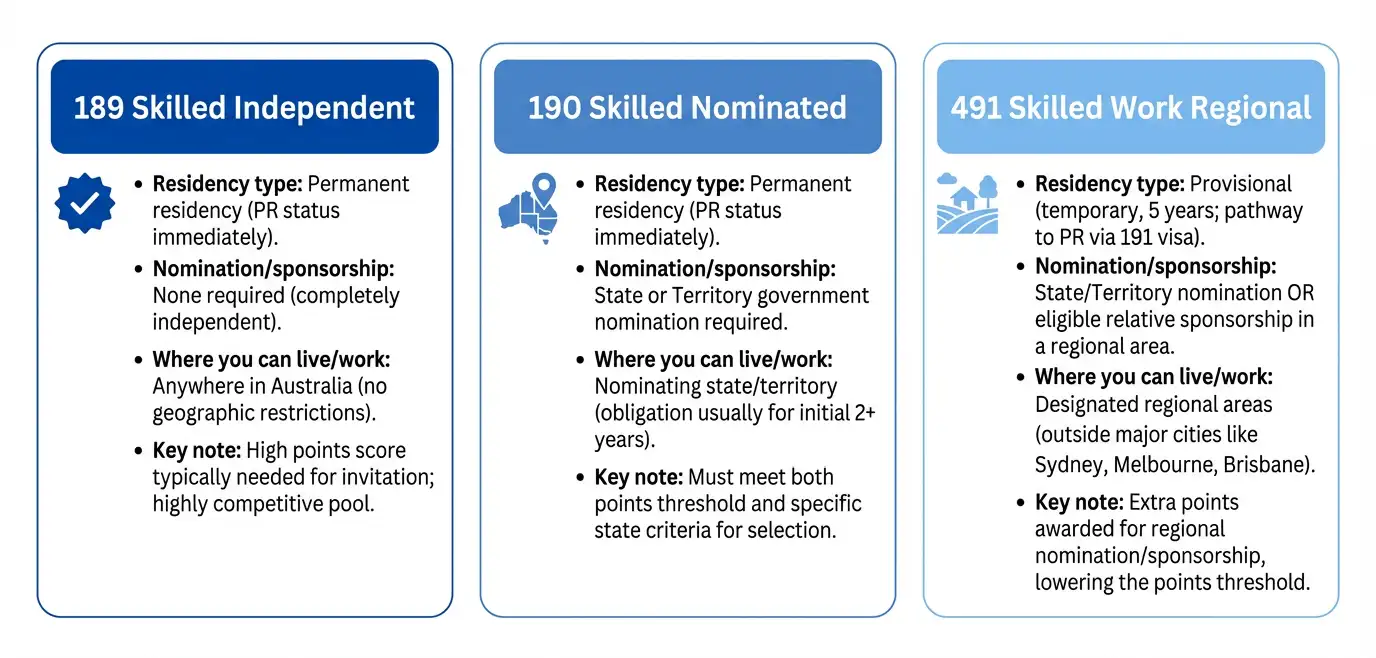
1. Skilled Independent Visa (Subclass 189)
The Skilled Independent Visa (Subclass 189) is a permanent visa for skilled workers who are invited to apply based on their points score.
Key features:
- No employer sponsor is required.
- No state or territory nomination is required.
- You can live and work anywhere in Australia as a permanent resident.
- You can sponsor eligible relatives for permanent residency.
- You must lodge an Expression of Interest (EOI) through SkillSelect and receive an invitation before applying.
Eligibility criteria:
- Your occupation must be on the Medium and Long-term Strategic Skills List (MLTSSL). You can check whether your occupation is listed using the Department of Home Affairs skilled occupation list search tool.
- You must be under 45 years of age at the time of invitation.
- You must meet minimum English language requirements (at least IELTS 6.0 in each band or equivalent).
- You must have a positive skills assessment from the relevant assessing authority for your occupation.
- You must achieve at least 65 points on the points test — though in practice, competitive scores are often much higher.
2. Skilled Nominated Visa (Subclass 190)
The Skilled Nominated Visa (Subclass 190) is also a permanent visa, but it requires nomination by an Australian state or territory government — not a job offer from an employer.
Key features:
- No employer sponsor is needed; instead, you are nominated by a state or territory.
- You become a permanent resident from the date your visa is granted.
- You can sponsor eligible relatives for PR and eventually apply for Australian citizenship.
- You are generally expected to live and work in the nominating state or territory for at least two years after the grant.
- You must lodge an EOI and meet both federal and state/territory criteria.
Eligibility criteria:
- Your occupation must be on the nominating state’s occupation list (typically the Consolidated Sponsored Occupation List — CSOL).
- You must score at least 65 points on the points test (state nomination adds 5 points).
- You must be under 45 years of age.
- You must have a positive skills assessment.
- You must meet all health and character requirements.
- You must satisfy any additional state criteria, such as specific work experience, English level or regional commitment requirements.
3. Skilled Work Regional (Provisional) Visa (Subclass 491)
The Skilled Work Regional (Provisional) Visa (Subclass 491) is a provisional visa for skilled workers who are willing to live and work in a designated regional area of Australia.
You can be either:
- Nominated by an Australian state or territory government, or
- Sponsored by an eligible relative who lives in a designated regional area.
Key features:
- No employer sponsor is required — the focus is on regional areas and skills needs.
- The visa is valid for 5 years and is provisional, but can provide a pathway to permanent residency through the Subclass 191 visa if you meet later requirements (including living and working in regional Australia for at least 3 years).
- You must meet points-test requirements (state/territory nomination adds 15 points) and receive an invitation to apply.
- Your occupation must be on a relevant skilled occupation list.
- You must be under 45 years of age and have a positive skills assessment.
For many people who do not have a job offer in Sydney or Melbourne, regional options such as the 491 visa can provide a more accessible pathway, particularly if your occupation is in demand outside the major cities.
Understanding Australia’s Skilled Occupation Lists
Before applying for any skilled migration visa, you need to confirm that your occupation appears on one of Australia’s official skilled occupation lists. The list your occupation appears on determines which visas you are eligible for:
| Occupation List | Eligible Visas | Purpose |
|---|---|---|
| MLTSSL (Medium and Long-term Strategic Skills List) | Subclass 189, 190, 491 | Jobs with lasting shortages — most direct route to PR |
| STSOL (Short-term Skilled Occupation List) | Subclass 190, 491 | Temporary shortages — typically state-nominated visas only |
| ROL (Regional Occupation List) | Subclass 491 | Occupations in demand in regional Australia |
| CSOL (Core Skills Occupation List) | Subclass 482, 186 | Employer-sponsored pathways (Skills in Demand visa) |
You can check whether your occupation is listed by visiting the Department of Home Affairs occupation list search tool. For a detailed guide on how to find your occupation and understand which list applies, read our blog on Australian Skilled Occupation Lists 2025-26: Find Your Visa Match.
Important: Your exact job title matters less than the specific duties you perform daily. Your official tasks must align with the ANZSCO (Australian and New Zealand Standard Classification of Occupations) description for your nominated occupation. The Department of Home Affairs typically updates these lists annually, often near the start of the financial year in July, but interim updates can occur at any time.
Other Ways to Come to Australia Without a Job Offer
Skilled migration is not the only way to come to Australia without a job offer. Depending on your circumstances, family, partner, study and working holiday pathways may be more realistic.
Family and Partner Visas
If you have close family in Australia, they may be able to sponsor you under certain family or partner visa categories. Examples include:
- Partner visas — if your spouse or de facto partner is an Australian citizen or permanent resident. Options include the Temporary Partner Visa (Subclass 820) onshore or the Partner Visa (Subclass 309) offshore.
- Parent visas — if you have a child who is an Australian citizen or permanent resident (subject to strict criteria and caps).
- Child visas — for dependent children of Australian citizens or permanent residents.
These visas do not require an employer to sponsor you, but they do have detailed eligibility rules and processing times can be lengthy. It is important to understand whether a family or partner pathway is genuinely available in your situation before relying on it.
Study in Australia First (Student Visa Pathway)
Another common approach is to study in Australia first on a student visa (Subclass 500) and then work towards skilled migration later.
For example, some people:
Expert Australian Migration Guidance
Navigating the complexities of your visa journey is easier with professionals. Start your Australian dream today.
Book Consultation- Enrol in Australian qualifications that align with occupations on the skilled occupation lists.
- Gain Australian work experience after study on a post-study work visa (Subclass 485).
- Later pursue a skilled visa such as Subclass 189, 190 or 491 if they meet the requirements.
This pathway does not guarantee permanent residency, and you need to consider tuition fees, living costs and visa conditions carefully. However, studying in Australia can improve your points score (you earn additional points for Australian qualifications and regional study) and give you local experience that may strengthen a future GSM application.
Temporary Graduate Visa (Subclass 485)
The Temporary Graduate Visa (Subclass 485) allows recent international graduates from Australian institutions to live and work in Australia temporarily — without a job offer. It includes two streams:
- Graduate Work Stream: For vocational education graduates with skills on the MLTSSL. Provides an 18-month visa.
- Post-Study Work Stream: For higher education graduates (bachelor’s, master’s or doctoral degrees). Duration ranges from 2 to 4 years depending on your qualification level.
The 485 visa provides full work rights and is a valuable stepping stone. It gives you time to gain Australian work experience, improve your English, and build the profile needed for a permanent skilled visa. Many successful GSM applicants used this visa to bridge the gap between study and permanent residency.
Working Holiday Visa (Subclass 417 / 462)
If you are a young applicant (typically aged 18 to 30, or up to 35 for some nationalities) from an eligible country, the Working Holiday Visa or Work and Holiday Visa offers another way to come to Australia without a job offer.
Key features:
- You can work, study and travel in Australia for up to 12 months initially.
- You can extend your stay for up to 3 years total if you complete specified work in regional areas.
- No job offer is required — you can seek employment after arriving.
- This is a temporary visa and does not directly lead to permanent residency, but it gives you valuable Australian work experience and local references that can support a skilled visa application later.
This pathway is particularly useful for younger applicants who want to explore Australia, gain work experience and assess whether they want to commit to a permanent move before investing in a skilled migration application.
How the Points Test Works If You Don’t Have a Job Offer
If you are applying for an Australian visa without a job offer under the skilled migration program, your eligibility will usually be measured through a points test.
As of 2026, the points test for visas like Subclass 189, 190 and 491 assesses the following factors:
| Factor | Points Available | Details |
|---|---|---|
| Age | 0 – 30 points | Maximum points for applicants aged 25–32. No points if 45 or over. |
| English Language | 0 – 20 points | Competent (IELTS 6): 0 pts | Proficient (IELTS 7): 10 pts | Superior (IELTS 8): 20 pts |
| Overseas Work Experience (in nominated occupation) | 0 – 15 points | 3 years: 5 pts | 5 years: 10 pts | 8+ years: 15 pts |
| Australian Work Experience (in nominated occupation) | 0 – 20 points | 1 year: 5 pts | 3 years: 10 pts | 5 years: 15 pts | 8+ years: 20 pts |
| Qualifications | 0 – 20 points | Doctorate: 20 pts | Bachelor’s: 15 pts | Diploma/Trade: 10 pts |
| Australian Study Requirement | 5 points | At least 2 academic years of study in Australia |
| Specialist Education / STEM | 10 points | Masters or Doctorate in STEM from an Australian institution |
| Regional Study | 5 points | Study and lived in regional Australia |
| Community Language (NAATI) | 5 points | NAATI-accredited community language credential |
| Professional Year | 5 points | Completed a Professional Year program in Australia |
| Partner Skills | 5 – 10 points | Partner with competent English + skills assessment: 10 pts | Partner with competent English only: 5 pts | Single applicant: 10 pts |
| State/Territory Nomination | 5 or 15 points | Subclass 190: 5 pts | Subclass 491: 15 pts |
Important: The current minimum pass mark is 65 points, but this is only the starting point. In practice:
- Scoring 65 points makes you eligible to be considered — it does not guarantee an invitation.
- Invitations are often issued to applicants with scores of 80 or above, depending on the occupation and the number of places available in each round.
- Occupation ceilings and policy settings change over time, so competitive scores vary by occupation.
Use our free Australian Points Calculator to estimate your score before lodging an EOI.
Common Reasons Applications Fail (and How to Avoid Them)
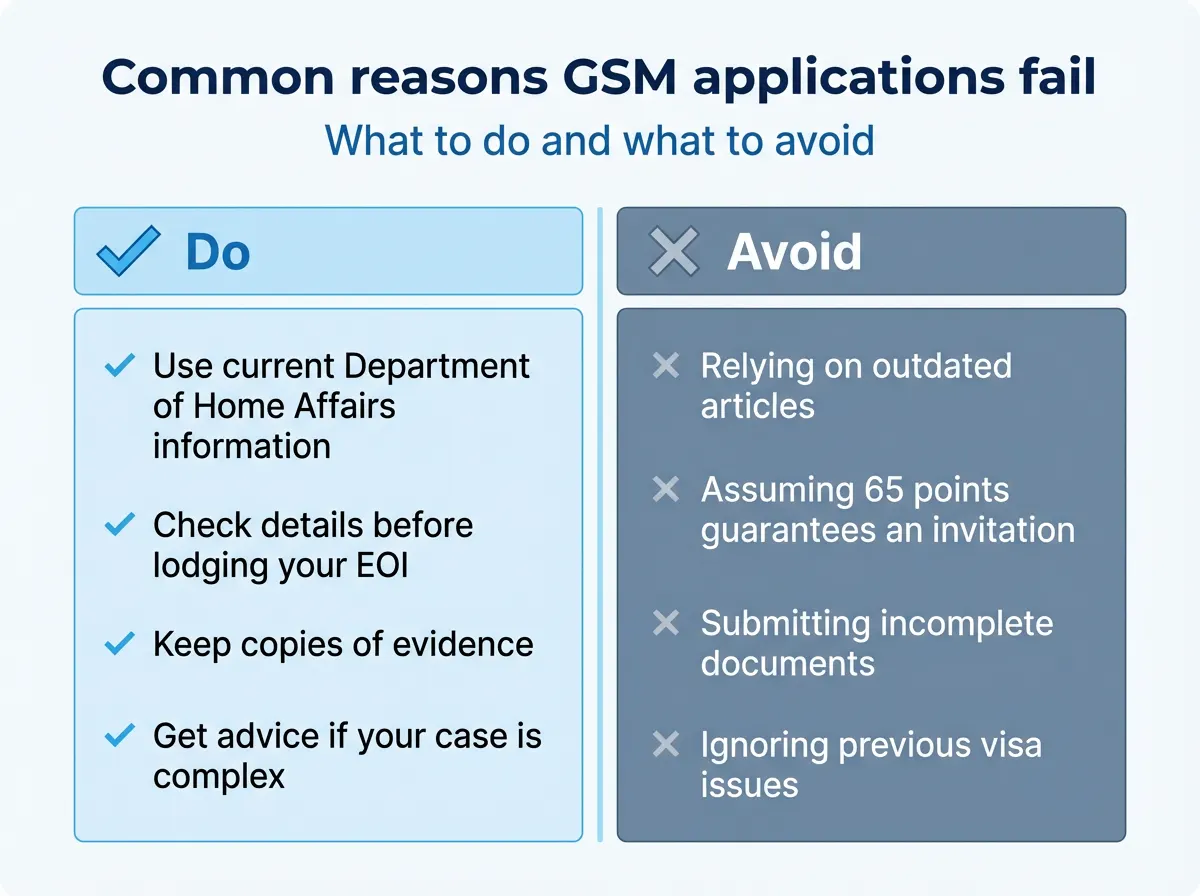
Even if you technically can migrate to Australia without a job offer, applications may fail for avoidable reasons. Some common issues include:
- Out-of-date information — relying on old occupation lists, points settings or policy articles. The Department of Home Affairs updates lists and criteria regularly, and a blog post from even 12 months ago may be inaccurate.
- Misunderstanding eligibility — assuming that meeting the minimum 65 points score guarantees an invitation or approval. In many occupations, the actual invitation threshold is significantly higher.
- Inaccurate or inconsistent details in your EOI or visa application — for example, claiming work experience that does not match the dates or duties in your supporting documents.
- Incomplete documents — missing employment references, incorrect qualifications, or skills assessments that do not match your nominated occupation.
- Choosing the wrong skills assessing authority — each occupation has a designated assessing body (such as ACS for IT, Engineers Australia for engineering, VETASSESS for many general professions). Using the wrong one can delay or invalidate your application.
- DIY errors — misinterpreting Department of Home Affairs guidance or not responding properly to requests for more information within the required timeframe.
- Not disclosing previous visa refusals or issues — this can lead to character or integrity concerns that result in refusal, even if the original issue was minor.
To reduce risk:
- Base your plans on current Department of Home Affairs information — not on social media posts or outdated guides.
- Double-check all details before lodging your EOI and application.
- Keep copies of all documents and evidence.
- Consider professional advice if your case is complex, your points score is close to the threshold, or you have had previous visa refusals.
When to Speak With a Registered Migration Agent
The decision to migrate to Australia without a job offer is significant, and the rules can feel overwhelming. Speaking with a MARA-registered migration agent can be especially helpful when:
- You are unsure whether you qualify for visas like 189, 190 or 491.
- Your points score is close to the minimum and you want to understand how to strengthen it.
- You have a complex history — for example, previous refusals, age concerns, or health/character factors.
- You are choosing between skilled, family and study pathways and want to know what is realistic.
- You want to avoid costly mistakes that can lead to delays or refusals.
A registered migration agent can:
- Review your occupation, age, English level, experience and study history.
- Assess whether you qualify for skilled migration visas that don’t require a job offer.
- Explain the steps involved in lodging an Expression of Interest and visa application.
- Help you avoid common mistakes and prepare a decision-ready application.
Conclusion
So, can you migrate to Australia without a job offer? For many people, the answer is yes — it may be possible, particularly through the General Skilled Migration program (Subclass 189, 190 and 491) or, in some cases, through family, partner, study or working holiday pathways.
Whether these options will work for you depends on:
- Your occupation and where it sits on the skilled occupation lists.
- Your age, English level and qualifications.
- Your points score and how competitive it is for your field.
- Any family connections or study plans you may already have.
Rules, occupation lists and invitation trends change regularly. As of 2026, a points score of 65 or more is required just to be considered, and many successful applicants have scores of 80 or above.
If you want a clearer view of your chances, the safest next step is to have your situation reviewed by a professional. Book your consultation with The Migration today and get personalised, expert guidance on your Australian migration journey.