If you are planning a working holiday in Australia, you have probably come across two similar‑sounding options: the Working Holiday visa (subclass 417) and the Work and Holiday visa (subclass 462). On the surface, both let you live, work and travel in Australia for up to several years, including in major cities like Sydney and Melbourne but the rules behind them are different.
Choosing the wrong visa, or applying before you clearly understand the difference between the 417 and 462 visa, can lead to refusals or limit your future options, including potential permanent residence (PR) pathways.
I guide you through the 417 vs 462 visa requirements in plain language, who each visa is for, key differences in age, country, education, English and caps, and how they can fit into a longer-term migration plan.
Overview of Australia’s Working Holiday Maker Visas
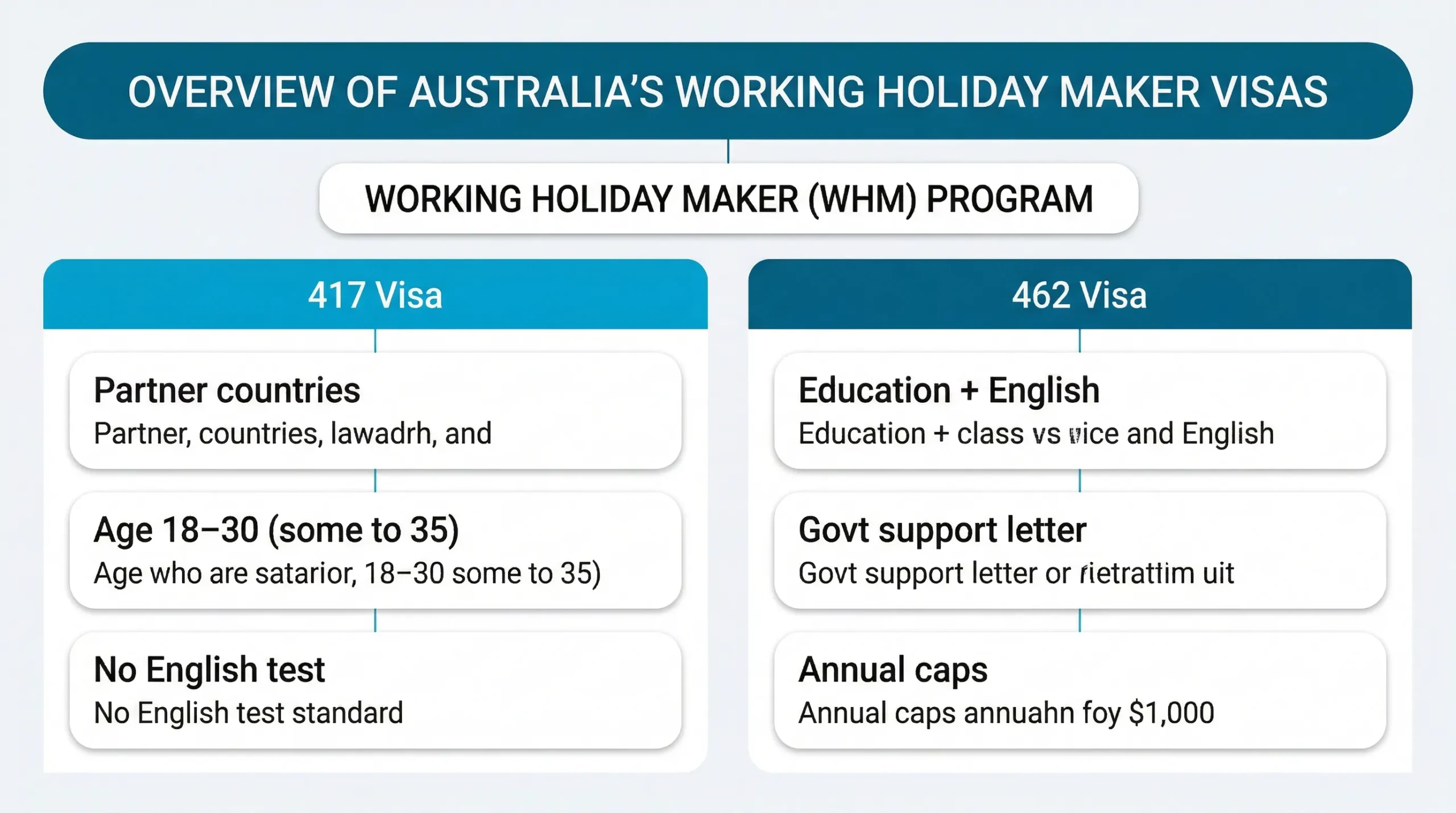
As of 2026, Australia’s Working Holiday Maker (WHM) program is made up of two main visa subclasses:
- Working Holiday visa (subclass 417)
- Work and Holiday visa (subclass 462)
Both visas are designed for young adults who want to:
- Visit Australia for an extended holiday
- Work to support their stay
- Experience life in cities like Sydney, Melbourne and other parts of Australia
The core rights are similar: temporary stay, work rights and the possibility of extending to a second or third working holiday visa if you complete enough specified work in eligible areas.
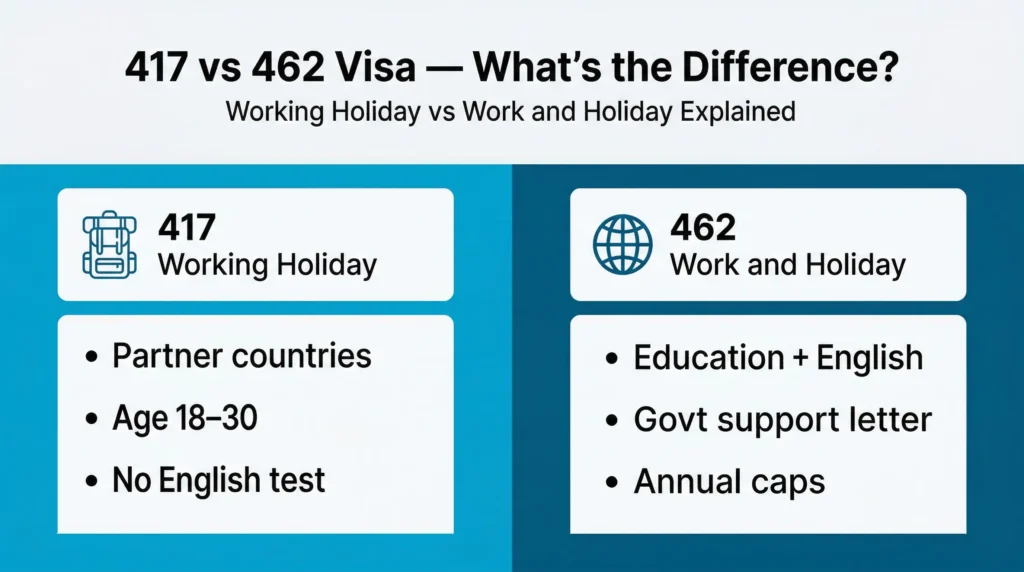
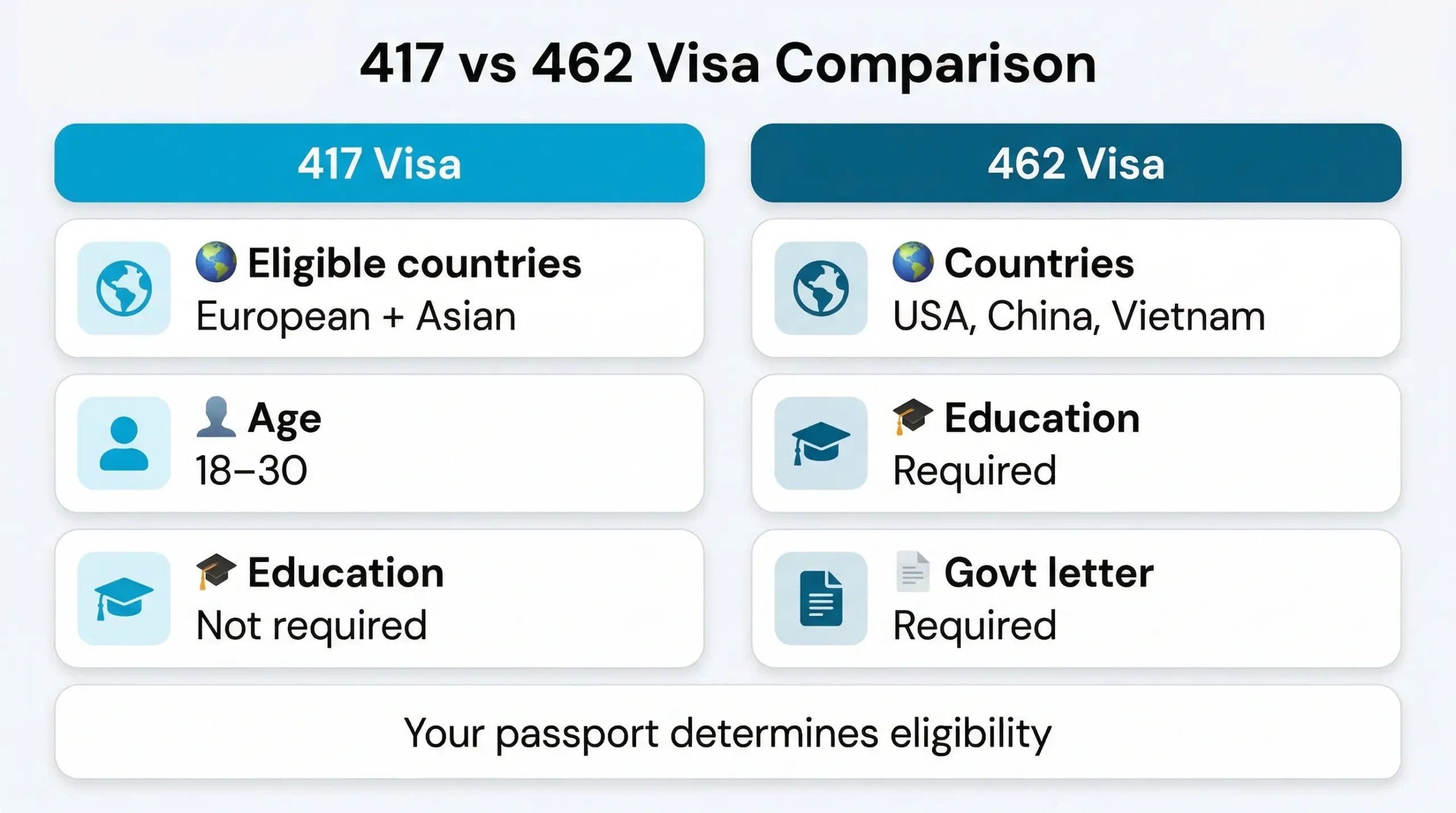
The biggest differences between the 417 and 462 visas are:
- Which countries are eligible
- Whether you must meet the education and English language requirements
- Whether you may need a government support letter
- Whether your country is capped each year under the program
What Is a Working Holiday Visa (Subclass 417)?
The Working Holiday visa (subclass 417) is aimed at young people from certain partner countries who want to visit Australia and fund their trip through short‑term work.
Key eligibility criteria for the 417 visa
As of 2026, typical criteria for a first 417 visa include:
- Age: 18–30 years (inclusive) at the time of application
- For some countries, currently including Canada, France, Ireland, Italy, Denmark and the United Kingdom, the upper age limit is 35 years.
- Eligible passport: You must hold a passport from a 417‑eligible country (for example, many European countries, the UK, Canada, several East Asian economies and others listed on the Department of Home Affairs website).
- Genuine visitor and health/character: You must meet standard health and character requirements and show a genuine intention to holiday.
- Funds: You usually need to show sufficient funds to support yourself and buy a return/onward ticket.
- No formal education or English test requirement: For most 417 applicants, there is no specific education requirement and no mandatory English language test built into the visa criteria.
Always check the latest 417 criteria on the official Department of Home Affairs website before applying, as requirements can change.
Related Article: Working Holiday Visa (subclass 417) – Criteria & Application Process.
What you can do on a 417 visa
While conditions can change, a first 417 Working Holiday visa generally allows you to:
- Live, work and travel in Australia for up to 12 months
- Work for employers in most industries (subject to any current work‑limitation rules)
- Study for a limited period
- Potentially qualify for a second or third 417 visa if you complete enough specified work in eligible industries and locations
These visas are temporary and do not guarantee permanent residency, but they can sometimes be a stepping stone into other visa pathways if carefully planned.
What Is a Work and Holiday Visa (Subclass 462)?
The Work and Holiday visa (subclass 462) is another working‑holiday option, aimed at young adults from a different set of partner countries.
Key eligibility criteria for 462 visa
As of 2026, common criteria for a first 462 visa include:
- Age: 18–30 years (inclusive) at the time of application
- Eligible passport: You must hold a passport from a 462‑eligible country (for example, countries in Europe, Asia and the Americas such as Argentina, Brazil, Chile, Indonesia, Spain, Thailand, Turkey, the United States, Vietnam and others listed by the Department of Home Affairs).
- Education: Many 462 applicants must have completed at least two years of tertiary study (for example, university or other higher education). The exact requirement can vary by country.
- English language: Many 462 countries require evidence of at least functional English (for example, through a recognised English test or certain study history).
- Government support letter: Some 462 countries require a letter of support from your home government confirming your participation.
- Annual caps: Several 462 partner countries are subject to annual caps, meaning only a fixed number of visas can be granted each program year.
- Funds and health/character: As with 417, you must show adequate funds and meet health and character requirements.
Because 462 requirements can vary significantly by country and are updated over time, it is essential to check the current rules for your passport country on the Department of Home Affairs website or seek professional advice before applying.
Related Articles: A Comprehensive Guide to Work and Holiday Visa (subclass 462) and, for Indian passport holders, Work and Holiday Visa 462 for Indians | Ballot System for Indians.
What you can do on a 462 visa
A first 462 Work and Holiday visa will usually allow you to:
- Live, work and travel in Australia (including in Sydney, Melbourne and regional areas)
- Work for Australian employers in a range of roles (subject to any current work‑limitation rules)
- Study for a limited period
- Become eligible for a second or third 462 visa if you complete the required amount of specified work in eligible industries and regions
As with the 417 visa, the 462 visa is temporary. It does not guarantee a future PR grant, but it can create options if you later meet the criteria for another visa.
417 vs 462 Visa Key Differences at a Glance
When people search for the difference between 417 and 462 visa or “417 vs 462 visa”, they usually want a quick comparison. The table below summarises the main points.
|
Feature |
Subclass 417 – Working Holiday |
Subclass 462 – Work and Holiday |
What this means for you |
|
Main purpose |
Holiday, short-term work and travel |
Holiday, short-term work and travel |
Both let you work while travelling in Australia. |
|
Age (first visa) |
18–30 for most countries; up to 35 for some (for example, Canada, France, Ireland, Italy, Denmark, UK) as of 2026 |
18–30 for most countries as of 2026 |
Your age and passport country determine which subclass (and age band) applies. |
|
Eligible countries |
Specific list of 417 partner countries (for example UK, Canada, many EU countries, several East Asian economies) |
A different list of 462 partner countries (for example, Argentina, Brazil, Chile, Indonesia, Spain, Thailand, Turkey, USA, Vietnam and others) |
Your passport country usually decides whether you are in the 417 or 462 stream. |
|
Education requirement |
No specific formal education requirement for most applicants |
Many applicants need to show at least two years of tertiary study (requirement varies by country) |
462 can be harder to qualify for if you have not completed enough studies. |
|
English language |
No specific English test requirement is built into the visa for most applicants |
Many applicants must show functional English through test results or study history |
If you need a test score for 462, plan this well before you apply. Expert Australian Migration GuidanceNavigating the complexities of your visa journey is easier with professionals. Start your Australian dream today. Book Consultation |
|
Annual caps |
Many 417 countries are uncapped |
Several 462 countries are capped in each program year |
If your country is capped, places can run out quickly, so timing is critical. |
|
Second/third year options |
Possible if you complete enough specified work in eligible areas |
Also possible with the right specified work |
Both visas can provide up to three years in total, depending on policy and your work history. |
Which Visa Is Right for You: 417 or 462?
There is no single visa that is “better” for everyone. The right choice depends on your:
- Country of passport
- Age at the time you apply
- Education and English language background
- Whether your country is capped under the 462 stream
- Your medium‑ to long‑term plans (for example, whether you may later want to study, work long‑term or pursue PR)
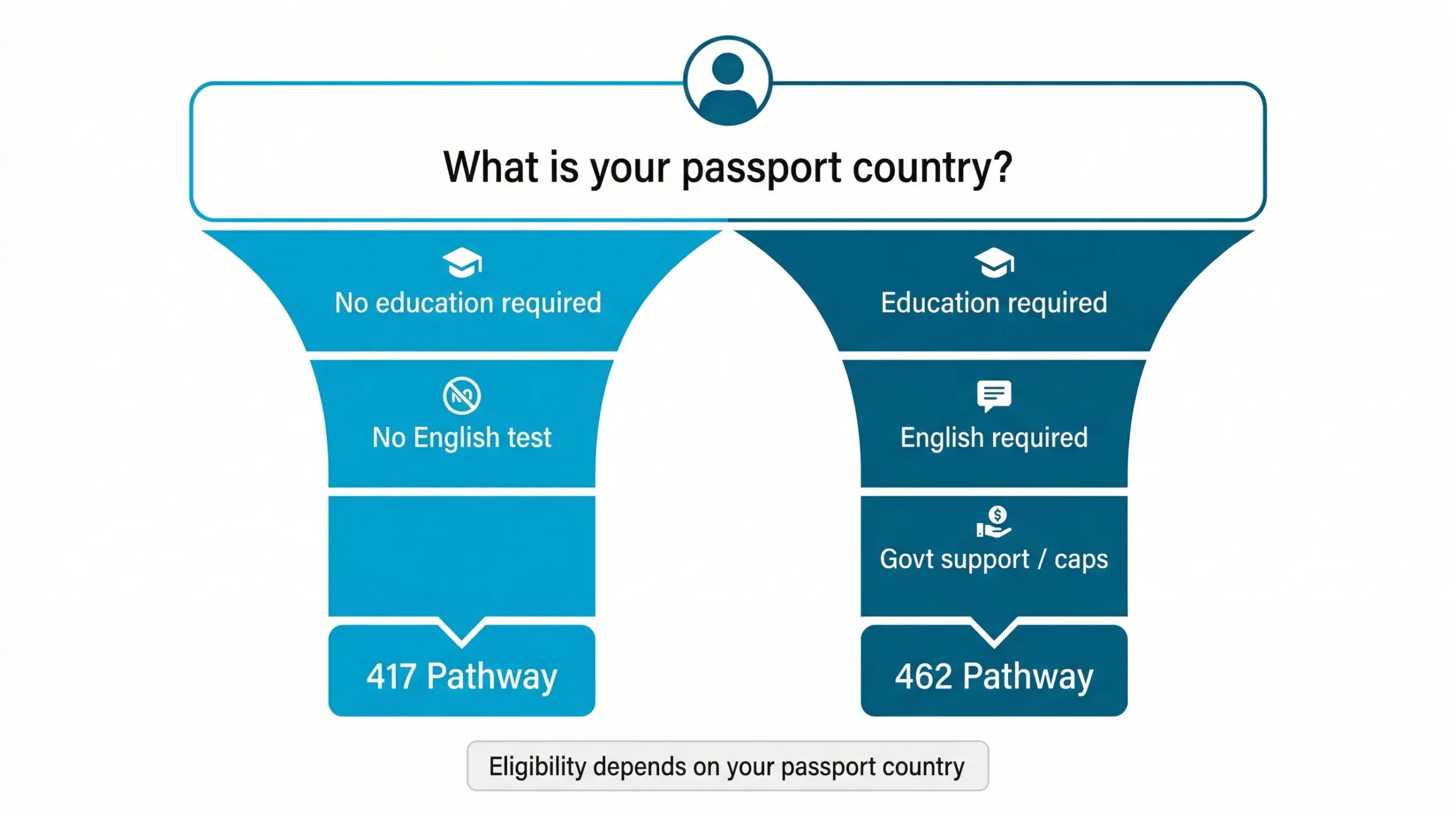
If you are from a 417‑eligible country
If you hold a passport from a 417 partner country, and you are within the allowed age range, you will usually apply for the 417 Working Holiday visa. For many applicants, this is a relatively straightforward pathway because there is:
- No built‑in education requirement
- No specific English test requirement in the visa criteria
You still need to meet health, character and funds requirements and make sure you choose the right time to apply.
If you are from a 462‑eligible country
If your passport is from a 462 partner country, you will need to consider:
- Whether you meet the study requirements for your country
- Whether you can show functional English (if required)
- Whether you must obtain a government support letter
- Whether your country has an annual cap, and how competitive that cap is
In some cases, even strong candidates can miss out if they underestimate how caps or ballot systems work.
When you are unsure which visa fits you
If you hold more than one passport, or your situation is more complex, it can be difficult to work out which working holiday option is best and how it may affect future plans.
Can a 417 or 462 Visa Lead to Permanent Residency?
Neither the 417 nor the 462 visa provides a direct permanent residency pathway. They are temporary visas designed primarily for holidays and short‑term work.
However, as of 2026, time spent on a working holiday can still be valuable if you later qualify for another visa. For example, you might:
- Gain Australian work experience that supports a skilled, employer‑sponsored or regional visa
- Build a relationship that later leads to a partner visa (if you meet the criteria)
- Use your time in Australia to improve your English, build networks and plan a longer‑term move
Whether PR is realistic will depend on your age, occupation, qualifications, English level, health, character and migration history, together with current policy settings.
Because PR rules are complex and change frequently, it is important not to rely on working holiday visas alone. A tailored PR strategy can help you make the most of the time you spend in Australia.
How The Migration Can Help With Your 417 or 462 Visa
At The Migration, our team of MARA‑registered migration agents helps working holiday makers and prospective applicants understand how the 417 and 462 visas work and how these visas fit into a broader migration plan.
We can assist you to:
- Confirm whether you are eligible for a 417 or 462 visa based on your passport, age, education and English
- Understand any country‑specific conditions, caps or ballot systems that may apply
- Minimise the risk of a refusal by preparing a complete, well‑evidenced application
- Map out next steps if you later want to study, work longer term or explore PR options in Australia
Whether you are planning a year in Sydney, Melbourne or regional Australia, speaking with an adviser before you apply can help you avoid mistakes and make informed decisions.
Conclusion
The difference between the 417 and 462 visa mostly comes down to who can apply and what you must prove. The 417 visa generally suits applicants from certain partner countries with no formal education or English test requirement, while the 462 visa often involves extra conditions
such as education, English evidence, government support letters and annual caps.
Both visas can let you live, work and travel in Australia, including in cities like Sydney and Melbourne, and may open doors for future opportunities if you plan ahead.
If you are unsure which visa fits you, or how a working holiday might affect your longer‑term plans, getting tailored advice before you lodge can make a real difference.
Choosing the right working holiday visa is critical if you want to avoid refusals and keep your future options open. If you are comparing the 417 vs 462 visa and want clear, MARA‑aligned advice, speak with our migration team before you apply. Book your consultation today.