
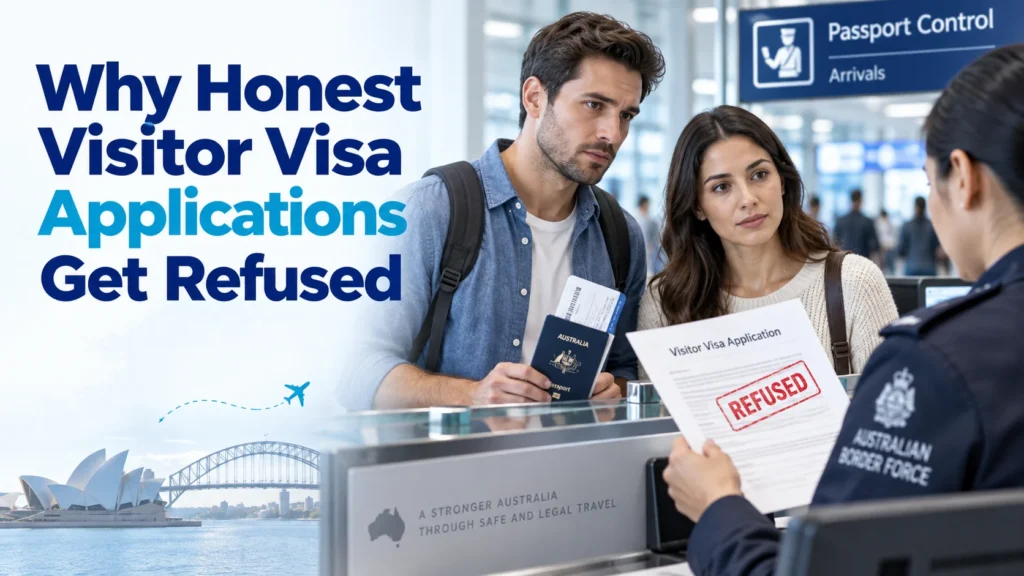
Most families who come to us after a visitor visa refusal told the truth on every page of the form. Real jobs. Real savings. A real wedding, or a real grandchild. The refusal came anyway, and nobody explained why.
That gap is where the damage happens. A refusal letter names a criterion, not a reason a person can understand, so families read it as an accusation. Relatives ask what went wrong. Some assume something was hidden. It almost never was.
A subclass 600 application is not marked on honesty. It is marked on whether a case officer is satisfied the visit is temporary and the applicant will go home at the end of it.
Truthful people fail that test all the time. Usually their ordinary life reads badly on paper, or something they did to help made the file look worse.
Have your visitor visa case looked at before you lodge — especially if there is already a refusal in the family’s history.
Why would a truthful application be refused?
Because the central requirement is not a document. It is an intention, and no document proves one. Passport, health, character, funds: each of those has an answer you can attach. The genuine visitor requirement has none.
The case officer weighs the whole picture and decides whether the stay is temporary. Honesty is assumed. So the useful question is not whether you are telling the truth. It is what your situation looks like to a stranger.
What is the case officer actually deciding?
They are asking one question: what is waiting at home that is worth more than staying here?
Here is the part families find unfair, and we would rather say it plainly. Having your children in Australia is a real factor the Department is allowed to weigh. On paper, a retired widow with three children here has little pulling her back.
That does not make her application hopeless. It means the pull has to be shown rather than assumed. A home she owns. A pension collected where she lives. A spouse staying behind, or a history of travelling and returning.
The Department sets out the requirements on its own subclass 600 page. It does not publish a bank balance, a document list, or a formula, because there isn’t one.
Which honest situations read badly on paper?
Four come up repeatedly in our consultations. None involves anyone being dishonest.
Money moved in shortly before lodging
- A transfer sent to a parent’s account so the balance looks strong is the most common self-inflicted problem here.
- A large deposit into a thin account reads as exactly what it usually is: money moved to look good.
- A modest balance that matches how the applicant actually lives is stronger than a sudden lump sum.
- If you are funding the trip, say so and evidence it as sponsorship. That is normal, not a weakness.
Retired parents with no payslips
- Farm income, a cash shop, a pension collected in person, savings held in gold or land. None of it produces the paperwork the form expects.
- The answer is an explanation, not more documents. Say what the money is, where it comes from, and why it stays there.
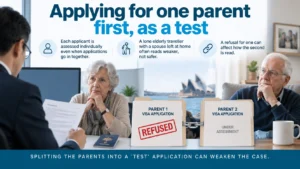
Applying for one parent first, as a test
- Each applicant is assessed individually, even when the applications go in together.
- A lone elderly traveller with a spouse left at home often reads weaker, not safer.
- A refusal for one can colour how the second is read.
An invitation letter copied from a template
- It is the one document your family fully controls, and templates spend it for nothing. A case officer sees the same downloaded wording every week.
- Cover purpose, dates, who is funding the visit, where they will stay, and why they will return. Write it from your real circumstances. Our guide to the invitation letter for a tourist visa shows what each paragraph has to establish.
If any of this describes your file, fix it before lodgement rather than after. Ask a MARA-registered agent (MARN 2619480) how your evidence will be read.
Can you appeal a visitor visa refusal?
Usually not, and this is the fact families learn too late. For most offshore Tourist stream refusals there is no merits review and no way to argue the decision.
Expert Australian Migration Guidance
Navigating the complexities of your visa journey is easier with professionals. Start your Australian dream today.
Book ConsultationOnshore refusals, and some sponsored cases, may carry review rights with short deadlines. Those deadlines sit in the refusal letter itself, so read the letter and confirm the position with the Administrative Review Tribunal. Where review exists, our page on visa refusal appeal processing times explains the wait.
The visa application charge is not refunded when an application is refused. A fresh application means a fresh charge. Two parents refused once, applying again, meet that charge twice each.
What has to change in a second application?
Everything the first one was missing, and the refusal letter tells you where to look. The next case officer can see the earlier application and why it failed. If nothing changed, nothing changes.
A second application has to do three things:
- Answer each reason given. Take the criterion named in the letter and address it in the applicant’s own circumstances.
- Add evidence that was not there before. Not more copies of the same documents. New material that speaks to the doubt raised.
- Test whether the stream was right. Where home-country ties alone will not convince the Department, the Sponsored Family stream can carry a case the Tourist stream cannot. It usually brings condition 8503 No Further Stay with it.
Sending the same file back a fortnight later, with a covering note, reliably repeats the result.
Conclusion
A refusal is not a verdict on your family’s character. It is a decision-maker saying the file did not settle a question, and that question is answerable with the right evidence, in the right stream.
If there is a refusal in your history, money that is hard to explain on paper, or a date that cannot move, have the case reviewed before it goes in.
Book a visitor visa consultation with a MARA-registered agent, MARN 2619480.