

There is no such thing as “the” skilled occupation list.
Australia runs four of them. The MLTSSL, the STSOL, the ROL and the CSOL. Each one controls different visas, and sitting on one says nothing about whether you sit on another.
Then there is a fifth thing that is not a list at all, and it causes more confusion than the other four combined. We will come to state lists shortly.
Here is the idea that makes all of this simple. Your occupation does not choose your visa. Your visa decides which list matters to you.
The short version: the MLTSSL controls the Subclass 189. The MLTSSL and STSOL feed state lists for the Subclass 190. The ROL joins them for the Subclass 491. The CSOL sits apart and covers employer-sponsored visas.
The rest of this article explains what each list does, why state lists work differently from the national ones, and what to do if your occupation sits outside the list you need.
Which List Applies to Which Visa
| Visa | Occupation list that applies |
| Subclass 189 Skilled Independent | MLTSSL only |
| Subclass 190 Skilled Nominated | The nominating state’s own list, drawn from MLTSSL and STSOL |
| Subclass 491 Skilled Work Regional | The nominating state or region’s list, drawn from MLTSSL, STSOL and ROL |
| Subclass 482 Skills in Demand | CSOL |
| Subclass 186 Employer Nomination Scheme | CSOL |
Check any occupation against the official skilled occupation list published by the Department of Home Affairs. That page is the source of truth, and it shows which visas each occupation supports.
Two points are worth fixing in your head early, because both changed recently. The 482 moved to the CSOL in December 2024, when the Skills in Demand reforms replaced the older arrangement. And the STSOL still exists as its own list. It was not absorbed into the CSOL, and it still applies to the visas listed above.
Not sure which list covers your occupation? Ask us for a straight answer.

Start With Your ANZSCO Code, Not Your Job Title
Your job title means nothing to the Department. Your six-digit ANZSCO code means everything.
ANZSCO stands for the Australian and New Zealand Standard Classification of Occupations. Every skilled occupation has a code, and that code decides which list you sit on, which body assesses you, and which visas you can apply for.
Take a common example. Someone whose business card says “Software Developer” could be assessed as 261312 Developer Programmer, 261313 Software Engineer, or 261399 Software and Applications Programmers not elsewhere classified. Those are three different codes with three different sets of outcomes.
Choosing the wrong code is one of the most expensive mistakes in this process. It can waste a skills assessment that took three months and several hundred dollars.
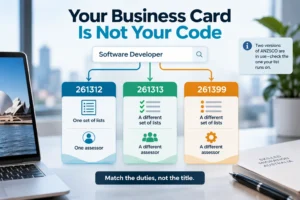
Confirm your code against the ABS ANZSCO classification before you do anything else. Match the duties in the description to the work you actually do, rather than matching the title.
Two versions of ANZSCO are in use
This catches people out, so it is worth knowing.
Home Affairs uses the 2022 version of ANZSCO for the CSOL, which covers the 482 and the 186. It uses the 2013 version of ANZSCO for the MLTSSL, STSOL and ROL, which cover the skilled visas.
So the same occupation can carry a different code depending on which program you are looking at. Always check the version that goes with the list you need.
Watch item. The ABS has published OSCA as the successor to ANZSCO. Migration still runs on ANZSCO, and OSCA does not yet apply to visa occupation lists. Confirm the current position on the Home Affairs occupation list page before you rely on either one.
MLTSSL: The Medium and Long-term Strategic Skills List
The MLTSSL holds occupations Australia expects to need for years, rather than months.
It is the strictest list and the most valuable one to be on. It is also the only list that supports the Subclass 189, which is the one skilled visa that needs no sponsor and no state commitment.
Occupations on the MLTSSL also feed state lists for the 190 and regional lists for the 491. So MLTSSL occupations have the widest set of options open to them.
Typical MLTSSL occupations include registered nurses, secondary teachers, most engineering disciplines, accountants, and a large number of trades.
Being on the MLTSSL opens a door. It does not walk you through it. You still need enough points to be invited, and for some MLTSSL occupations that number is very high. Our guide on what your occupation actually needs covers the gap between the 65-point pass mark and the real cutoffs.
STSOL: The Short-term Skilled Occupation List
The STSOL holds occupations Australia needs now, with less certainty about the long term.
The important point is that the STSOL still exists. Some guides say it disappeared when the CSOL arrived. It did not.
STSOL occupations cannot support a 189. They can support a 190 or a 491, because states are allowed to draw from both the MLTSSL and the STSOL when they build their own lists.
For a lot of trades, hospitality roles, and support occupations, this is the difference between having a pathway and having none. If someone told you that your occupation has no skilled route, check whether it sits on the STSOL before you accept that.
What is the difference between MLTSSL and STSOL?
The MLTSSL supports the 189, the 190, and the 491. The STSOL supports the 190 and the 491 only.
That is the practical difference. An MLTSSL occupation can go it alone. An STSOL occupation needs a state or a region to nominate it.
ROL: The Regional Occupation List
The ROL exists for regional Australia.
It holds occupations that regional areas need, and it only supports regional pathways. In practice, that means the Subclass 491, which leads to permanent residency through the Subclass 191 after three years.
If your occupation appears only on the ROL, your pathway runs through a regional area. You will need a state nomination or an eligible family sponsor, and you will need to live and work in a designated regional area.
Regional does not mean remote. Perth, Adelaide, the Gold Coast, Hobart, Canberra and Newcastle all count as regional for migration purposes. Our guide to regional areas for PR lists what qualifies.
The 491 asks more of you than the other two visas. It also asks for fewer points, because state or family sponsorship adds 15. For many people, that trade is worth making.
CSOL: The Core Skills Occupation List
The CSOL is the newest list and the one causing the most confusion.
It arrived in December 2024 as part of the Skills in Demand reforms. Home Affairs applies it to both the Subclass 482 Skills in Demand visa and the Subclass 186 Employer Nomination Scheme, which is the permanent pathway that follows it.
The CSOL does not govern the 189, the 190, or the 491. If you are pursuing General Skilled Migration, the CSOL is not your list.
Here is why it matters anyway. The CSOL is broader than the MLTSSL. An occupation closed to skilled migration is sometimes open to employer sponsorship. So if the points-tested route is shut to you, the CSOL is worth checking before you give up.
That check needs an employer willing to sponsor you, which is a different kind of problem to solve. It is still a real pathway, and plenty of people reach permanent residency that way.
The Fifth Thing: State Lists
This is the part promised at the top, and it is where most of the confusion on this topic comes from.
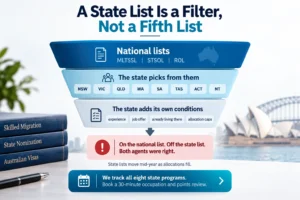
A state list is not a fifth national list. Home Affairs publishes the national lists. Each state and territory then builds its own shortlist by choosing occupations from those national lists.
States also add their own conditions. A state might list your occupation but require two years of work experience, a current job offer, or that you already live and work there.
So your occupation can sit on the MLTSSL and still be unavailable in Victoria this year. Being on a national list is necessary. It is not enough on its own.
Expert Australian Migration Guidance
Navigating the complexities of your visa journey is easier with professionals. Start your Australian dream today.
Book ConsultationThe eight programs all work differently, and they change their lists during the year. Check the state you are targeting directly:
NSW · Victoria · Queensland · South Australia · Western Australia · Tasmania · ACT · Northern Territory
This is also why the same profile gets different answers from different agents. One is looking at the national list. Another is looking at the state list. Both can be right at the same time.
Our guide to which state is easiest for PR compares the programs by occupation.
Want to know which states currently list your occupation? We track all eight.
Can My Occupation Be on Two Lists at Once?
Yes, and that is usually good news.
Occupations appear on the list or lists that suit them. An occupation on the MLTSSL is generally available for the 189, the 190 and the 491, subject to the state’s own choices. An occupation on the STSOL is available for the 190 and the 491.
What you cannot do is nominate two occupations. You pick one ANZSCO code, you get assessed against it, and your whole application runs on that choice.
So the question is not which lists include your occupation. The question is which code best matches your actual duties and experience, and which visas that code opens.
What If My Occupation Is Not on the MLTSSL?
This is the moment most people arrive at this article. You have three real options.
Option one: check the STSOL and the state lists.
Plenty of occupations sit outside the MLTSSL and are still nominated regularly by states through the 190. Start with the eight state links above. This is the cheapest option to check, and it costs you nothing but an hour.
Option two: look at regional.
If your occupation appears on the ROL, or a regional area lists it, the 491 becomes your route. It adds 15 points, which changes the maths considerably, in exchange for living regionally for three years.
Option three: look at employer sponsorship.
The CSOL is broader than the skilled lists. If an employer will sponsor you, the 482 and then the 186 can take you to permanent residency without a points test at all.
Before you accept any of those, check one more thing. Confirm that you nominated the right ANZSCO code in the first place. A surprising number of people are told they have no pathway when the real problem is that they were matched to the wrong occupation.
How Often Do the Lists Change?
The lists are reviewed periodically, and occupations move on and off them.
That worries people, and it is worth being clear about what actually matters. Your eligibility is assessed at the point you are invited to apply, not at the point you lodge your Expression of Interest.
So an occupation that is eligible when your invitation arrives keeps you eligible, even if the list changes afterwards.
State lists move more often than national lists. States open and close occupations during the program year as their allocations fill, which is why an occupation that was available in July may be closed by March.
Two practical habits help here. Check the Home Affairs occupation list before every major decision, and keep your EOI current so you are ready when your occupation opens.
Watch the invitation rounds too. Home Affairs publishes results after each round, and our invitation rounds tracker follows them month by month.
A Few More Things Worth Knowing
Your assessing body follows your occupation. Your ANZSCO code decides who assesses you. Engineers go to Engineers Australia. IT professionals go to the ACS. Trades go to TRA or VETASSESS. Nurses go to ANMAC, and accountants go to CPA Australia. Change your code, and you change your assessor, your fee, and your timeline.
Some occupations carry caveats. Certain codes have restrictions attached for particular visa programs, covering things like salary or workplace type. Read the caveat notes on the Home Affairs list rather than assuming the code alone settles it.
The list is step one, not the finish line. Being listed makes you eligible. Your points score decides whether you are invited. If your occupation is listed and your score is short, our guide on how to add 10 points covers the levers available to you.
Still Not Sure Which List Covers You?
Most people who reach the end of this article know their acronyms and still have one question left: what does this mean for me specifically?
That question takes about twenty minutes to answer properly. We check your ANZSCO code against your actual duties, confirm which lists currently include it, tell you which of the eight states are nominating it, and give you a realistic read on your points.
Sometimes the answer is that a pathway exists that nobody has mentioned to you. Sometimes the answer is that the honest route is employer sponsorship rather than skilled migration. Either way, you leave knowing where you stand.
Book a 30-Minute Occupation and Points Review