

As of the 2025-26 Victorian skilled migration program, Registration of Interest (ROI) is the critical gate between your SkillSelect Expression of Interest (EOI) and a potential state nomination for the Skilled Nominated visa (subclass 190) or Skilled Work Regional (Provisional) visa (subclass 491).
For many skilled workers in Victoria, elsewhere in Australia, or offshore, the rules feel confusing: How is ROI different from EOI? Who actually receives invitations? And what role do annual earnings, priority sectors and work location play?
This guide explains how the ROI Victoria for skilled visas works in 2025–26, who the program is for, how ranking really operates, and where a clear strategy can make the difference between waiting indefinitely and moving forward with a more realistic plan.
What is a Registration of Interest (ROI) for Victoria’s skilled migration?
A ROI Victoria is an online form you submit through the Live in Melbourne portal to tell the Victorian Government you would like to be considered for state nomination for:
- Subclass 190 – Skilled Nominated visa, or
- Subclass 491 – Skilled Work Regional (Provisional) visa.
An ROI:
- Is not a visa application.
- Is not a Victorian nomination application.
- Does not guarantee nomination or a visa invite.
Instead, Victoria uses your ROI together with the information in your SkillSelect EOI to rank you against other candidates and decide who may be invited to apply for Victorian nomination.
For a deeper comparison of how ROI fits with your EOI, see our explainer on the difference between EOI and ROI in Australian skilled migration.
Who is the Victoria ROI program for in 2025-26?
As of 2026, the Victorian program focuses on skilled workers who can contribute to key priority sectors and meet the criteria for 190 or 491.
In general, ROI Victoria is relevant if you:
- Are you targeting Victoria as your preferred state for skilled migration?
- Hold (or are aiming for) a positive skills assessment in an eligible occupation.
- Can reach at least 65 points (including state nomination points), noting that competitive scores are usually higher.
- Are you working in, or have skills aligned with, one of Victoria’s priority sectors, particularly for onshore candidates?
Priority sectors highlighted by Live in Melbourne include:
- Health
- Social services
- Education (including Early Childhood)
- Construction
- New energy
- Digital economy (especially common for 491)
- Advanced manufacturing (491)
- Hospitality and tourism (491)
For offshore 491 applicants, priority often focuses on sectors such as health, social services and education, but you should always check the latest program year guidance for detailed lists and examples.
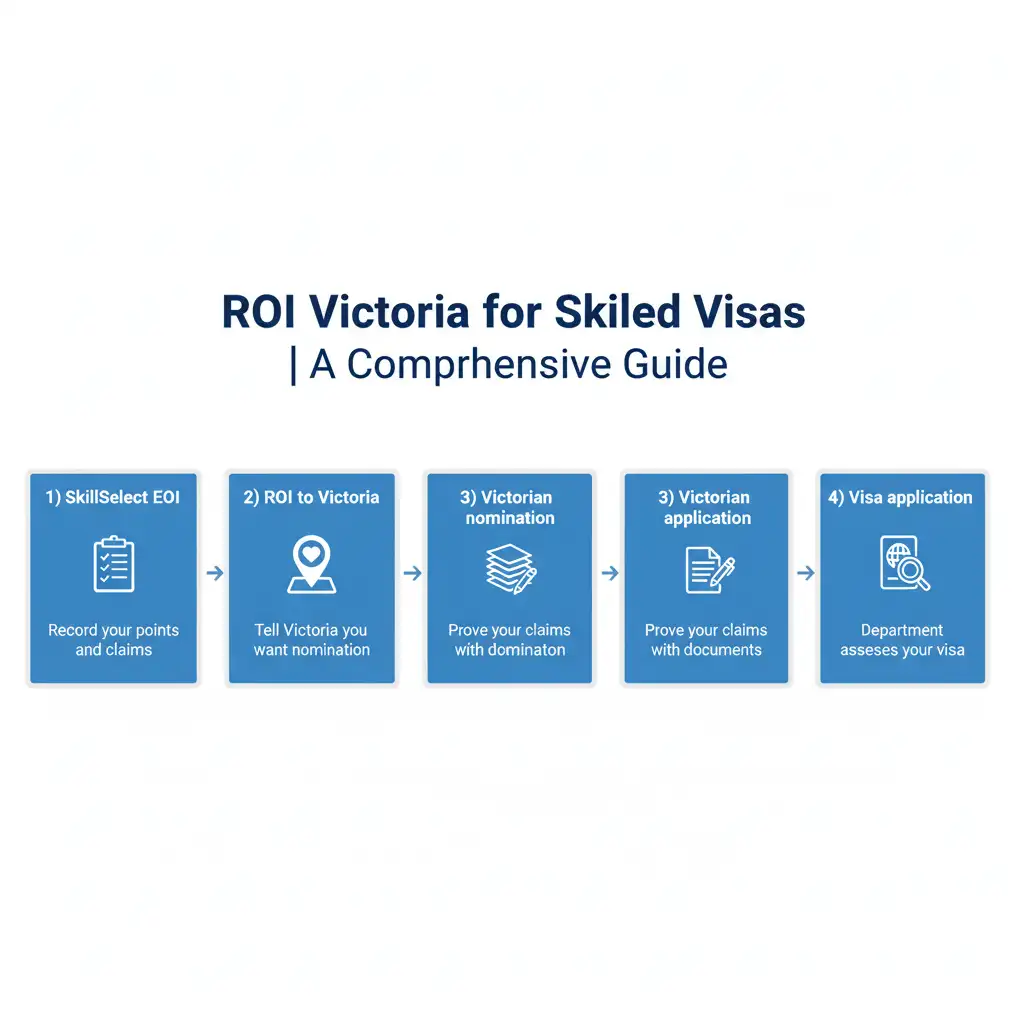
How ROI fits with EOI and Victorian nomination (Victoria 190 & 491)
It helps to see ROI as one step in a longer decision chain:
- SkillSelect EOI: lodged with the Department of Home Affairs.
- ROI to Victoria: submitted via Live in Melbourne, using your EOI ID.
- Selection & invitation to apply for nomination: if your ROI is ranked highly enough.
- Victorian nomination application: submitted with supporting documents.
- Visa application: lodged with the Department of Home Affairs if nomination is approved.
A quick comparison
- EOI: tells the Australian Government you want a visa and records your points, occupation and claims.
- ROI: tells Victoria you want to be considered for state nomination and provides extra information (e.g. sector, earnings, work location).
- Nomination application: is where you prove your claims with documents.
- Visa application: is assessed by the Department of Home Affairs against the visa criteria.
Throughout this journey, ensure your EOI and ROI tell the same story. Inconsistent information is a common reason for nomination refusal.
Step‑by‑step: How to submit an ROI for Victoria 190/491
Here’s the step-by-step process of how to submit an ROI for Victoria subclass 190 and subclass 491.
Step 1 – Check your visa and points eligibility
Before thinking about ROI, confirm you:
- Meet the basic criteria for subclass 190 or 491 (age, English, skills assessment, occupation and points).
- Understand how many points you can honestly claim and whether they match your evidence.
- Have an occupation and sector that align with current Victorian priorities.
If you are unsure, a structured review such as a PR Pathway Roadmap session can help you test whether Victoria is realistically competitive for you.
Step 2 – Lodge or update your SkillSelect EOI
You must have a current EOI in SkillSelect for the visa you want:
- Make sure your occupation, work experience, qualifications, English and partner details are accurate.
- Double‑check your points and remove any claims you cannot document.
- Keep your contact details up to date. Invitations rely on this.
Victoria will cross‑check your ROI against this EOI. If the two do not match, it can damage your credibility.
Step 3 – Create a Live in Melbourne account and submit your ROI
Next, go to the Live in Melbourne website and:
- Create or log in to your Live in Melbourne account.
- Select the relevant visa stream (190 or 491).
- Enter your SkillSelect EOI ID and complete the ROI form, including questions about your:
- Occupation and sector
- Work location (in Victoria, elsewhere in Australia, or offshore)
- Estimated annual earnings (for onshore skilled employment in Victoria)
- Qualifications, English and any Victorian study
Take your time to answer honestly and carefully. Victoria may later ask you to prove your claims with contracts, payslips, tax documents and other evidence.
Step 4 – Wait for selection and respond quickly
After submitting your ROI:
- Victoria will rank your ROI against others and may invite the most competitive candidates to apply for nomination.
- There is no fixed processing time and no guarantee of selection – some strong candidates may still miss out.
- If you receive an invitation, respond within the stated deadline and provide clear evidence for everything you have claimed.
ROI ranking factors you need to know for Victoria
As of the 2025–26 program year, Victoria indicates that it looks at several key inputs when ranking ROIs, including information from both your EOI and ROI. These may include:
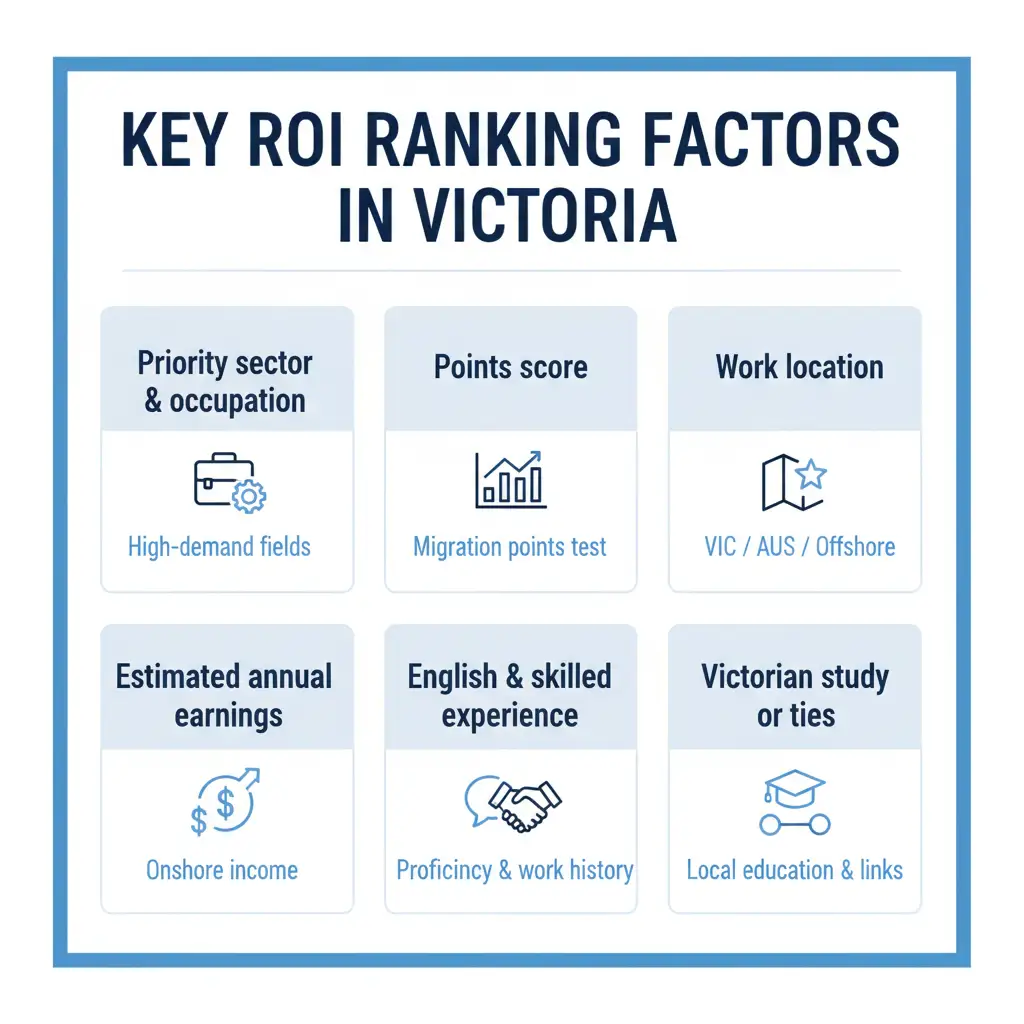
- Sector and occupation alignment – how closely your role fits one of Victoria’s priority sectors.
- Points score: higher points generally improve competitiveness but are not the only factor.
- Work location: whether you are onshore in Victoria, elsewhere in Australia, or offshore.
- Estimated annual earnings (onshore candidates): your honest estimate of gross annual earnings from skilled employment in Victoria.
- English language level and years of experience in your nominated occupation.
- Study or professional ties to Victoria, where relevant.
Because the program is competitive and dynamic, there is no published minimum earnings threshold or magic points score that guarantees selection. Two candidates with similar points may have very different chances depending on occupation, sector, and current program needs.
Expert Australian Migration Guidance
Navigating the complexities of your visa journey is easier with professionals. Start your Australian dream today.
Book ConsultationStrategy tips to strengthen your ROI, Victoria
In the section below, we explain the strategy tips to strengthen your ROI, Victoria.
1. Clarify your occupation, sector and points
Before you submit anything, make sure you are clear on:
- Which ANZSCO occupation you are relying on and how it aligns with Victoria’s priorities.
- Whether your current role genuinely fits one of the priority sectors.
- Your true points score, using only claims you can back up.
If your occupation has not been invited recently, it may be worth exploring alternative pathways or states instead of relying only on Victoria.
2. Make sure your EOI and ROI match
Victoria compares your ROI with your EOI. Inconsistencies such as different employment dates, hours, earnings or qualifications can lead to refusal at the nomination stage. Update your EOI before you submit a new ROI so the two documents tell a consistent story.
3. Understand how annual earnings and hours affect competitiveness
For onshore skilled workers in Victoria, estimated annual earnings are one of several ranking inputs. When estimating earnings, you generally include:
- Base wages and paid leave
- Penalty rates and commissions (where applicable)
- Eligible salary‑sacrificed amounts
You do not include superannuation, unskilled work, overtime, most allowances, bonuses or government benefits. Over‑estimating your earnings can lead to nomination refusal later when documents are checked.
4. When it may be worth withdrawing and resubmitting an ROI
In some situations, it can be sensible to withdraw and lodge a new ROI, for example, when:
- Your occupation, sector or job role changes significantly.
- Your points have increased in a way that you can clearly evidence.
- You move into (or out of) a priority sector in Victoria.
Always read the latest Live in Melbourne guidance first. Only one active ROI is allowed at a time, and many ROIs from 2024–25 carry over into 2025–26, so a new ROI is needed only when your circumstances genuinely change.
Common mistakes with ROI Victoria (and how to avoid them)
Some patterns we see among applicants include:
- Lodging ROI with ineligible or low‑priority occupations, even with a high points score, may struggle if the occupation is not aligned with current Victorian needs.
- Claiming earnings you cannot substantiate optimistic estimates can later be challenged when contracts, payslips and tax records are reviewed.
- Treating ROI as a visa application, assuming an ROI or invitation equals an eventual visa grant, instead of understanding each assessment stage.
- Relying on last year’s rules, using out‑of‑date blogs or forum advice and missing changes announced for 2025–26.
Careful preparation, honest claims, and regularly checking official sources are the best ways to reduce these risks.
When to get help with your Victoria ROI strategy
Victoria’s ROI system can be particularly complex for:
- Applicants with stuck EOIs who are unsure whether to wait, pivot, or change strategies.
- Professionals with borderline points or complicated work histories.
- People juggling several options (e.g. 189 vs 190 vs 491, or multiple states).
A registered migration agent can:
- Review whether you are realistically competitive for the ROI Victoria for skilled visas.
- Check that your EOI, ROI and documents align before you are invited.
- Map alternative pathways if Victoria is unlikely.
If you want a deeper, structured review of your options, you can explore a PR Pathway Roadmap session focused on your Victorian nomination and long‑term PR goals.
Conclusion
ROI Victoria for skilled visas is a powerful pathway for the right candidates, but it is also highly competitive and selective. As of 2025–26, success depends on more than just points; you need the right occupation, sector, work location and honest earnings, all backed by solid evidence.
Rather than treating ROI as a quick form, view it as a core part of your overall General Skilled Migration (189/190/491) strategy, alongside your EOI, nomination application and visa plan.
If Victoria is your top choice and you want to understand your realistic chances, consider booking a consultation with a registered migration agent in Melbourne (or online) to review your EOI, ROI and broader PR pathway.