

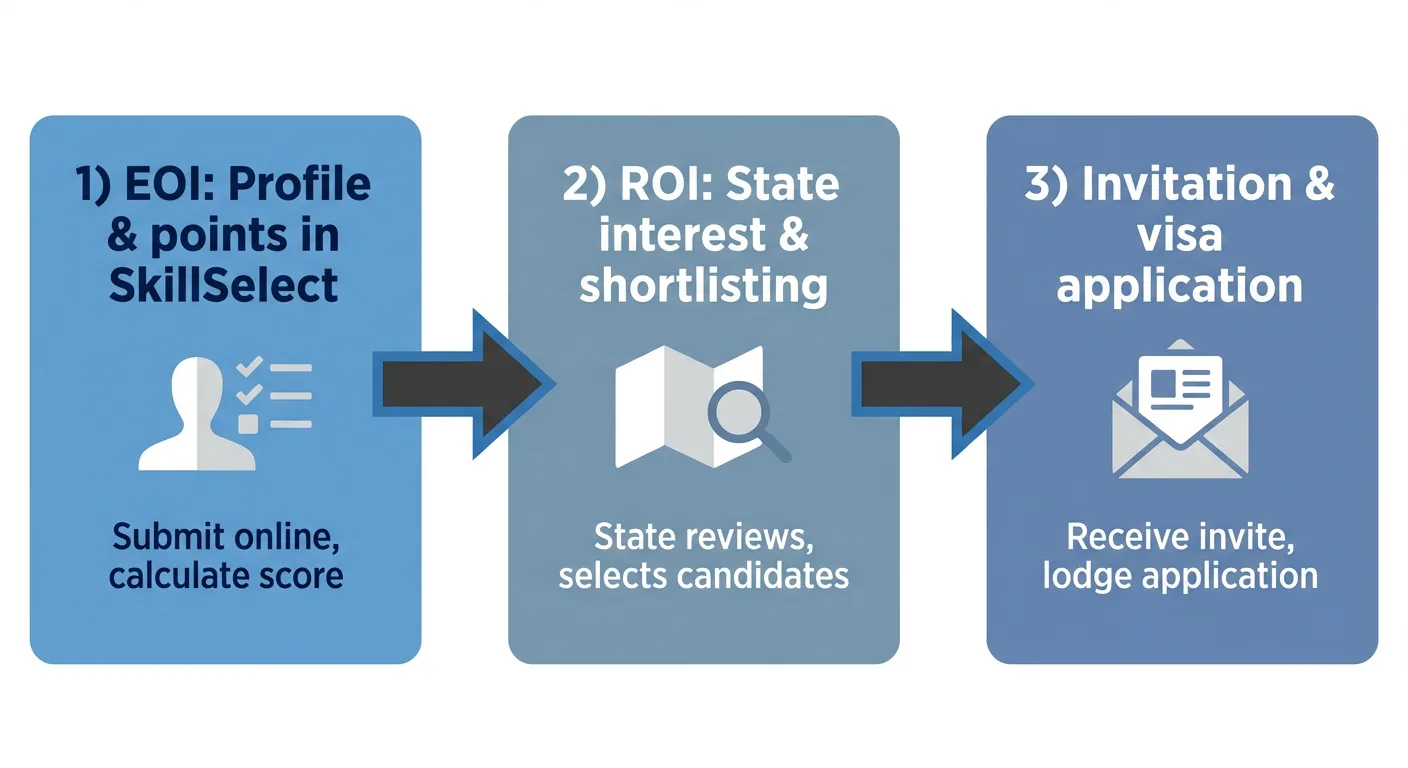
If you are planning to migrate to Australia, you will quickly come across two important terms in the skilled migration process: Expression of Interest (EOI) and Registration of Interest (ROI). They sound similar, but they serve different purposes and involve different decision-makers.
As of 2026, most points-tested skilled visas, such as the Skilled Independent (subclass 189), Skilled Nominated (subclass 190), and Skilled Work Regional (provisional) (subclass 491), are managed through the Department of Home Affairs’ SkillSelect system via an EOI.
Some state and territory governments, including Victoria, also use an additional step called a Registration of Interest (ROI) for their own nomination programs. This is particularly relevant if you are hoping to live and work in cities like Sydney or Melbourne under a state-nominated visa pathway.
Understanding how EOIs and ROIs work, and how they interact, is critical to planning a realistic migration strategy and avoiding missed opportunities.
What is an Expression of Interest (EOI)?
An Expression of Interest (EOI) is an online form you submit through the Australian Government’s SkillSelect system to tell the Department of Home Affairs that you would like to be considered for certain skilled migration visas.
According to official guidance from the Department of Home Affairs, an EOI is:
- Mandatory for points-tested skilled visas such as the subclass 189, 190, and 491 visas;
- Not a visa application;
- Used to rank candidates against others using the GSM points test; and
- Stored for up to two years from the date you submit it, unless you receive an invitation or withdraw it.
Reference: Expression of Interest – SkillSelect
Key features of an EOI
- Where it is lodged: SkillSelect (Department of Home Affairs online system).
- What it includes: Your age, qualifications, skilled employment, English test scores, partner details (if applicable) and other points-tested information.
- Points requirement: As of 2026, you generally need at least 65 points to be eligible for an invitation under most points-tested skilled visas. However, in practice, competitive rounds may require a higher score.
- Validity: Up to two years from the day you submit it, unless you are invited or withdraw it earlier.
- Fee: There is no government fee to submit an EOI.
- Can you update it? Yes. You can usually update details (for example, a new skills assessment or higher English test results) any time before you receive an invitation to apply.
Importantly, submitting an EOI does not guarantee that you will be invited to apply for a visa. It simply places you in the pool of candidates the Department and state or territory governments can select from.
What is a Registration of Interest (ROI)?
A Registration of Interest (ROI) is an extra step used by some state and territory governments to manage demand for their state nomination programs.
For example, as of 2026, Victoria requires both:
- A valid SkillSelect EOI, and
- A Registration of Interest (ROI) submitted through the Live in Melbourne portal
If you wish to be considered for Victorian nomination for the Skilled Nominated (subclass 190) or Skilled Work Regional (provisional) (subclass 491) visas.
Reference: Registration of Interest for Victorian Skilled Migration
Key features of an ROI
While details can vary slightly between states and territories, typical features of an ROI include:
- Where it is lodged: A state or territory government portal (for example, Live in Melbourne for Victoria).
- What it includes: Information drawn from your EOI plus extra state-specific questions, for example, your Victorian work experience, current residence, salary, or priority industry sector.
- Who assesses it: The state or territory government, not the Department of Home Affairs.
- Fee: As of 2026, there is no fee charged by Victoria to submit an ROI.
- Can you update it? In Victoria, once an ROI is submitted, you cannot update it; if information changes, you generally need to withdraw the existing ROI and lodge a new one.
- Validity: ROIs remain in the system until they are withdrawn, selected, or the program year ends (depending on the state’s rules).
EOI vs ROI: Key differences at a glance
Although both are “expressions of interest”, they operate at different levels of the skilled migration system.
|
Feature |
Expression of Interest (EOI) |
Registration of Interest (ROI) |
|
Who manages it? |
Australian Government (Department of Home Affairs) via SkillSelect |
State or territory governments (e.g. Victoria via Live in Melbourne) |
|
Main purpose |
To be considered for a skilled visa invitation |
To be considered for state or territory nomination |
|
When it is used |
Before any invitation for points-tested skilled visas (e.g., 189, 190, 491) |
After or alongside an EOI, where a state requires an ROI for nomination |
|
Platform |
SkillSelect online system |
State/territory portal (varies by jurisdiction) |
|
Fee to submit (as of 2026) |
No government fee |
Typically, no fee (e.g., Victoria) |
|
Can you update it? |
Yes, until you receive an invitation |
Often, you cannot update it; you may need to withdraw and lodge a new ROI Expert Australian Migration GuidanceNavigating the complexities of your visa journey is easier with professionals. Start your Australian dream today. Book Consultation |
|
Outcome |
May lead to an invitation to apply for a visa |
May lead to an invitation to apply for state nomination |
Which one do you need: EOI, ROI, or both?
What you need depends on the visa pathway and where you want to live and work.
1. For independent points-tested visas, e.g., subclass 189
You generally need only an EOI in SkillSelect. There is no ROI because there is no state nomination.
2. For state-nominated visas, e.g., subclass 190 and 491
You usually need an EOI, and in some states (such as Victoria), you also need an ROI to be considered for nomination.
3. Different rules across states and territories
Each state or territory can set its own nomination criteria and processes. As of 2026, Victoria uses an ROI system and ranks candidates based on factors such as occupation, sector, work experience, and earnings. Other jurisdictions may use different methods or may not require an ROI at all.
Because these settings can change each program year, you should always refer to:
- The Department of Home Affairs’ pages on SkillSelect and the relevant visa subclass; and
- The latest nomination guidelines are on the website of the state or territory you are interested in.
Common mistakes with EOIs and ROIs (and how to avoid them)
In the section below, we explain the common mistakes with EOIs and ROIs and how to avoid them.
1. Treating an EOI like a visa application
An EOI is an eligibility and ranking tool, not a visa application. You still need to meet all criteria and lodge a full visa application if invited.
2. Over‑claiming points
Claiming points for qualifications, English, or work experience that you cannot substantiate can lead to refusal later. As of 2026, you should only claim points you can prove with formal documents and assessments.
3. Leaving EOIs or ROIs with outdated information
For EOIs, you should update details when your circumstances change (for example, a new birthday that lowers points, or new work experience that increases them). For ROIs like Victoria’s, you may need to withdraw and resubmit if key information changes.
4. Assuming an ROI is enough without an EOI
For programs like Victoria’s 190 or 491 nomination, an ROI does not replace the EOI; you generally need both.
5. Not checking state‑specific rules
Each state or territory sets its own criteria, priority sectors, and invitation approach. Relying on outdated forums or word‑of‑mouth can easily lead to misunderstandings.
When to get advice from a registered migration agent
The difference between an EOI and ROI seems simple on paper, but in practice, strategy matters. Questions like when to lodge, which occupation to nominate, whether to target a particular state, or how to improve your points can have long‑term consequences.
Speaking with a registered migration agent can help you:
- Confirm that you are eligible before you lodge an EOI.
- Understand how current invitation trends may affect your chances.
- Decide whether a state‑nominated pathway (and ROI) is realistic for you; and
- Avoid errors that could delay or jeopardise a future visa application.
If you are unsure whether you should focus on an EOI alone or combine it with an ROI for a state like Victoria, you can book an online consultation with our registered migration agents in Sydney and Melbourne to review your options.
Conclusion
EOIs and ROIs both play important roles in Australia’s skilled migration system, but they operate at different levels.
- An EOI is lodged with the Department of Home Affairs through SkillSelect and is essential for most points‑tested skilled visas.
- An ROI is usually lodged with a state or territory government and is used to decide who will be invited for nomination under that state’s program.
As of 2026, submitting an EOI or ROI does not guarantee an invitation; they are selection tools that sit before any formal visa application. The strength of your profile, the demand for your occupation, and each state’s priorities will strongly influence your prospects.
If you are serious about migrating to Australia and want to minimise avoidable mistakes, consider speaking with a registered migration agent who understands both Commonwealth and state nomination requirements.
Ready to plan your next step? Book your consultation with our MARA expert to start your journey in Australia.