You’ve found your person and are ready to start your life together. But between now and then lies the partner visa process, and while your partner is the “applicant,” your role as the “sponsor” is equally crucial. It’s common to think this just means being a supportive partner, but it’s actually a distinct legal role with its own set of significant requirements you must meet.
Thinking of sponsoring your partner for a partner visa is a bit like co-signing a major loan. You are not just vouching for your relationship; you are making a formal, binding promise to the government to support your partner financially. In practice, this means the government will closely examine your eligibility, including your residency status, character, and financial stability. This part of the process is all about you.
This guide demystifies the Partner Visa Sponsor Requirements & Obligations, walking you through everything from the documents you’ll need to prepare to the long-term commitments you are making. Let’s make this journey clear and manageable so you can move forward with confidence.
Are You Eligible to Sponsor? The First Checklist You Need to Pass
Before you dive into gathering relationship evidence, the government first checks if you are eligible to be a sponsor. These are non-negotiable hurdles you must clear before the application can even proceed. These foundational sponsorship requirements confirm your role is even possible in an Australian partner visa application.
To sponsor your partner, you must meet three core criteria. Think of this as your first personal checkpoint:
- Your Status: You are an Australian citizen, a permanent resident, or an eligible New Zealand citizen.
- Your Age: You are 18 years of age or older.
- Your Sponsorship History: You have not recently sponsored another partner or been sponsored as a partner yourself.
That last point on sponsorship history is crucial. The government places limits on how many partners you can sponsor and how often, ensuring the system is intended for genuine, lasting relationships.
Generally, you can only sponsor two partners in your lifetime, with a waiting period of at least five years between sponsorships. This highlights the difference in sponsor vs applicant responsibilities in visa applications; these limitations apply directly to you. If you meet these initial tests, the next step is passing the sponsor’s character requirement.
The Sponsor’s Character Requirement: What They’re Really Looking For
Beyond your status and age, the government needs to ensure you are a person of good character. This isn’t a vague moral judgment; it’s a formal process called the “character requirement,” designed to protect your partner and the community. As the sponsor, meeting these character requirements for visa sponsors means proving you don’t have a history that would make you unsuitable. This mandatory checkpoint starts with a background check.
This process involves providing official police certificates. You will need to obtain a partner visa sponsor police check from the Australian Federal Police (AFP). Critically, you must also get a similar police certificate from every country where you have lived for a total of 12 months or more in the last 10 years, since you turned 16. Start gathering these early, as obtaining documents from overseas can sometimes take a while.
Having a record doesn’t always mean an automatic refusal. The Department of Home Affairs looks at the whole picture: the nature of the offense, when it happened, and your conduct since. Passing the character test is a major step in fulfilling your sponsorship requirements. With that cleared, the focus shifts to your ability to support your partner financially.
Meeting the Financial Requirements: What “Support” Really Means in Dollars and Cents
One of the biggest worries for sponsors is money. “Do I earn enough?” is a common question. The good news is that for most partner visas, there isn’t a specific partner visa sponsor income threshold you must meet. Instead, the focus is on proving you have the financial capacity to support your partner when they arrive, ensuring they won’t need to rely on government welfare.
The government needs to see that you can reliably cover basic living costs like rent, food, and bills for both of you. It’s about demonstrating financial stability, not necessarily being wealthy. This is a key part of the financial requirements for spouse sponsorship. Your ability to provide this support shows you are ready to be the financial anchor for your partner as they settle into their new life in Australia.
To prove this, you’ll need to provide solid evidence of your financial situation. Strong examples of documentation for the Australian partner visa sponsor financial requirements include:
- Your employment contract and recent pay slips
- Your last two years of tax assessment notices (Notices of Assessment)
- Bank statements showing a consistent income and/or savings
- A letter from your employer confirming your salary and position
The goal is to paint a clear picture that you can responsibly support your household. But what if you’re studying, working part-time, or currently between jobs? Don’t panic, there are still ways to demonstrate your ability to meet these obligations.
Read Articles :
- Partner Visa Australia – Eligibility, Requirements & Application Process
- Australian Partner Visa Eligibility – 2026 Detailed Breakdown
Can I Sponsor My Partner if I’m Unemployed, a Student, or on a Low Income?
A common worry is, “Can I sponsor my partner if I am unemployed or on a student visa?” The answer is often yes. Remember, the government’s main concern is your overall financial capacity, not just the number on your last payslip. They are looking for proof that your partner won’t be left without support.
If your current income doesn’t tell the whole story, the Department of Home Affairs will look at your broader financial picture. This is where your other resources come into play. Significant savings held over time or valuable assets, like property you own, can also be used as powerful evidence to meet the partner visa sponsor’s financial requirements. It shows you have a safety net available.
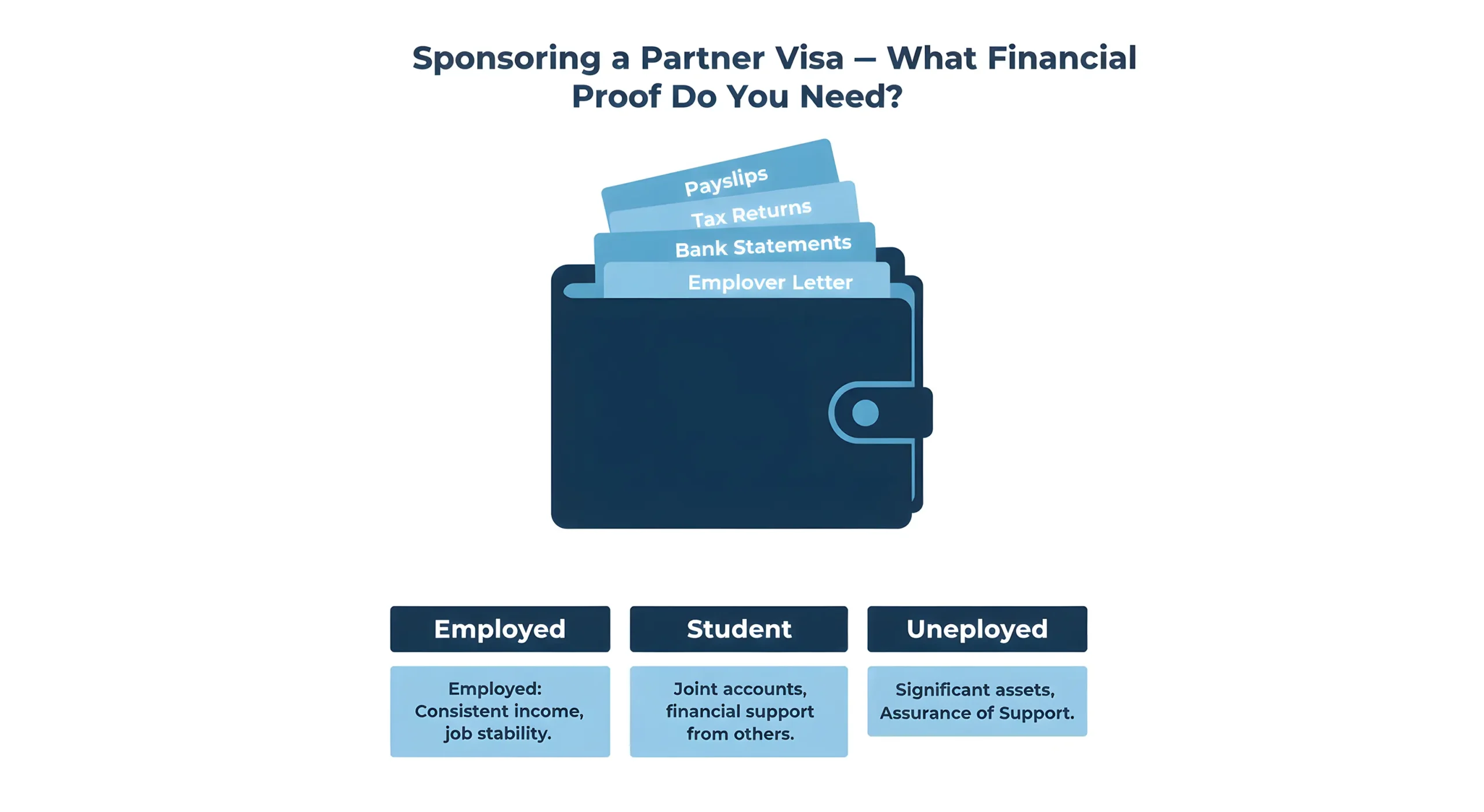
In some situations, particularly if your financial standing is a key concern, the Department may ask for an Assurance of Support. Think of this as a formal financial guarantee from another person, often a close relative. This “assurer” makes a separate legal commitment to the government, promising to repay any welfare benefits your partner might claim during a set period.
An Assurance of Support is not required for every application; it is a specific tool used when an extra layer of financial security is deemed necessary. Whether through your income, assets, or a potential AoS, demonstrating this financial backing is a core part of the sponsorship promise you are about to make.
Sponsorship Obligations at a Glance
| Obligation | Details |
| Financial support duration | 2 years from permanent visa grant date |
| Lifetime sponsorship limit | Maximum 2 partners |
| Minimum wait between sponsorships | 5 years |
| Police checks required | AFP + all countries lived in 12+ months (last 10 years) |
| Minimum sponsor age | 18 years or older |
| Must notify DHA of | Separation, change of address, relationship changes |
| Centrelink repayment risk | Applies if ex-partner claims welfare within 2-year obligation period |
| Assurance of Support | Required in some cases; optional financial guarantee from a third party |
The “Sponsorship Undertaking”: Understanding the Promise You’re Making to the Government
Beyond just showing you have the financial means, you will be asked to formalize your commitment by signing a “sponsorship undertaking.” This is a legally binding document and a core part of the Partner Visa Sponsor Requirements & Obligations. View it not as a form, but as a direct, written contract between you and the Australian government, confirming you understand and accept your responsibilities.
what are the obligations of a visa sponsor that you are agreeing to? The undertaking primarily covers your promise to take financial responsibility for your partner, ensuring they have adequate accommodation and support. It also includes the responsibility to inform the Department of Home Affairs if key circumstances change, such as your relationship status. This applies whether you are providing sponsorship undertakings for a de facto visa or a spousal visa.
This undertaking is a binding agreement, not just another piece of paperwork for the application. Your signature confirms you accept these responsibilities for a specific period, even if your relationship were to end. This naturally raises a crucial question: just how long do these sponsorship obligations actually last?
How Long Do Sponsorship Obligations Actually Last?
This is one of the most important questions a sponsor can ask. Your sponsorship obligations don’t simply end the moment the visa is approved; they are designed to provide a long-term safety net for your partner. Your commitment lasts for a specific, legally defined period that extends well beyond the initial application process. Knowing this timeline is crucial before you sign the undertaking.
To figure out the duration, you first need to know that most partner visas are granted in two stages: a temporary visa first, then a permanent one roughly two years later. While you are considered the sponsor throughout this entire period, the most significant financial responsibilities detailed in your sponsorship undertakings have a more specific timeframe.
how long does a sponsorship obligation last in financial terms?
The core period is two years, starting from the date your partner is granted their permanent visa. This means that for two years after your partner becomes a permanent resident, you are still legally bound to your promise of financial support. This is a critical detail, as it confirms your responsibilities continue even after the main visa journey is over.
Onshore vs. Offshore Partner Visas: What Sponsors Need to Know
When it comes to Australian partner visas, the pathway you and your partner take depends largely on where your partner is located at the time of application. There are two main routes, and while your sponsorship obligations are fundamentally the same in both, the journey looks quite different.
Subclass 820/subclass 801 (Onshore): is for partners already living in Australia at the time of lodgement. The application is submitted while your partner remains in the country, and they are typically granted a bridging visa to stay and work legally while the application is processed. The 820 is the temporary stage; the 801 is the permanent outcome granted roughly two years later.
Subclass 309/ subclass 100 (Offshore): is for partners living outside Australia. Your partner applies from their home country and must remain offshore until the temporary 309 visa is granted. Once approved, they can travel to Australia. The 100 permanent visa follows after the standard two-year waiting period.
Expert Australian Migration Guidance
Navigating the complexities of your visa journey is easier with professionals. Start your Australian dream today.
Book ConsultationAs the sponsor, your obligations financial support, character requirements, sponsorship undertaking, and the two-year post-permanent-visa commitment apply equally under both pathways. The key difference is simply timing and where your partner waits during processing.
What Happens if You Break Up? The Reality of Post-Separation Obligations
It’s a scenario no one hopes for, but it’s vital to know what to do if your relationship ends. Your first and most important responsibility is to inform the Department of Home Affairs about the separation. This must be done in writing. Simply stopping communication isn’t enough; you need to formally withdraw your sponsorship to sever that legal link with the government.
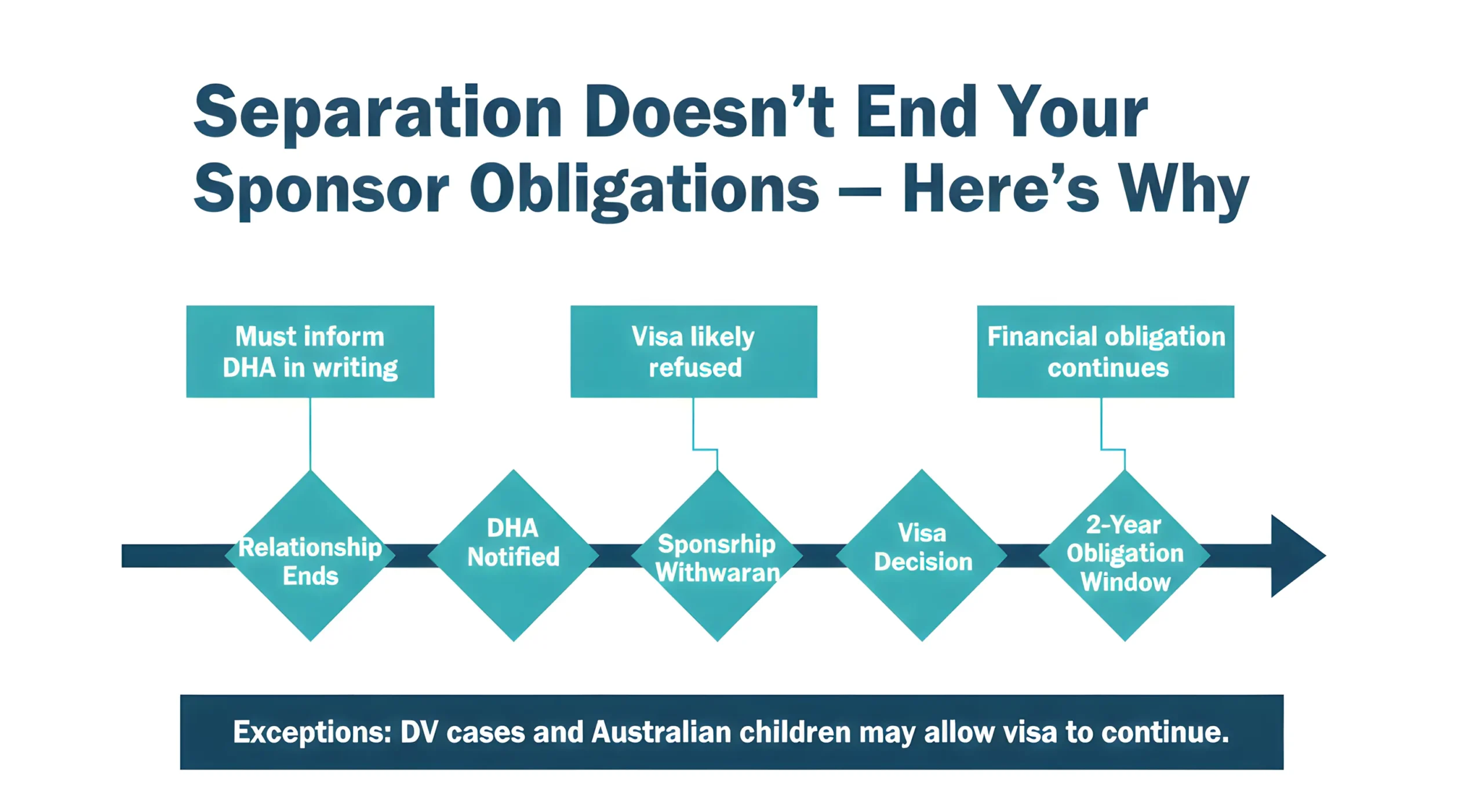
Once you have formally withdrawn your support, it has direct consequences for your partner’s visa. In most cases, the visa application will be refused, as the foundation of the application your relationship no longer exists. While there are some very specific exceptions, such as cases involving domestic violence or an Australian child, withdrawal typically prevents the visa from moving forward.
- Ongoing Government Obligation: Your legal responsibility to the government may continue even after the relationship has ended.
- Two-Year Financial Undertaking: If the partner’s visa has already been granted, your financial undertaking remains in effect for a full two years.
- Repayment of Social Security: You may be legally required to repay the government if your ex-partner claims specific social security payments, such as those from Centrelink, during the undertaking period.
- Serious Consequences: This potential for mandatory debt repayment is considered one of the most significant consequences of sponsoring a partner visa.
These post-separation rules highlight why the sponsorship undertaking is taken so seriously. You are making a binding promise directly to the government that outlasts the relationship itself in some circumstances. Being aware of these potential outcomes ensures you understand the full weight of the commitment before you even begin the application process.
Your Sponsorship Checklist: Moving Forward with Confidence
The journey to sponsoring a partner can feel complex, but you now have a clear map. You’ve moved beyond the vague idea of being a “sponsor” and can see the role for what it is: a defined commitment with manageable responsibilities to both your partner and the government.
To transform this knowledge into action, focus on this final checklist as you prepare your sponsorship application:
- Confirm your eligibility.
- Gather your identity and status documents.
- Prepare your financial evidence.
- Apply for your police checks.
- Understand your long-term obligations.
This process is no longer an intimidating legal hurdle, but a project you can confidently lead. By understanding these partner visa sponsor requirements upfront, you’re not just ticking boxes; you’re building the secure foundation for your future together. You are prepared, informed, and ready for the next step.
How The Migration Helps You To Access Your Sponsor Requirements
Navigating Partner Visa Sponsor Requirements & Obligations is rarely straightforward, and one misstep can cost you months or worse, a refusal. That’s where The Migration comes in. The Migration is an Australian-based immigration and education consultancy with deep expertise in partner visa applications. With offices serving clients across the country, our team understands exactly how the Department of Home Affairs evaluates sponsorship cases and what case officers are actually looking for when they review your file.
Our approach is built around partner visa risk assessment: a thorough review of your circumstances that aligns your application with the way case officers make decisions. This means nothing is left to chance.
If you need clear guidance on Partner Visa Sponsor Requirements & Obligations in Sydney or Melbourne, speak with an experienced migration agent Harris Park or a trusted MARA agent Melbourne at The Migration. Our specialists provide confidential consultations to explain your sponsorship responsibilities, assess eligibility risks, and help you understand the right steps before lodging your application.
Conclusion
Sponsoring your partner for an Australian visa is one of the most meaningful commitments you can make both to your relationship and to the government. While the legal responsibilities may seem daunting at first, understanding them upfront puts you firmly in control of the process. From confirming your eligibility and passing the character requirement to gathering financial evidence and signing the sponsorship undertaking, each step has a clear purpose: protecting your partner and ensuring your relationship has a genuine, stable foundation to grow on.
The obligations don’t end at visa grant they extend into your shared life together. Go in informed, prepared, and confident.
Ready to take the next step without the guesswork? The Migration’s partner visa specialists are here to assess your case, flag any risks, and build a strategy that gives your application the strongest possible foundation. Don’t leave your future together to chance book your confidential consultation with The Migration today and move forward with clarity and confidence.
Frequently Asked Questions
Q1. Can my partner work in Australia while the partner visa is being processed?
If your partner applied onshore and was granted a bridging visa, they are generally allowed to work while the application is under assessment. The specific work rights depend on the conditions attached to their bridging visa, so it’s worth checking these carefully.
Q2. What happens if I lose my job while my partner’s visa application is in progress?
Losing your job doesn’t automatically disqualify you as a sponsor. The Department of Home Affairs looks at your overall financial picture including savings, assets, and future earning capacity rather than just your current employment status. Keeping your documents updated and transparent is key.
Q3. Can I sponsor a partner if I have a criminal record?
Not necessarily an automatic disqualification. The Department reviews the nature of the offence, how long ago it occurred, and your conduct since. Certain serious offences, particularly those involving violence or child exploitation, are more likely to result in refusal of sponsorship approval.
Q4. How long does the partner visa sponsorship approval process take?
Sponsorship assessment is typically processed alongside the visa application itself. Overall partner visa processing times can range from 12 months to over 24 months depending on the visa subclass, application volume, and how complete your documentation is at the time of lodgement.
Q5. Do I need a migration agent to sponsor my partner?
It’s not legally required, but it is highly recommended for complex cases especially if you have a criminal history, prior sponsorships, or financial circumstances that aren’t straightforward. A registered migration agent can help you avoid costly mistakes and ensure your application is as strong as possible.