
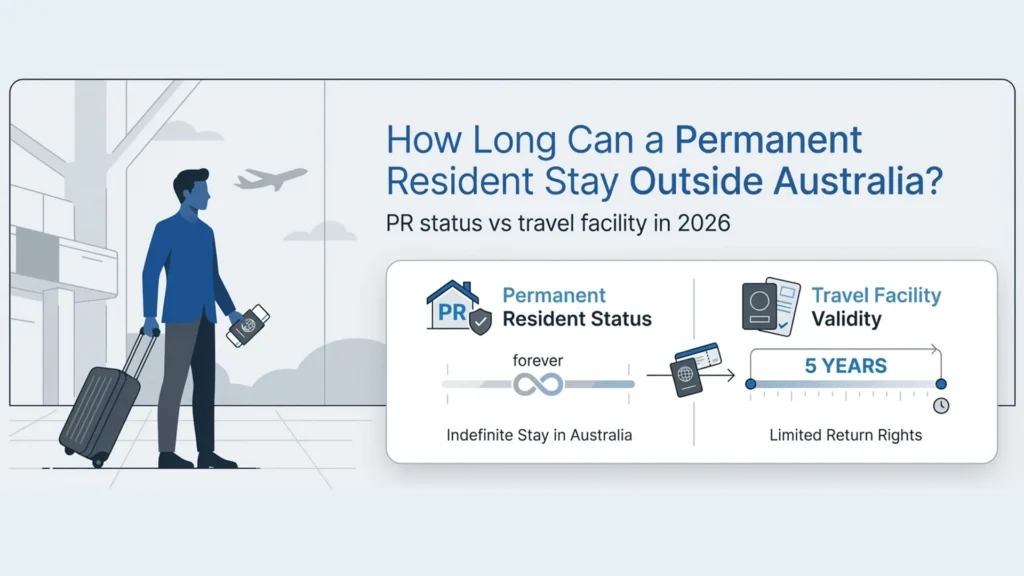
As of 2026, an Australian permanent resident can stay outside Australia for a long time but the key issue is not how long you stay away. The real issue is whether your travel facility is still valid when you want to return. If your travel facility has expired, you may need a Resident Return Visa (RRV) before you can re-enter Australia as a permanent resident.
This is where many people get confused. Your permanent resident status and your right to travel back into Australia as a permanent resident are not exactly the same thing. For many permanent residents in Sydney and Melbourne who travel for family, business, or work commitments, understanding this distinction early can help avoid last-minute travel stress.
If you are overseas now, planning a trip, or worried your travel facility is about to expire, this guide explains how the 5-year rule works, when an RRV may be needed, and when it makes sense to get tailored advice.
Can a Permanent Resident Stay Overseas Indefinitely?
Yes, a permanent resident can remain outside Australia for an extended period. However, staying outside Australia for a long time can create practical problems if your travel facility expires while you are away.
In simple terms:
- Your permanent residency does not automatically end just because you live overseas for a period of time
- Your travel facility is usually valid for 5 years from the date your permanent visa is granted
- If that travel facility expires, you may need an RRV to return to Australia as a permanent resident
Permanent Resident vs Australian Citizen: What Is the Difference?
Many people use the terms permanent resident and Australian citizen interchangeably, but they carry very different rights, obligations, and long-term implications, especially if you are planning to live, work, or migrate to Australia.
What Is a Permanent Resident in Australia?
A permanent resident holds a visa that allows them to live and work in Australia indefinitely. However, they remain citizens of their home country and hold an Australian visa, not an Australian passport.
As a permanent resident, you can:
- Live and work anywhere in Australia without restriction
- Access Medicare (Australia’s public health system)
- Sponsor eligible relatives for certain visas
- Study at domestic student rates in many cases
- Apply for Australian citizenship after meeting residency requirements
As a permanent resident, you cannot:
- Hold an Australian passport
- Vote in federal or state elections
- Work in certain government or defense roles that require citizenship
- Re-enter Australia without restrictions if your resident return visa has expired
- Hold some positions that require Australian citizenship by law
What Is an Australian Citizen?
Australian citizenship is the next step after permanent residency for most migrants. It grants full membership of the Australian community and carries rights and responsibilities that go beyond what a visa can provide.
As an Australian citizen, you can:
- Hold an Australian passport, one of the world’s most travel-friendly passports
- Vote in federal, state, and local elections
- Access a wider range of government jobs and security-cleared roles
- Live outside Australia indefinitely without visa concerns
- Pass citizenship to eligible children born overseas
- Never be deported from Australia
What Is the 5-Year Travel Facility for Australian Permanent Residents?
When you are granted an Australian permanent visa, it generally comes with a 5-year travel facility. During that period, you can usually leave and re-enter Australia as a permanent resident.
According to the official Department of Home Affairs overseas travel guidance, permanent residents should check whether their travel facility is still valid before travelling. If it is no longer valid, returning to Australia as a permanent resident may require a new visa.
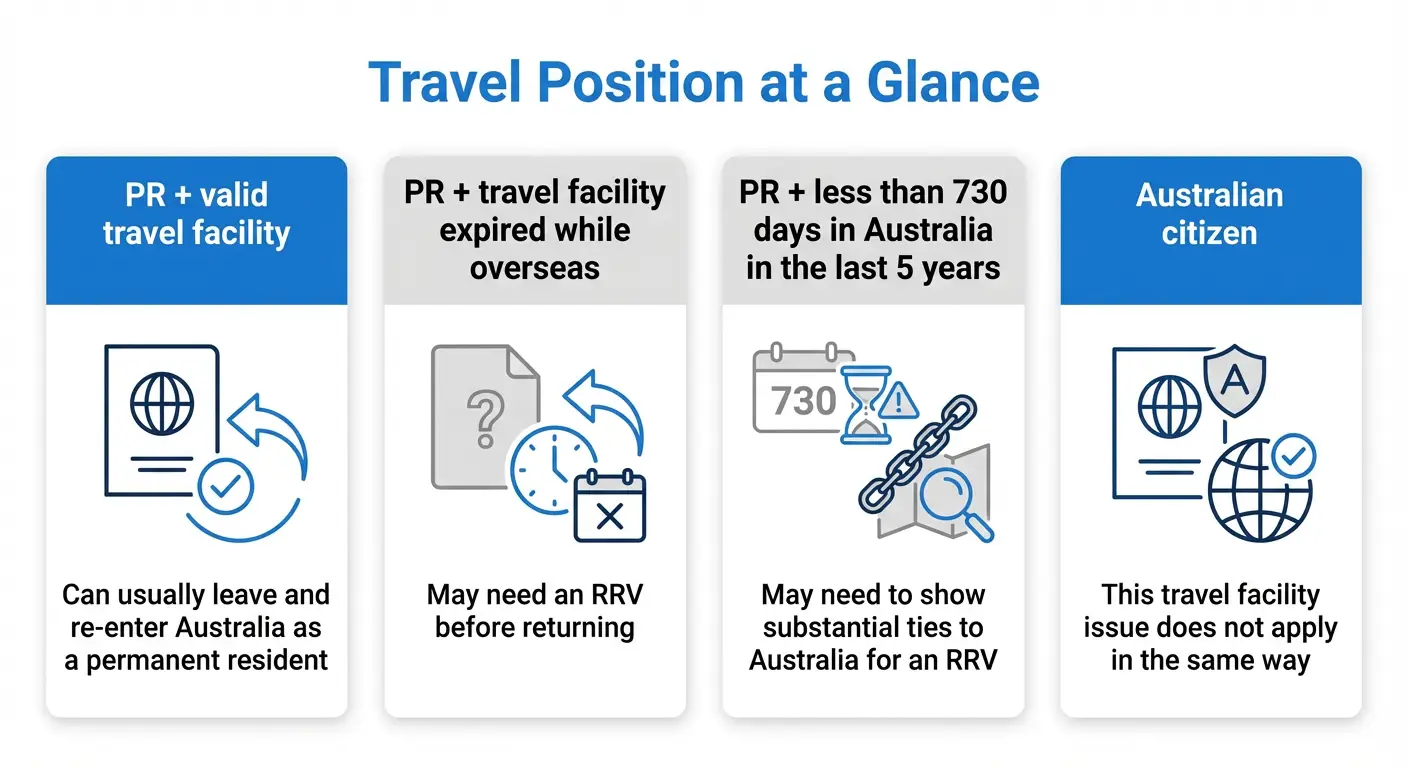
A simple way to think about it is this:
|
Situation |
What it usually means |
|
PR + valid travel facility |
You can usually leave and re-enter Australia as a permanent resident |
|
PR + travel facility expired while overseas |
You may need an RRV before returning |
|
PR + less than 730 days in Australia in the last 5 years |
You may need to show substantial ties to Australia for an RRV |
|
Australian citizen |
This travel facility issue does not apply in the same way |
Many people assume permanent residency itself expires after 5 years. In practice, what usually expires is the travel facility, not necessarily your PR status itself.
What Happens When Your Travel Facility Expires?
If your travel facility expires while you are in Australia, you may still be able to stay in Australia as a permanent resident. The bigger issue usually arises when you are outside Australia and want to return.
If you are overseas and your travel facility has expired, you may need to apply for a Resident Return Visa (subclass 155 or 157) before travelling back.
The Department of Home Affairs also offers a Travel Facility Expiry Reminder service for some permanent residents. This can be useful, but it should never replace checking your visa details yourself before you travel.
A practical first step is to review your travel facility expiry date and your recent travel history well before booking flights.
Do You Need a Resident Return Visa to Return to Australia?
You may need a Resident Return Visa if:
- Your travel facility has expired
- You are currently outside Australia
- You want to return to Australia as a permanent resident
The two RRV subclasses most commonly discussed are:
1. Resident Return Visa subclass 155
This is the main return visa for current or former permanent residents and former Australian citizens. As a general rule, a person may be eligible for a longer travel facility if they have spent at least 730 days in Australia in the last 5 years as a permanent resident or eligible person.
|
Metric |
Processing Timeframe |
|
50% of Applications |
Less than 1 Day |
|
90% of Applications |
30 Days |
2. Resident Return Visa subclass 157
This visa may be relevant in more limited circumstances where a person does not meet the usual residence requirement but may still qualify based on specific rules and supporting factors.
Because eligibility can depend on your travel history and circumstances, it is important not to assume the same outcome applies to everyone.
|
Metric Expert Australian Migration GuidanceNavigating the complexities of your visa journey is easier with professionals. Start your Australian dream today. Book Consultation |
Processing Timeframe |
|
50% of Applications |
34 Days |
|
90% of Applications |
68 Days |
For a deeper explanation of the process, see this guide to resident return visa Australia.
Who Can Get a Resident Return Visa?
As of 2026, one of the most important eligibility questions is whether you have spent 730 days in Australia during the last 5 years.
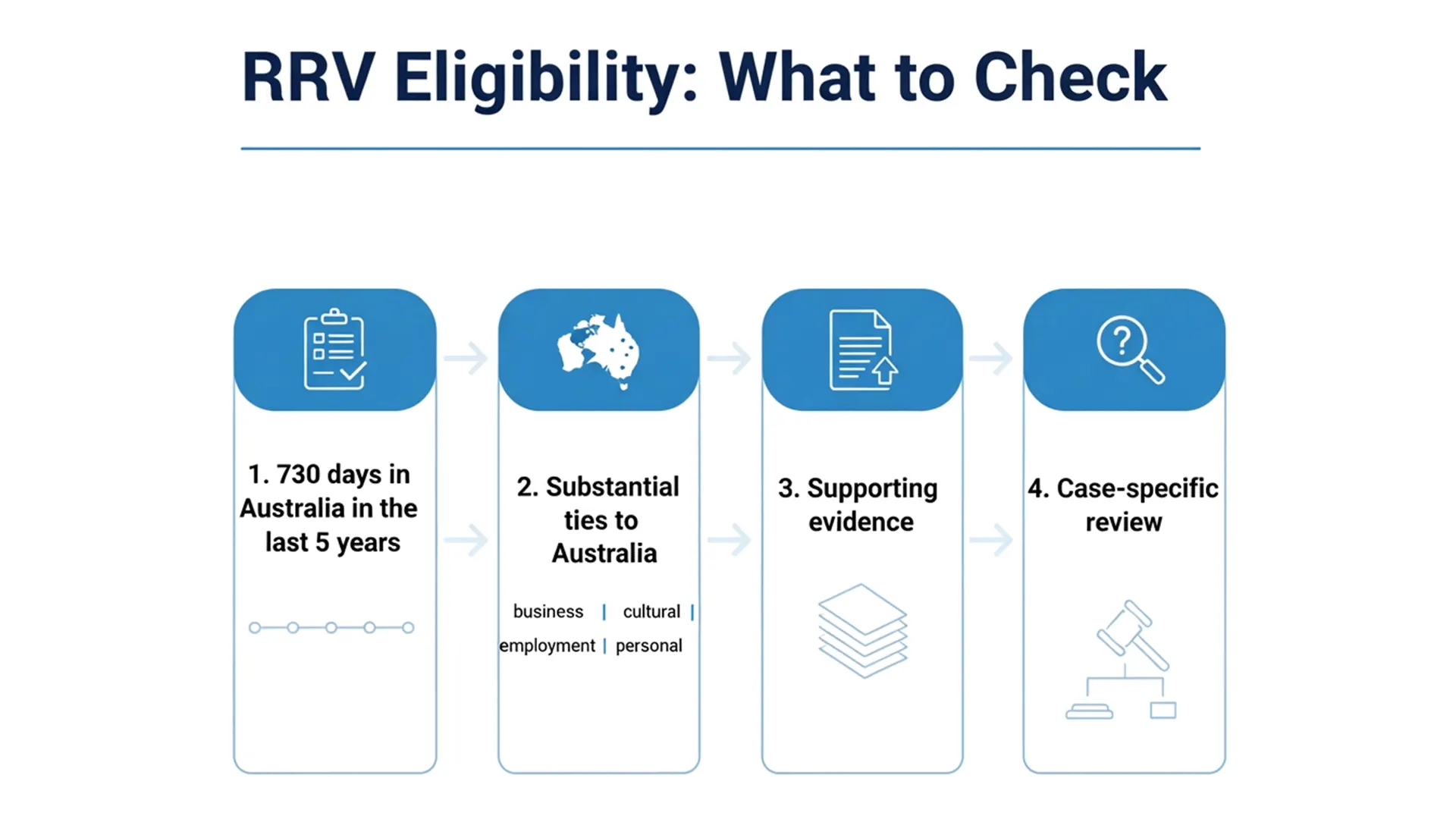
If you meet that residence requirement, your RRV pathway is often more straightforward. If you do not, you may still need to show substantial ties to Australia that benefit the country.
Official Home Affairs guidance indicates that substantial ties may include:
- business ties
- cultural ties
- employment ties
- personal ties
The strength of those ties and the evidence available can make a real difference.
If your travel facility has expired, you are outside Australia, or you are unsure whether you meet the 730-day rule, it is sensible to get tailored advice before lodging an RRV application or making urgent travel plans.
Can You Lose PR by Staying Overseas Too Long?
This is one of the most common concerns.
In many cases, the issue is not that permanent residency instantly disappears because you spent too long overseas. The real problem is that a long absence can make it harder to show you still meet the requirements for return travel as a permanent resident.
That is why it helps to separate two different questions:
- Do you still hold permanent resident status?
- Do you still have a valid way to return to Australia as a permanent resident?
If you have spent a long period overseas, your travel facility may expire and your RRV eligibility may depend on your residence history and evidence of substantial ties. This is also one reason many people later compare citizenship vs permanent residency when planning their long-term future.
What Else Should You Check Before You Travel?
Before leaving Australia or before trying to return it is worth checking:
- whether your current travel facility is still valid
- How many days have you spent in Australia during the last 5 years
- whether you have documents showing employment, family, business, or other ties to Australia
- whether your circumstances are simple enough for self-lodgement or complex enough to justify professional advice
If you are newly granted PR, this guide on what to do after getting PR in Australia may also help you plan your next steps. If you want a broader overview of your rights, read about the benefits of Australian permanent residency.
Processing Times, Charges, and Current Policy Notes
As of 2026, the Department of Home Affairs makes clear that processing times can change depending on the completeness of the application, supporting documents, response times, and the complexity of the case. For the most current information, applicants should check the official visa processing times guide.
The Department also notes that visa application charges can change and may involve instalments depending on the visa arrangement. Before lodging, check the official fees and charges guidance.
For this topic, there are no occupation lists to update. The core policy issue is the distinction between PR status, travel facility validity, and RRV eligibility.
When Should You Get Advice Before Travelling or Returning?
It is worth getting advice before travel or return if:
- Your travel facility has already expired
- It is close to expiring, and you expect to stay overseas longer
- You are not sure whether you meet the 730-day requirement
- Your time outside Australia has been extensive
- Your case depends on proving substantial ties to Australia
- You need to make urgent travel decisions for work, family, or compassionate reasons

Conclusion
So, how long can a permanent resident stay outside Australia? In practical terms, you can stay overseas for a long time but your ability to return depends on whether your travel facility is still valid or whether you qualify for a Resident Return Visa.
That is the distinction that matters most. If your travel rights are close to expiring, you are already overseas, or your residence history is not straightforward, getting tailored advice early can reduce risk and help you plan properly.
If you would like help reviewing your travel history, understanding your RRV options, or preparing the strongest possible next step, you can book a consultation or arrange an online/remote consultation.