

The short answer is usually yes, most Student Visa 500 holders can start or run a business in Australia (including online businesses, freelancing and small companies) if they:
- Obey the current work-limit rules (up to 48 hours per fortnight during study periods).
- Keep their primary purpose as full-time study and maintain attendance and course progress.
- Meet their tax and business law obligations (for example, ABN, records, registrations and licences).
The Migration experts explain how you can i start a business in Australia on a student visa, what is allowed, what is risky, and how to think about your long-term visa plans if you want to combine study with business or self-employment.
Can I Start a Business on a Student Visa in Australia?
Yes. As of 2026, most Student Visa (subclass 500) holders can start and run a business, or be self‑employed, in Australia as a sole trader, freelancer, partner or company director, provided you:
- Stay within the 48 hours per fortnight work limit in teaching periods (for all paid work combined).
- Maintain full-time enrolment, attendance and satisfactory academic progress.
- Continue to meet all other visa conditions and Australian laws.
If your business leads to work-hour breaches, failed subjects or concerns that you are in Australia mainly to run a business (not study), your visa can be at risk, and future applications may be affected.
What the Student Visa 500 Allows (and What It Doesn’t)
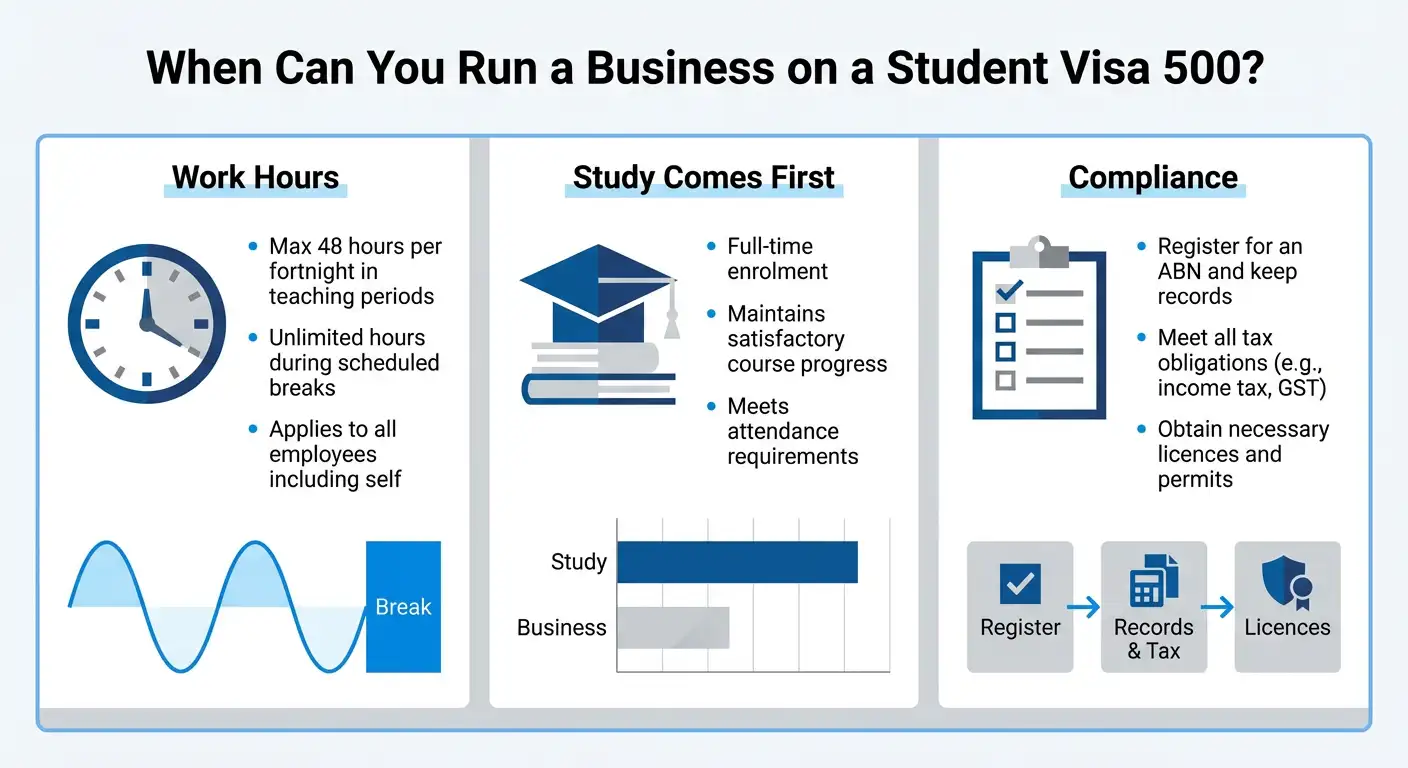
The Student Visa (subclass 500) is designed for full-time study in a registered course. As of 2026:
- You can usually work up to 48 hours per fortnight during teaching periods.
- You can work unlimited hours during official course breaks.
- You must stay enrolled in an appropriate course, attend classes and make satisfactory academic progress.
Importantly, for work-rights purposes, the visa does not distinguish between:
- Working as an employee for someone else.
- Running your own business (for example, as a sole trader or company director).
- Freelancing or consulting under an ABN.
All of these are generally treated as work. That means:
Any active hours you spend running or delivering services in your business usually count towards your 48 hours per fortnight limit during study periods.
Rules and policy settings can change, so it is essential to check the latest information on the Department of Home Affairs and Study Australia websites before you rely on a particular setting.
Types of Business Activities Students Commonly Consider
International students in Australia often think about different ways to earn extra income or build experience. Below are common models and how they interact with your visa conditions.
Sole Trader or Freelancer (ABN) as a Student
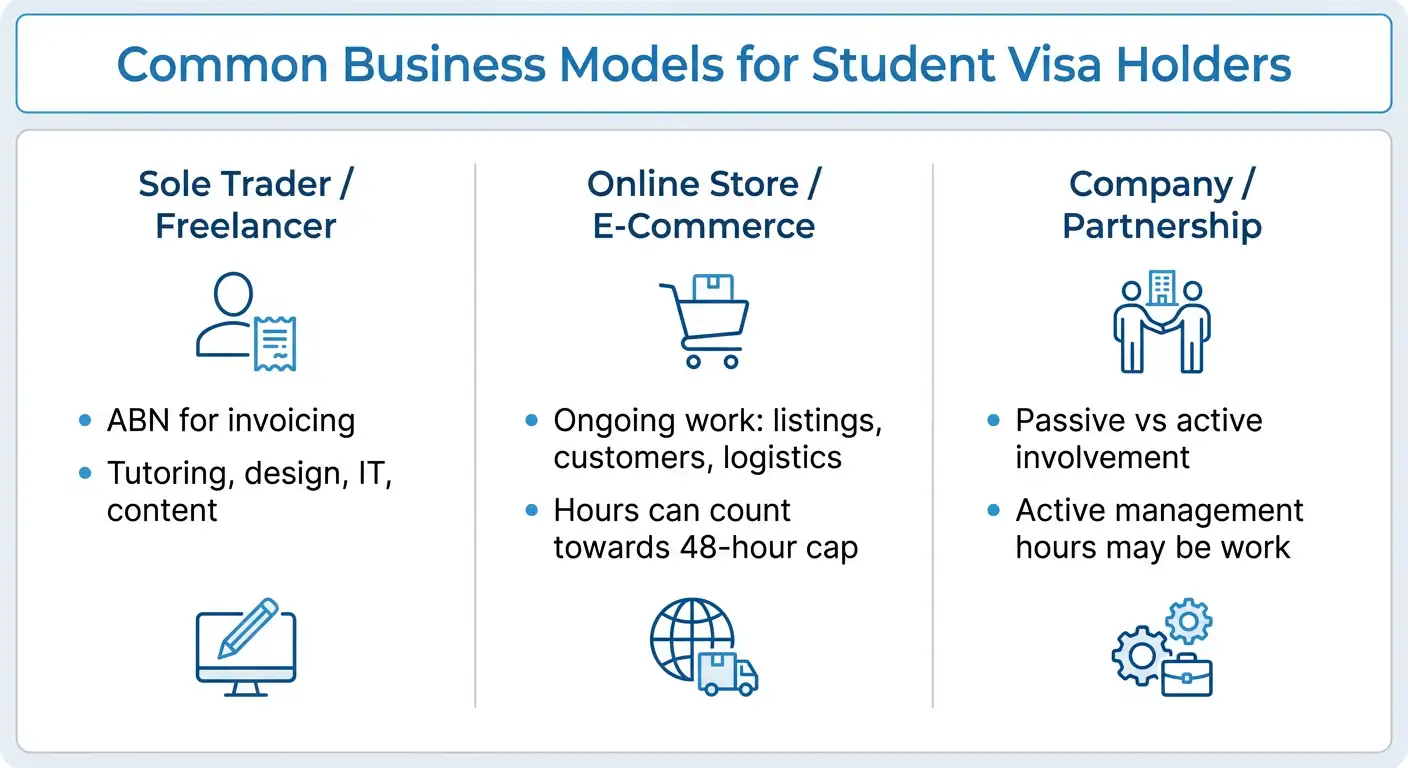
Many students set up as sole traders and obtain an Australian Business Number (ABN) so they can invoice clients directly. Examples include:
- Private tutoring or coaching.
- Freelance design, IT, marketing or development work.
- Social media management, content creation or consulting.
- Rideshare or delivery work (where allowed and licensed).
Key points:
- Your ABN does not give you extra work rights; it is only a registration and tax identifier.
- Time spent finding clients, delivering services, doing admin, marketing, or invoicing can all be seen as work and counted towards the 48-hour per fortnight limit during teaching periods.
- You must still prioritise your course if your business causes poor attendance or failed units, which can trigger compliance concerns.
Online Store or E‑Commerce Business
Some students run an online store, for example, via Shopify, Etsy or a dropshipping model. Common misunderstandings include the idea that “online income doesn’t count” or that automation means it is not work.
In reality:
- Setting up and running an online store usually involves ongoing work product research, listing products, customer service, marketing, packaging and logistics.
- These active tasks are likely to be counted towards your 48-hour per-fortnight limit.
- If your store is truly passive (for example, you hold an investment interest but are not involved in day-to-day operations), that is different, but it must be genuine and consistent with your Genuine Student requirements (GS) story.
Company or Partnership Involvement
You may be a director or shareholder in a company, or a partner in a partnership.
- Passive ownership (for example, simply holding shares in a family business) is different from active management.
- If you are actively managing staff, meeting clients or making operational decisions, those hours can count as work.
- A structure that looks very business-focused, with heavy involvement from you, can raise questions about whether your primary purpose in Australia is still study.
Whatever the structure, the key questions are the same:
- How many hours are you spending on it?
- Is it affecting your studies?
- Does it fit with your overall migration story and future visa plans?
Work Limits: How Business Hours Count Towards the 48-Hour Cap
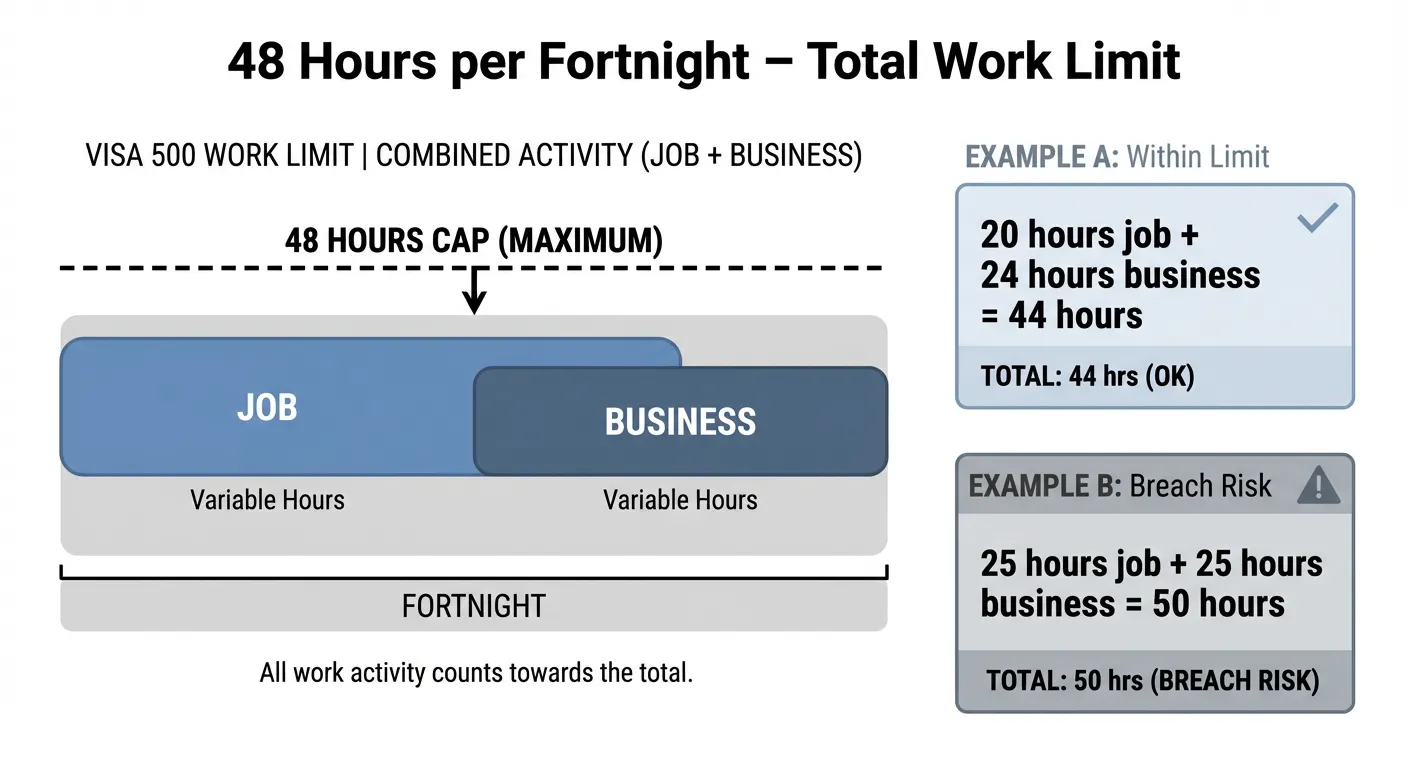
As of 2026, most Student Visa 500 holders can work up to 48 hours per fortnight during teaching periods. This cap applies to the total of:
- Paid employment for an employer, plus
- Any self-employment, freelancing or business activity you personally perform.
During recognised course breaks, you can usually work unlimited hours, but other visa conditions still apply.
Practical Examples
Some examples are given below.
Example 1 – A student in Sydney running a tutoring business
You work 20 hours per fortnight for a casual employer and spend another 24 hours tutoring students under your own ABN. Together, this is 44 hours within the limit. If you added 8 more hours for admin and marketing, you would reach 52 hours and risk a breach.
Example 2 – Student in Melbourne running a design studio
You freelance as a designer and spend around 25 hours per fortnight on client work, revisions and admin. You also work 25 hours per fortnight in a part-time retail job. Your combined total of 50 hours would likely exceed the permitted limit in teaching periods.
Because the rules apply to your overall work pattern, it is your responsibility to:
- Track your hours across all jobs and business activities.
- Reduce or pause business work during busy study periods or exams.
- Keep evidence (for example, rosters, invoices, timesheets) in case questions are raised later.
If you are doing a master’s by research or a doctoral degree, you may have more flexible work rights once your research program has started, but you should always confirm the current settings for your specific visa conditions before relying on that.
Legal & Compliance Requirements for Starting a Business as an International Student
This section is general information only as of 2026. For detailed legal or tax advice, you should speak with a qualified professional.
ABN and Business Registration
- Many types of self-employment or contracting require an Australian Business Number (ABN).
- You may operate as a sole trader under your own name, or you can register a business name.
- Registering a business or ABN does not provide extra migration benefits or extra work hours; your Student Visa 500 conditions still apply.
Tax Obligations
- The income you earn from your business is generally taxable in Australia.
- You should keep proper records of income and expenses and lodge returns on time.
- If your turnover exceeds the GST threshold (which can change over time), you may need to register for Goods and Services Tax (GST).
- For detailed guidance, refer to official sources such as the Australian Taxation Office (ATO) and business.gov.au, or talk to a registered tax agent.
Licences, Insurance and Industry Rules
Depending on the nature of your business, you may need:
- Specific licences or permits (for example, food handling, transport or professional registrations).
- Appropriate insurance, such as professional indemnity or public liability.
Failing to comply with local laws and regulations can create problems not only for your business but potentially for future visa applications if serious issues arise.
Risks That Can Lead to Visa Problems
Running a business while studying can be positive if it is well managed, but there are clear risks you should understand.
Breaching Work-Hour Limits
If your combined employment and business activity regularly exceeds 48 hours per fortnight during teaching periods, you may be breaching your visa conditions.
Home Affairs can consider rosters, bank records, invoices, delivery logs and other evidence. Repeated or serious breaches can lead to visa cancellation and may affect future applications.
Expert Australian Migration Guidance
Navigating the complexities of your visa journey is easier with professionals. Start your Australian dream today.
Book ConsultationFailing Your Course or Poor Attendance
If your business causes you to miss classes, fail units or change courses repeatedly, this can trigger concerns about your genuine intention to study.
Issues with your Confirmation of Enrolment (CoE) or course progress can flow through to your visa. Even if your work hours are technically within the limit, poor academic performance can raise red flags.
Related Article: What Happens after CoE Cancellation in Australia?
Genuine Student Requirement Concerns
When you applied for your student visa, you needed to satisfy the Genuine Student requirement.
If your behaviour in Australia suggests that your main purpose is to run a business, for example, you are heavily involved in a growing company while barely meeting study requirements, this can create difficulties for:
- Future student visa applications.
- A Temporary Graduate (subclass 485) visa.
- Other temporary or permanent visas.
Poor Record-Keeping and Tax Issues
Tax and business-compliance problems can have long-term consequences. For example:
- Not declaring income or failing to lodge returns.
- Significant unpaid tax debts.
- Irregular or misleading information across visa and tax documents.
These issues can damage your credibility and may be taken into account when future visa applications are assessed.
Running a business while studying can be exciting, but if it leads to work-hour breaches, CoE issues or tax problems, it can damage your future in Australia. A short strategy session with a MARA-registered migration agent can help you structure your business in a way that better supports your visa and long-term goals.
How Starting a Business Fits Into Your Long-Term Visa Strategy
A business can sometimes support your broader migration story for example, by building skills, experience, networks and English language use. However, it is not a guaranteed pathway to permanent residency.
Depending on your situation, your longer-term pathway might involve:
- A Temporary Graduate visa (subclass 485) to gain post-study work experience.
- Skilled migration visas (for example, through the General Skilled Migration program) if you meet occupation, points and other criteria.
- An employer-sponsored visa, if a suitable employer is prepared to sponsor you.
- In some cases, business or investment-focused visas, if you meet strict eligibility requirements.
The right strategy depends on:
- Your age, qualifications and English level.
- Your occupation and experience (including any business activities).
- Where you live (for example, Sydney, Melbourne or a regional area) and which visa programs are available.
A registered migration agent can help you map how your student years, early work experience and any business activity fit into a realistic 3–5 year plan.
To explore these options, it can be useful to review our pages on Temporary Graduate (subclass 485) visas, skilled migration visas and employer-sponsored visa options, and then book tailored advice.
Related Article: Complete Subclass 485 visa Requirements 2025-2026 – Step by Step with checklist
How The Migration Can Help Student Entrepreneurs in Australia
At The Migration, we regularly assist international students who want to balance study, work and business plans.
In a consultation, our MARA-registered migration agents can:
- Review your current visa, course, grades and work pattern.
- Discuss your business idea or existing operations and how they interact with work limits.
- Identify risks or red flags (for example, hours, GS concerns or major tax issues).
- Outline a step-by-step migration strategy from Student Visa 500 to Temporary Graduate 485 and then to a longer-term visa, if appropriate.
If you are studying in Sydney, Melbourne or elsewhere in Australia and are serious about starting or growing a business while staying compliant, consider booking a consultation with The Migration. Our team can help you understand your options before you make big decisions.
You may also find it helpful to explore related pages on our site, such as:
Conclusion
Yes, as of 2026, you can usually start a business or be self-employed on a Student Visa 500 in Australia, provided you respect your work limits, study obligations and legal responsibilities.
- The main risks come from how you run the business – especially if your combined hours exceed 48 per fortnight, your grades suffer, or your activities look inconsistent with your stated study purpose.
- Owning a business does not automatically lead to permanent residency, but it can form part of a broader strategy if your profile and visa options support it.
When in doubt, especially if your situation is complex or you are planning significant growth, it is safer to get tailored advice from a MARA-registered migration agent before you expand.
If you want to start a business on a student visa in Australia and stay on the right side of both migration and tax rules, consider booking a consultation with The Migration. Our team can review your visa, study plans and business idea and outline a safer path forward.