

Clause references and review periods below were checked against Home Affairs and the Administrative Review Tribunal that day.
The email lands on an ordinary weekday. A PDF, a few pages, and one line near the top saying the application has been refused.
You read it twice. It never quite says why. It quotes a clause number and says an officer was not satisfied.
Then the calls start, and somebody asks what your family did wrong.
So let’s settle that first. A visitor visa refusal in Australia always comes with a written decision, and that letter is now the most useful thing you hold.
It names the exact requirement that wasn’t met. It says whether anyone can ask for a review, and by when. In most cases, it also shows there is no waiting period before you apply again.
Below: what each part of the letter does, what the clause numbers mean, and what to do in the first week. If you’d rather have someone read yours with you, you can book a consultation.
What is actually inside a visitor visa refusal letter?
Three things. The decision, the findings and reasons, and a section on review rights.
Most families read the first part, feel the drop, and never reach the third. That’s where the useful information sits.
- The decision. Short. It records that the application was assessed and refused.
- The findings and reasons. The long middle. It works through each requirement, then names the one the case officer wasn’t satisfied about.
- Review rights. Usually last, sometimes a separate attachment. Short, formal, and it has a deadline attached.
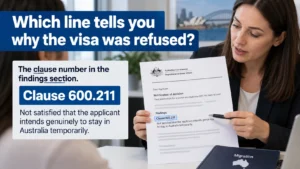
Which line tells you why the visa was refused?
The clause number in the findings section. Everything else is context around it.
Visa criteria are set out in the Migration Regulations, and a refusal cites the one that wasn’t met. The wording feels cold, but it is exact, and it is what a second application has to answer.
On most visitor refusals, the key sentence reads close to this: “I am not satisfied that the applicant intends genuinely to stay in Australia temporarily.” That is clause 600.211. It is a finding about evidence, not about character.
| What the letter cites | What it means in plain words | What the next application has to show |
| Clause 600.211 genuine intention to stay temporarily | The officer wasn’t satisfied the visit would end. Behind most visitor refusals. | What pulls the applicant home: a house, a spouse staying behind, past trips that ended on time. |
| Clause 600.212 adequate means to support the stay | The funds shown didn’t match the trip, or couldn’t be explained. | A money trail that fits how the applicant really lives. If you’re funding the visit, say so openly. |
| Public Interest Criterion 4020 false or misleading information | A document or statement was assessed as wrong. This one carries weight beyond the refusal. | Advice before anything else is lodged. See the section on bans below. |
| Public Interest Criterion 4005 health | A health requirement wasn’t met, or the medicals weren’t finished. | Often a procedural fix. Some findings need a health waiver, where one is available. |
| Public Interest Criterion 4001 character | Something in the character check was not cleared. | Advice first. Character findings follow an applicant across visa types. |
If the clause is 600.211, the letter is not saying anyone lied. It is saying the paperwork didn’t show enough reason to go home. Those are very different findings, and the second one can be fixed.
The Home Affairs subclass 600 page sets out the requirements, and the decision itself is made under section 65 of the Migration Act 1958. Home Affairs publishes separately what it looks at for the health and character requirements.
None of them publishes a document list or a bank balance, because there isn’t one. If the finding was about ties or funds, the answer is evidence specific to your family, including the invitation letter, which is the one document you fully control.
What if one parent was refused and the other wasn’t?
That’s normal, and it isn’t a mistake. Every applicant is assessed individually, even when applications are lodged together, so two people in the same household can get two different decisions.
Read the two letters side by side, and the reason is usually visible.
- The refused applicant had weaker ties on paper: no property in their name, no pension in their own name, no travel history of their own.
- A spouse travelling alone can read as a weaker case than a couple travelling together, not a safer one.
- The granted visa keeps its own conditions and dates, which don’t change because of the other refusal.
The grant doesn’t have to be given up. Our guide to visitor visas for parents covers how couples are assessed.
Does your letter give you the right to appeal?
The letter answers that itself, in its own section, and the answer depends on where the application was lodged.
The Tribunal puts it plainly. Your decision letter tells you whether the decision can be reviewed, and whether you are a person who can apply.
Broadly, visitor refusals fall three ways:
- Refused while the applicant was in Australia. Usually reviewable by the applicant, and the window is short: 21 days from receiving the notice.
- Refused offshore, with a sponsor or nominator in Australia. Review generally belongs to that person here rather than the applicant, with a longer window of 70 days.
- Refused offshore, standard Tourist stream, no sponsor. Usually no merits review right at all. The letter will say so.
That last line is one families rarely hear before they lodge, and it’s why the first application matters more than it feels like at the time.
These periods are set by regulation, and the Tribunal cannot extend them. So if your letter grants review rights, read the date first and get advice inside that window. Fees are on the Home Affairs review of decisions page; the Tribunal sets out the process, and our guides cover how to lodge an appeal and how long it takes.
Not sure what your letter allows? Our MARA-registered agents (MARN 2518738) can tell you in one conversation. Book a consultation.
What changes if the refusal happened while you were in Australia?
Two more rules can apply, and the letter won’t always spell them out.
Section 48 bites if you hold no substantive visa and have had a visa refused since you last arrived. Most new onshore applications are then blocked, though a prescribed list stays open so it’s narrower than it sounds. Most people in this position hold a bridging visa while it’s worked out, and are not unlawful.
Condition 8503, “No Further Stay”, may already sit on the visa the applicant travelled on. You can check it yourself through the Home Affairs online conditions check, and our explainer on what condition 8503 means covers when a waiver is possible.
Expert Australian Migration Guidance
Navigating the complexities of your visa journey is easier with professionals. Start your Australian dream today.
Book ConsultationSeparate rules, separate remedies. Clearing one does not clear the other.
Does a refusal stop you applying again?
Usually not. There is no general waiting period after a visitor visa refusal. A new application can go in once the reasons in the letter have really been addressed.
The exception is PIC 4020. Where a visa is refused because false or misleading information or a bogus document was given, a three-year bar can apply to later applications carrying that criterion. Where identity wasn’t established, it’s ten years.
The three-year bar can be waived in limited cases. The ten-year identity bar cannot.
So this is the line to check first. If PIC 4020 appears anywhere in your letter, take advice before lodging anything, including a different visa type.
What to do with the letter in the first week
Two things, and neither is lodging a new application.
Read it as a checklist, not a verdict
- Find the clause number and write it at the top of the page.
- Note the date the notice was received, not the date on the letter.
- Highlight the review rights paragraph and any deadline in it.
- Check whether PIC 4020 appears anywhere in the reasons.
Keep the file exactly as it was lodged
- Save the application, every attachment, and the decision together.
- Don’t edit or swap out documents from the original file.
- Any future application must disclose this refusal, so the record matters.
Where families lose the most ground after a refusal
By re-lodging the same application with a covering letter attached.
At our Harris Park office in Sydney, this is the most common thing we see after a refusal. The second file repeats the first, adds a paragraph saying the family was honest, and is read by someone holding the earlier decision.
Honesty was never the question. Clause 600.211 asks about ties, intention, and circumstances, so a second application has to look different on those points, not sound more sincere.
The other pattern is silence. A refusal gets treated as a family embarrassment rather than an administrative outcome, so nobody asks for help.
If you’re in that week now, send us the decision letter and nothing else to start with. Get in touch, and we’ll tell you what it says.

How The Migration helps after a visitor visa refusal
We’re a MARA-registered practice (MARN 2518738), verifiable on the public register of migration agents, working with families across Sydney from our Harris Park office and with applicants overseas.
After a refusal, the work is specific:
- Reading the decision and naming the criterion that decided it.
- Confirming whether review is open, to whom, and by what date.
- Checking for section 48, condition 8503 and PIC 4020 before anything is lodged.
- Rebuilding the evidence so the next visitor visa application answers the finding instead of repeating the first.
- Advising whether a parent visa is the better long-term route where visits keep being refused.
We’ll also tell you when a case is simple enough that you don’t need us. That happens often, and it’s more useful than a quote.
Before you lodge anything else
A visitor visa refused in Australia is not a judgement on your family, and for most applicants it is not a ban. It is a written note of one requirement that wasn’t met, with the deadline for challenging it on the same page.
Read the clause. Check the review rights and the date. Look for PIC 4020. Then decide whether the next step is review or a rebuilt application, because it’s rarely both.
If you’d like a MARA-registered agent (MARN 2518738) to read the decision letter before you act on it, book a consultation and bring the letter with you.