
The reality is that the old fixed TSOL has effectively been replaced by a system of priority roles and updated skilled migration pathways. That shift can be confusing, especially if you’re reading older content or comparing advice from different sources.
Our Migration Expert will walk you through:
- What TSOL was and how it fits into Tasmania’s skilled migration story
- How priority roles now guide nomination decisions in Tasmania
- How Tasmanian nomination connects to the Skilled Nominated (subclass 190) and Skilled Work Regional (provisional) (subclass 491) visas
- Practical steps to check whether your occupation and work history are competitive in the current program
- When it’s worth speaking with a registered migration agent before you act
What Was the Tasmania Skilled Occupations List (TSOL)?
The Tasmania Skilled Occupations List (TSOL) was a list published by the Tasmanian Government to highlight occupations in demand in Tasmania.
Historically, TSOL helped skilled migrants to:
- See whether their occupation was prioritised for the Tasmanian nomination
- Understand which occupations could be considered under pathways leading to subclass 190 and 491 visas
- Get a broad sense of employment prospects in Tasmania before committing to a move
TSOL included occupations such as engineers, health professionals, IT specialists, managers, and trades. Being on the list did not guarantee a visa, but it often meant:
- A clearer pathway to state nomination (subject to meeting all criteria)
- A potential advantage when Migration Tasmania assessed Registration of Interest (ROI) applications
As Tasmania’s labour market and policy settings evolved, the government gradually moved away from a static occupation list and towards a priority roles and skilled employment model.
TSOL 2025 Update: From Occupations List to Priority Roles
While many people still search for “Tasmania Skilled Occupations List 2025 (TSOL)”, the program has shifted. Instead of relying on a long static list, the current system focuses on priority roles that better reflect Tasmania’s immediate workforce needs.
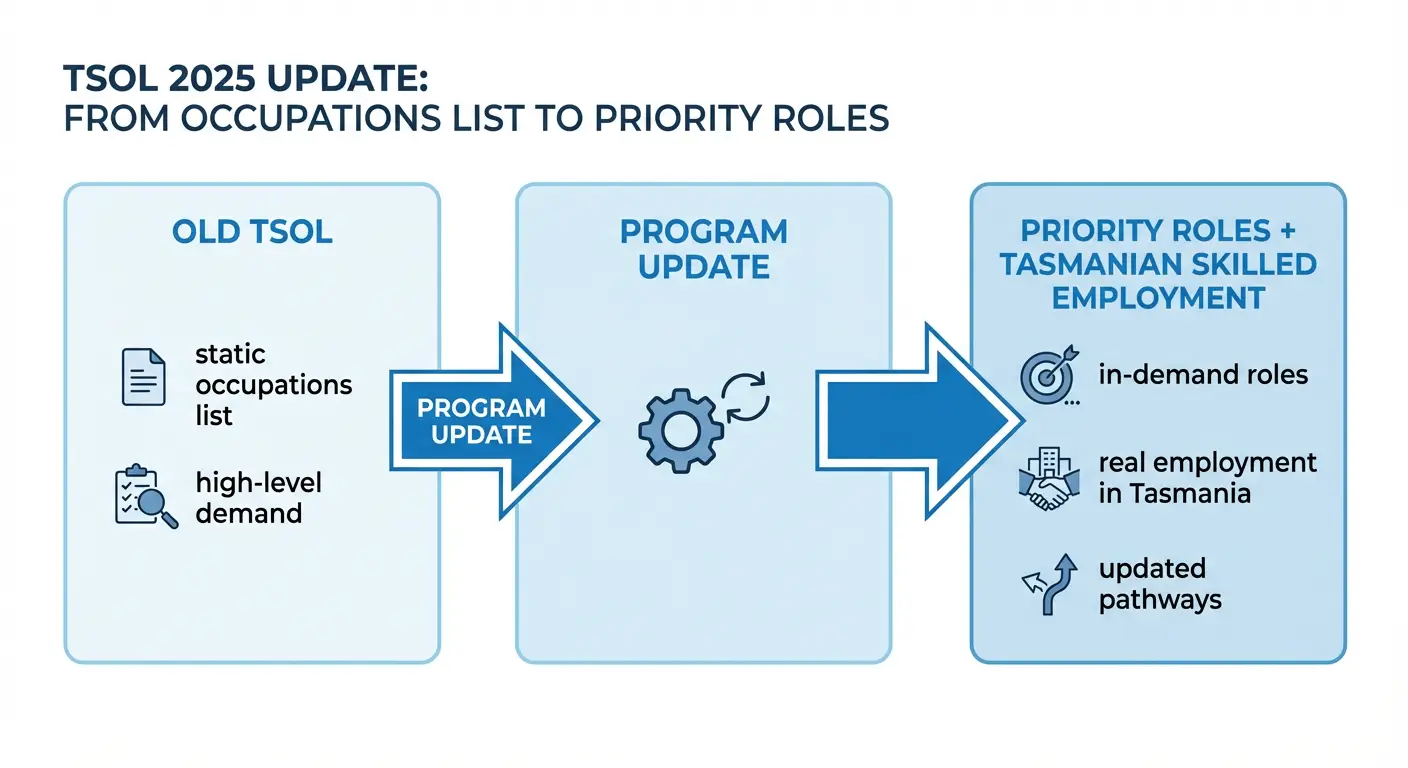
In practice, this means:
- The state gives particular attention to health, allied health, and education roles, along with other occupations where there are clear skills shortages
- There is a stronger emphasis on genuine, ongoing employment in Tasmania, not just a nominated occupation on paper
- Priority roles and other attributes are considered when Migration Tasmania ranks ROIs and decides who to invite
Importantly:
- Priority roles can change over time; they are updated as the Tasmanian economy and workforce needs shift
- Some occupations that previously appeared on TSOL may now have lower priority, even if they are still technically eligible for skilled migration
Before you rely on any list you find online, always:
- Check the latest information on the official Migration Tasmania website
- Confirm how your occupation is currently treated under the Tasmanian Skilled Employment and other nomination pathways
Tasmania Skilled Migration Pathways: 190 and 491 Visas
Tasmanian state nomination is usually connected to two skilled visas under Australia’s General Skilled Migration (GSM) program:
Skilled Nominated Visa (subclass 190)
The Skilled Nominated (subclass 190) visa is a permanent visa for skilled workers nominated by an Australian state or territory. For Tasmania, nomination can be an important step if you:
- Work in, or have strong ties to, Tasmania
- Meet Tasmanian nomination requirements for your chosen pathway
- Meet the Department of Home Affairs criteria for the 190 visa itself
If granted, a 190 visa offers:
- Permanent residency in Australia
- Access to Medicare (subject to eligibility)
- A pathway to Australian citizenship in the future
Skilled Work Regional (Provisional) Visa (subclass 491)
The Skilled Work Regional (Provisional) (subclass 491) visa is a temporary visa that can lead to permanent residency. It is designed for skilled workers who are prepared to live, work, and study in a designated regional area, which includes all of Tasmania.
With a 491 visa, you typically need to:
- Live and work in a designated regional area for a qualifying period
- Meet specific income or other requirements (set by the Department of Home Affairs) before you can transition to permanent residency
In both cases, Tasmanian nomination is a separate step on top of Home Affairs requirements. Being in a priority role or on an old list like TSOL does not guarantee a nomination or visa grant.
Related Article: General Skilled Migration Australia 2025-26: The Roadmap to Your Australian Dream
How Priority Roles and Tasmanian Employment Affect Your Eligibility
Today, Tasmania places strong weight on what you are actually doing in the state, not just your occupation title.
Key factors Migration Tasmania may consider include:
- Whether your occupation is on the current priority roles list
- Your employment in Tasmania – including how long you’ve been working, whether it is ongoing, and whether it matches your skills assessment
- The level of your earnings and whether they reflect skilled employment in Tasmania’s labour market
- Other attributes such as your qualifications, English, work history, and settlement prospects
Under pathways like Tasmanian Skilled Employment, applicants working in priority roles with solid, ongoing employment can be more competitive than those who only recently arrived or who are in lower-demand roles.
However:
- Exact timeframes, income thresholds, and detailed criteria can change and are set by Migration Tasmania
- Being in a priority role does not guarantee an invitation or visa approval
Because of this, it is critical to rely on current official guidance rather than old TSOL-only rules or outdated forum posts.
Expert Australian Migration Guidance
Navigating the complexities of your visa journey is easier with professionals. Start your Australian dream today.
Book ConsultationChecking Whether Your Occupation Is Competitive in Tasmania
Here is a practical way to assess where you stand before you lodge an ROI or EOI.
1. Confirm your ANZSCO occupation and skills assessment
- Make sure you know your correct ANZSCO code and occupation title
- Obtain or confirm a positive skills assessment from the relevant assessing authority (for example, Engineers Australia, ACS, ANMAC, VETASSESS)
- Check that your skills assessment is current and valid for skilled migration purposes
2. Check current Tasmanian priority roles and pathways
- Visit the official Migration Tasmania website and review the current priority roles or equivalent guidance
- Read the detailed criteria for the Tasmanian Skilled Employment and other nomination pathways
- Note any extra conditions about work hours, contract type, income levels, or regional location within Tasmania
3. Review your actual work and settlement situation
Ask yourself:
- Am I already working in Tasmania? If so, is my role skilled and related to my occupation and skills assessment?
- How long have I been in the role, and is it likely to continue?
- Am I building a genuine connection with Tasmania, such as living there long term, studying locally, or having family ties?
Applicants who can demonstrate stable, skilled work and a genuine commitment to staying in Tasmania usually present a stronger case than those who have only just arrived or are working in unrelated roles.
4. Understand how 190/491 fits your long-term plan
For some people, a Tasmanian nomination for a 491 visa is a realistic stepping stone, even if 190 nomination is highly competitive. For others, it may make sense to aim directly for a 190 visa if their occupation, work profile, and points score are strong.
A registered migration agent can help you compare options across:
- Tasmanian nomination
- Other state and territory programs
- Federal options like the Skilled Independent (subclass 189) visa, where relevant
Common Mistakes with TSOL, Priority Roles, and Tasmanian Nomination
Many applicants miss opportunities or harm their chances because they rely on outdated TSOL lists or misunderstand what “priority” really means.
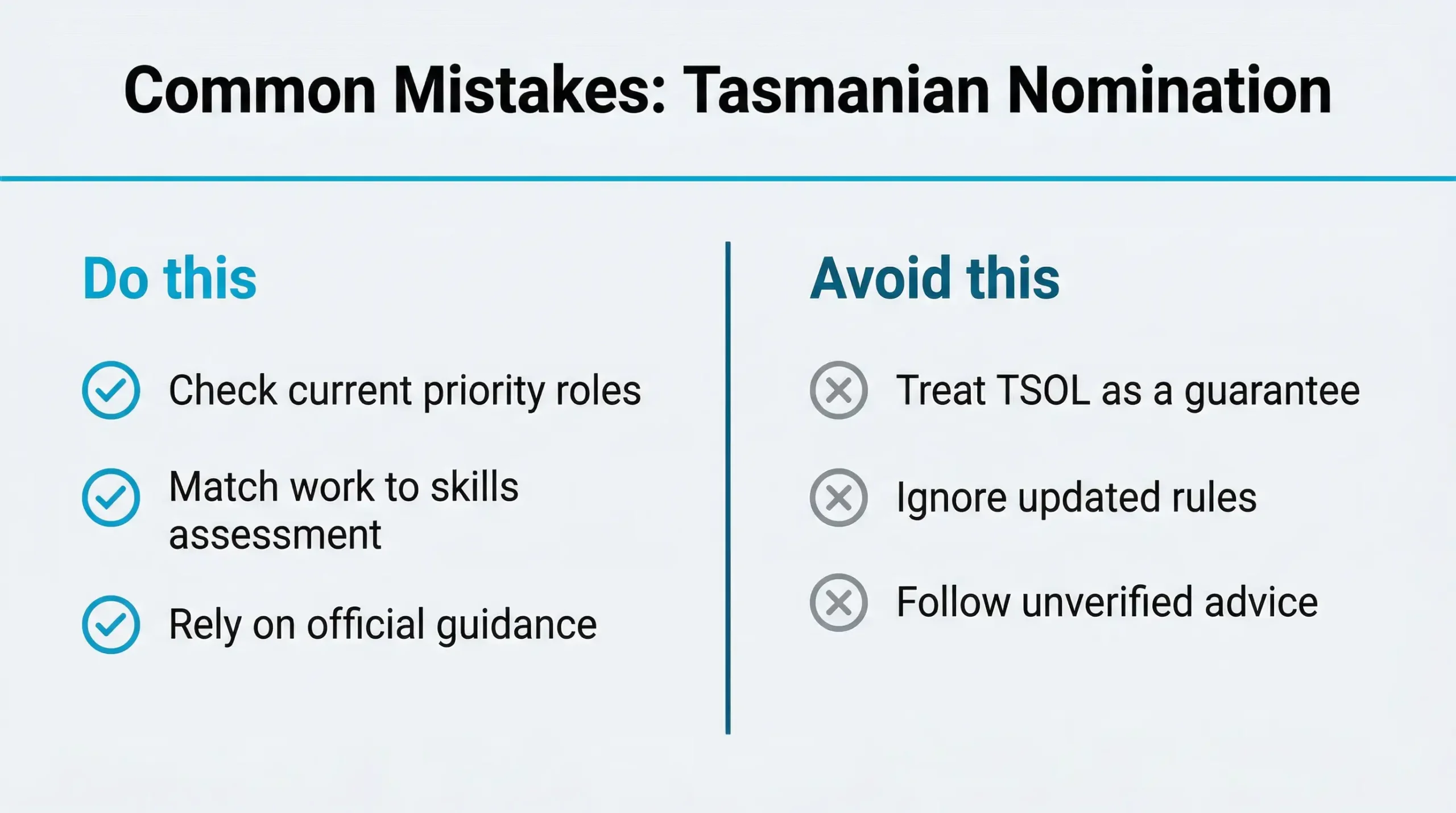
Common issues include:
- Treating TSOL as a guarantee: Being on an old occupations list never meant automatic nomination or visa approval
- Ignoring updated guidance: Applicants continue to follow 2020–2022 rules instead of checking current priority roles and pathways
- Misaligned employment: Working in a role that doesn’t match their skills assessment or is not at a genuinely skilled level
- Relying on informal sources: Making major decisions based on social media advice or unverified blog posts
If you are unsure whether your occupation and role meet today’s expectations, it’s usually safer to get tailored advice before you lodge an ROI or change visas.
When to Speak with a Registered Migration Agent
Because Tasmania’s skilled migration settings change regularly, there are clear situations where professional advice is highly recommended, for example, if:
- You previously relied on TSOL and now aren’t sure how priority roles affect your options
- Your occupation is not clearly on current priority lists, but you do have Tasmanian work or study
- You have already lodged an EOI/ROI and haven’t received an invitation
- You are weighing up whether to move from another state (such as New South Wales or Victoria) to Tasmania for better skilled migration prospects
A MARA-registered migration agent can:
- Review your occupation, skills assessment, and work history
- Check current Tasmanian and federal criteria and invitation trends
- Map out realistic pathways, including Tasmanian nomination, other state options, or alternative visas
- Help you avoid decisions that might damage your future visa options
Conclusion
The phrase “Tasmania Skilled Occupations List 2025 (TSOL)” is still widely used, but the state’s program now revolves around priority roles, skilled employment, and carefully defined nomination pathways.
If you understand how your occupation, work history, and long-term plans fit into this new framework, Tasmania can still be a powerful pathway to 190 or 491 visas and, eventually, permanent residency.
If the changes to TSOL and the move to priority roles feel confusing, don’t guess your chances. Book a consultation so an experienced migration agent can review your case, check the latest Migration Tasmania and Department of Home Affairs criteria, and help you plan your next steps with confidence.