

If a visa has been refused or cancelled since you last arrived in Australia, section 48 of the Migration Act may stop you lodging most new applications while you stay here. That is the part people hear first, and it is the part that keeps them awake.
Here is the part that gets left out. The bar is not total. The Department publishes a list of visas you can still apply for from inside Australia, and three skilled visas were added to it in 2021. Whether one fits depends on facts you can check today.
Section 48 also gets confused with a “No Further Stay” condition. They are two different bars with two different remedies, and clearing one does not clear the other. Knowing which one you face changes what you do next.
This piece sets out what triggers the bar, what it leaves open, and where the real options sit.
Had a visa refused and unsure what you can lodge? Our MARA-registered team can check your history before you spend anything. Book a consultation.
What is the section 48 bar, and when does it apply?
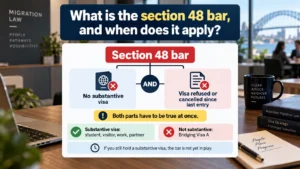
Section 48 blocks most onshore visa applications when two things are true. You hold no substantive visa. And a visa has been refused or cancelled since you last entered Australia.
A substantive visa is any visa other than a bridging visa or a criminal justice visa. A student, visitor, work or partner visa counts. A Bridging Visa A does not.
The Department sets the rule out in Form 1026i, Limitations on applications in Australia. Both parts have to be true at once. If you still hold a substantive visa, the bar is not yet in play, even with a refusal on file.
That timing matters more than anything else here. It is why the date your current visa ends is worth knowing exactly.
Does every refusal trigger the bar?
No. Two common situations sit outside it.
- A bridging visa refusal does not trigger section 48. Form 1026i excludes it. If the only thing refused was a bridging visa, that is not what bars you.
- A refusal before your last entry does not count. The rule looks only at what has happened since you last entered Australia.
Two situations narrow your options rather than widening them. A refusal or cancellation on character grounds leaves only a Protection visa available. And where a Protection visa has already been refused since your last entry, you generally cannot lodge another one here. The exception is where the Minister decides it is in the public interest.
Which of these applies is a question about your decision record, not your memory of it. Get the refusal letter out before you assume anything.
Which visas can you still apply for while you’re barred?
The Department’s published list in Form 1026i covers the family, humanitarian and bridging categories.
On the Department’s published list
- Partner (temporary) and Partner (residence) but only if the visa refused since your last entry was not itself a Partner (residence) visa.
- Child (residence) and Special Eligibility (residence).
- Protection, and Territorial asylum (residence).
- Medical treatment (visitor), in limited cases.
- Border (temporary), and Special category (temporary) for New Zealand citizens.
- Bridging visas A, B, C, D and E.
The three skilled visas added in 2021
- Since 13 November 2021, regulation 2.12 has also covered subclass 190 (Skilled Nominated), subclass 491 (Skilled Work Regional) and subclass 494 (Skilled Employer Sponsored Regional).
- All three need a nomination from a state or territory for the 190 and 491, or from an employer for the 494.
- Subclass 189 was not added. Points alone will not get an application lodged onshore while the bar applies.
Two cautions on that list. Form 1026i carries a 2018 design date, so it does not mention the 2021 skilled additions. Treat it as reliable on the core rule, not as a complete set of options.
The second is bigger. Being able to lodge is not the same as qualifying. An onshore partner application by someone without a substantive visa also has to meet the Schedule 3 criteria, and those need compelling reasons before they are set aside.
How is a No Further Stay condition different from section 48?
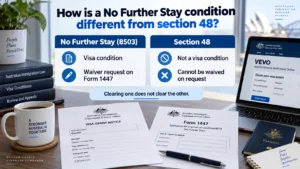
They are separate bars with separate remedies, and both can apply to the same person.
Condition 8503 is attached to a visa when it is granted. It says the holder cannot be granted a further substantive visa while they stay in Australia. It is lifted by requesting a waiver on Form 1447, which turns on compassionate and compelling circumstances beyond the person’s control.
Section 48 is not a condition and cannot be waived on request. You work around it through the prescribed list, or from outside Australia.
Clearing one leaves the other standing. Our guide to condition 8503 and what it means covers the waiver in detail. Check your grant letter, or VEVO, before planning around either bar.
Expert Australian Migration Guidance
Navigating the complexities of your visa journey is easier with professionals. Start your Australian dream today.
Book ConsultationWhat are your options if nothing on the list fits?
Three, and the right one depends on what was refused and when.
Ask the tribunal to review the decision. Many refusals carry review rights to the Administrative Review Tribunal, and the time limit is short. Review does not lift the bar. What it does is put the decision back in play, and a decision set aside removes the refusal behind the problem. Our guide to lodging a visa refusal review sets out the steps.
Apply from outside Australia. Section 48 only restricts applications made here. Leaving and applying offshore reopens subclasses that are closed to you onshore. For many families it is the practical route, but it needs planning around your current status.
Get a substantive visa first. If one is granted through a route above, the first part of the bar is no longer met. That is why the bridging visa you hold, and what it allows, is worth understanding early see our guide to bridging visas in Australia and whether you can apply for another visa on one.
Where families lose time and money
Four things account for most of the avoidable loss we see, and all four can be checked in advance.
- Lodging an application that was never valid. A barred application can be refused as invalid, and charges already made are generally not recoverable.
- Missing the review deadline while researching. Time limits run from when you are taken to have received the decision. If review may matter, protect that right first.
- Assuming the bar blocks everything. People leave, or go unlawful, without checking the prescribed list. Sometimes a listed visa fits.
- Clearing one bar and forgetting the other. A waived 8503 does nothing about section 48, and a prescribed visa does nothing about an unwaived 8503.
Have the refusal letter read before you lodge anything. Our MARA-registered agents (MARN 2518738) check what was refused, when, and what remains open. Talk to our team.
How The Migration helps after a refusal or cancellation
We see this at our Harris Park office in Sydney most weeks, usually within a fortnight of the letter arriving. The first job is almost never the new application. It is working out which bars actually apply.
- Reading the decision record for what was refused or cancelled, and when, against your last entry date.
- Checking your current visa and its conditions, including 8503, on VEVO and the grant letter.
- Testing your circumstances against the prescribed list, including the skilled options where a nomination is realistic.
- Protecting review rights and their deadlines while the longer plan is worked out.
- Running the same checks before any onshore parent visa lodgement, such as the subclass 884.
Migration advice here is given only by MARA-registered agents (MARN 2518738). You can verify any agent’s registration on the MARA public register. No registered migration agent can guarantee a visa outcome, and nobody can promise a bar will be lifted.
Before you lodge anything
Section 48 is narrower than it first sounds. It needs two things true at once, it ignores bridging visa refusals, and it leaves a defined list of visas open a list that grew in 2021.
What it does not forgive is guesswork. The difference between a valid application and a wasted charge usually sits in two documents: your refusal letter and your current visa. Start there.
Get your history checked before you lodge. Our MARA-registered agents (MARN 2518738) will tell you which bars apply and what is realistically open to you. Book a consultation with The Migration.