

If you are planning a General Skilled Migration (GSM) pathway to Australian permanent residency, your partner’s English can make a real difference. Under the GSM points test, a spouse or de facto partner who meets the Competent English requirement can usually help you claim 5 additional partner points.
Where it becomes confusing is when people search for the PTE score for spouse visa Australia to claim 5 points and find different numbers, examples and opinions, especially if the partner already has a strong overall score like 65 or 69 in PTE Academic.
This guide explains, as of 2026:
- What Competent English means for a spouse in the GSM points test;
- The minimum PTE Academic scores per skill your partner generally needs to contribute 5 points;
- How scores like 65 or 69 are treated in practice;
- How long are English test results usually valid for points, and
- When to speak with a MARA‑registered migration agent about your overall strategy.
Throughout, we are talking about English points in the GSM points test, not about a separate “spouse visa” subclass. These 5 partner points typically support visas such as Subclass 189, Subclass 190 and Subclass 491, not a standalone partner visa.
Why Your Spouse’s PTE Score Matters in the GSM Points Test
Under the GSM points test, you may be able to claim extra points for a partner who meets certain criteria. One common pathway is where your spouse or de facto partner:
- Is included in your skilled visa application; and
- Is assessed as having at least Competent English.
Those 5 partner points can be important where:
- Your overall score is just below the recent invitation ranges, or
- You are competing in a high‑demand occupation where every point counts.
Remember:
- These partner English points sit inside the GSM points framework.
- They do not guarantee an invitation or a visa grant; and
- All final decisions rest with the Department of Home Affairs and can change as policy changes.
What Is the PTE Score for Spouse Visa to Claim 5 Points?
To claim 5 partner points for English in the GSM points test, your spouse normally needs to be assessed as having at least Competent English.
As of 2026, Competent English can be shown in several ways (for example, via IELTS, PTE Academic and other accepted tests). For PTE Academic, official equivalence tables commonly interpret Competent English as at least 50 in each of the four skills:
- Listening
- Reading
- Writing
- Speaking
In practice
Many applicants and advisers aim for a small buffer above the minimum to avoid any risk from rounding or interpretation differences.
Practical guideline (as of 2026)
If your spouse scores around the low‑50s or higher in each skill (for example, 51+ in Listening, Reading, Writing and Speaking), they will generally be treated as meeting the Competent English threshold for the 5 partner points – provided all other criteria are satisfied.
A few important notes:
- It is the individual skill scores, not just the overall PTE score, that matter for Competent English.
- Requirements can change. Always check the latest guidance on the Department of Home Affairs website or with a registered migration agent.
- Higher English scores (Proficient or Superior) may help you, the main applicant, earn additional points in your own right, but they do not increase the partner English component beyond the 5 points.
Compliance note
This information is general and based on guidance available as of 2026. It is not personal migration advice and does not replace official Department of Home Affairs policy.
Is a 69 PTE Score Enough to Claim 5 Points for a Spouse Visa?
Many readers arrive at this article with a real‑world scenario like:
- “My partner scored 69 overall in PTE is that enough for us to claim 5 partner points?” or
- “My spouse has 65 in each skill, will that count as Competent English?”
The key point is that the Department looks at the per‑skill scores, not just the overall number.
Example 1 – Strong scores in every skill
Suppose your spouse’s PTE Academic result shows:
- Listening: 65
- Reading: 66
- Writing: 69
- Speaking: 67
- Overall: 69
In this case, each individual score is well above the typical Competent English threshold. Assuming the test is still valid at the relevant time, and all other requirements are met, this kind of result would generally be more than sufficient to show Competent English for the 5 partner points.
Example 2 – Scores just above the minimum
Now imagine the result is:
- Listening: 52
- Reading: 51
- Writing: 53
- Speaking: 52
- Overall: 52
These scores are only slightly above the indicative minimum, but still in the “low‑50s” band in each skill. As of 2026, a result like this will often be treated as meeting Competent English, again assuming the test is valid at the right time, and there are no other issues.
Example 3 – High overall score, but one low band
Consider a scenario where your spouse has:
- Listening: 49
- Reading: 70
- Writing: 72
- Speaking: 68
- Overall: 65
Even though the overall score looks strong, one skill (Listening) is below the usual Competent English threshold. In that case, your spouse may not be accepted as having Competent English for the purposes of the 5 partner points.
Accepted English Tests for Spouses (Not Just PTE)
While this article focuses on PTE Academic, the Department of Home Affairs accepts a range of English language tests for demonstrating Competent English. As of 2026, these may include (subject to current policy):
- PTE Academic
- IELTS (Academic or General Training, depending on the visa)
- TOEFL iBT
- OET (for certain professional occupations)
- Other recognised tests as listed by the Department
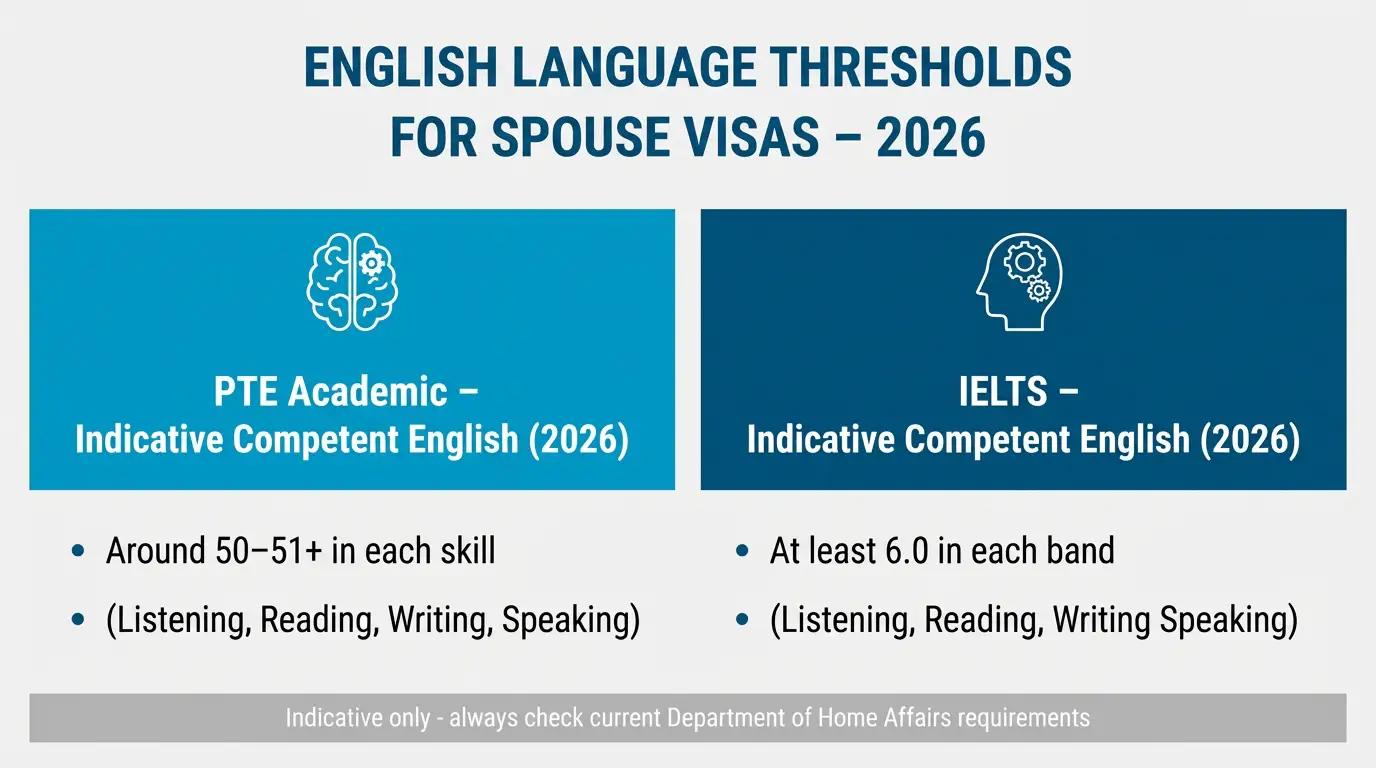
The exact minimum scores differ for each test. For example, Competent English is often equated with approximately:
- PTE Academic: low‑50s or higher in each of the four skills;
- IELTS: at least 6.0 in each of the four bands (Listening, Reading, Writing, Speaking).
These numbers are indicative only and can change.
Indicative comparison – Competent English (as of 2026)
Here’s the comparison Table between PTE & IELTS.
|
Test |
Indicative Competent English threshold (per skill)* |
|
PTE Academic |
Around 50–51+ in Listening, Reading, Writing, and Speaking |
|
IELTS Expert Australian Migration GuidanceNavigating the complexities of your visa journey is easier with professionals. Start your Australian dream today. Book Consultation |
At least 6.0 in Listening, Reading, Writing, and Speaking |
How Long Is a PTE Score Valid for Claiming Points?
Another common question is how long a spouse’s PTE result stays valid for the GSM points test.
As of 2026, English language tests such as PTE Academic are generally considered valid for three years for points‑tested purposes. However, what matters in practice is whether the result is valid at the:
- Time of invitation to apply for the visa; and
- The time of decision on your application depends on the visa and policy in force.
Because processing times and invitation patterns can change, it is important to:
- Check the test date against the likely timeline for your Expression of Interest (EOI) and visa application; and
- Allow for the possibility of delays or multiple invitation rounds.
If your spouse’s PTE result is close to expiring, or if you are planning a long‑term pathway from a temporary visa to PR, a migration agent can help you decide whether to:
- Retake PTE or another accepted test now; or
- Lodge earlier and rely on the current result.
Common Mistakes With Spouse PTE Scores and Points
Below are some of the patterns we see when people try to use a spouse’s PTE score to claim 5 partner points in the GSM points test.
Focusing only on the overall PTE score
Many applicants look at a single number like 65 or 69 overall and assume it is enough. In reality, it is possible to have a high overall score but still be below the threshold in one skill, which can mean you do not meet Competent English.
Assuming any English test result will do
Not all English tests or test formats are accepted for GSM points purposes. Some tests are limited to particular visa types or professions. Always check that the exact test type and date are acceptable for the visa you are targeting.
Letting the test expire before the invitation or decision
A spouse’s PTE result might be valid on test day, but no longer valid by the time an invitation is issued or a decision is made. This can happen where:
- EOIs sit in the pool for a long time; or
- Policy or invitation patterns change while you are waiting.
Planning around test validity is just as important as achieving the right score.
Over‑claiming points in your EOI
Claiming partner points on the assumption that Competent English is met, without checking the band scores or validity dates, can create problems if the Department later finds that the requirement was not satisfied.
Over‑claiming points may lead to:
- Additional scrutiny
- Requests for further information
Not aligning partner English with the overall GSM strategy
Partner English interacts with other parts of your GSM strategy, including:
- Your own English test results and potential extra points
- EOI competitiveness in your occupation; and
- State or regional nomination options
Looking at the spouse’s PTE score in isolation, without a broader strategy, can mean missed opportunities or unnecessary retests.
When to Get Help With Partner English and GSM Strategy
Because English test rules, points thresholds, and invitation patterns change over time, it is often sensible to get tailored advice, especially when:
- Your overall GSM points are close to the likely cut‑offs for your occupation.
- Your spouse’s PTE result is close to the minimum in one or more skills.
- The test is approaching the three‑year validity window; or
- You are balancing multiple moving parts – EOIs, state nomination, temporary visas, and long‑term PR plans.
A MARA‑registered migration agent can help you:
- Confirm whether your spouse’s current PTE (or other English test) is likely to meet Competent English for the 5 partner points as of 2026;
- Model scenarios where higher English scores might benefit your own points as the main applicant.
- Check test validity against realistic timelines for invitations and visa decisions; and
- Integrate partner English into a broader PR Pathway Roadmap so you are not relying on a single number.
Conclusion
If you are wondering “What PTE score does my spouse need to claim 5 points in Australia?”, the answer sits inside the GSM partner English rules rather than a separate “spouse visa” requirement.
As of 2026, your spouse will usually need to meet Competent English, which, for PTE Academic, is commonly interpreted as scores in the low‑50s or higher in each skill, not just a high overall number. Scores like 65 or 69 overall are generally more than enough if every band meets the minimum, but a single low band can still be a problem.
Instead of guessing whether your spouse’s PTE result is enough or when it might expire, consider speaking with a MARA‑registered migration agent. A tailored review of your scores, partner points, and overall GSM strategy can help you make informed decisions and avoid avoidable setbacks.
Rather than leaving your PR plans to chance, book a consultation with The Migration so a registered migration agent can review your spouse’s PTE score, your points, and your visa options.