
If you’re applying for an Australian partner visa, your partner visa relationship statement is one of the most important pieces of your application. It’s your chance to speak directly to the case officer, explain your story in your own words, and show that your relationship is genuine and continuing.
Many couples in Sydney, Melbourne, and across Australia feel anxious about this part. They worry about saying the wrong thing, leaving out key details, or sounding too emotional or too brief. The good news is that with the right structure and clear guidance, you can write a statement that is honest, organised, and aligned with Department of Home Affairs expectations.
This guide walks you through what to include, how to structure it, common mistakes to avoid, and when to get professional help from a registered migration agent.
What Is a Partner Visa Relationship Statement?
A partner visa relationship statement is a written, first‑person account that explains your relationship to the Department of Home Affairs. It usually sits alongside your forms, relationship evidence, and supporting statements from friends or family.
In your statement, you should:
- Explain how your relationship started and developed.
- Show how you share financial, household, and social responsibilities.
- Demonstrate that your relationship is genuine, exclusive, and continuing.
- Outline your plans together in Australia.
For many partner visa streams, each partner will usually provide their own statement. Even if your story is similar, each statement should be in your own words and reflect your own perspective.
What to Include in Your Partner Visa Relationship Statement
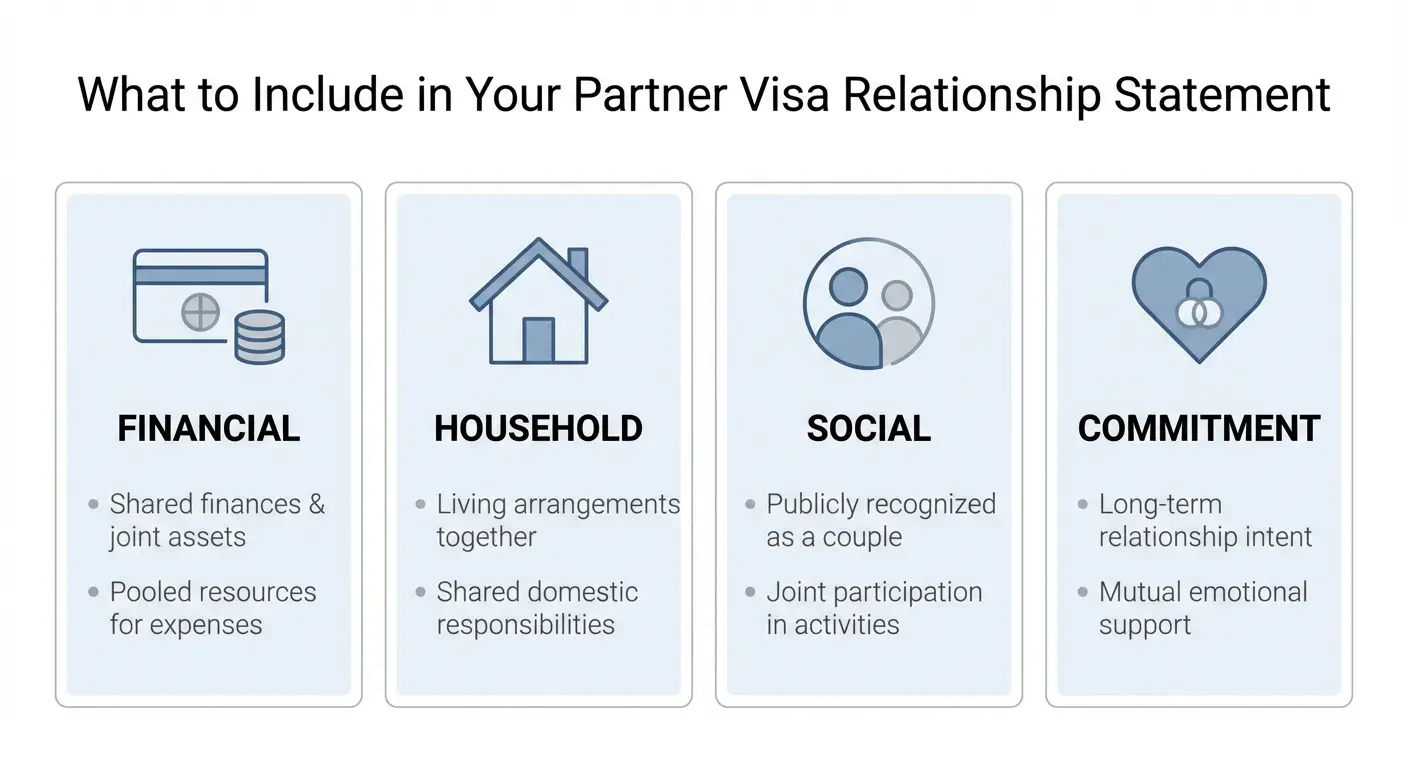
Home Affairs assesses relationships under four key aspects: financial, household, social and commitment. A clear statement logically touches all of these areas.
Below is a helpful structure you can follow.
How, When, and Where You Met
Start with the basics:
- When and where you first met.
- Who introduced you, or what event brought you together?
- Your first impressions of each other.
Keep this section factual but personal. Dates don’t need to be exact to the day, but they should be broadly consistent with your forms and evidence.
How Your Relationship Developed Over Time
Next, describe how your relationship grew from that first meeting to becoming a committed partnership. You might cover:
- When you started dating or became a couple.
- Important milestones: moving in together, engagement, marriage, travel, and meeting families.
- Any significant challenges you faced and how you worked through them.
Aim to give a clear timeline so the case officer can easily follow your story.
Financial Aspects of Your Relationship
This section should show how you support each other financially. Examples include:
- Joint bank accounts or shared savings.
- How you split rent, mortgage, utilities or other bills.
- Shared big purchases, such as furniture, a car or travel.
- Any financial support given during study, illness, or time out of work.
You don’t need to list every transaction, but your description should match the financial evidence you upload.
Household and Living Arrangements
Explain what everyday life looks like when you’re living together in Australia or overseas:
- Where do you live now, and how long have you been there?
- How do you share cooking, cleaning, shopping, and other chores?
- How do you make decisions about your home (moving, leases, furniture, etc.)?
If you have spent time living apart (for work, study, or family reasons), briefly explain when and why, and how you stayed in touch.
Social Aspects and How Others See Your Relationship
Here you show that your relationship is recognised by friends, family, and your wider community. You can mention:
- Events you attend together, birthdays, weddings, religious or cultural celebrations.
- Trips, holidays, or weekends away you’ve taken as a couple.
- How families and close friends know and support your relationship.
- Social media or online evidence (used carefully and consistently with your other documents).
Your Commitment and Future Plans in Australia
Finish this section by outlining your long‑term plans together, especially in Australia:
- Whether you plan to marry (if not already married).
- Whether you hope to start or grow your family.
- Career and study plans, and where you see yourselves living (for example, settling in Sydney or Melbourne).
- Your intentions to build a stable life together in Australia.
Avoid promising things you cannot control (such as visa approval or exact timeframes). Focus instead on your genuine intentions and commitments to each other.
Step‑by‑Step Guide: How to Write Your Partner Visa Relationship Statement
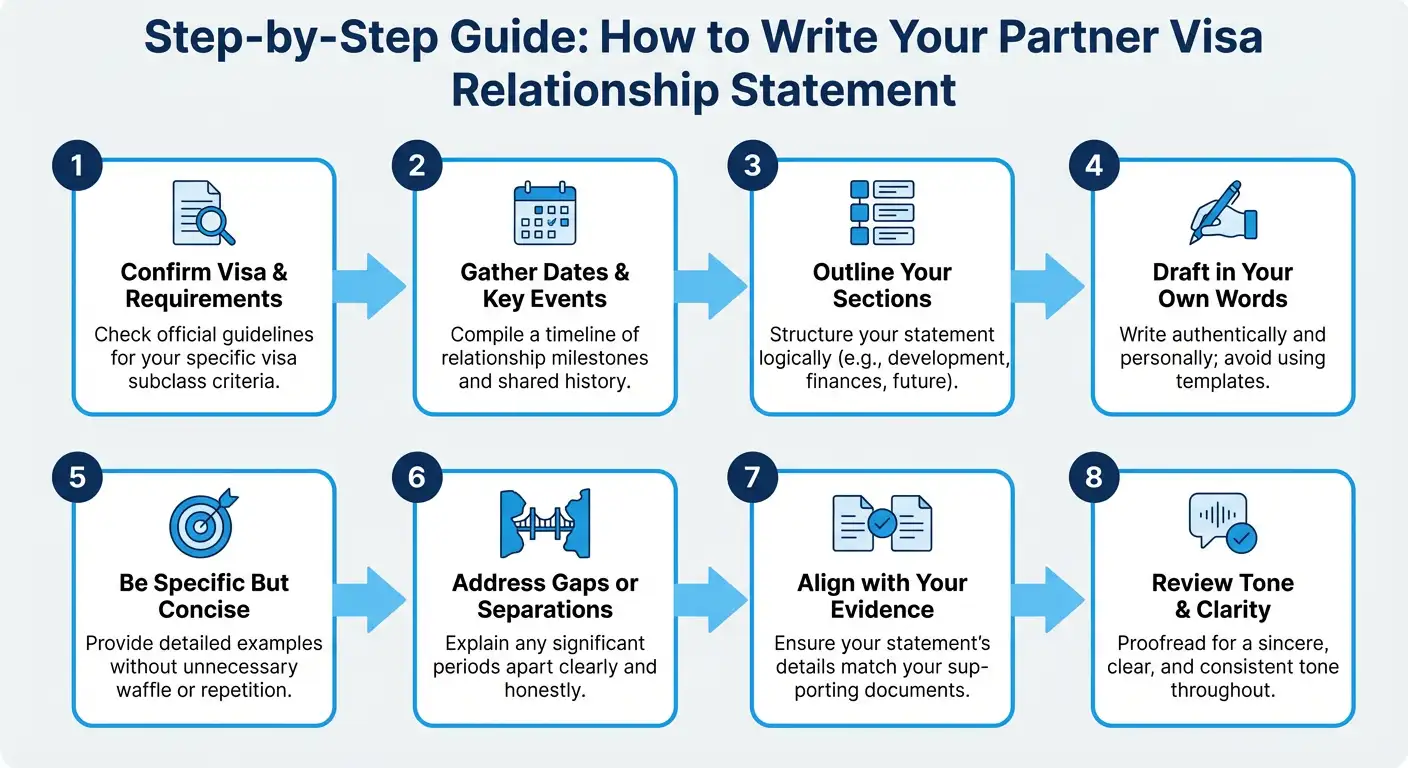
Use this practical process to turn your story into a clear, well‑structured statement.
Expert Australian Migration Guidance
Navigating the complexities of your visa journey is easier with professionals. Start your Australian dream today.
Book Consultation1. Confirm the visa and requirements
- Before you start, confirm which partner visa you’re applying for (for example, subclass 820/801, 309/100 or 300) and check the current Department of Home Affairs guidance. As of 2026, requirements can change, so always rely on the latest official information.
Related Article: Subclass 801 vs 100 – The Permanent Partner Visa Stage
2. Gather your dates and key events
- Make a list of important dates when you met, became a couple, moved in, got engaged or married, major trips, and any periods of separation. Compare these with your forms and evidence so everything is consistent.
3. Outline your sections
- Use headings such as How we met, How our relationship developed, Financial aspects, Household, Social, and Our future plans. This mirrors the way a case officer looks at your relationship.
4. Write in your own words
- Draft your statement in plain English, as if you were explaining your story to someone who doesn’t know you. Avoid copying templates or other couples’ statements — case officers see patterns very quickly.
5. Be specific but concise
- Aim for around 2–4 pages (depending on your circumstances). Include concrete details, dates, and places, and examples without turning it into a diary. Focus on moments that clearly show your commitment.
6. Address any gaps or separations
- If you lived apart for a period or had a break in the relationship, explain when, why and how you stayed in contact. Leaving this out can raise questions later.
7. Align your statement with your evidence
- Check that what you write is supported by documents such as leases, bills, joint bank statements, travel bookings and photos. Your relationship statement and evidence should tell the same story.
8. Review tone, spelling and clarity
- Read your statement aloud. Make sure it sounds genuine, respectful and consistent. Correct spelling, grammar and formatting so it’s easy for the case officer to follow.
9. Have it reviewed (if appropriate)
- Many couples choose to have a registered migration agent in Sydney or Melbourne review their relationship statements to reduce the risk of missing important details or creating inconsistencies.
Common Mistakes to Avoid in Your Relationship Statement
Being aware of common pitfalls can help you avoid delays or extra questions from Home Affairs.
- Being too vague or generic
Statements that could apply to any couple (“we love spending time together”) without specific examples are less persuasive.
- Inconsistencies with forms or evidence
Dates and events in your statement should line up with application forms, leases, bank records and other supporting documents.
- Ignoring periods of separation
Not mentioning time apart (for work, study or travel) can create confusion. Always explain how you stayed in touch and when you reunited.
- Copying templates or other couples’ statements
Re‑using online templates or another person’s statement can appear inauthentic and may raise concerns.
- Making promises or guarantees about visa outcomes
Focus on your relationship, not on guaranteeing approval or speculating on processing times.
After reviewing these issues, many couples choose to have their statement checked by a professional before they lodge it.
When to Get Professional Help With Your Partner Visa
Writing about your relationship can feel emotional and overwhelming, especially when a visa outcome is involved. Professional support can be helpful if:
- Your history is complex (for example, previous relationships, long periods apart, or multiple moves between countries).
- You are worried about consistency between your forms, evidence, and statements.
- English is not your first language, and you want help expressing your story clearly.
A partner visa migration agent in Sydney or Melbourne can review your relationship statement, highlight any gaps or risks, and help you align it with the rest of your application. While they cannot guarantee approval, they can help you present your case more clearly and confidently.
Include a clear next step for readers here, such as a call to book a partner visa consultation or speak to a registered migration agent through your contact page.
Conclusion
Your partner visa relationship statement is your opportunity to speak directly to the case officer about your life together. A strong statement:
- Follows a logical structure.
- Covers how you met, how your relationship developed, and how you share financial, household, and social responsibilities.
- Clearly explain your commitment and future plans in Australia.
Taking the time to plan, draft, and review your statement can reduce confusion, support your evidence, and make your partner visa application easier to understand.
If you’re unsure whether your statement is detailed enough or consistent with your documents, consider having it reviewed by an experienced partner visa migration agent in Sydney or Melbourne. They can’t promise an outcome, but they can help you feel more confident before you submit. Book your consultation with The Migration and start your journey in Australia.