
As of 2026, international students on a Student Visa (subclass 500) are generally allowed to work up to 48 hours per fortnight while their course is in session. During scheduled course breaks, eligible students can usually work unlimited hours. What you actually earn depends on the kind of job you do, whether you are paid under an award, whether you are a casual employee, and whether you work weekdays, nights, weekends or public holidays.
Many students can legally earn a meaningful side income in Australia, but compliance matters just as much as pay. Understanding your work rights early can help you protect your visa, avoid exploitation, and make better decisions about study, work and your longer-term migration plans.
How Much Can International Students Earn in Australia Per Week?
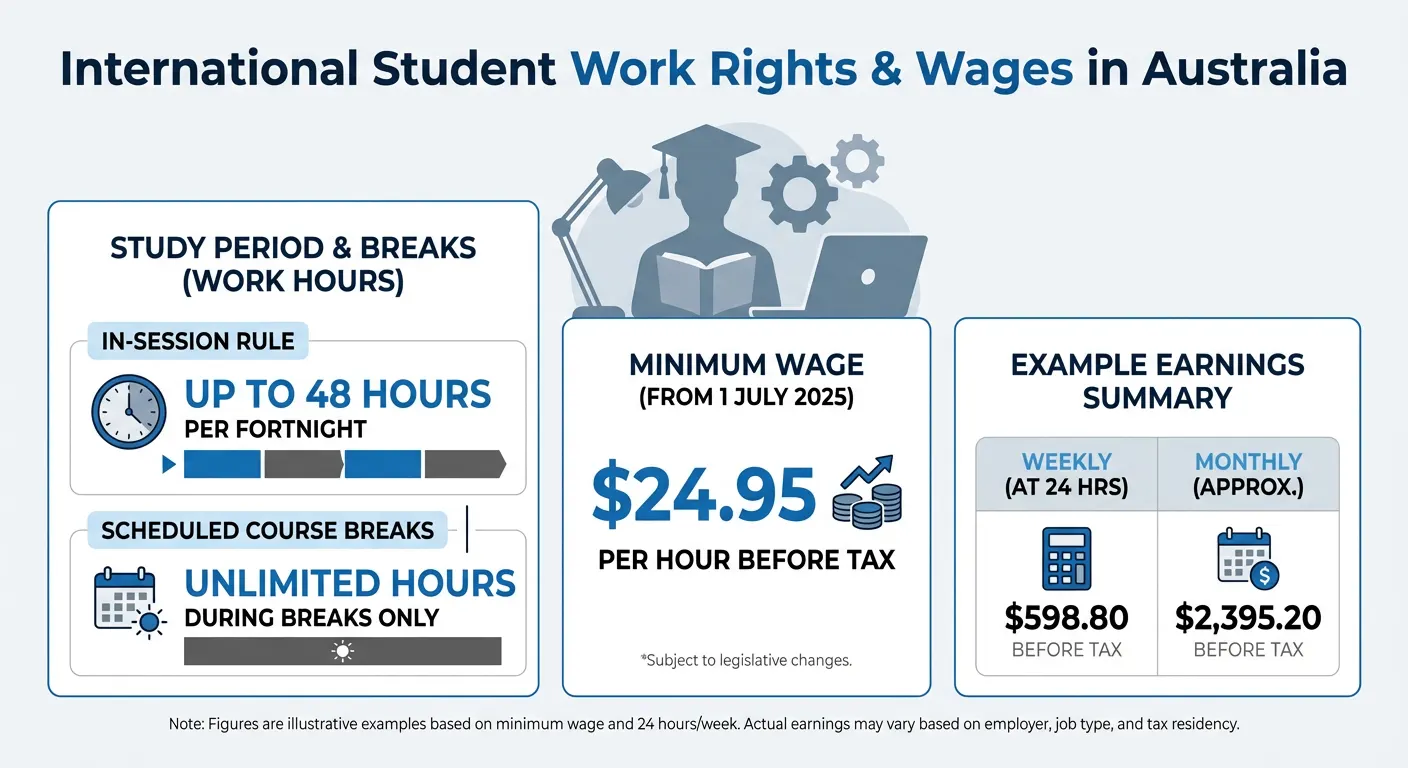
A realistic starting point is the national minimum wage currently in effect from 1 July 2025: $24.95 per hour before tax, according to the Fair Work Ombudsman.
If an international student works the equivalent of 24 hours per week across a fortnightly cycle, that works out to about:
- $598.80 per week before tax
- Around $2,395.20 per month before tax
That is a useful guide, but it is not a guaranteed amount. Some students earn more because they work casual shifts, weekends, or higher-paying roles. Others earn less because they work fewer hours, receive different award rates, or have limited availability during study periods.
The key legal point is that most Student Visa 500 holders cannot simply work unlimited hours during study periods. The general cap remains 48 hours per fortnight, and breaching that limit can create visa risk.
What Is the Minimum Wage in Australia for International Students After Tax?
International students are taxed under Australia’s PAYG (Pay As You Go) system. Most students enrolled in courses of six months or more are treated as Australian tax residents, meaning they benefit from the tax-free threshold of AUD $18,200 per year.
After tax, a student working 24 hours per week at the minimum wage of $24.95/hour can expect to take home approximately AUD $2,000–$2,200 per month. Without a Tax File Number (TFN), employers are required to withhold tax at a high rate of 47%, so applying for a TFN through the ATO before starting work is essential.
What Are the Current Work Rights for International Students in Australia?
According to the Australian Government’s international student work rights guidance and the Department of Home Affairs student visa work restrictions guidance, the general position as of 2026 is:
- Up to 48 hours per fortnight while your course is in session
- Unlimited hours during scheduled course breaks
- Some exceptions may apply in limited situations, such as certain postgraduate research students
- Work that is a mandatory part of your course may be treated differently in some cases
“In session” can include more than just classroom teaching weeks. It can also cover periods where your course still requires attendance, including exam periods. That means students should be careful not to assume they can automatically work full-time just because classes feel lighter.
If you are unsure how the work limitation applies to your course structure, it is safer to check the latest Home Affairs guidance and get advice before relying on assumptions.
What Is the Minimum Wage in Australia for Students?
International students generally have the same workplace rights and protections as other employees in Australia. That includes minimum pay protections under Australian workplace law. The Fair Work Ombudsman’s workplace rights guidance for visa holders and migrants makes it clear that visa holders are still entitled to lawful pay and conditions.
As of 2026, the national minimum wage currently in effect from 1 July 2025 is:
- $24.95 per hour, or
- $948.00 per week before tax
There are two important points to remember:
- Your actual minimum rate may be different if you are covered by an award or enterprise agreement.
- If you are a casual employee, you may receive 25% casual loading, which can increase your hourly rate.
That is why two students doing seemingly similar jobs may still receive different lawful pay rates depending on the industry, shift timing and employment type.
If you are unsure how the work limitation applies to your course structure, it is safer to check the latest Home Affairs guidance and get advice before relying on assumptions.
Not sure how Australia’s student work rules apply to your situation? You can book a consultation with The Migration to understand your visa conditions, work rights and safest next step.
How Much Can International Students Earn Per Week or Per Month?
Here is a simple guide using the current national minimum wage as a baseline. These figures are before tax and are only examples.
| Hourly rate | Approx. hours per week | Approx. weekly earnings | Approx. monthly earnings | Notes |
| $24.95 | 10 | $249.50 | $998.00 | Useful for students with heavy study loads |
| $24.95 | 16 | $399.20 | $1,596.80 | Common for students balancing classes and shifts |
| $24.95 | 24 | $598.80 | $2,395.20 | Equivalent to the usual 48-hour fortnight cap |
| $31.19 | 24 | $748.56 | $2,994.24 | Illustrative casual rate with 25% loading |
In real life, earnings vary because of:
- award coverage
- casual loading
- penalty rates for nights, weekends and public holidays
- city and employer differences
- whether you can consistently secure shifts
For many students, the more useful question is not only how much an international student can earn in Australia per week, but also whether that income is enough to support rent, bills and transport in the city where they plan to live.
Highest-Paying Part-Time Jobs for International Students in Australia
Many students search for the highest-paying part-time jobs for international students in Australia, but it is important to stay realistic. Some roles pay well because they require experience, certifications, strong English, physical work, or irregular hours.
Here are some common categories that may offer solid earning potential:
Tutoring and academic support
Students with strong academic results, English ability, or subject expertise may earn more through private tutoring or structured support roles.
These roles can be attractive because:
- They may pay above baseline retail or hospitality rates
- They can be flexible around class schedules
- They may strengthen communication and professional skills
Administrative and customer support roles
Reception, office support, and customer service jobs can sometimes offer steady pay and more predictable hours than casual hospitality work.
These roles often suit students who:
- have strong written and spoken English
- are comfortable with basic systems and organisation
- want experience that feels more office-based or professional
Hospitality and barista work
Hospitality remains one of the most common pathways for international students, especially in Sydney and Melbourne.
Pay can vary depending on:
- the venue
- your shift times
- whether weekend or public holiday penalties apply
- whether you are employed lawfully under the correct award
Delivery, event and shift-based work
Some students prefer delivery work, event staffing or other flexible jobs because they can choose shifts around class schedules.
These roles may offer flexibility, but income can fluctuate, so they are not always as predictable as they first appear.
Expert Australian Migration Guidance
Navigating the complexities of your visa journey is easier with professionals. Start your Australian dream today.
Book ConsultationCare and support roles
Some support, disability or aged-care related roles may pay more than entry-level retail or hospitality work, but they often require checks, training or a suitable background.
Students should make sure they understand:
- the legal requirements for the role
- whether the role suits their timetable
- whether the work aligns with their skills and comfort level
What Affects How Much a Student Can Actually Earn?
Even if two students have the same visa and live in the same city, their income can look very different. That is because earnings are shaped by more than the minimum wage alone.
Key factors include:
1. Location
A student in Sydney or Melbourne may find more job opportunities, but their living costs are also often higher. A student in another city or regional area may have lower living costs, but fewer high-paying shift options.
2. Casual vs permanent employment
Casual employees may receive higher hourly rates because of casual loading, but they often have less certainty around shifts.
3. Award and penalty rates
Hospitality, retail and service roles may involve different pay rates depending on the day and time worked.
4. English level and communication skills
Students with stronger communication skills may have access to front-facing, administrative or tutoring roles that can pay better and support future employability.
5. Experience and skill set
Students with admin, teaching, digital, customer service or specialist skills may be able to target better-paying part-time work.
6. Study timetable
A demanding course can reduce your availability and limit how many hours you can realistically work, even when the visa rules would otherwise allow more.
Can International Students Work Full-Time During Holidays?
In many cases, yes, international students can work full-time during scheduled course breaks, provided they are still complying with the terms of their visa and their break is genuinely a scheduled break.
That distinction matters. Not every quiet study period counts as a scheduled break. If you want a broader explanation of the rules, see Can Students Work Full Time in Australia?.
Students should also be cautious about relying on informal advice from friends, employers or social media. When it comes to work rights, it is always safer to follow official guidance and check how the rule applies to your own course calendar.
What Earnings Mean for Student Visa Planning and Compliance
For many readers, this topic starts as a budgeting question. But in practice, it is also part of a bigger migration planning question.
Earning potential matters because it affects:
- whether Australia feels financially manageable while you study
- How much legal work experience you can gain
- whether your job supports your longer-term career direction
- how well you stay compliant with your Student Visa 500 conditions
It is important not to confuse part-time student work with a guaranteed migration pathway. Casual jobs can help you support yourself and build confidence, but long-term planning usually depends on a bigger picture that includes study choices, work rights, qualifications and future visa options.
If your goal is not just to study, but also to understand what may come after graduation, it can help to read 500 Visa to Permanent Residency – A Complete Guide and review your broader Student Visa options.
Conclusion
So, How Much Can an International Student Earn in Australia? A realistic baseline is the current minimum wage in effect from 1 July 2025, which means many students working around the usual legal cap may earn roughly $598.80 per week before tax. Some students will earn more, especially in casual roles or higher-paying part-time work, but earnings always depend on the role, award, location, and shift pattern.
Just as importantly, international students need to stay focused on legal work rights and visa compliance. Understanding the 48-hour fortnight limit, scheduled course break rules, and lawful pay protections can help you earn safely while protecting your future options in Australia.
If you are comparing study, work and migration pathways at the same time, the safest next step is to book a consultation and get advice tailored to your own situation.