
Usually yes. Australia lets one person sponsor two partners in a lifetime, and the second sponsorship goes through like the first as long as enough time has passed since the earlier one.
The rule that catches people is the waiting period rather than the number. Five years have to pass, and they are counted from a date most sponsors get wrong.
This article covers how the limit works, where the five years starts, which earlier sponsorships count, the version of the rule that catches people who were once sponsored themselves, and what to do when the timing does not fall in your favour. It applies to the Prospective Marriage visa subclass 300 and to every partner visa stream, because they share one sponsorship rule.
The Rule in One Paragraph
Regulation 1.20J of the Migration Regulations 1994 limits partner sponsorships in two ways. You cannot sponsor more than two partners in your lifetime. And you cannot sponsor again within five years of an earlier partner visa application, a bar that applies whether you sponsored someone else or were sponsored yourself.
The Minister can waive the limitation where there are compelling circumstances affecting the sponsor. That waiver is real, and it is also harder to obtain than most people expect.
Read the regulation on AustLII or in the current compilation, and the sponsorship requirements on the Home Affairs subclass 300 page.
Where the Five Years Starts
This is the part worth reading twice.
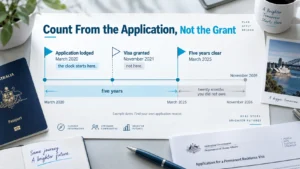
The five years runs from the date the earlier partner visa application was made. It does not run from the date the visa was granted, and it does not run from the date the relationship ended.
That distinction moves the date by years in ordinary cases. A 309 application lodged in March 2020 and granted in November 2021 puts your clock at March 2025, not November 2026. If you were counting from the grant letter, you have been waiting twenty months longer than the law asks.
It cuts the other way too. A combined 309 and 100 or 820 and 801, application carries one application date, and the permanent stage granted years later does not restart anything. One application, one date.
Work out your date before anything else. Find the earlier application, not the earlier grant, and count five years from there.
Which Earlier Sponsorships Actually Count
| The cap counts granted visas, not approved sponsorships
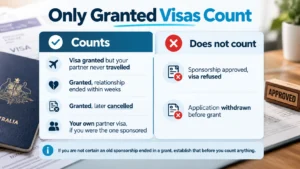
Regulation 1.20J is triggered by a person you sponsored having been granted a relevant permission, meaning a visa actually granted. A sponsorship you had approved where the visa was then refused does not count against your two, and neither does an application withdrawn before grant. This is the most common miscount we see. |
What does count:
- A visa granted where your partner never travelled to Australia
- A visa granted where the relationship ended within weeks
- A visa granted and later cancelled
- Your own partner visa, if you were the one sponsored, including where you obtained permanent residency through the family violence provisions
Count grants. If you are not certain an old sponsorship ended in a granted visa, establish that before you count anything else.
If You Were the One Sponsored
Here is the version of the rule that surprises people. You arrived in Australia on a partner visa, your former Australian partner sponsored you, the relationship ended, you became a permanent resident or a citizen, and you have now met someone overseas you want to marry. You are the sponsor this time.
Regulation 1.20J still applies to you, and your five years runs from the date of your own partner visa application, the one your former partner sponsored. The date people reach for is their permanent residency grant, often three or four years later than the date that counts. Checking takes one look at your original application receipt, and it decides whether you lodge now or wait.
The Lifetime Limit of Two
Time fixes the five-year wait. It does not fix the lifetime cap.
Once two partners you sponsored have been granted visas, a third sponsorship needs a waiver, no matter how many years have passed. Two is the number, and waiting longer does not add to it.
When the Limitation Is Assessed
Regulation 1.20J is directed at the Minister approving a sponsorship, and approval happens when the application is decided rather than when it is lodged. On that reading, if your five year anniversary passes while the application sits in the queue, the limitation no longer bites by the time a decision is made.
| Treat this as a calculated risk, not a free option
Practitioners are not unanimous on this, and there is no court or tribunal decision squarely on it. A case officer who reaches your file before your anniversary will refuse, and you then carry a refusal, a review deadline and a tribunal fee. Anyone who tells you it is a sure thing is overselling it. |
Processing a subclass 300 runs into many months, so do the arithmetic against current processing times, with a registered agent, before you decide either to lodge or to wait. Waiting has its own costs in age, in evidence and in the life you are trying to start.
Compelling Circumstances, and What That Actually Means
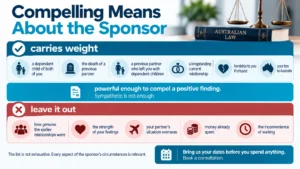
Where the limitation applies, the Minister may waive it for compelling circumstances affecting the sponsor. The Full Federal Court set the standard in Babicci v Minister for Immigration and Multicultural and Indigenous Affairs [2005] FCAFC 77. Circumstances are compelling only where they are powerful enough to lead a decision-maker to a positive finding that the limitation should be waived. Sympathy is not enough. Difficult is not enough.
The circumstances also have to affect the sponsor rather than the applicant, which is a distinction that decides cases. Hardship to your partner overseas only helps to the extent it bears on you.
Departmental policy gives these examples:
Expert Australian Migration Guidance
Navigating the complexities of your visa journey is easier with professionals. Start your Australian dream today.
Book Consultation- A dependent child who is dependent on both the sponsor and the applicant
- The death of a previous partner
- A previous partner who abandoned the sponsor, leaving dependent children in the sponsor’s care
- A longstanding current relationship
The list is not exhaustive, and policy says every aspect of the sponsor’s circumstances is relevant. Two factors are weighed alongside it: the hardship or detriment if the sponsorship is not approved, and the extent of the sponsor’s ties to Australia.
One argument to leave out. The genuineness of your earlier relationships is not a compelling circumstance, and it is the argument sponsors reach for first. In Nagaki, the Federal Circuit Court upheld a refusal where the sponsor pointed to genuine earlier relationships, a relationship of more than three years, financial hardship, and mental distress. None of it was compelling, separately or together.
Family violence in a previous relationship is not on the policy list either, although it can be argued where it affects the sponsor. Build it as an argument rather than a box to tick.
Also rarely decisive: the strength of your feelings, the applicant’s situation overseas, the money already spent, and the inconvenience of waiting. Build the waiver submission with the same care as the visa application. It rests on evidence about you, and it decides these cases. Our guide to Form 888 statements covers how third-party evidence is best assembled.
Character Bars, Which Are Separate
The five year rule and the cap are not the only limits on who may sponsor. Regulation 1.20KC requires refusal where the sponsor has a significant criminal record for a relevant offence. The list covers violence including assault and sexual assault, harassment, stalking and intimidation, weapons offences, people smuggling, trafficking, slavery and forced marriage, and kidnapping. A limited discretion exists, weighing time since sentencing, the best interests of any children, and the length of the relationship.
Regulation 1.20KB is separate and narrower. It engages where the sponsor or the sponsor’s partner has a conviction or an outstanding charge for a registrable offence and a person under 18 is involved in the application, usually a child included with the partner application. It is not absolute either: a discretion exists where five years have passed since the sentence was completed, with no further relevant charges and compelling circumstances.
Sponsors provide an Australian police check and a certificate from every country they have lived in for twelve months or more in the last ten years since turning 16. Convictions for relevant offences must be disclosed even where the record is spent or expunged, and the sponsor must consent to disclosure to the visa applicant. Our note on how visa cancellation and refusal work covers the wider character picture. If anything in your history concerns you, raise it at the first conversation rather than at the police check stage.
What to Do Before You Lodge
- Establish whether each earlier sponsorship ended in a granted visa. Only grants count.
- Find the date of the earlier application. Your own, if you were sponsored, or your former partner’s, if you sponsored them.
- Count five years from that date and compare it to today.
- Count your grants. If the answer is two, you are in waiver territory, whatever the dates say.
- If the five years have not passed, weigh lodging now against waiting, with realistic processing times in front of you.
- If you need the waiver, start gathering evidence about the sponsor now: children, medical evidence, relationship history, and the circumstances of the earlier relationships.
If the Application Is Refused
A partner visa refusal based on the sponsorship limitation carries review rights at the Administrative Review Tribunal. Two things are worth knowing about how that works.
The sponsorship is not separately reviewable. For the 300, the 309 and 100, and the 820 and 801, it is assessed inside the visa application, so the decision under review is the visa refusal. The Tribunal considers the waiver afresh as part of that review, and its decisions turn heavily on the quality of the evidence about the sponsor.
| The deadline is 28 days, and it cannot be extended
Twenty-eight days, or 14 days if the applicant is in immigration detention, counted from the day you are taken to have been notified rather than the day you read it. The Tribunal has no power to extend it. This changed when the ART replaced the AAT on 14 October 2024, and the old 21 and 70 day periods no longer apply. A great many pages still publish them. |
The application fee for a migration matter is AUD 3,727 from 1 July 2026, with a 50 percent hardship reduction, a concessional rate of AUD 100 for eligible applicants, and a 50 percent refund if the Tribunal sets the decision aside or remits it.
Get Your Dates Checked Before You Spend Anything
Bring us the earlier application, the grant letter, and the dates you have. Our team will tell you which clock applies, when it clears, whether a waiver is needed, and what it would rest on. We see clients in Harris Park, Melbourne, and online.
Book a consultation Ask us about your sponsorship dates
No registered migration agent can guarantee a visa outcome. Verify any agent on the Register of Migration Agents.