
If you are asking “can we apply 870 visa onshore?”, you are usually a parent already in Australia on a Visitor visa 600 or another temporary visa, and hoping to avoid flying home just to lodge a new application.
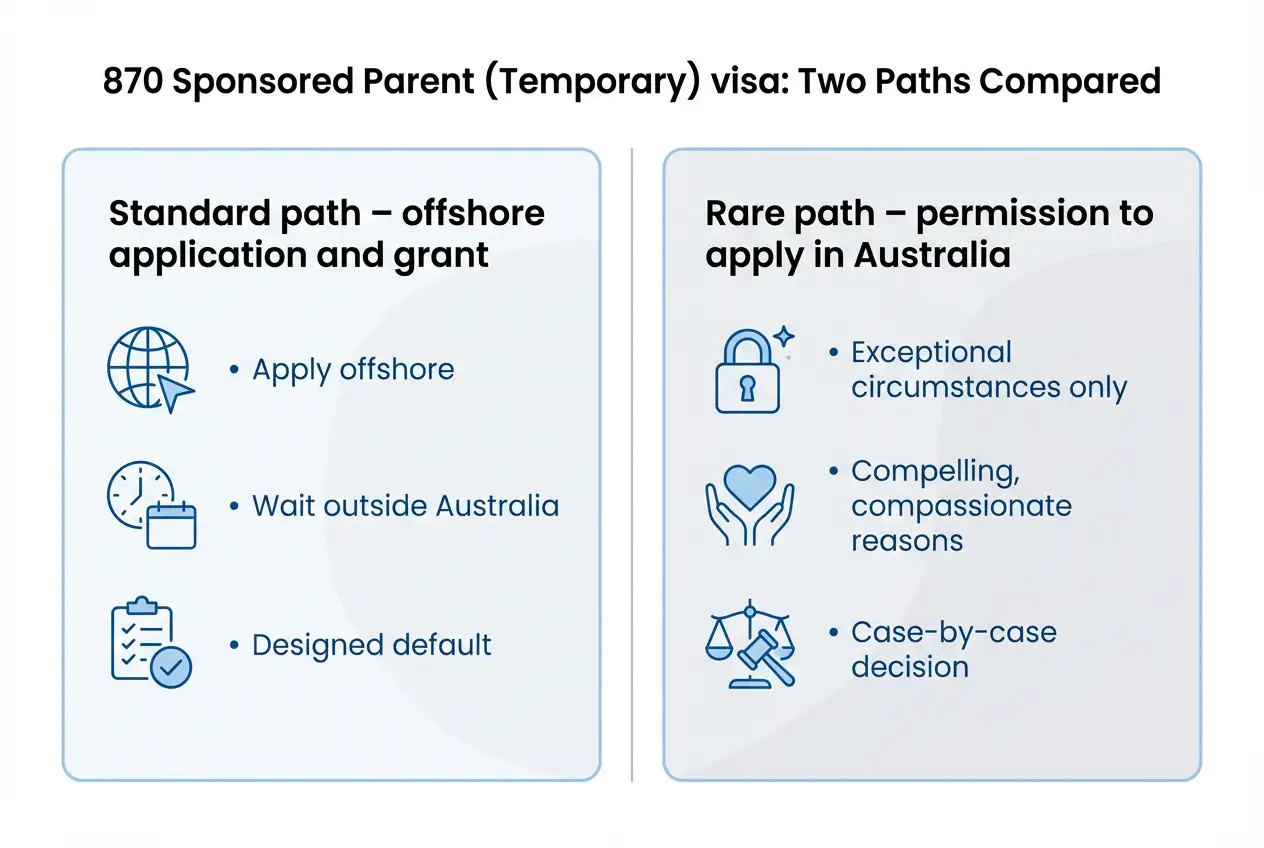
As of 2026, the Sponsored Parent (Temporary) visa (subclass 870) is designed primarily as an offshore visa. In most cases, parents must be outside Australia when they apply and when the visa is granted.
There are, however, some narrow, exceptional situations where a parent may be able to request “permission to apply in Australia” and lodge the 870 visa while onshore. These cases are rare and highly discretionary.
This guide explains:
- The default offshore rule for the 870 visa
- What “permission to apply in Australia” means in practice
- How the onshore vs offshore 870 visa strategy works
- Alternatives if you cannot apply 870 visa onshore
- When to speak with a registered migration agent in Sydney or Melbourne before making any move
Can We Apply for an 870 Visa Onshore?
In most situations, the answer is no, you should expect an offshore application and a grant for the subclass 870 visa.
- The 870 program is generally set up so that parents are outside Australia when they apply and when the visa is granted.
- The key planning assumption for most families is: depart, apply offshore, then return on the 870 visa once granted.
There is a narrow mechanism called “permission to apply in Australia”. In exceptional, compassionate circumstances, some parents may be allowed to lodge the 870 visa while in Australia, but this does not change the underlying nature of the visa program.
Because the consequences of getting this wrong can be serious (unlawful stay, future visa refusals, exclusion periods), it is strongly recommended to get tailored advice before trying any onshore strategy.
How the Subclass 870 Sponsored Parent (Temporary) Visa Works (2026 Overview)
The Sponsored Parent (Temporary) visa (subclass 870) is a temporary visa that allows certain parents to spend longer periods with their children and grandchildren in Australia.
As of 2026, key features include:
- Who it is for: Parents of Australian citizens, Australian permanent residents, or eligible New Zealand citizens (including some step‑parents and adoptive parents, subject to rules).
- Length of stay: Up to 3 or 5 years per visa, with the possibility of staying in Australia for up to 10 years in total across multiple 870 visas.
- No Balance of Family test: Unlike permanent parent visas, the 870 visa does not require the Balance of Family test.
- No work rights: Holders cannot work in Australia on this visa.
- Health insurance: Applicants are generally expected to hold and maintain adequate health cover.
- Separate sponsorship: The Australian child must first be approved as a sponsor before the visa application is lodged.
Onshore vs Offshore Rules for the 870 Visa
Here are some rules for the onshore vs offshore subclass 870 visa.
Standard Rule Outside Australia to Apply and When Visa Is Granted
As of 2026, the default rule for the 870 visa is that parents are outside Australia both when they apply for the visa and when the visa is granted.
In practice, this usually means:
- The parent travels out of Australia before lodging the 870 visa application, and
- They wait offshore for the decision and only return once the visa is granted.
From a policy perspective, the 870 visa is intended to manage temporary parent stays while avoiding additional pressure on the migration and social support systems. Designing it as an offshore visa is one way the program manages risk.
Always check the latest rules on the official Department of Home Affairs website before planning travel.
What “Permission to Apply in Australia” for an 870 Visa Means
In some exceptional cases, a person may be able to request “permission to apply in Australia” for a subclass 870 visa.
In simple terms, this means:
- You normally need to be outside Australia to lodge the application, but
- The Department may allow you to submit the 870 application while in Australia if there are compelling and compassionate reasons beyond your control.
Typical examples used in practice and commentary include:
- A serious illness or accident that makes international travel unsafe
- Major, unexpected events such as natural disasters or sudden border closures that prevent departure
- Other significant changes in circumstances where leaving Australia in the short term is not realistic or safe
Even if you get permission to apply in Australia, it does not guarantee that the visa will be granted. It simply affects where you can lodge the application.
Why Most Applicants Should Plan for an Offshore Application
For most families, an offshore strategy remains the safest and most realistic approach:
- It is aligned with how the 870 visa is designed and how policy is commonly applied.
- It avoids the risk of a parent becoming unlawful in Australia while trying to force an onshore outcome.
- It reduces the need to rely on narrow exceptions that can be interpreted strictly.
In many cases, a combination of Visitor visa 600 options and a carefully timed offshore 870 application can achieve the family’s goals without unnecessary risk.
When Can You Request Permission to Apply for an 870 Visa in Australia? (Rare Cases)
Requests to apply onshore for an 870 visa should be treated as exceptional, not routine. Some scenarios where families may explore this option include:
- Serious health issues: The parent has developed a condition where flying home safely is difficult or impossible in the short term, supported by strong medical evidence.
- Major disruption or disaster: Events such as a natural disaster or sudden political instability in the home country that genuinely prevent safe return.
- Unexpected changes beyond the family’s control: Significant events that could not reasonably have been planned for when the parent first arrived.
The Department assesses these requests on a case-by-case basis. There is no automatic right to onshore permission, and documentation must clearly support why an exception is justified.
Common Scenarios Can I Apply Onshore in My Situation?
Your visa status and personal situation determine whether you can submit an onshore visa application. In the section below, we explain some common scenarios.
My Parents Are Visiting on a Visitor Visa 600 Can We Switch to an 870 Visa Onshore?
In most cases, parents on a Visitor visa 600 will need to leave Australia and apply for the 870 visa offshore.
Key points to check:
Expert Australian Migration Guidance
Navigating the complexities of your visa journey is easier with professionals. Start your Australian dream today.
Book Consultation- Whether the current visitor visa has a “No Further Stay” condition
- How long is left on the current visa, and can departure be planned calmly
- Whether a combination of visitor visas and a future 870 visa provides a safer long‑term pathway
Because each family’s history is different, it is important to get individual advice before making any onshore application attempt.
My Parents’ Visitor Visa Is Expiring Soon, and They Are Unwell. Is There Any Onshore Option?
If a parent becomes seriously unwell and travel home is unsafe, this may be a situation where it is appropriate to explore:
- Whether permission to apply in Australia for an 870 visa is realistic, or
- Whether another temporary visa or bridging arrangement is more suitable.
These cases are complex and time‑sensitive. A MARA‑registered migration agent can review medical evidence, visa history, and timing to help map options.
We Want Parents to Stay for 3–5 Years but They Are Already in Australia. What Should We Do?
For many families, the most practical approach is:
- Plan a shorter‑term visitor strategy now, making sure conditions and dates are followed, and
- Map an offshore 870 application when the timing, budget, and eligibility are right.
You may also want to consider whether a permanent parent visa pathway is a better long‑term fit, especially where parents hope to settle in Australia eventually.
Related Article: Balance of Family test for permanent parent visas.
Alternatives if You Cannot Apply 870 Visa Onshore
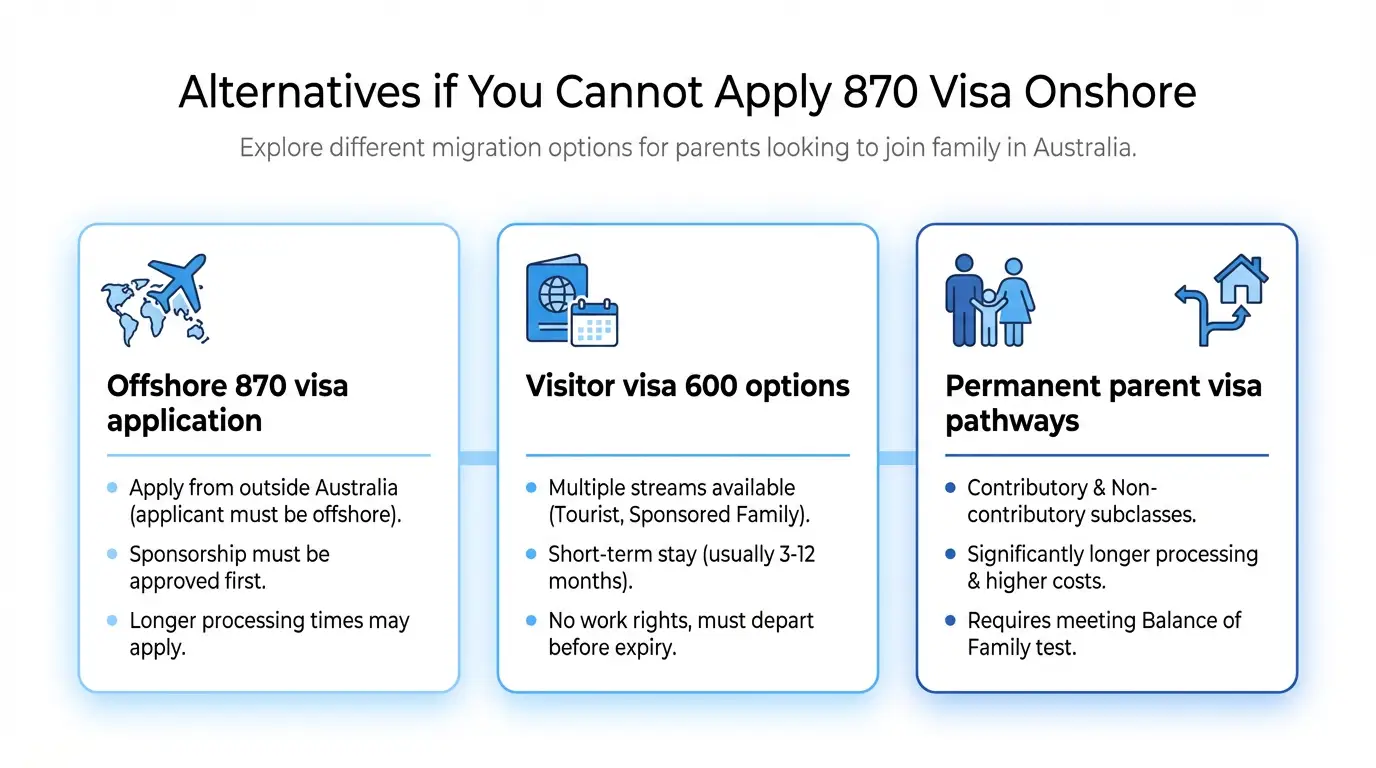
If you cannot apply 870 visa onshore, which will be the case for most parents, there are still practical ways to stay connected as a family:
- Offshore 870 visa application (standard path)
- Parent departs Australia and lodges the 870 visa offshore.
- Once granted, they can return for 3 or 5 years, up to 10 years in total across multiple visas.
- Visitor visa options (shorter but flexible stays)
- A Visitor visa 600 can sometimes provide extended visits, especially under parent streams, subject to conditions.
- This can be used while planning a later offshore 870 application.
- Permanent parent visa pathways
- For some families, a Contributory or non‑contributory parent visa may be more appropriate in the longer term, depending on budget and priorities.
- Understanding the Balance of Family test and queues is critical.
Related Article: Balance of Family test for permanent parent visas
How The Migration Helps With the 870 Visa Strategy
Trying to manage visitor visas, 870 visas, and potential permanent parent visas on your own can feel overwhelming, especially when your parents are already in Australia and time is tight.
At The Migration, our MARA‑registered migration agents in Sydney and Melbourne can help you:
- Confirm whether the 870 visa is the right fit compared with the visitor or permanent parent options
- Map a safe onshore/offshore strategy, so your parents do not become unlawful or trigger unnecessary bans
- Prepare sponsorship and visa applications in line with the current 2026 policy settings
- Understand timing, costs, and risks so you can plan family visits with confidence
If you feel unsure about whether to pursue an onshore 870 visa strategy or stick with an offshore application, it is usually safer to get tailored advice first.
Conclusion
In most cases, you cannot simply apply 870 visa onshore and should plan for an offshore application and grant for the Sponsored Parent (Temporary) visa (subclass 870).
There are limited, exceptional circumstances where the Department may grant permission to apply in Australia, but these are rare and require strong, well‑documented reasons. Permission to apply onshore does not guarantee that the visa itself will be granted.
As of 2026, rules, processing times, and charges can change. Your parents’ visa history, health, travel plans, and budget will all affect the best pathway.
If you are considering a 10‑year parent visa (subclass 870) or balancing visitor and parent visa options for your family, you can book a parent visa consultation or contact our team to talk through your next steps.