
If you hold a Subclass 186 Employer Nomination Scheme visa, it is normal to wonder whether you can change jobs or leave your sponsoring employer especially if your role no longer feels right, the business is changing, or you receive a better offer.
The short answer is that you usually can leave your employer after your 186 visa is granted, because this is a permanent residency visa. However, both you and your employer are expected to have had a genuine intention that you would work in the nominated role for around two years. If you leave very quickly without a clear reason, the Department of Home Affairs may look more closely at your case.
In this guide, we explain:
- What the 186 visa actually requires from you and your employer
- What “genuine intention to work for two years” really means in practice
- When changing employers is likely to be lower risk and when it could raise concerns
- Practical steps to protect your 186 visa and your career before you resign
- When to speak with a 186 visa migration agent in Sydney or Melbourne for tailored advice
Can You Leave Your 186 Visa Employer?
In most cases:
- You can change employers or leave your 186 visa employer after your visa is granted, because the 186 is a permanent residency visa, not a temporary sponsored visa.
- The Department expects that both you and your employer genuinely intended that you would work in the nominated role on a full-time, ongoing basis for around two years.
- If you leave very soon after the grant, or there are signs that the job was never genuine, the Department may investigate whether false or misleading information was provided. In serious cases, this can lead to visa cancellation.
If you have already been working for close to two years or more, or if there is a clear and well‑documented reason your employment is ending (such as redundancy, business closure, or unsafe conditions), changing employers is usually much lower risk.
If you are unsure whether your situation could be questioned, it is wise to speak with a registered migration agent before you resign. Early in the process, many of our clients book a consultation so they can talk through their specific facts and options. Book a confidential consultation with a registered migration agent.
Understanding the 186 Employer Nomination Scheme Visa
The Employer Nomination Scheme (ENS) Subclass 186 visa allows skilled workers to become permanent residents of Australia when nominated by an eligible employer. It is commonly used by people who have already worked in Australia on visas such as the 482, or who are being recruited from overseas into long‑term roles.
Key points about the 186 visa:
- It is a permanent residency visa. Once granted, you are no longer tied to your employer in the same strict way as a temporary sponsored visa, but your application can still be reviewed if concerns arise.
- There are different streams (such as the Temporary Residence Transition and Direct Entry streams), but in each case, the role must be genuine, full‑time and usually ongoing for at least two years.
- Your employer must meet nomination requirements, including market salary, genuine position, and training/turnover criteria.
For a broader overview of this visa, see The Migration’s main service page:
Subclass 186 Employer Nomination Scheme visa
Recent processing times and policy focus (as at 2025–26)
While processing times will always depend on your stream and individual circumstances, Department data published in August 2025 showed a median processing time of around 9 months for many permanent skilled visas, including the 186 visa category.
Visa processing times – overview
Skilled visas are also processed according to a priority order set out in Ministerial Direction No. 105. Employer‑sponsored applications in designated regional areas and for healthcare or teaching occupations are currently processed ahead of other cases.
In September 2025, the Australian Government confirmed that the 2025–26 permanent migration program would broadly maintain the same settings as 2024–25, with a continued focus on skilled pathways such as the 186 visa.
Permanent Migration Program 2025–26 announcement
These figures and policies do not change your basic obligation to act honestly in your application, but they do help show how important the 186 visa remains in Australia’s long‑term skilled migration strategy.
Your Obligations to Your 186 Visa Employer
There is no written law in the Migration Act that says you must stay with your employer for exactly two years. However, by applying for and accepting a 186 visa, you are effectively declaring that:
- The job offer is genuine and ongoing; and
- You intend to work in the nominated role on a full‑time basis for at least two years from the visa grant.
In practice, this means:
- If you never intended to stay for two years (for example, you planned to resign immediately after grant), the Department may consider that your application was not genuine.
- If you tried to work for your employer but circumstances changed later for example, the business restructured, the role became unsafe, or family needs required relocation then your original intention can still be genuine.
Australian employment law (including Fair Work rules) continues to apply. This means:
- You can resign by giving proper notice under your contract or the relevant award.
- Your employer can lawfully make your role redundant if there is a genuine operational change.
- Either party can end the employment due to serious misconduct or other lawful reasons.
When Leaving Your 186 Visa Employer May Be Lower Risk?
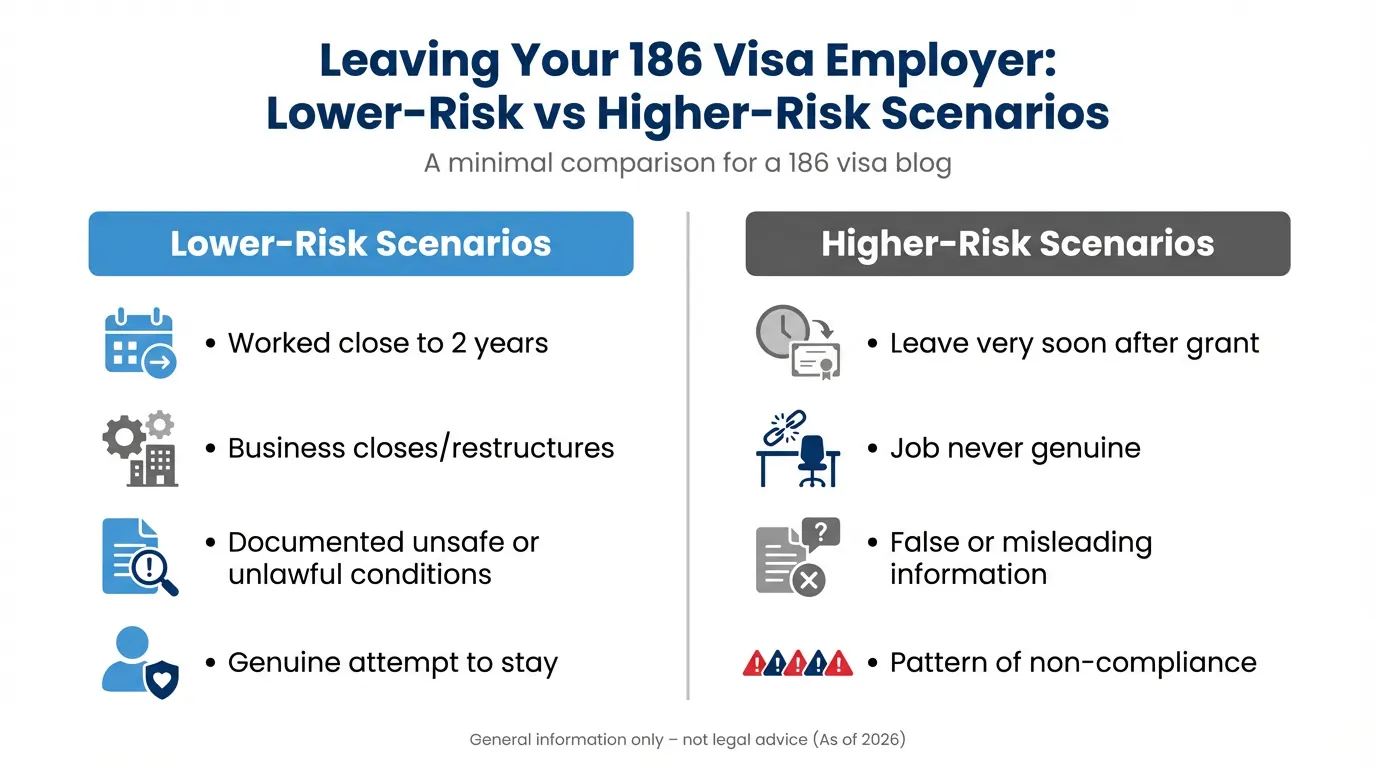
While every case is different, the risk of Department scrutiny is usually lower where:
- You have worked for close to or beyond two years in the nominated role after grant.
- The business closes, sells, or restructures your position, and there is clear documentation of this.
- There are documented unsafe, unreasonable or unlawful conditions, such as ongoing underpayment, bullying, or WHS concerns, and you have made genuine attempts to resolve the issues.
- There has been a genuine attempt to stay, but life circumstances have changed for example, your partner secures work in another city such as Sydney or Melbourne, you experience health issues, or you have caring responsibilities.
In these scenarios, you can usually show that your original intention was genuine, but circumstances that were outside your control made it difficult or impossible to continue in the role.
When Leaving Your 186 Visa Employer Could Raise Concerns?
On the other hand, the Department may look more closely at your visa if:
- You leave very soon after grant (for example within a few weeks or months) without any clear or documented reason.
- There is evidence that the job never genuinely existed for example, you were not given real duties, did not actually work in the role, or the agreed salary was never paid.
- The Department receives information suggesting false or misleading documents were used, such as fabricated work references, incorrect occupation details, or sham contracts.
- There is a pattern of non‑compliance, for example, where the same employer has sponsored multiple workers who quickly leave, or there have been previous monitoring issues.
In serious cases, the Department can investigate and, if it finds that fraud or serious misrepresentation occurred, may consider cancelling the visa. This is one reason it is so important to keep accurate records and get advice early if things do not go to plan.
Expert Australian Migration Guidance
Navigating the complexities of your visa journey is easier with professionals. Start your Australian dream today.
Book ConsultationFor more details on common visa cancellation risks, see The Migration’s guide:
Visa cancellation in Australia – key risk factors
Practical Steps Before You Change Employers on a 186 Visa
Before you resign or accept a new job, it can help to work through these practical steps:
Review your employment contract
- Check your notice period, any restraint clauses, and whether there are specific obligations linked to your sponsorship.
Write down your reasons for leaving
- Be clear about what has changed: for example, non‑payment of wages, unsafe conditions, a significant role change, redundancy, or family relocation to another city such as Sydney or Melbourne.
Gather supporting evidence
Keep copies of payslips, rosters, emails, performance reviews, HR complaints, medical reports, or redundancy letters that show you made a genuine effort to stay.
Consider timing
- If you are close to the two‑year mark, it may be worth discussing with a migration professional whether waiting a little longer could lower risk.
Line up your next step where possible
- Securing a new role before resigning can help with both financial stability and demonstrating that you remain committed to working in your skilled occupation.
Get tailored advice from a registered migration agent
- A 186 visa migration agent can assess whether your specific facts are likely to raise concerns and help you to explain your situation clearly if the Department ever asks questions.
- If you are feeling pressured to resign, or your relationship with your employer has broken down, getting early advice can help you avoid reactive decisions that may affect your long‑term residency.
Speak to a 186 visa migration agent in Sydney or Melbourne
How a 186 Visa Migration Agent in Sydney or Melbourne Can Help?
At The Migration, our team regularly assists clients who:
- Are thinking about changing employers after a 186 visa
- Have already left their sponsoring employer and are worried about the impact on their residency
- Have received letters or requests for information from the Department about their employment
- Are dealing with complex issues such as underpayment, sham positions, or potential visa cancellation
A registered migration agent can:
- Review your visa grant, nomination documents, and employment history
- Help you understand how the Department is likely to view your situation
- Identify any red flags and steps you can take to manage risk
- Prepare clear, supportive documentation if the Department ever makes enquiries
If you are based in Sydney, Melbourne or elsewhere in Australia, consultations are available both in‑person and online.
Contact our team to discuss your 186 visa situation
Conclusion
For most people, it is possible to change employers after getting a 186 visa, especially where you have made a genuine effort to stay in the role and can explain why circumstances changed.
The biggest risks usually arise when:
- There was never a genuine intention to work in the nominated role; or
- You leave very quickly after grant without good reasons or supporting evidence; or
- The Department uncovers false or misleading information about the job or your background.
By understanding your obligations, documenting what has happened in your workplace, and getting timely advice, you can usually protect both your permanent residency and your long‑term career in Australia.
If you are unsure whether leaving your 186 visa employer is safe in your situation, don’t guess: Book a confidential consultation with a registered migration agent to get advice tailored to your goals.