
Being refused an Australian student visa can be overwhelming. You have made plans for your studies, invested money, and told your family and then received a refusal letter full of legal wording and policy references.
The good news is that most Australian student visa rejection reasons fall into a few clear categories. Once you understand how case officers assess evidence under current rules, you can avoid repeating the same mistakes and, in many cases, prepare a much stronger new application.
As of 2026, the Department of Home Affairs has:
- Tightened English language requirements for Student Visa (subclass 500) applicants;
- Increased minimum financial capacity thresholds; and
- Replaced the old Genuine Temporary Entrant (GTE) requirement with the Genuine Student (GS) requirement.
Most common Australian student visa rejection reasons in 2026
Below are the nine most common Australian student visa refusal reasons we see in practice, plus practical tips on how to avoid Australian student visa rejection under the 2026 settings.
For each reason, we explain why it leads to refusal and what you can do differently next time.
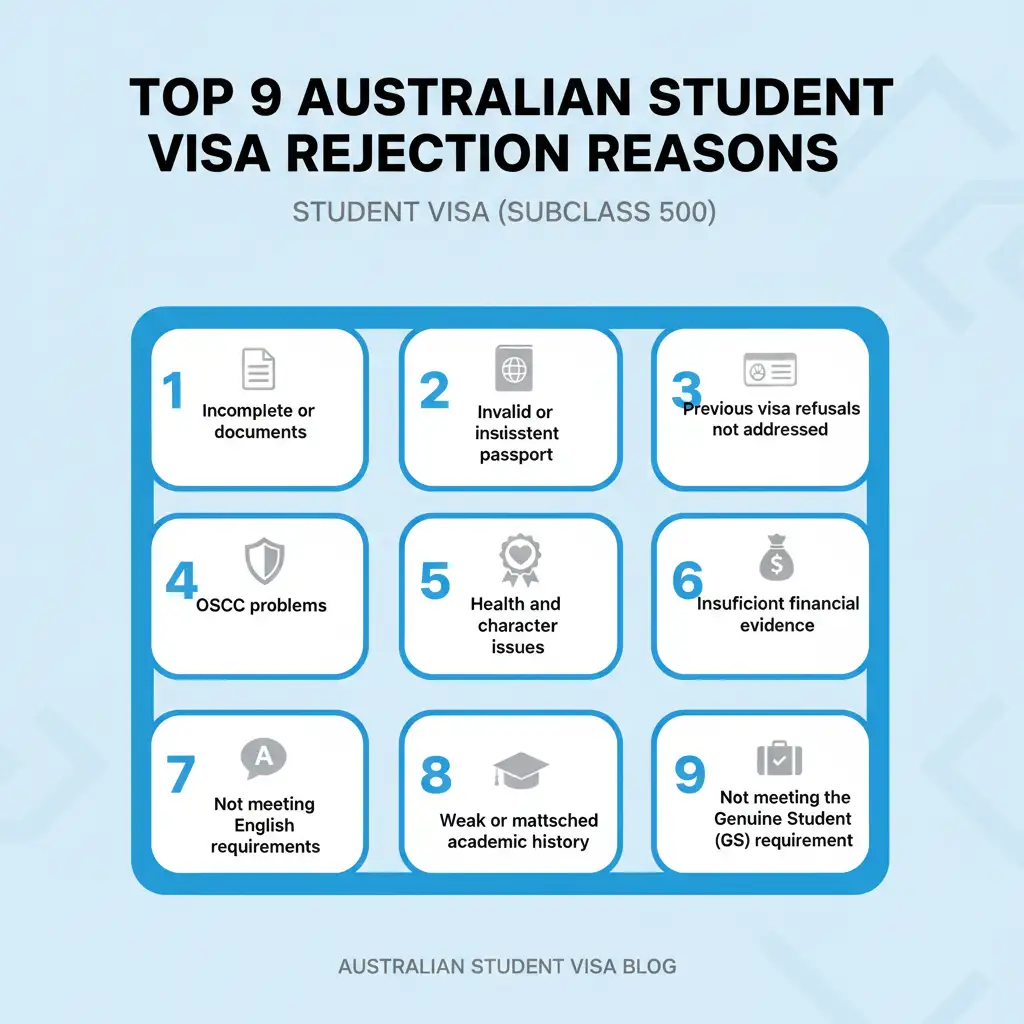
1. Providing incomplete or incorrect documents
Why does this lead to refusal?
Department of Home Affairs case officers must be satisfied that you genuinely meet the criteria for a Student Visa (subclass 500). If documents are missing, inconsistent or incorrect, they may decide they cannot be satisfied and refuse the visa.
Common document problems include:
- Missing Confirmation of Enrolment (CoE) or offering the wrong course details;
- Inconsistent names or dates of birth across passports, academic records and forms;
- Untranslated documents, or translations not done by an accredited translator;
- Incorrect or outdated forms; and
- Evidence that does not match the claims made in your application.
Even small mistakes can raise doubts about your credibility or make it difficult for an officer to understand your circumstances.
Related Article: What Happens after COE Cancellation in Australia?
How to avoid this refusal in 2026?
- Use the official document checklist for your nationality and education provider and follow it carefully.
- Prepare a simple document index that groups evidence (identity, finances, English, OSHC, academic history, GS statement), so it is easy to review.
- Check that all personal details (name, date of birth, passport number) match across documents.
- Provide certified translations where required.
- Before lodging, have a migration professional review your documents to identify gaps or conflicts.
2. Providing an invalid or inconsistent passport
Why does this lead to refusal?
Your passport is your primary identity and travel document. If it is expired, damaged or does not cover the period of your intended stay, your application can be refused. Problems also arise when:
- The passport is due to expire partway through the proposed course.
- There are discrepancies between passport details and application forms.
- A new passport is issued, but not properly updated in the visa application.
If your identity or travel document is in doubt, the case officer may refuse the application rather than request further information.
How to avoid this refusal in 2026?
- Ensure your passport is valid for at least the full length of your course, plus extra time for graduation and travel.
- If you renew your passport after lodging, upload the new passport and update your details promptly.
- Check that your name, date of birth and passport number match exactly across all forms and supporting documents.
- Avoid using nicknames or unofficial name spellings anywhere in your application.
3. Previous visa rejections that are not properly addressed
Why does this lead to refusal?
A prior visa refusal, whether for Australia or another country, does not automatically mean your new application will be refused. However, if you do not properly address the reasons for the earlier refusal, the Department may decide that the same issues still exist.
Common issues include:
- Not explaining previous refusals in the application form;
- Ignoring serious concerns raised in an earlier refusal letter, and
- Lodging a new application with almost identical documents to the one that was refused.
How to avoid this refusal in 2026?
- Always answer the questions about past visa refusals honestly and completely.
- Obtain and carefully read your earlier refusal decision.
- Address each refusal reason directly in your new application and Genuine Student statement.
- Provide new or stronger evidence that clearly responds to the case officer’s concerns.
- Consider professional advice before reapplying, particularly for complex histories.
4. Problems with Overseas Student Health Cover (OSHC)
Why does this lead to refusal?
Holding Overseas Student Health Cover (OSHC) is a mandatory condition for most student visa applicants. If you do not hold appropriate OSHC for the entire proposed stay, or cannot prove it, your visa can be refused.
Typical OSHC issues include:
- Policy start or end dates that do not cover the full course length;
- Uploading only a quote or invoice instead of proof of purchase;
- Using a non-approved provider, or
- Letting OSHC lapse while you remain in Australia.
How to avoid this refusal in 2026?
- Arrange OSHC with an approved provider for the full period of your intended stay (course plus any additional months).
- Upload clear evidence of your OSHC policy, including start and end dates and policy number.
- Keep OSHC active while you are in Australia on a student visa.
- If you change courses or extend your stay, update your OSHC accordingly.
5. Failure to meet Health and Character requirements
Why does this lead to refusal?
Australia applies strict health and character requirements to protect the community and maintain the integrity of its migration program. Student visa applicants may be refused if:
- They have certain serious health conditions and are assessed as likely to require very high‑cost treatment; or
- They have a significant criminal record, or there are concerns about their character.
Case officers rely on documentation such as:
- Medical examination certificates from approved panel doctors; and
- Police clearance certificates from countries where you have lived.
Not disclosing relevant information or providing incomplete certificates can also lead to refusal.
How to avoid this refusal in 2026?
- Complete all health examinations requested by the Department and attend appointments on time.
- Obtain police clearance certificates for all countries where you have lived as required.
- Be honest about your health and character history; non‑disclosure can be more damaging than the issue itself.
- If you have a complex medical or character history, seek advice from a registered migration agent before you apply.
6. Failure to provide sufficient financial evidence
Why does this lead to refusal?
One of the most common reasons for a student visa 500 refusal is weak or confusing financial evidence. Case officers must be satisfied that you have enough genuine funds to pay for tuition, living costs for at least the first 12 months, travel, and (if applicable) schooling costs for dependants.
Applications are often refused when:
- Bank statements show large, unexplained recent deposits.
- Funds belong to someone who is not clearly linked to the student.
- There is no clear evidence of ongoing income, or
- The total funds do not meet the minimum amount published by the Department of Home Affairs.
How to avoid this refusal in 2026?
- Check the latest official financial capacity requirements on the Department of Home Affairs website before lodging. As of 2026, you must show enough funds to cover at least 12 months of living costs, tuition fees and travel. The exact amounts are updated periodically.
- Provide clear, well‑organised evidence such as:
- Bank statements over several months, not just a single snapshot;
- Proof of regular income (salary slips, tax returns, business financials);
- Evidence of government loans or scholarships, if applicable; and
- Formal support letters from sponsors, with proof of their income.
- Avoid unexplained lump‑sum deposits shortly before you apply.
- For a deeper explanation of the latest figures, see the blog on the latest student visa financial requirements.
7. Failure to meet English language requirements
Why does this lead to refusal?
To succeed in an Australian course, you must have adequate English. As part of broader migration reforms, the Government increased minimum English levels for many student visa applicants.
As of 2026 (for applications lodged on or after 1 July 2024), most Student Visa (subclass 500) applicants must achieve at least:
Expert Australian Migration Guidance
Navigating the complexities of your visa journey is easier with professionals. Start your Australian dream today.
Book Consultation- IELTS overall 6.0, with no individual band score below 5.5, or an equivalent score in another accepted test.
Different courses, such as ELICOS or foundation programs, may have slightly different minimums.
How to avoid this refusal in 2026?
- Check the current English language requirements for your exact course and visa pathway on the Department of Home Affairs website.
- Allow enough time to prepare for your test and, if necessary, re‑sit it to achieve the required score.
- Upload your official test report, ensuring that it is still within its validity period when you lodge.
- If your score is borderline, consider an English language course or packaged ELICOS program before your main course.
8. Failure to meet the required academic Qualification
Why does this lead to refusal?
Case officers look at whether your academic history makes sense for the course you intend to study. Applications can be refused when there is a large mismatch between past studies and the proposed course, or when your academic performance has been very weak without a convincing explanation.
This can affect the assessment of your Genuine Student intentions and your likelihood of successfully completing the course.
How to avoid this refusal in 2026?
- Choose a course that is logically connected to your previous studies and/or work experience.
- Provide certified copies of academic transcripts and completion certificates.
- If there are gaps or low grades in your history, explain them honestly in your statement (for example, illness, family responsibilities or changed career direction).
- Show how the new course fits into your long‑term career plans in your home country or region.
9. Not meeting the Genuine Student (GS) requirement (replacing GTE)
Why does this lead to refusal?
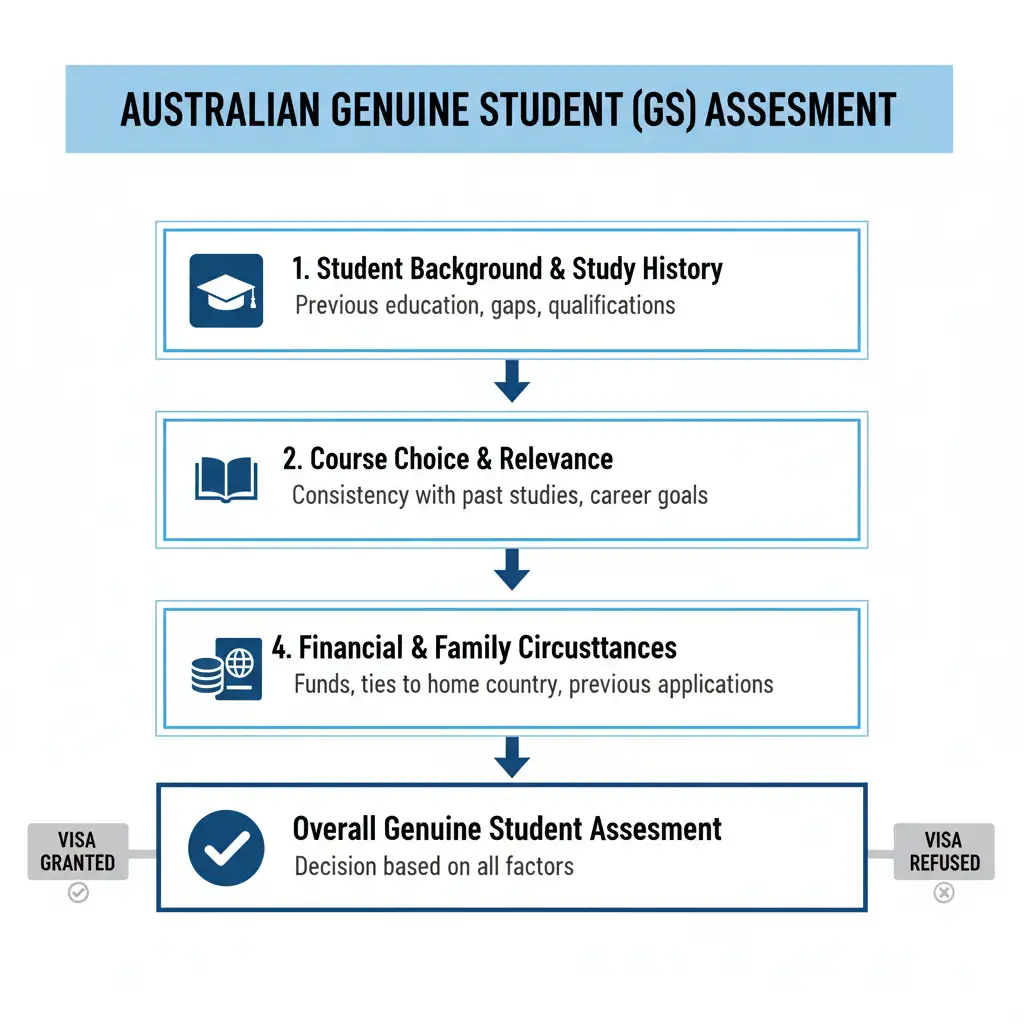
From March 2024, the Genuine Temporary Entrant (GTE) requirement was replaced by the Genuine Student (GS) requirement in Australia. Under GS, the Department considers whether your primary purpose is to study, taking into account factors such as:
- Your study history and progression;
- The relevance of the course to your background and future plans.
- Economic circumstances in your home country, and
- Your immigration history and any previous visa compliance issues.
If your statement is generic, inconsistent or focused only on migration outcomes (for example, permanent residence) without a genuine study plan, your visa may be refused.
How to avoid this refusal in 2026
- Write a detailed, honest, Genuine Student statement that explains:
- Why did you choose Australia and this particular education provider?
- How the course fits your skills, experience and future career;
- Your financial and family circumstances; and
- Your realistic plans after graduation.
- Avoid copying templates from the internet; officers can recognise generic text.
- Make sure your statement is consistent with your documents (finances, academic history, employment).
- If you are already in Australia, explain your study pathway clearly and address any changes of course or provider.
How to avoid Australian student visa rejection: practical next steps
While each case is different, there are common steps that can reduce the risk of another refusal:
- Start early so you have time to gather strong, consistent evidence.
- Read your refusal letter carefully and address each reason with new, better‑organised documents.
- Check all current requirements on the official Department of Home Affairs site before lodging.
- Keep copies of everything you submit so you can respond quickly if further information is requested.
- If you are unsure, get professional advice before you lodge a new application.
Conclusion
A refusal does not have to be the end of your Australian study plans. However, lodging a new application with the same weaknesses almost always leads to the same result.
By understanding these common reasons for Australian student visa refusal, from documents and finances to English language scores and the Genuine Student requirement, you can take more control of the process and prepare a stronger, more consistent application.
If your student visa has been refused in Sydney, Melbourne or elsewhere in Australia, consider getting your situation reviewed before you make your next move. A registered migration agent can:
- Analyse your refusal letter and explain the reasons in plain language.
- Help you understand your options (such as reapplying, appealing, or considering a different pathway); and
- Work with you to build a clearer, evidence‑based case.
For personalised advice, you can book a consultation with a registered migration agent at The Migration.