
If you’re getting ready for the Australian citizenship test in 2026, it’s normal to feel nervous, especially if English is not your first language or you’ve had a complex visa history. The good news is that the test is based on clear rules and a single official resource: Australian Citizenship: Our Common Bond.
Our immigration experts guide youthrough Australian citizenship test practice questions and answers, so you can see what the test feels like, understand why each answer is correct, and spot any knowledge gaps before test day. Whether you live in Sydney, Melbourne or anywhere else in Australia, use these sample questions together with the official booklet and practice test.
What is the Australian citizenship test?
As of 2026, the Australian citizenship test is a computer‑based, multiple‑choice test run by the Department of Home Affairs. It is designed to check whether you understand:
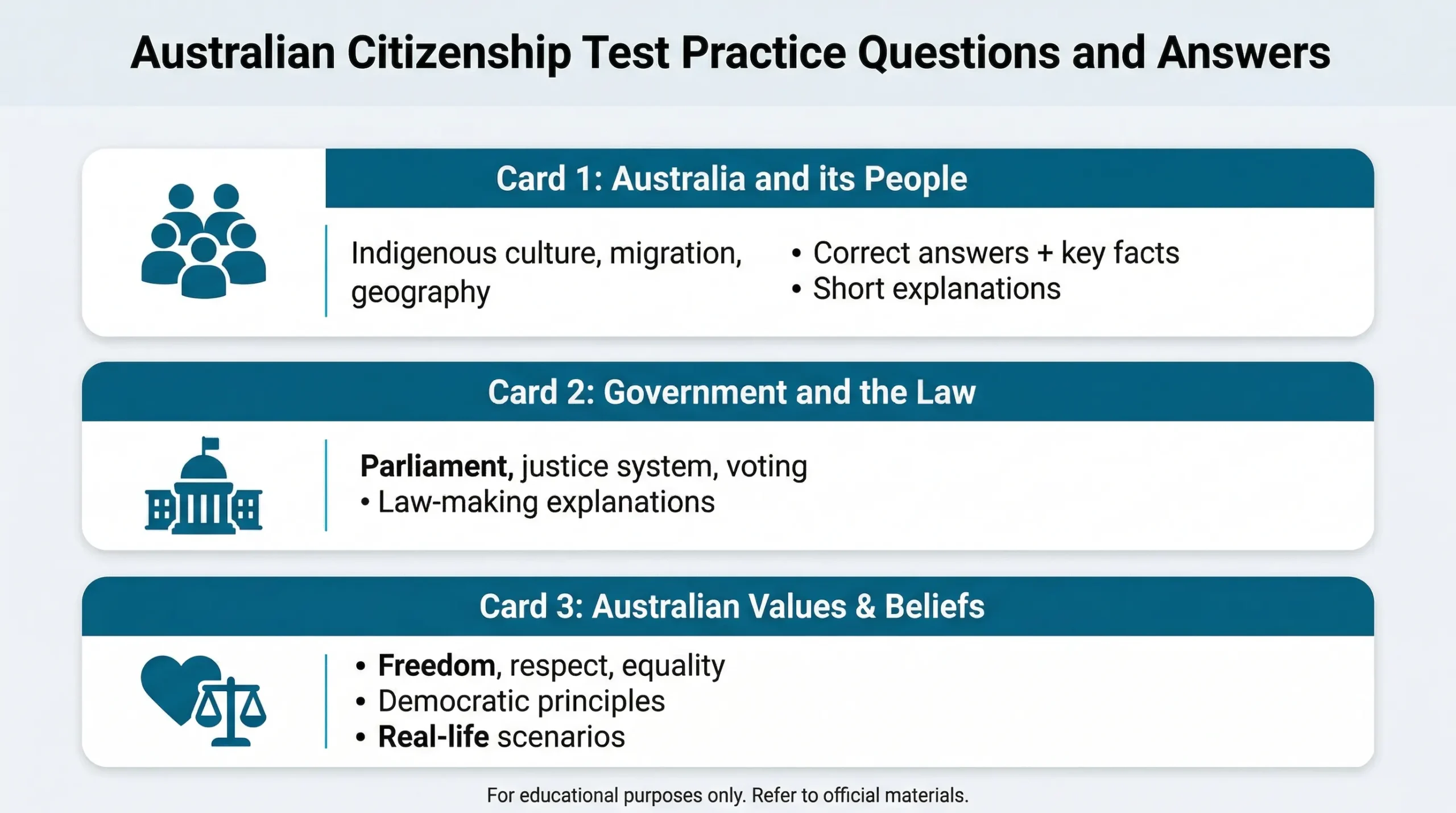
- Australia and its people
- Australia’s democratic beliefs, rights and liberties
- Government and the law in Australia
- Core Australian values
Key points:
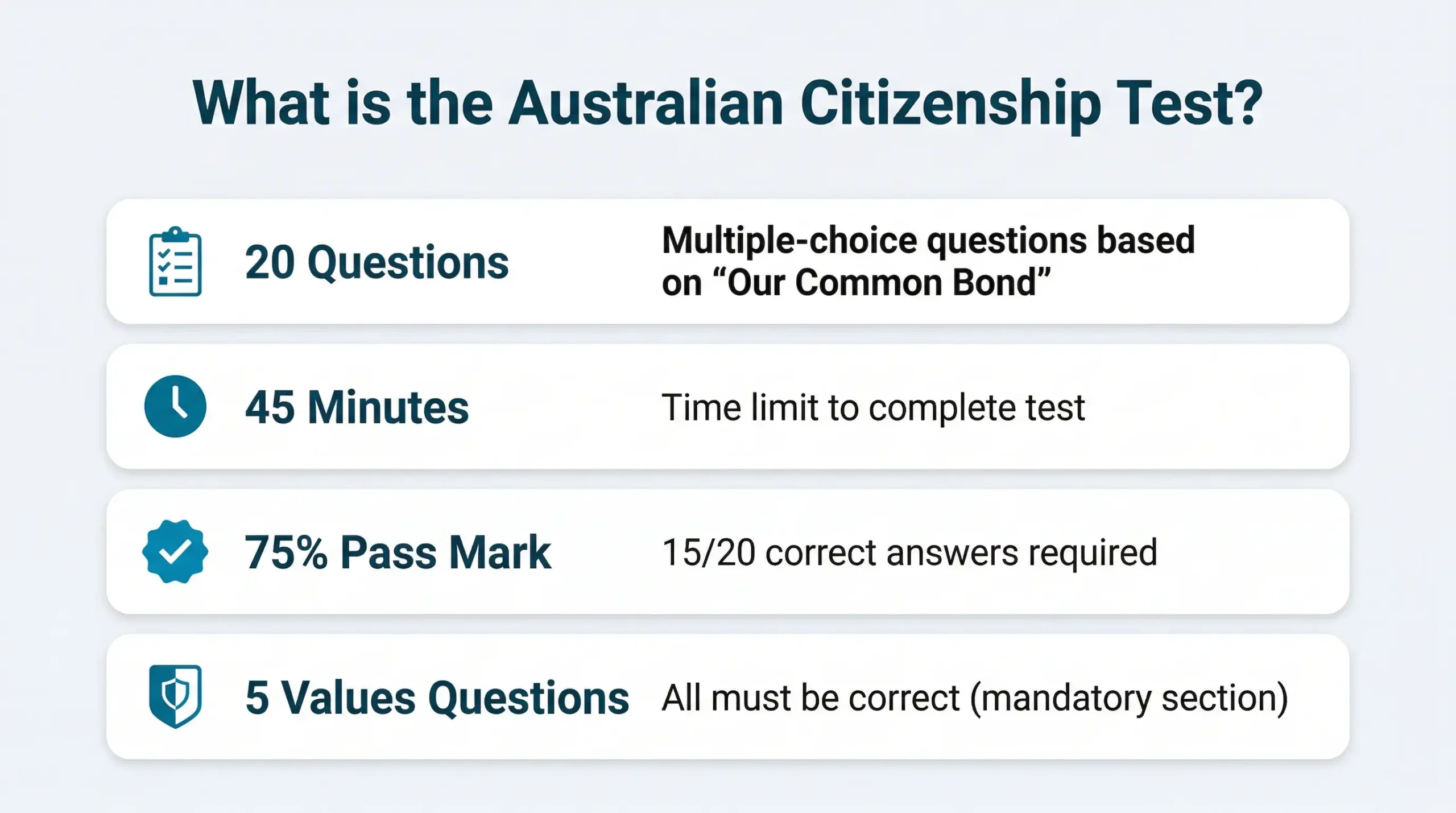
- 20 multiple‑choice questions
- 45‑minute time limit
- You must get at least 75% overall (15 out of 20 questions correct)
- There are 5 Australian values questions – you must answer all 5 correctly to pass
- The test is conducted in English only
All questions are drawn from the official booklet Australian Citizenship: Our Common Bond and related support materials provided by the Department of Home Affairs.
Official resources:
- The Our Common Bond booklet is the core source of information for the test (testable and non‑testable sections)
- The official citizenship practice test online simulation with 20 questions, similar to the real test
- Optional: Our Common Bond audio/podcast and learning modules to help you study
How to prepare for the Australian citizenship test
Preparing well before you look at any Australian citizenship practice test questions will make the test feel much more manageable.
Read Australian Citizenship: Our Common Bond
The Our Common Bond booklet is the official source for the citizenship test. It explains Australia’s history, democratic system, laws and values, and clearly shows which chapters are testable.
When you study, aim to:
- Read all testable sections at least two or three times
- Make short notes or flashcards in your own words
- Pay special attention to values‑related content, because all value questions must be answered correctly
You can download the booklet and related resources from the Department of Home Affairs website.
Use official and third‑party practice tests
Once you know the content, start checking your understanding with practice questions.
- Complete the official citizenship practice test provided by Home Affairs (20 questions in test format)
- Use reputable third‑party practice tools to expose yourself to more sample questions
- Time yourself to get used to answering questions within the 45‑minute limit
This article focuses on Australian citizenship test sample questions so you can practise in a more detailed, guided way.
For extra strategies on planning your study, you can also read our in‑depth guide on how to pass the Australian citizenship test.
Listen to Our Common Bond audio or podcast
If you prefer audio learning, the Department of Home Affairs provides audio versions and supportive learning modules based on Our Common Bond. These can help if you:
- Commute to work or study
- Find it easier to listen than to read
- Want to revise while doing other tasks
Combine reading, listening and Australian citizenship practice test questions for the best results.
Australian citizenship test practice questions and answers
Below are Australian citizenship test practice questions and answers grouped by topic. These are not real exam questions, but they are inspired by the style and subjects covered in Our Common Bond.
Use them together with the official practice test, not instead of it.
Australia and its people sample questions
Question# 1
What is the capital city of Australia?
- a. Brisbane
- b. Canberra
- c. Perth
Correct answer: b. Canberra
Explanation: Canberra is Australia’s capital city and the centre of the national government.
Question# 2
Which statement best describes Australia’s Indigenous peoples?
- a. They first arrived in Australia about 200 years ago
- b. They are the first peoples of Australia and have lived here for tens of thousands of years
- c. They came to Australia with the First Fleet in 1788
Correct answer: b. They are the first peoples of Australia and have lived here for tens of thousands of years.
Explanation: Aboriginal and Torres Strait Islander peoples are the original custodians of Australia and have a continuous connection to the land.
Question# 3
Which of the following is a national symbol of Australia?
- a. The kiwi bird
- b. The kangaroo and the emu
- c. The bald eagle
Correct answer: b. The kangaroo and the emu
Explanation: The kangaroo and the emu appear on Australia’s coat of arms and are widely recognised national symbols.
Question# 4
Australia is best described as:
- a. A continent and an island country
- b. A landlocked country
- c. A kingdom in Europe
Correct answer: a. A continent and an island country
Explanation: Australia is both a continent and an island nation surrounded by water.
Government and the law in Australia: sample questions
Question# 5
Which statement about voting in Australian federal elections is correct?
- a. Voting is by a show of hands at the polling place
- b. People are free and safe to vote for any candidate they choose
- c. People must write their names on the ballot paper
Correct answer: b. People are free and safe to vote for any candidate they choose.
Explanation: Voting is by secret ballot. Australians can choose any candidate without their name appearing on the ballot paper.
Question# 6
Who is the head of the Australian Government?
- a. The Governor‑General
- b. The Prime Minister
- c. The Chief Justice of the High Court
Correct answer: b. The Prime Minister
Explanation: The Prime Minister is the head of the Australian Government and leads the executive branch.
Question# 7
Expert Australian Migration Guidance
Navigating the complexities of your visa journey is easier with professionals. Start your Australian dream today.
Book ConsultationWhat are the three levels of government in Australia?
- a. Federal, state or territory, and local
- b. Royal, national and district
- c. International, national and city
Correct answer: a. Federal, state or territory, and local
Explanation: Australia has three levels of government, each with different responsibilities that affect daily life.
Question# 8
Which statement about Australian law is correct?
- a. Everyone must obey Australian law, including government and community leaders
- b. Only citizens must obey Australian law
- c. Visitors do not have to follow Australian law
Correct answer: a. Everyone must obey Australian law, including government and community leaders.
Explanation: The rule of law means all people in Australia, including officials, must follow the law.
Australian values and democratic beliefs sample questions
Question# 9
Which statement best demonstrates Australian values about freedom of expression?
- a. Everyone can peacefully express their opinions within the law
- b. Only government‑approved topics may be discussed
- c. People with different views must stay quiet
Correct answer: a. Everyone can peacefully express their opinions within the law.
Explanation: Australians value the right to share opinions respectfully and peacefully, as long as the law is followed.
Question# 10
Which of the following best describes equality of men and women in Australia?
- a. Men and women have equal rights and responsibilities under the law
- b. Men have more legal rights than women
- c. Women are not allowed to work in certain jobs by law
Correct answer: a. Men and women have equal rights and responsibilities under the law.
Explanation: Australian law promotes gender equality and protects the rights of both men and women.
Question# 11
What is expected of citizens when they disagree with a law or government decision?
- a. Use violence to show their anger
- b. Protest peacefully and work within the law to change it
- c. Ignore all future laws
Correct answer: b. Protest peacefully and work within the law to change it.
Explanation: Australians are encouraged to participate in democracy through peaceful protest, voting and respectful debate.
Question# 12 (values question style)
Which statement shows respect for freedom of religion in Australia?
- a. People are free to choose, change or not follow any religion, as long as they obey the law
- b. Everyone must follow the same religion
- c. People can force others to follow their religion
Correct answer: a. People are free to choose, change or not follow any religion, as long as they obey the law.
Explanation: Freedom of religion is a key Australian value, provided people follow Australian law.
Study tip: When you answer Australian citizenship practice test questions, always ask yourself which option best reflects fairness, respect, equality, freedom and the rule of law. These are central Australian values.
Conclusion
With the right preparation, the Australian citizenship test becomes a structured, manageable step on your journey to citizenship. By studying Our Common Bond, using official and third‑party practice tools, and working through Australian citizenship test practice questions and answers like the ones above, you can walk into the test centre feeling more confident.
If you’re worried about your eligibility, past refusals or a complicated immigration history, you don’t have to navigate it alone. Book a confidential consultation with our registered migration agents in Sydney and Melbourne to discuss your situation and next steps before or after you sit the test.