As of 2026, Australian student dependent visa processing times can vary widely depending on your situation. Our immigration experts guided you through typical timeframes, the key factors that speed up or slow down decisions, and when it makes sense to speak with a registered migration agent in Sydney or Melbourne for tailored advice.
Studying in Australia is a big step, and many students want their spouse/partner and children to share the experience. A common and stressful question is:
“How long will the Australian student dependent visa take to process?”
While no one can promise exact approval dates, you can understand typical ranges, why some cases move faster than others, and what you can do to avoid avoidable delays. If your situation is complex or time‑sensitive, you can also book a consultation with The Migration’s registered migration agents to get a personalised assessment of your timelines.
Current Australian Student Dependent Visa Processing Times (2026)
As of 2026, there is no single fixed processing time for Australian student dependent visas (Subclass 500). Timeframes depend on:
- Whether the dependent is applying with the main student visa or later as a subsequent entrant
- The priority group your application falls into
- How complete and well‑documented your application is
- Whether extra checks (health, character, genuineness) are required
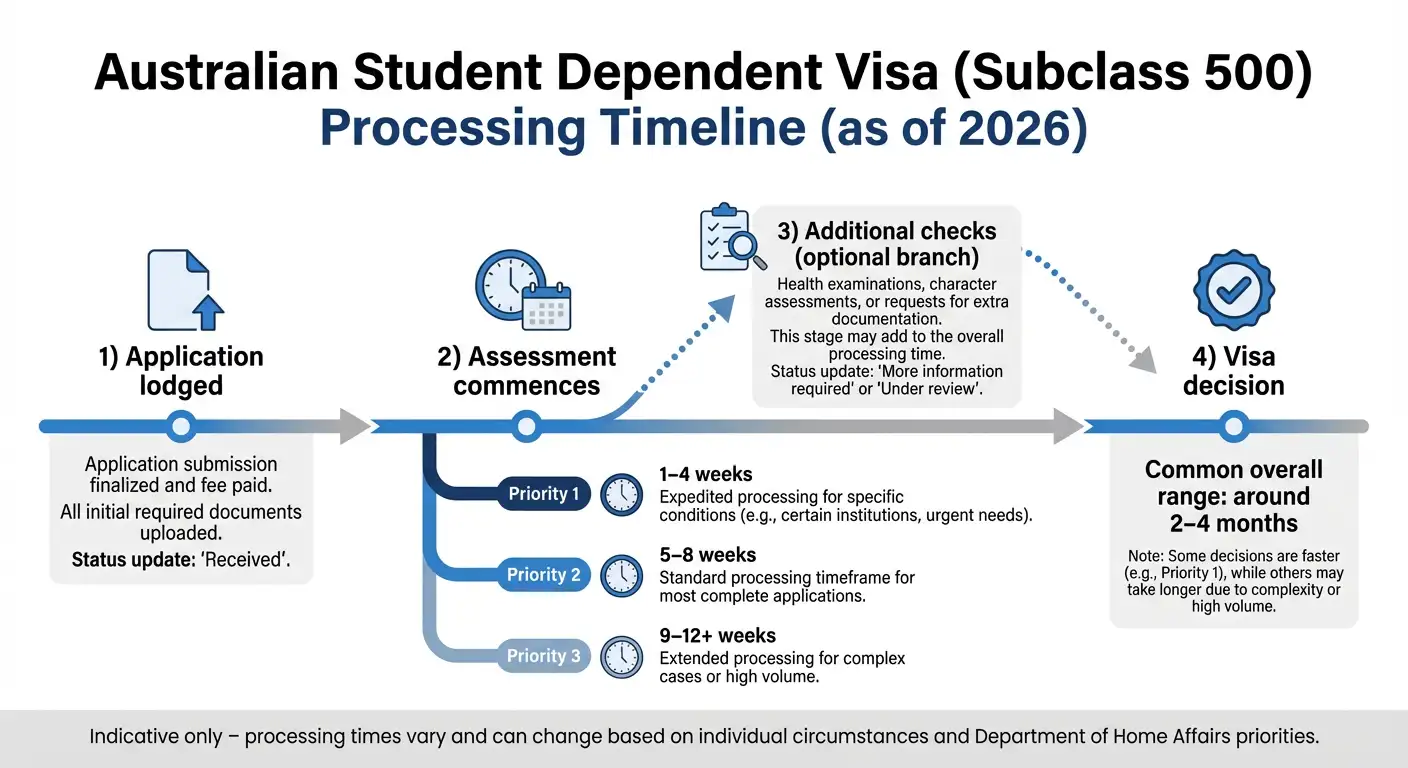
Typical processing ranges (as of 2026)
Based on recent Department of Home Affairs guidance and processing priorities:
- Priority 1 cases (for certain schools, non‑award, ELICOS and specified TAFE students): assessment may start within 1–4 weeks of lodgement.
- Priority 2 cases (many higher‑education and VET students, including most dependants): assessment may start within roughly 5–8 weeks of lodgement.
- Priority 3 cases (where providers have exceeded certain thresholds): assessment can take 9–12 weeks or more to commence.
For many families, a practical expectation for the overall Australian student dependent visa processing time in 2026 is around:
- Common range: about 2–5 months from lodgement to decision
- Faster cases: where documents are complete, and no additional checks are needed, some applications may be decided in a shorter timeframe
- Slower or complex cases: can take longer than 4 months, especially if further information, health checks, or genuine relationship evidence is requested
Important: These are general indications only, not guarantees. Processing times can change due to policy updates, application volumes, and your individual circumstances. Always refer to the official Department of Home Affairs processing time tool for the most up‑to‑date guidance.
Factors That Affect Student Dependent Visa Processing Time
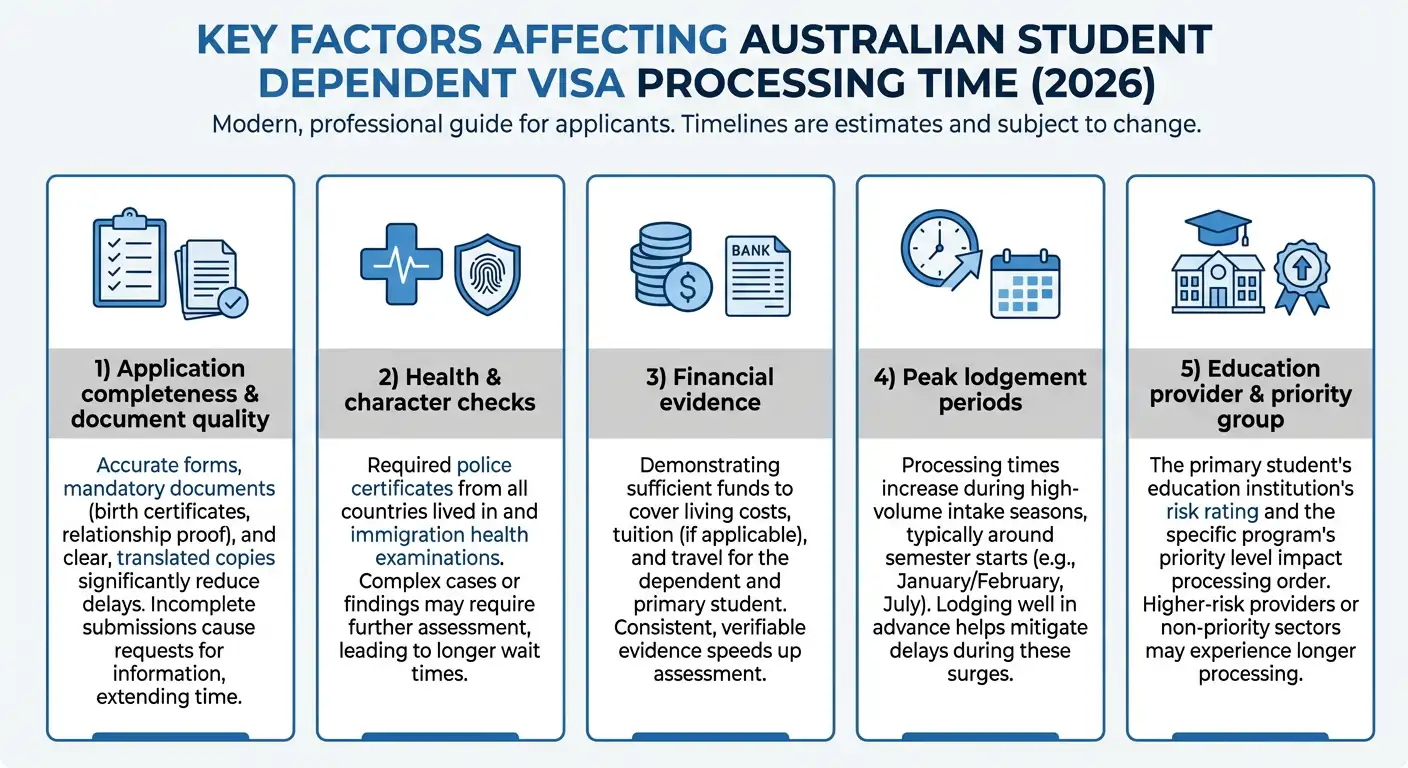
If you are asking, “Why is my student’s dependent visa taking so long in Australia?”, it usually comes down to one or more of the following factors.
1. Application completeness and document quality
Incomplete or inconsistent applications are one of the most common reasons for delay.
- Missing forms, unsigned declarations or outdated documents
- Gaps or contradictions in your relationship, study or work history
- Documents that are not translated correctly or are difficult to verify
A well‑prepared application with clear, organised evidence gives case officers less to chase and can help keep your file moving.
2. Health and character checks
All applicants must meet Australian health and character requirements.
- Health examinations may be required for the main student and dependents
- Police clearances or character information may be requested from multiple countries
- Any previous visa issues, refusals, or complex health histories can trigger an extra assessment
These checks can add several weeks or more to the student dependent visa processing time in Australia.
3. Financial evidence
You must show that you have sufficient funds to support your student visa and dependents.
- Bank statements, savings, scholarships or sponsor evidence
- Proof of funds for tuition, living costs and travel
- Evidence must be consistent with your declared circumstances
If financial evidence is unclear or inconsistent, the Department may request more information, which stops the clock until you respond.
4. Peak lodgement periods
Processing often slows down around major intake periods, such as semester 1 and semester 2.
- Large volumes of student and dependent applications are lodged at the same time
- Case officers must distribute priority according to Ministerial Directions
Lodging early rather than right before your intended course start can give you a buffer if the student-dependent visa processing time in Sydney or Melbourne stretches out.
5. Education provider and priority group
As of 2026, certain providers and courses may fall into different priority groups under Ministerial Direction 115.
- Some schools, ELICOS and specified TAFE students are processed under a higher priority
- Other higher‑education and VET students and their dependants may fall under different priority levels
This does not mean lower‑priority cases are refused. It simply means when the assessment is likely to start.
Expert Australian Migration Guidance
Navigating the complexities of your visa journey is easier with professionals. Start your Australian dream today.
Book ConsultationRelated Article: Student Visa Subclass 500 to Permanent Residency: A Complete Guide (2026)
How to Avoid Delays and Help Speed Up Your Application
While you cannot control every factor, there are practical steps you can take to support a smoother process.
Prepare your documents early
- Collect identity documents (passports, birth certificates, marriage certificates) well in advance
- Check document validity dates and ensure translations meet Australian standards
- Keep scans clear and legible
Follow the document checklist carefully
- Use the Department of Home Affairs document checklist for the Student visa (Subclass 500) and dependants
- Make sure the evidence aligns with your answers in the application form
- Avoid submitting conflicting or unnecessary documents that create confusion
Meet health and character requirements promptly
- Book health examinations as soon as you receive your HAP ID, if required
- Gather police clearances early, especially if you have lived in multiple countries
- Respond quickly and accurately if further health or character information is requested
Provide clear financial evidence
- Show access to funds for tuition, living expenses and travel for the whole family
- Ensure bank statements and sponsor letters clearly match what you have declared
- Be prepared to explain the source of funds if requested
Lodge early and monitor your application
- Avoid leaving your application until the last minute before course commencement
- Regularly check your ImmiAccount for any messages or requests for further information
- Respond within the requested timeframe to prevent your application from stalling
Applying With Your Student Visa vs. Later as a Subsequent Entrant
Many families want to know whether it is better to apply together or separately.
Applying at the same time as the main student visa
- The Department of Home Affairs generally assesses the main student and dependents together
- The Department of Home Affairs broadly aligns processing times, which helps you plan your travel more easily
- You may need to provide more evidence upfront about your family’s financial capacity and intentions
Applying later as a subsequent entrant
- Dependants can apply once the Department of Home Affairs grants the main student visa
- This can give families time to organise finances, schooling and other logistics
- However, subsequent entrant applications can still take several months, and may be assessed under different priority settings
Processing Time for Families in Sydney and Melbourne
The Department of Home Affairs processes student and dependent visas centrally, not by city. However, families living in or moving to Sydney or Melbourne often experience similar practical challenges:
- High demand for schools and childcare
- Tight rental markets and move‑in dates
- Course start dates at universities and colleges
Because of this, it can be especially important for families heading to Sydney or Melbourne to allow enough time for the student dependent visa processing time in Sydney and Melbourne and to avoid last‑minute travel or accommodation stress.
When to Get Help From a Registered Migration Agent
You may wish to seek professional advice if:
- Your family has complex health or character histories
- There has been a previous visa refusal or cancellation
- You are unsure how to prove a genuine spousal or de facto relationship
- Multiple accounts or sponsors cover your finances
- You are already waiting longer than the typical processing time and feel uncertain about what to do next
A MARA‑registered migration agent can:
- Review your documents and identify gaps that may cause a delay
- Explain the current 2026 processing trends for student dependents
- Help you respond to requests for further information from the Department
- Provide tailored advice based on your nationality, course, provider and family situation
If you are planning to study in Sydney or Melbourne and want clearer expectations around timelines, you can book a student visa consultation with The Migration to map out realistic dates and next steps.
Conclusion
As of 2026, there is no fixed Australian student dependent visa processing time that applies to every family. Many straightforward applications are decided in roughly 2–5 months, but some move faster and others take longer, especially where extra checks or additional information are required.
What you can control is how clearly and completely you present your case and whether you get help early if your situation is complex or your timelines are tight.
If you are planning to bring your spouse or children to Australia while you study, or if you are already waiting and feel unsure about the next step, The Migration’s registered migration agents can review your circumstances and guide you on realistic processing expectations.
Worried about delays with your Australian student dependent visa? Book a consultation with our team so we can help you understand your likely timelines and how to avoid unnecessary setbacks.