
Missed the Original Application? You Can Still Join Your Family in Australia
If your partner or parent holds a Subclass 482 Skills in Demand visa — or a Subclass 457 visa — and you were not included in their original application, you can still join them in Australia. This is called a subsequent entrant application, and it is the pathway specifically designed for family members who apply separately.
You do not need to wait for the primary visa holder to apply again. You apply for your own visa. The same workplace rights, study rights, and travel rights apply — and the same pathway to permanent residency is available through the primary visa holder’s employer.
With the student visa subclass 500, you can
Stay
Up to 5 years (expires same time as primary visa holder)
Cost
From AUD4,910.00
Work Rights
Work only in designated regional areas
Study
Study in designated regional areas
PR Pathway
Apply for Subclass 191 with the primary visa holder after 3 years
What Is a Subsequent Entrant Application?
A subsequent entrant visa application is for family members of a Subclass 457 or 482 visa holder who need to apply separately — either because:
- The primary visa holder has already submitted their 482 application and it is still being processed, and you were not included
- The primary visa holder has already been granted their 482 visa and you now want to join them
Once the primary visa holder’s application has been submitted, family members cannot be added to it. You must apply separately. The key difference from a standard application is that the primary visa holder’s employer (sponsor) must agree in writing to extend the nomination to include you. Without this letter, your application cannot succeed.
What You Can Do on This Visa
- Live and work in Australia
- Study in Australia at your own expense — no government assistance
- Travel to and from Australia as many times as you want while the visa is valid
- If eligible, apply for permanent residence when the primary visa holder does
- Your specific conditions are set out in your visa grant letter — check using VEVO
Who Can Apply as a Subsequent Entrant?
Family members eligible to apply as subsequent entrants of a 457 or 482 primary visa holder include:
- Spouse or de facto partner of the primary visa holder
- Dependent child or stepchild of the primary visa holder or their partner
- Dependent child or stepchild of the above dependent child or stepchild
- A person who currently holds a Subclass 457 or 482 visa granted on the basis of being a family member — and who is currently the primary holder’s spouse/de facto partner, or their dependent child who is: under 23, or 23+ and wholly/mostly reliant on the primary holder due to a disability preventing work
482 Visa Eligibility — Subsequent Entrant
Your relationship to the primary visa holder — and their current visa status — is the foundation of your eligibility.
The sponsor with the most recent approved nomination for the primary visa holder must provide a written letter agreeing to include you as a family member in the nomination. This is mandatory — it is what extends the sponsor's obligations to you. You must speak with the primary visa holder's employer before applying to confirm they will provide this letter.
If you are applying from within Australia, you must hold a substantive visa or a Bridging Visa A, B or C. You may be able to apply even if your visa has a 'no further stay' condition — this depends on your specific circumstances and must be assessed individually.
You must meet Australia's health and character requirements. All family members aged 16 or over must provide character documents.
You must have adequate health cover for your full intended stay, covering medically necessary treatment including transport. You are personally liable for healthcare costs.
Your immigration history will be assessed. Previous cancellations or refusals may affect eligibility.
You must not have, in the past 3 years, engaged in any conduct involving giving or receiving a benefit in exchange for sponsorship.
You and family members must have repaid or arranged to repay any outstanding government debt.
If aged 18 or older, you must sign the Australian Values Statement confirming you will respect Australian law and way of life.
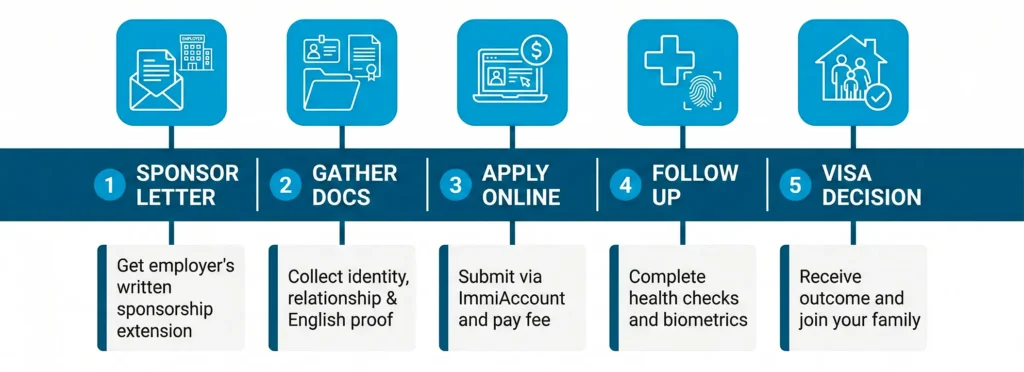
Step-by-Step Process — Subsequent Entrant Application
Step 1: Before You Apply
- Speak to the sponsor first. The primary visa holder’s employer must agree in writing to extend the nomination to you. This step is non-negotiable — confirm the sponsor will provide the letter before doing anything else
- Arrange health examinations if possible before applying — this reduces processing delays. Results are valid for 12 months
- Check your passport is valid. Get a new one if needed before applying
- Appoint a registered MARA agent, legal practitioner, or exempt person for immigration assistance if needed (Form 956)
Step 2: Gather Your Documents
This is your 482 visa document checklist for the Subsequent Entrant application:
- Written letter from the primary visa holder's sponsor confirming they agree to extend the nomination to include you as a family member — this is a hard requirement and must be attached at lodgement
- Current passport — photo page, personal details, issue and expiry dates
- Proof of name change if applicable — marriage certificate, deed poll, relevant registry documents, or statutory declaration for minor differences
- If you are the partner of the primary visa holder:
- Current marriage certificate, OR
- De facto relationship evidence: joint bank account statements, billing accounts in joint names, joint leases or mortgages, documents showing shared address
- Documents about other previous relationships if applicable
- If you are a dependent child of the primary visa holder:
- Birth certificate or adoption papers showing the relationship
- Adoption papers if applicable
- Evidence of adequate health insurance for you and any secondary applicants for the full duration of stay — must cover medically necessary treatment including transport
- If your country has a reciprocal healthcare agreement with Australia: note this and confirm through Services Australia
- AFP National Police Certificate (complete disclosure only — AFP-issued, not state/territory) if 12+ months in Australia in the last 10 years since age 16
- Overseas police certificates from every country where you spent 12+ months in the last 10 years since age 16 (including home country)
- Military service records or discharge papers if you have served in any armed forces
- Form 80 — Personal Particulars for Character Assessment (if requested by Department)
- Form 1221 — Additional Personal Particulars Information (if requested by Department)
- Passport pages, birth certificate, adoption papers if applicable
- Character documents for children aged 16–17
- Form 1229 — parental consent from any person with legal rights to decide where the child lives who is not applying — must include photo ID of the signatory (passport or driver's licence)
- Or a statutory declaration giving consent for the child to travel to Australia
- Identity documents
- Documents about other relationships if applicable
- Character documents
- Form 47a — Details of a Child or Other Dependent Family Member Aged 18 Years or Over
- Evidence of financial dependency for at least 12 months before you apply: proof of shared residence, tax records, proof of current enrolment in study
- Form 956A — Appointment or withdrawal of an authorised recipient (for correspondence only)
- Form 956 — Appointment of a registered migration agent, legal practitioner or exempt person (for immigration assistance)
- All non-English documents must be translated to English — in Australia: by a NAATI-accredited translator; outside Australia: translator must include full name, address, phone, qualifications and experience in English
- Scan all documents in colour — must be clear and readable
- Multi-page documents must be saved as a single file
- Attach each document only once in ImmiAccount
Step 3: Apply Online via ImmiAccount
- Log in or create an ImmiAccount
- Complete the application form accurately — false information can result in refusal and a 10-year ban
- Attach the sponsor’s written agreement letter and all supporting documents
- Pay the visa application charge — processing will not begin until payment is received
- Note your Transaction Reference Number
- If applying in Australia: hold a substantive visa or Bridging Visa A, B or C
Step 4: After You Apply
You can be in or outside Australia.
- If health examinations have not been completed, the Department will advise when they are needed — results valid for 12 months
- Upload any missing documents to ImmiAccount as soon as possible
- The Department may request further information — respond promptly
- If your current visa expires before a decision is made: Bridging Visa A activates automatically — do NOT cancel your current visa
- Check travel conditions before leaving Australia if on a Bridging Visa
- Notify the Department of any changes: contact details, passport changes, relationship status changes, or birth of a child
Step 5: Visa Decision
- You can be in or outside Australia when the Department decides your application
- The employer’s nomination must be approved and valid before the visa can be granted
- If granted: visa grant number, visa start date, and conditions provided in writing — keep a copy
- If refused: written reasons and review rights provided — application fee not refunded
- Check your visa details and conditions using VEVO at any time
Cost and Processing Time
The 482 visa cost for subsequent entrant applications depends on the stream of the primary visa holder:
If the primary visa holder holds a current SID (Subclass 482) visa:
- Charge is calculated based on the stream of the primary visa (Core Skills, Specialist Skills, or Labour Agreement)
If the primary visa holder holds a TSS visa (under the previous framework) or a Subclass 457 visa:
- Applicant
- Cost
- Base application charge
- AUD 3,210.00
- Each additional applicant aged 18+
- AUD 3,210.00
- Each applicant under 18
- AUD 805.00
Note: If the sole applicant on a subsequent entrant application is under 18, they are charged the base application charge — not the additional applicant charge.
About This Visa
You can stay in Australia for as long as your visa is valid — which is tied to the primary visa holder’s visa. The moment the primary visa holder’s visa ends, your own visa situation is affected. Check your specific conditions and expiry using VEVO.
If the primary visa holder’s visa is expiring and they want to continue working for the same employer, their employer must submit a new nomination, and both the primary holder and you must apply for new visas. This visa cannot be extended.
Pathway to Permanent Residency: If the primary visa holder’s employer sponsors them for permanent residency through the Employer Nomination Scheme (Subclass 186) or another permanent visa, you may be able to apply at the same time. This depends entirely on the employer’s decision and your meeting all eligibility criteria — permanent residency is not guaranteed.
Your Obligations on This Visa
- Meet all visa conditions and obey Australian laws
- Notify the Department of changes to: contact details, relationship status, passport, or birth of a child
- Maintain adequate health insurance for the duration of your stay
- If you have a newborn child while on this visa: update ImmiAccount and notify the Department
- If the primary visa holder’s employment situation changes: seek advice immediately — this can directly affect your visa status
- If you have work rights (check VEVO): you are protected by Australian workplace law
What Happens If the Primary Visa Holder’s Situation Changes?
Your visa is connected to the primary visa holder’s circumstances. If they lose their job, their visa is cancelled, or they leave Australia permanently, your status may be affected. Key points:
- If the primary visa holder’s employment ends, they have up to 180 days to find a new sponsor
- If their visa is cancelled, seek MARA-registered advice immediately
- Notify the Department of any relationship status changes — including separation from the primary visa holder
- If you experience domestic or family violence, there may be options available to you even if the relationship ends — speak to a MARA agent confidentially
Why Choose The Migration?
Subsequent entrant applications carry their own unique complexities — from coordinating with a sponsor who may not fully understand their obligation, to timing the application around the primary visa holder’s status, to managing family members at different visa stages.
MARA Registered Agents
Authorised to advise on and represent your application with the Department
Sponsor Coordination
We guide you and the primary visa holder on what to request from the sponsor and what the written agreement must contain
Relationship Evidence
We compile and structure your relationship and dependency documents to maximise application strength
Application Timing
We advise on the optimal time to lodge based on the primary visa holder's current status
Bridging Visa Management
We ensure you remain lawful throughout processing
Sensitive Situations
We handle applications involving separation, family violence, and complex family structures with discretion and care
Ready to Join Your Family in Regional Australia?
Your family is already in Australia. You should be there too. Let’s sort the sponsor letter and get your application lodged.
Frequently Asked Questions
Can I apply as a subsequent entrant if I am in Australia on a tourist visa?
If you hold a valid substantive visa including a tourist visa, you may be eligible to apply from within Australia — provided all other requirements are met. Certain conditions such as ‘No Further Stay’ (Condition 8503) may require a waiver before applying. We assess your specific visa conditions during consultation.
What if the sponsor refuses to write the required letter?
The written agreement is mandatory. Without it, your application cannot succeed. If the sponsor declines, we advise on any alternative visa pathways that may exist for your specific circumstances.
Can I work in Australia on this visa?
Work rights depend on the conditions attached to your specific visa. In most cases, subsequent entrants of 482 visa holders have full work rights. Check your exact conditions using VEVO — when working in Australia you are protected by Australian workplace law.
What is the 482 visa processing time for subsequent entrant applications?
482 visa processing time for subsequent entrant applications varies. The most effective way to reduce it is to submit a complete application with all required documents — especially the sponsor’s written agreement — from the outset.
My child was born after the primary visa was granted. What do I do?
You must update ImmiAccount and notify the Department. Your newborn may be able to apply for their own subsequent entrant visa. We advise on the exact steps required.
What is the difference between being included in the original application and applying as a subsequent entrant?
When included in the original application, family members are assessed together with the primary applicant. A subsequent entrant applies separately after the primary application has been submitted or the visa granted — requiring a separate sponsor letter, separate lodgement, and separate processing. The eligibility requirements are the same; only the process differs.