

Every year, over 100,000 Indian passport holders apply for an Australian visa, and yet, many are caught off guard by one critical fact: unlike several other popular destinations, Australia offers no visa on arrival for Indian citizens. Every trip, every study plan, every career move has to begin with the right application and choosing the wrong one can mean outright rejection, financial penalties, or even a future travel ban.
The types of Australian visas for Indians span several categories, covering everything from tourism and education to skilled migration and family reunification. India is consistently one of Australia’s top source countries for tourists, students, and skilled migrants, making the visa process a journey millions of Indians navigate each year.
Whether you’re planning a holiday, pursuing a world-class education, joining family, or building a career Down Under, this guide breaks down 7+ visa categories to help you find the one that’s right for you.
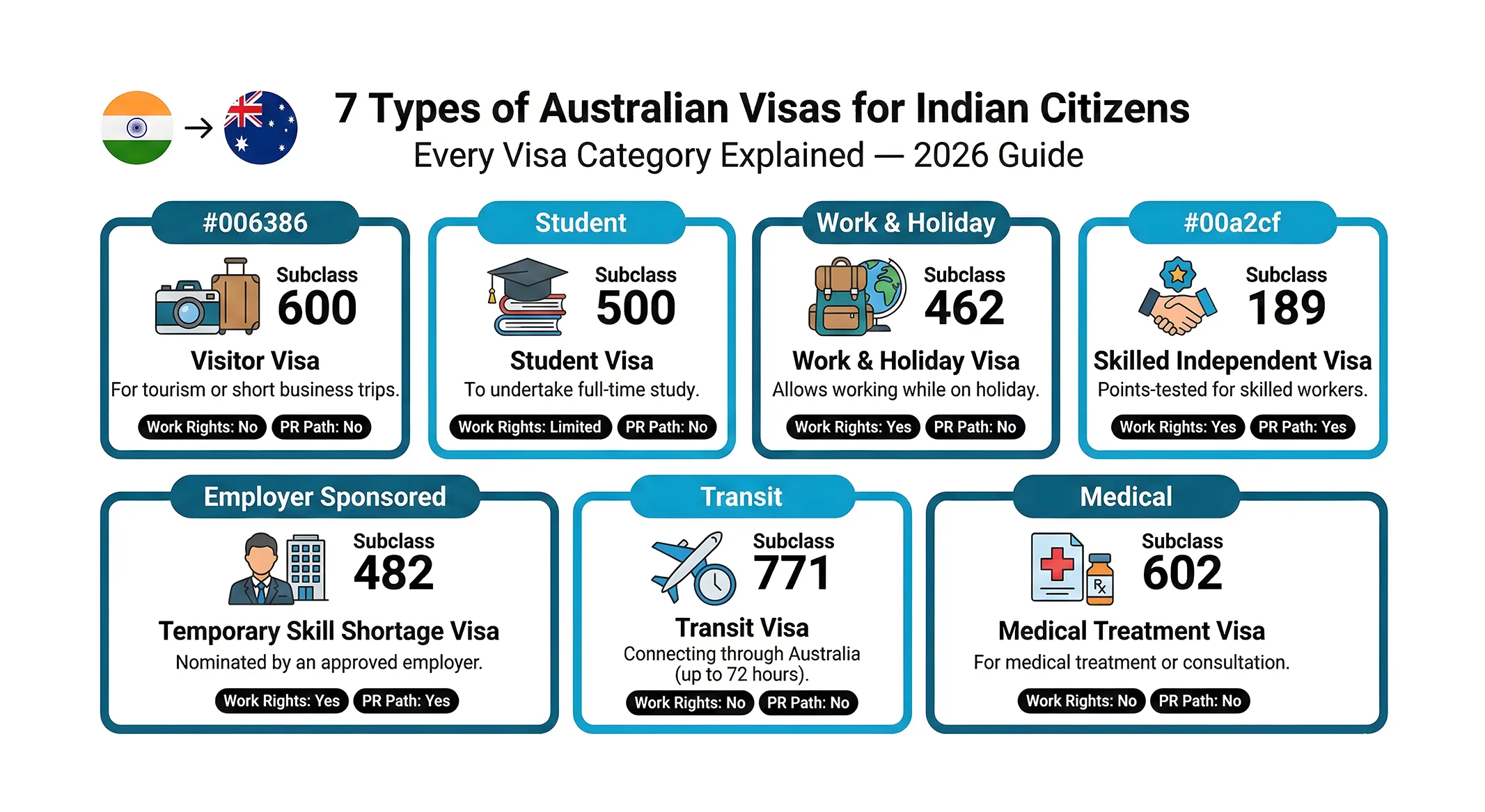
1: Visitor Visa (Subclass 600)
The Visitor Visa (Subclass 600) is the most commonly used Australian visa for Indian citizens, offering a straightforward pathway for those looking to travel for tourism, family visits, short business meetings, or conferences. Whether you’re exploring the Great Barrier Reef or attending a corporate summit in Sydney, this is the visa you’ll need.
Here’s a quick overview of what the Visitor Visa (Subclass 600) offers:
- Purpose: Tourism, family visits, short business meetings, and conferences
- Validity: Stay of 3 to 12 months; single or multiple entry options available
- Sponsored Family Stream: Can be sponsored by an Australian citizen or permanent resident
- Fee: Starts at AUD 200
Step-by-Step process for an Australian Visitor Visa (Subclass 600):
Applying for the Visitor Visa (Subclass 600) is a straightforward process if you know what to expect. Here’s a step-by-step breakdown to help you navigate it smoothly.
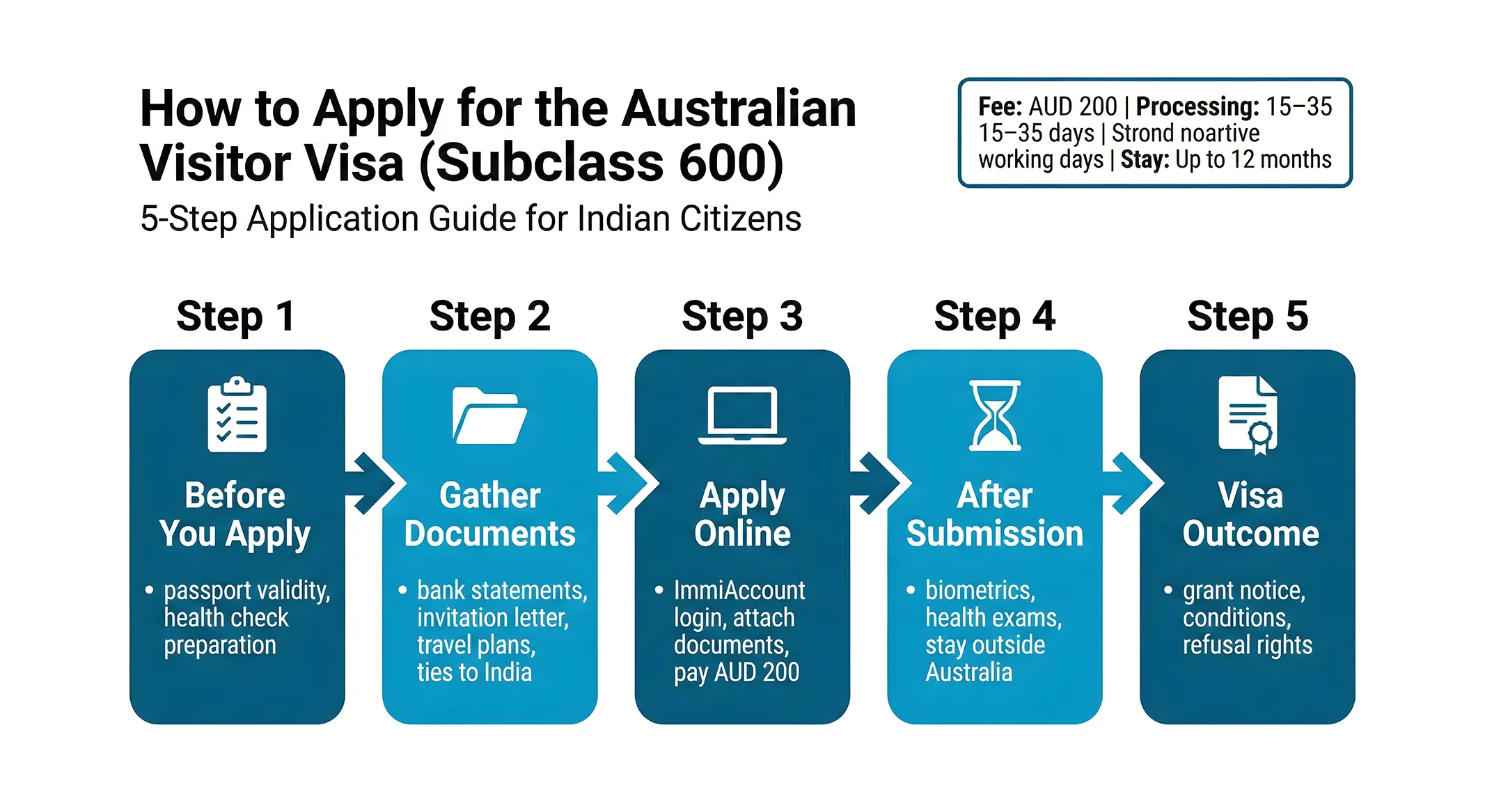
Step 1: Before You Apply
Start by ensuring your passport is valid. If you plan to get a new passport, do this before submitting your application. You can also complete your health examinations at this stage or wait until the authorities request them. If you need help with your application, make sure you appoint only authorised individuals, such as a registered migration agent, legal practitioner, or exempt person.
Step 2: Gather Your Documents
This is one of the most critical steps. You’ll need to provide:
- Identity documents: Current passport pages showing your photo, personal details, and expiry date, plus a national identity card if applicable
- Genuine visitor documents: Bank statements (3 months), pay slips, tax records, or proof of funds; an invitation letter from your Australian host; your travel plans; and proof of ties to India, such as employment letters, property ownership, or family connections
- Character documents: Military service records if applicable; police certificate if requested
- Additional documents: If applying for a longer stay or if the applicant is under 18, additional supporting documents and consent forms will be required
- All non-English documents must be translated into English by an accredited translator
Step 3: Apply Online
- Log in or create an ImmiAccount on the official Australian immigration portal
- Fill in your application accurately. Providing false information can lead to rejection or a future ban
- Attach all required documents
- Submit family applications together
- Pay the application fee (starts at AUD 200). Your application will not be processed until payment is made
Step 4: After You Apply
Once submitted, here’s what to keep in mind:
- If applying from outside Australia, you must remain outside Australia until the visa is granted
- You may be asked to provide biometrics
- Complete health examinations if requested
- Attach any additional documents through ImmiAccount if asked
- Notify the authorities immediately if any of your details change, phone number, address, passport, relationship status, or if a child is born
Step 5: Visa Outcome
You’ll receive the decision in writing. If approved, you’ll be informed of your visa grant number, start date, and conditions. Keep a copy with you at all times while in Australia. If refused, you’ll be told the reason and whether you have the right to appeal the decision.
2: Student Visa (Subclass 500)
Australia has firmly established itself as one of the world’s top study destinations, and Indian students are leading the charge. In 2024 alone, over 120,000 student visas were granted to Indian nationals, a testament to the growing appeal of Australian universities, colleges, and language institutions. If you’re an Indian student planning to study abroad, the Student Visa (Subclass 500) is your gateway.
Here’s a quick overview of what the visa offers:
- Purpose: Enrol in a registered Australian educational institution, such as universities, a school, or an ELICOS (English language courses)
- Duration: Up to 5 years, depending on the length of your course
- Work rights: Up to 48 hours per fortnight during the academic term
- Post-study pathway: Graduates may apply for the Temporary Graduate Visa (Subclass 485), now extended up to 4 years for eligible graduates
Step-by-Step Guide to Applying for Subclass 500 Student Visa
The Subclass 500 application process is straightforward when you know exactly what to expect.
Hares the step bt step process to applying for subclass 500 student visa for indians.
Step 1: Before You Apply
Timing is everything. If you’re applying from outside Australia, submit your application well in advance of your course start date. Use the official visa processing time guide tool to get an indication of current processing times. If you’re already in Australia on another visa, avoid waiting until the last day of your current visa; apply early to avoid complications.
Step 2: Gather Your Documents
Unlike other visas, the Student Visa has a personalised document checklist. Use the official Document Checklist Tool on the Australian immigration portal and enter your country of passport and education provider to get an accurate list. If you haven’t chosen a provider yet, select ‘I have not decided on a provider yet.’ Re-check the checklist just before submitting, as it is updated regularly.
Step 3: Apply Online
- Apply through ImmiAccount; you can be inside or outside Australia when you apply
- Submit a complete, decision-ready application with all required documents attached
- Incomplete applications may be refused or delayed
Step 4: After You Apply
- Regularly log into ImmiAccount to check for messages from the Department
- Respond promptly to any requests for additional information. Don’t wait until the deadline
- Avoid booking flights or making travel arrangements until your visa is finalised
Step 5: Visa Outcome
You’ll receive the decision in writing, including your visa grant number, expiry date, and conditions. Keep a copy with you at all times while in Australia. If your visa is refused, you’ll be informed of the reason and whether you can appeal. Note that the application fee is non-refundable in the event of a refusal.
3: Work & Holiday Visa (Subclass 462)
For young Indians with a sense of adventure, the Work & Holiday Visa (Subclass 462) is one of the most exciting and competitive opportunities available. Introduced under the Australia-India Economic Cooperation and Trade Agreement (AI-ECTA), this visa allows you to work, travel, and study in Australia for up to 12 months. However, securing one is no easy feat.
Before diving in, here’s an important clarification: Indian passport holders are not eligible for the Working Holiday Visa (Subclass 417), a common point of confusion. The Subclass 462 is the only work and holiday option available to Indian citizens.
Here’s what you need to know:
- Age requirement: 18 to 30 years at the time of application
- Annual quota: Only 1,000 places available for Indian citizens per year
- What it allows: Work, travel, and short-term study in Australia for up to 12 months
The odds are steep, but for those lucky enough to secure a place, it’s an unmatched opportunity to experience Australia while funding your travels through work.
4: Skilled Migration Visas (Permanent Residency Pathway)
For Indians dreaming of building a long-term life in Australia, skilled migration visas represent the most aspirational and rewarding pathway available. These are points-tested visas designed to attract qualified professionals across in-demand fields, including IT, engineering, nursing, accounting, and construction.
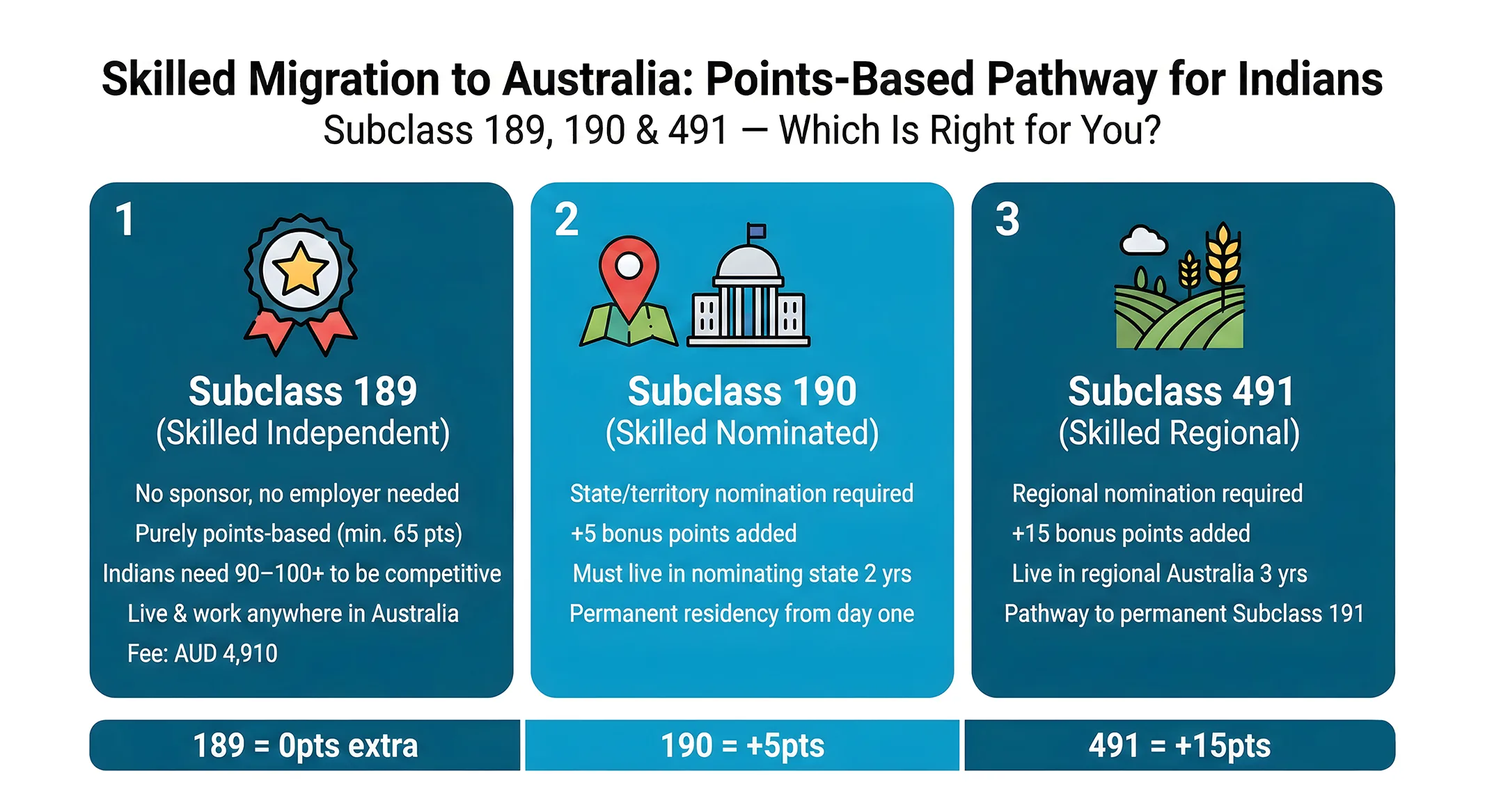
The process begins with submitting an Expression of Interest (EOI) through Australia’s SkillSelect system, where you’re assessed on a points test based on factors like age, English proficiency, work experience, and qualifications. The higher your score, the better your chances of receiving an invitation to apply.
There are three main skilled migration pathways for Indian nationals:
Skilled Independent Visa (Subclass 189)
A points-tested visa that requires no employer or state sponsorship is the most direct route to permanent residency for skilled professionals
Skilled Nominated Visa (Subclass 190)
Requires a nomination from an Australian state or territory government, offering additional points in exchange for committing to live and work in that state
Skilled Work Regional Visa (Subclass 491)
A provisional visa for skilled workers willing to live and work in regional Australia, with a clear pathway to permanent residency after meeting residency and work requirements
Application fees for skilled migration visas can reach up to AUD 4,910.00 so it’s important to be well-prepared before lodging your application.
Expert Australian Migration Guidance
Navigating the complexities of your visa journey is easier with professionals. Start your Australian dream today.
Book ConsultationFor a deeper breakdown of eligibility, points calculations, and state nomination lists, explore our dedicated PR visa guides.
5: Employer-Sponsored Work Visas
For Indian professionals who have already secured a job offer from an Australian employer, employer-sponsored visas offer a direct and well-defined pathway both for temporary work and permanent residency. However, one crucial requirement applies across all options: your employer must be an approved sponsor registered with the Department of Home Affairs. If they’re not, the application cannot proceed.
There are three main visa options under this category:
Temporary Skill Shortage Visa (Subclass 482):
An employer-sponsored temporary work visa valid for 2 to 4 years, allowing you to live and work in Australia while your employer covers your role
Employer Nomination Scheme (Subclass 186):
A permanent residency pathway for workers nominated directly by their Australian employer
6: Transit Visa (Subclass 771)
If you have a connecting flight through Australia, the Transit Visa (Subclass 771) allows Indian travellers to pass through with a layover of up to 72 hours. However, whether you actually need this visa depends on one key distinction: airside vs. landside.
If you remain airside (staying within the international terminal without clearing immigration), you may not need a visa at all. If you plan to go landside (clearing immigration and stepping out of the airport), the Subclass 771 is required.
7: Medical Treatment Visa (Subclass 602)
For Indian nationals travelling to Australia specifically for medical consultation or treatment, the Medical Treatment Visa (Subclass 602) provides a dedicated pathway. A carer accompanying the patient can also be included in the same application, making it a practical option for those who need support during their medical journey.
One important note: this visa does not cover surrogacy-related travel, a common query among applicants. If that is your purpose, you will need to explore alternative visa options.
Quick Comparison for all visa Types for Indian Citizens
| Visa Type | Subclass | Purpose | Work Rights | Path to PR |
| Visitor | 600 | Tourism / Family | No | No |
| Student | 500 | Education | Limited | Indirect |
| Work & Holiday | 462 | Work + Travel | Yes | No |
| Skilled Visa and PR | 189/190/491 | Migration | Yes | Yes |
| Employer Sponsored | 482 | Work | Yes | Possible |
| Transit | 771 | Transit | No | No |
| Medical | 602 | Treatment | No | No |
How The Migration Helps
The Migration is an Australian-based immigration and education consultancy that specialises in helping Indian nationals identify the most suitable visa pathway to permanent residency in Australia. With a deep understanding of the Australian immigration system and the unique circumstances of Indian applicants, our MARA-certified agents guide you through every available option with clarity and confidence.
If you are in Sydney and exploring the Australian visas available for Indians, The Migration provides confidential consultations to help you identify the strongest pathway for your specific circumstances.
Applicants in Melbourne can book an in-office or Zoom session with our experts to get a clear, honest assessment of which visa type best suits their profile and PR goals.
Conclusion
Summarise the key visa types covered. Reinforce that the right visa entirely depends on the purpose of travel, whether it’s tourism, education, employment, or permanent settlement. Encourage readers to verify all requirements on the official Australian Department of Home Affairs website or consult a registered migration agent before applying.
Your visa is too important to leave to chance. Book a confidential consultation with The Migration today and let’s build your pathway to Australian PR the right way.
Frequently asked questions
Q1: Can Indians get a visa on arrival in Australia?
No. Indian passport holders must apply for a visa in advance through the Australian Department of Home Affairs via ImmiAccount.
Q2: What is the easiest Australian visa to get for Indians?
The Visitor Visa (Subclass 600) is the most straightforward for tourism and short stays, provided financial and character requirements are met.
Q3: Can I work in Australia on a tourist visa?
No. The Visitor Visa (Subclass 600) does not permit any form of paid employment in Australia.
Q4: How long does an Australian visa take for Indians?
Tourist visas typically take 15–35 working days, student visas around 4–6 weeks, and skilled migration visas can take several months.
Q5: Can an Indian student get PR in Australia?
Yes. Students can transition from a Student Visa (Subclass 500) to a Temporary Graduate Visa (Subclass 485) and then pursue a skilled migration pathway to permanent residency.