
Skilled Independent Visa (Subclass 189): PR Without Sponsorship
The Subclass 189 visa is Australia’s premier permanent residence pathway for skilled workers who can qualify independently. This points-tested visa grants complete freedom to live, work, and study anywhere in Australia. Unlike the 190 or 491, the skilled independent visa doesn’t tie you to a state, employer, or regional area. It’s the ultimate freedom visa for those who have the points to make it.
Key Facts
Stay Duration
Permanently (indefinite)
Sponsorship
Not required
Cost:
AUD $4,910 (Main Application)
Processing Time:
Typically 45 to 56 months for 90% process of New Zealand Stream
10 to 12 months for 90% process of Point test stream
Why Choose Subclass 189? The Ultimate Freedom Visa
The Subclass 189, a key pathway under General Skilled Migration (GSM), stands apart as Australia’s most liberating visa pathway, offering unmatched independence and complete flexibility. Unlike state-sponsored or employer-tied visas, the 189 grants complete control over your Australian life from approval no geographic restrictions, no sponsorship obligations, no provisional periods. Here’s why skilled professionals choose this exceptional pathway:
Benefits of Skilled Independent Visa
Total Freedom Across Australia
You're not restricted to any state or regional area. Move between Sydney, Melbourne, Brisbane, or anywhere else freely. Other visas lock you into locations. The 189 doesn't.
Direct Permanent Residency
No provisional period. You get full permanent residency immediately with Medicare access, social security eligibility after waiting periods, and the right to sponsor family members. No conversion process needed later.
Family Inclusion
Your partner and dependent children receive permanent residency on the same application with full work and study rights.
Unlimited 5-year travel facility
Enjoy unrestricted multiple entry rights to Australia for five years, with the ability to renew your travel facility through a Resident Return Visa for continued international mobility
Education benefits for your family
Children gain access to subsidized public school education at Australian rates, plus eligibility for domestic student fees (HECS-HELP) for university, saving tens of thousands compared to international student costs
Eligibility Criteria For Skilled Independent Visa: Can You Qualify?
To qualify for the skilled independent visa subclass 189, you must be under 45 years old at invitation, achieve at least 65 points (competitive scores typically 85+), have your occupation on the MLTSSL, obtain a positive skills assessment, demonstrate competent English proficiency, and pass health and character assessments.
You must be under 45 years old when invited to apply. Age points decrease after 32, so apply early.
While 65 points is the official minimum, competitive scores vary dramatically by occupation. Recent invitation rounds show construction trades invited at 65 points, healthcare professionals needing 70 to 85 points, and IT professionals requiring 95+ points.
Is 75 points enough for 189 visa? For high-demand trades and some healthcare roles, yes. For IT and accounting, you'll need significantly more in the current competitive environment.
You need a positive skills assessment from the relevant authority before submitting your Expression of Interest. Different occupations have different assessing authorities:
ACS for IT professionals (4 to 6 weeks)
Engineers Australia for engineering disciplines (6 to 12 weeks)
VETASSESS for 361 professional occupations (8 to 12 weeks)
TRA for trade occupations (processing varies)
ANMAC for nurses and midwives
Skills assessments typically remain valid for three years.
Your occupation must appear on the Medium and Long-term Strategic Skills List. This list includes 212 occupations like software engineers, registered nurses, civil engineers, accountants, electricians, and teachers. If your occupation isn't on MLTSSL, consider the 190 or 491 pathways.
Competent English (IELTS 6.0 each band) is the minimum. However, higher levels earn crucial points:
Competent (IELTS 6.0): 0 points
Proficient (IELTS 7.0): 10 points
Superior (IELTS 8.0): 20 points
Given current competition, superior English is almost essential for IT and accounting professionals to reach competitive thresholds.
All applicants and accompanying family members are required to meet Australia’s health and character criteria, which involve medical checks and police clearance certificates.
Your Skilled Independent Visa Success Depends on Your Points Score!
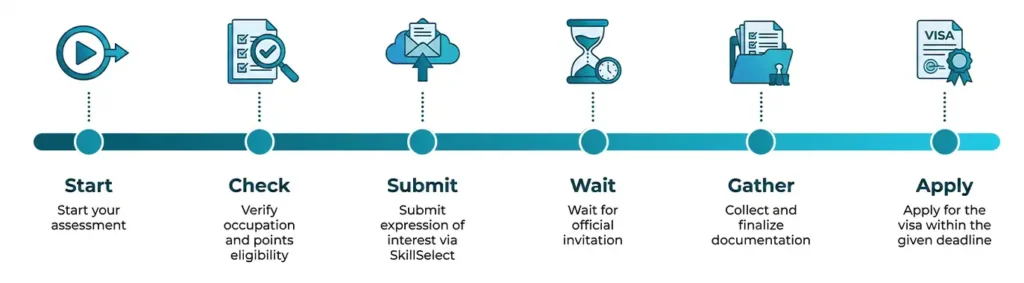
Step-by-Step Skilled Independent Visa Application Process
Step 1
Check Eligibility and Calculate Points
Verify your occupation is on Occupation list and honestly calculate your points using a 189 visa points calculator.
Step 2
Obtain Skills Assessment
Apply to the relevant assessing authority with detailed employment references, qualifications, and work experience evidence. Allow 4 to 12 weeks.
Step 3
Achieve Target English Score
Take your English test (IELTS, PTE Academic, TOEFL iBT, or other accepted tests). Aim for proficient or superior levels to maximize points.
Step 4
Submit Expression of Interest
Lodge your EOI in SkillSelect selecting "Skilled Independent (Subclass 189)". Your EOI remains active for two years and can be updated as circumstances change.
Step 5
Wait for Invitation
The Department of Home Affairs conducts regular invitation rounds, typically twice monthly. Invitations are issued based on points ranking within each occupation. Higher points mean earlier invitations.
Step 6
Lodge Visa Application
Once invited, you have 60 days to submit your complete visa application with all supporting documents including police clearances, health examinations, employment evidence, and qualifications.
Step 7
Visa Decision
Current 189 visa processing time averages 10 to 12 months, though this varies by occupation. Priority occupations like healthcare and construction may process faster.
Cost Breakdown and Visa Process Time
Visa fees and processing times are based on official Department of Home Affairs data, accurate as of 2025. Fees are subject to change annually.
Subclass 189 Visa Cost
- Base application charge
- AUD $4,910
- Additional applicant charge 18+
- AUD $2,455
- Additional applicant charge under 18
- AUD $1,230
- Other Charges may be applicable
189 visa processing time
- Points-Tested Stream
- 10 to 12months
- New Zealand Stream
- 45 to 56 months
- Combined timeline
- Experience 10 to 56 months
- Complete applications move quicker than those requiring additional information.
🛡️ MARA Registered
Registered migration agents with 7+ years of trusted experience
⚡ Faster Processing
Complete applications reduce delays
🛡️ MARA Protection
Fully licensed MARA agents
How The Migration Maximize Your Success
Our expert MARA agents guidance and proven strategies significantly improve your chances of visa approval.
Points Optimization Strategy
We identify legitimate opportunities many applicants miss. Partner skills assessments, NAATI credentials, Professional Year programs, and strategic English coaching can add 10 to 20 points, transforming borderline applications into competitive ones.
Occupation-Specific Intelligence
We track invitation rounds for every occupation code and provide realistic advice based on recent trends. If your occupation needs 100+ points at 85, we'll recommend exploring 190 or 491 alternatives rather than having you wait indefinitely.
Perfect Application Management
One EOI mistake can cause visa refusal later. We ensure employment dates, skills assessment claims, and qualification details align perfectly with supporting documents, preventing errors that derail applications.
Secure Your Australian Permanent Residency
The skilled independent visa Australia pathway rewards strategic planning and preparation. With competitive points thresholds for most occupations, professional guidance ensures you maximize every opportunity.
Frequently Asked Questions
What is the Australian Subclass 189 Skilled Independent visa?
The Subclass 189 is a permanent residence visa for skilled workers who don’t need employer, state, or family sponsorship. It’s points-tested, invitation-only, and allows living and working anywhere in Australia permanently
What are the benefits of 189 visa?
Complete geographic freedom, immediate permanent residency, Medicare access, family inclusion, pathway to citizenship after four years, no state commitments, and full work and study rights anywhere in Australia.
What's the difference between 189 and 190 visa?
The 189 offers complete freedom with no state commitment but requires higher points (typically 85 to 95+). The 190 Visa provides 5 bonus points and accepts more occupations but requires two-year state commitment. The 190 is often more achievable for applicants with 70 to 80 base points.
How long does 189 visa processing take?
Current processing averages 10 to 12 months. Priority occupations like healthcare and construction may process faster. Complex cases or those with health or character issues may take longer.
Do I need a job offer for skilled independent visa?
No. The 189 requires no employer sponsorship or job offer. However, skilled Australian work experience significantly boosts your points, improving invitation chances.
How much points required for 189 visa?
The official minimum is 65 points. However, competitive scores vary by occupation: construction trades at 65, healthcare at 70 to 85, engineering at 75 to 95, and IT/accounting typically requiring 95+ points in recent invitation rounds.
Can 189 visa holders apply for citizenship?
Yes. After holding permanent residency for four years (including 12 months as a PR holder) and meeting residency requirements, you can apply for Australian citizenship.
How to apply for 189 visa?
First, obtain a skills assessment. Submit an Expression of Interest in SkillSelect. Wait for invitation. Lodge visa application within 60 days with all supporting documents. Wait for processing and decision.