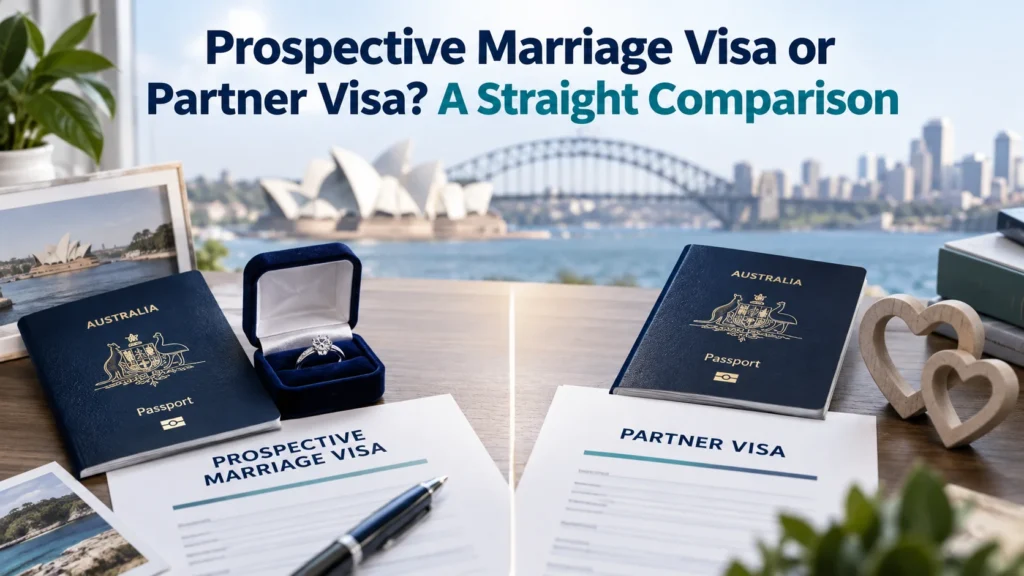
If you are reading this, you are probably sitting with two browser tabs open and a decision that feels heavier than it should. One says Prospective Marriage visa, subclass 300. The other says Partner visa, subclass 309. Both lead to permanent residency, both cost a great deal, and nothing you have read so far has told you which one is yours.
Let me make this smaller. The choice comes down to one question, and once you answer it honestly, the rest follows.
The Question That Settles It
Can the two of you legally marry before you lodge an application?
If the answer is yes, the 309 is usually the better route. You marry overseas, apply as a married couple, and you never have to lodge a second application.
If the answer is no, the subclass 300 exists for precisely your situation.
Notice the question is about what is possible, not what you would prefer. Plenty of couples could technically marry somewhere quickly and still cannot marry in a way their families would accept, or in a country whose paperwork Australia recognises. That is a real constraint, and the subclass 300 was designed with it in mind.
What Each Visa Actually Is
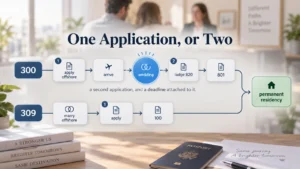
The subclass 300 lets you come to Australia to marry your partner. It is usually granted for nine months, and for up to fifteen. You must be outside Australia when you apply and when it is granted. Once you marry, you apply onshore for the Partner visa 820, which leads to the permanent 801.
| One condition catches people out
Condition 8515 means you must not marry before you enter Australia. The ceremony does not have to be held here, and nothing requires an Australian wedding, but you must arrive on the visa first, and you must be in Australia to lodge the 820. In practice most couples marry here, which is why the 300 is described as the Australian-wedding route. |
The subclass 309 is for couples who are already married, or who have been living together in a genuine de facto relationship for at least twelve months. You also apply from outside Australia. The permanent subclass 100 is then assessed without a second application from you, and eligibility generally begins two years after you lodged.
The twelve months has exceptions. It falls away if your relationship is registered under a prescribed state or territory law, in NSW, Victoria, Queensland, South Australia, Tasmania and the ACT. Most registers require one of you to live in that state, so it rarely helps a couple both offshore. It also falls away for compelling and compassionate circumstances, or where your Australian partner holds a permanent humanitarian visa granted after your relationship began.
There is also a faster route to the permanent 100 that most comparisons miss. If, on the day you apply, your relationship has run for three years, or two years with a dependent child of you both, the permanent visa can be granted directly, with no two-year wait.
The Comparison, Side by Side
| Subclass 300 | Subclass 309 and 100 | |
| Your status when you apply | Engaged | Married, or 12 months de facto |
| Where you must be | Outside Australia | Outside Australia |
| The wedding | After you arrive in Australia; ceremony may be here or overseas | Overseas, before you apply |
| First charge | AUD 11,710 | AUD 11,710 |
| Second-stage charge | AUD 1,955, or AUD 2,475 if the 300 has expired | None |
| Applications you lodge | Two | One |
| Time to reach Australia | 14 months (median) | 21 months (median) |
| Deadline pressure | Marry and lodge the 820 before the visa expires | None once you have married |
Let Us Talk About Money Honestly
The first charge is the same on both pathways: AUD 11,710 for the main applicant from 1 July 2026, up from 9,365. You can confirm it on the Home Affairs pricing page, because charges are indexed on 1 July 2026.
| A new concession almost nobody has written about
From 1 July 2026, there is a second, lower tier. If you hold a passport from a Pacific-regional country: Fiji, PNG, Samoa, Solomon Islands, Timor-Leste, Tonga, Vanuatu, Nauru, Kiribati, Tuvalu, Palau, the Marshall Islands or Micronesia, the charge is AUD 9,600 instead of 11,710, on either pathway. That is 2,110 less, and the concessional second-stage charge drops to 1,600 too. |
The difference between the pathways arrives later. On the 300, you marry, then lodge the 820. Because you already paid the full charge once, that second application costs AUD 1,955, but only if two things are true. You must still hold the subclass 300 when you lodge, and you must have married the person named as your intended spouse in the 300 application.
Miss the first of those, and the charge becomes AUD 2,475. Let the 300 expire before you lodge the 820 and you fall into a higher fee tier. That slip costs an extra 520 dollars, and it is the most common expensive mistake on this pathway. Diary the expiry date the day the visa is granted.
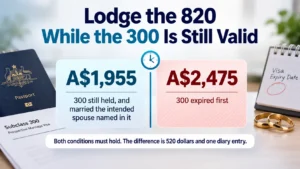
So across the whole journey, the subclass 300 costs roughly AUD 1,955 more than the 309, or 2,475 if you are late. That is real money, and it is also less than most couples spend on the wedding itself. What it buys is the ability to marry in Australia, with the people you want in the room.
Two things before you budget. There is no second instalment for lacking functional English on partner visas; you may see a figure quoted for one, and it does not exist. And each additional applicant carries a charge of their own: AUD 5,860 for someone 18 or over, AUD 2,935 for a child. Our child visa page covers the children who cannot be included, and our partner visa fee breakdown sets out the medicals, police certificates and translations.
And About Time
This is the part that hurts, so I would rather be straight with you than gentle.
Home Affairs does not publish a range. It publishes percentiles: the time within which half of recently finalised applications were decided, and the time within which ninety percent were. The September 2026 data:
| Visa | Half decided within | Ninety percent within |
| 300 Prospective Marriage | 14 months | 26 months |
| 309 Partner (Provisional) | 21 months | 39 months |
| 100 Partner (Migrant) | 9 months | 18 months |
| 820 Partner (temporary) | 23 months | 29 months |
| 801 Partner (permanent) | 3 months | 17 months |
Read the first two rows carefully, because they may not be what you expect. The subclass 300 is currently the faster way to reach Australia: fourteen months against twenty-one for the 309. That seven-month gap argues for the subclass 300 more strongly than anything else on this page.
Expert Australian Migration Guidance
Navigating the complexities of your visa journey is easier with professionals. Start your Australian dream today.
Book Consultation 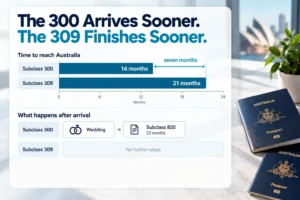
What the 309 buys is the back half. Once it is granted, the permanent 100 follows without a further application from you. On the 300 you still have a wedding to hold and an 820 to lodge, and the 820 is running at twenty-three months to a median decision. So the 300 gets you here sooner and reaches permanence later. That is the trade, not a reason to avoid either.
Two notes. The 100 and 801 figures are measured from the date you become eligible for the permanent stage, not from lodgement. And they move monthly, so check the tool rather than trusting a blog, including this one.
Four Places Couples Get Caught Out
The sponsorship limits
Under regulation 1.20J, your Australian partner can sponsor two partners in a lifetime, and five years must pass between partner visa applications, measured from the date the earlier one was lodged, not granted. It also catches people who were themselves sponsored: if your partner came here on a partner visa, they generally cannot sponsor you until five years after they applied.
This is not the dead end it is usually described as. Regulation 1.20J(2) allows the Minister to approve the sponsorship anyway where there are compelling circumstances affecting the sponsor: a previous partner’s death, a previous partner leaving the sponsor with young children, dependent children of your current relationship, a long-standing relationship. Note who they must affect: showing your relationship is genuine is not, on its own, enough. Waiving the five-year gap is easier than waiving the two-sponsorship cap, and either is worth a conversation before you assume the pathway is closed.
Your partner’s police check
Since November 2016, partner and prospective-marriage sponsors must provide police checks, and convictions for relevant offences, largely family violence, are disclosed to the applicant and can bar the sponsorship. Sponsorship is assessed as its own step and can be refused regardless of how genuine your relationship is. If there is something in your partner’s history, raise it with an agent before you lodge.
Marrying while the subclass 300 is still being decided
Marry before the decision and you stop being eligible, because the visa requires you to intend to marry rather than to be married.
This is fixable, and cheaper than couples fear. Under regulation 2.08E you tell the Department in writing, with your marriage certificate, that you want to be considered for the subclass 309 and 100, and those applications are treated as having been made, with no second visa application charge. Your original charge is not refunded, but you are not paying twice either. What produces a refusal is saying nothing and letting the 300 run on to a decision you can no longer meet.
Thin relationship evidence
This decides more applications than the choice of subclass ever will. Both pathways need the same kind of proof, including Form 888 supporting statements from people who know you both, a written relationship history, and evidence you have met in person as adults. Couples who met online worry most and succeed regularly, because message history, video calls, money transfers and flight records carry a long-distance file the way a shared lease carries other couples. Overstating anything does far more damage than a thin file honestly explained.
So, Which One Is Yours?
Choose the subclass 300 if you cannot marry before applying, or the wedding needs to happen in Australia for reasons that matter to your family. You accept one extra application and about AUD 1,955, and on current figures you also arrive sooner.
Choose the 309 and 100 if you are already married, or have twelve months of genuine de facto history you can evidence. Fewer moving parts, no second deadline, and the permanent visa arrives without another application.
If you are onshore right now, our comparison of onshore and offshore partner visas covers that separately, and our step-by-step 309 guide walks through that pathway.
If You Are Still Unsure
Most couples arrive at the right answer within ten minutes, once someone asks about the wedding, the timing and your partner’s sponsorship history in the right order.
You can check your eligibility first, or read through every option on our partner visa hub. When you would rather have someone work through it with you, our team is here, in Harris Park, Melbourne or online.
Book a 30-Minute Strategy Session Send Us Your Situation in Writing
You can verify our registration on the Register of Migration Agents. No registered migration agent can guarantee a visa outcome. Figures verified 14 September 2026.