
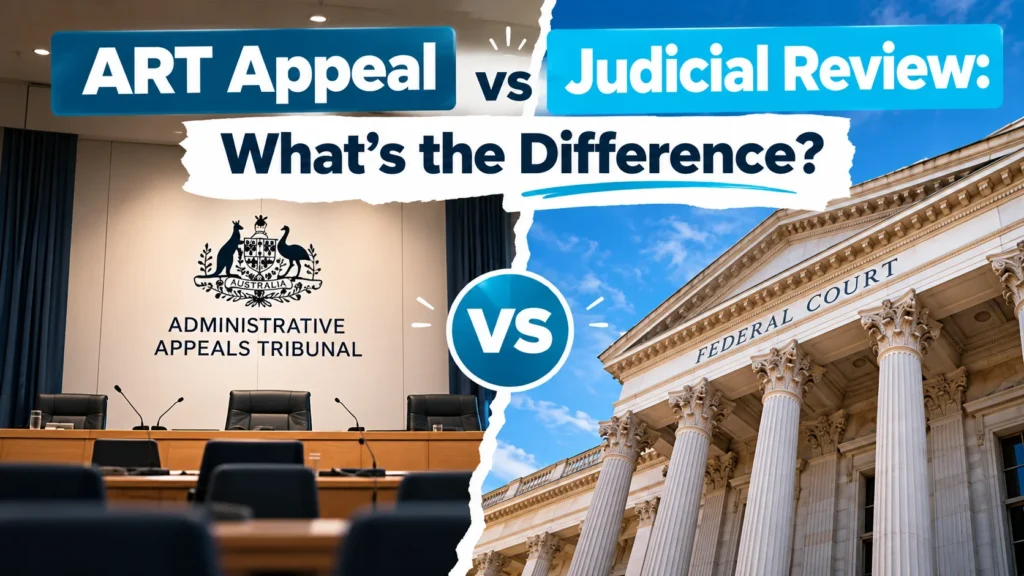
Priya lives in Melbourne on a bridging visa, and her partner visa refusal has just arrived by email. One friend tells her to appeal to the ART. Another says she should take it to court. Both options exist, but they do very different jobs, and the order in which you use them matters. This guide explains what an ART appeal is, what judicial review is, how the two fit together, and how to work out which one applies to your decision.
How are the two options different?
An ART appeal is a merits review. The Administrative Review Tribunal looks at your case again, can accept new evidence, and can make a fresh decision. Judicial review happens in court. The court only checks whether the decision was made lawfully. It cannot weigh up your evidence again or grant you a visa. For most onshore refusals that carry review rights, the ART comes first. Judicial review becomes relevant later if the Tribunal’s decision contains a legal error.
What does an ART appeal look at?
The Administrative Review Tribunal (ART) replaced the Administrative Appeals Tribunal on 14 October 2024. It is independent of the Department of Home Affairs. When you apply, a Tribunal member reviews the whole decision again, including the facts, the law and the evidence.
You can give the Tribunal new documents, such as updated relationship evidence, a new English test result or fresh employment records. Many reviews include a hearing where you can explain your circumstances. Some decision types are now decided on the papers instead.
The Tribunal can affirm the decision, vary it, set it aside and make a new decision, or send the case back to the Department with directions. The application fee for most migration decisions is about AUD 3,727 for fees paid from 1 July 2026.
Not every decision can go to the ART. Your decision letter states whether you have review rights, who can apply, and the deadline, which the Tribunal cannot extend. Your letter is the most reliable guide to your own deadline, so keep it close.
What is judicial review in a migration case?
Judicial review is a court process. For most migration decisions, it starts in the Federal Circuit and Family Court of Australia (Division 2). The court does not ask whether you deserve the visa. It asks whether the decision-maker acted within the law.
Lawyers call a serious legal flaw a jurisdictional error. Examples include denying you procedural fairness, misreading the law, ignoring an issue the law required them to consider, or reaching a decision no reasonable decision-maker could reach. The court generally works from the material that was before the decision-maker, so new evidence about your situation usually plays no part.
If the court finds an error, it usually sets the decision aside and sends the matter back to be decided again. It cannot grant you a visa itself. You must file within 35 days of the date of the decision, which can be different from the date on your letter. The court can extend this time, but you must ask for it and explain why.
Can you go straight to court?
In most cases, the ART comes first. Where a decision carries merits review rights, applicants generally use the Tribunal because it can look at facts and new evidence, and the court cannot.
Judicial review then becomes relevant in two situations. The first is when the ART has affirmed the refusal and its decision appears to contain a legal error. The second is when a decision has no merits review rights at all, so the court is the only formal review path.
A court case is not a second ART hearing. It is a narrower and more technical process. A registered migration agent who is not a lawyer can help you with an ART review but cannot represent you in court, so judicial review generally needs a lawyer.
Where review plans often go off track?
Most review problems come from timing and expectations rather than the law itself. Some people wait to hear back from the Department and let the ART deadline pass. Others go to court hoping to present new evidence, which the court generally cannot consider. Some count the 35-day court window from the day they read the decision, when it runs from the date the decision was made.
For example (illustrative only, not a real case): Mei’s onshore partner visa is refused because the Department is not satisfied the relationship is genuine. She lodges an ART review on time and gives the Tribunal joint lease records and statements from friends. Because the ART can consider fresh evidence, it can assess her relationship on the fuller picture.
If your decision letter has arrived and you are unsure which path applies, The Migration’s team can read it with you and explain your options and deadlines. Book a consultation.
How to work out your next step?
A refusal is a serious moment, but it is often not the final word, and knowing your deadline is the first step. Start with your decision letter. It tells you whether the decision is reviewable, who can apply and the exact time limit. Note both the date on the letter and the date you received it.
Expert Australian Migration Guidance
Navigating the complexities of your visa journey is easier with professionals. Start your Australian dream today.
Book ConsultationNext, look at why the visa was refused. If the reason is about evidence, such as your relationship, English score or work history, the ART is usually the natural fit because you can respond with new material.
If the ART has already decided against you, read its written reasons carefully. The question now changes from “was this right?” to “was this lawful?”. A lawyer can assess whether the reasons show a possible jurisdictional error, and this needs to happen early because of the 35-day limit.
It also helps to check other paths alongside review, such as a different visa, if the section 48 bar does not stop you applying onshore. In limited cases, ministerial intervention may be possible after the Tribunal decides, although it is at the Minister’s discretion.
The Migration team helps onshore clients understand their decision letter and prepare ART review applications. Talk to the team about your options.
Side-by-side comparison
This table sets out the main differences at a glance.
| ART appeal (merits review) | Judicial review | |
| Who decides | Administrative Review Tribunal | Federal Circuit and Family Court (Division 2), in most cases |
| Main question | Was the decision correct? | Was the decision lawful? |
| New evidence | Usually accepted | Generally not considered |
| Hearing | Often, though some cases are decided on the papers | Court hearing on legal arguments |
| Possible outcomes | Affirm, vary, set aside, or send back | Set aside and send back, or dismiss |
| Can it grant a visa? | It can make a new decision | No |
| Deadline | Set by law, stated in your letter, cannot be extended | 35 days from the decision date; extension possible |
| Government fee | About AUD 3,727 for most migration decisions | A filing fee and a hearing fee apply |
| Who can represent you | Registered migration agent or lawyer | Lawyer |
Your visa status, costs and other limits
If you were onshore and lodged a valid ART application on time, the bridging visa linked to your application usually stays in effect while the review runs. This changes once the Tribunal decides. If you then seek judicial review, your bridging visa may end around 35 days after the Tribunal’s decision, so you may need to apply for a new bridging visa to stay lawfully.
The section 48 bar can also limit which visas you can apply for onshore after a refusal, so check this before planning a new application.
Court costs work differently from Tribunal fees. You pay a fee to file and another before the final hearing, with exemptions available in some cases, such as financial hardship. If the court dismisses your application, you will probably have to pay the Minister’s legal costs.