
Every year, 36% of permanent residents in Australia started their journey as international students, making the student visa to PR Australia pathway the most common route to calling Australia home. This remarkable statistic demonstrates that Australia actively welcomes international students who wish to build their future in this vibrant, multicultural nation.
The journey from student visa to permanent residency represents more than just a change in visa status, it’s a transformational pathway that opens doors to long-term career opportunities, social security benefits, and the chance to sponsor family members. Understanding this process thoroughly can mean the difference between achieving your Australian dream and facing unnecessary delays or disappointments.
This comprehensive guide covers every essential aspect of the student visa to PR Australia journey, including detailed timelines, financial requirements, visa options, and proven strategies for success. Whether you’re just beginning your studies or currently on a post-study work visa, this roadmap will help you navigate each critical step toward permanent residency.
Understanding Your Complete Pathway to Permanent Residency
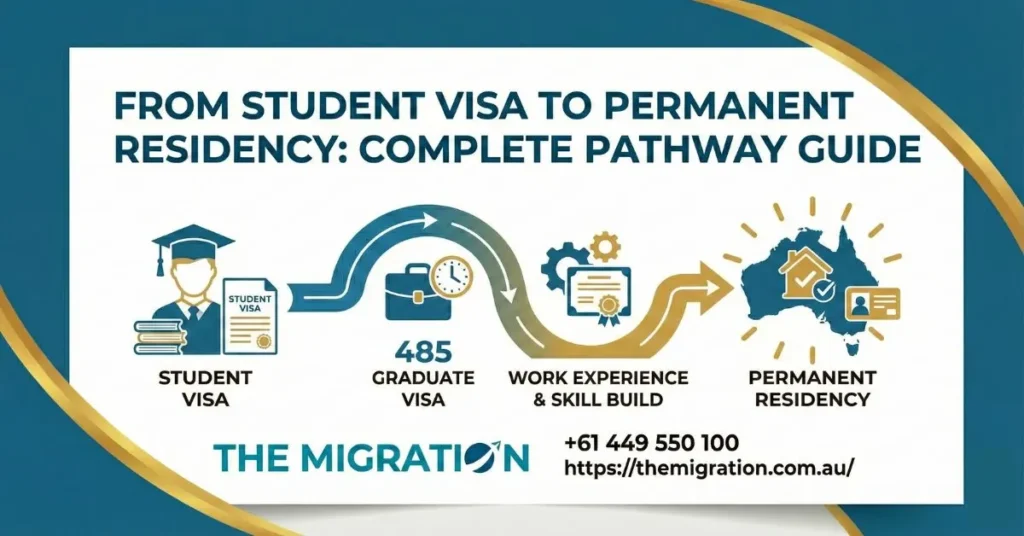
The student visa to PR Australia pathway follows a strategic three-stage journey that typically spans 5-7 years. Each stage builds upon the previous one, creating a logical progression toward permanent residency.
Stage 1: Student Visa Foundation (2-4 years)
During your student visa period, you’ll complete at least two years of CRICOS-registered study while building the foundational qualifications necessary for skilled migration. This stage involves choosing courses strategically, maintaining excellent academic performance, and beginning to build professional networks through internships and part-time work.
Stage 2: Temporary Graduate Visa Bridge (18 months to 4 years)
The Temporary Graduate Visa (Subclass 485) serves as your critical bridge to permanent residency. This period allows you to gain Australian work experience, improve English language skills, and build the points necessary for competitive skilled migration applications.
Stage 3: Permanent Residency Application (6-22 months processing)
Your final stage involves applying for one of three main permanent residency pathways: Skilled Independent (189), State Nominated (190), or Regional Provisional (491) visas. Success depends on your points score, occupation demand, and strategic application timing.
The typical timeline for student visa to PR Australia spans 5-7 years total, with most successful applicants receiving permanent residency 6-8 years after first arriving as students. This timeline allows for strategic point building, work experience accumulation, and English language improvement.
Maximizing Your Temporary Graduate Visa Opportunities
The Temporary Graduate Visa 485 represents your most crucial stepping stone in the student visa to PR Australia journey. This visa provides the time and work rights necessary to build a competitive permanent residency application.
Post-Higher Education Work Stream
This stream suits most university graduates, offering 2-4 years depending on your qualification level. Bachelor’s degree graduates receive 2 years, master’s degree graduates get 3 years, and doctoral graduates enjoy 4 years of work rights. Importantly, this stream requires no skills assessment, providing maximum flexibility for career development.
Post-Vocational Education Work Stream
Designed for diploma and trade qualification holders, this stream provides 18 months of work rights. However, your qualification must relate to an occupation on the skilled occupation list, and you’ll need a skills assessment for your nominated occupation.
Essential 485 Visa Requirements
To qualify for either stream, you must complete at least two years (92 weeks) of study in Australia through CRICOS-registered courses taught in English. You must apply within six months of course completion while holding a valid student visa or bridging visa.
English language requirements include IELTS overall 6.5 with no band below 5.5, or equivalent scores in TOEFL iBT (79) or PTE Academic (58-65). These test results must be valid within 12 months of your application.
Current visa costs for 2025 include AUD 2,235 for primary applicants, AUD 1,115 for secondary applicants over 18, and AUD 560 for children under 18. Processing times typically range from 4-6 months.
Strategic 485 Period Planning
Use your 485 visa period strategically to build points for permanent residency. Gain skilled work experience in your nominated occupation, as each year of Australian work experience adds 5 points (maximum 20 points). Consider completing a Professional Year program if eligible, which adds 5 points while providing industry training and networking opportunities.
Focus intensively on improving your English to Superior level (IELTS 8.0 each band), which can add 10-20 additional points to your skilled migration application. These points often make the difference between receiving an invitation and waiting indefinitely.
Navigating Skilled Migration Pathways to Permanent Residency
Australia offers three primary skilled migration pathways, each designed for different circumstances and offering unique advantages in your student visa to PR Australia journey.
Skilled Independent Visa (Subclass 189)
This visa requires no sponsorship and allows you to live anywhere in Australia. You need a minimum 65 points, though most successful applicants score 80-85+ points due to high competition. Your occupation must appear on the Medium and Long-term Strategic Skills List (MLTSSL), which includes 212 high-priority occupations across healthcare, engineering, IT, and education sectors.
Processing times average 6-8 months, and successful applicants enjoy complete freedom to live and work anywhere in Australia immediately upon visa grant.
Skilled Nominated Visa (Subclass 190)
State nomination adds 5 crucial points to your application while expanding occupation options to include the Short-term Skilled Occupation List (STSOL). This pathway suits applicants with 60-80 points who may struggle to receive 189 visa invitations.
Each Australian state maintains unique nomination criteria and occupation priorities. Popular states like New South Wales focus on healthcare and engineering, while South Australia offers more generous nomination criteria with broader occupation lists. Successful nominees commit to living in their nominating state for two years.
Skilled Work Regional Visa (Subclass 491)
This provisional visa offers the fastest pathway to permanent residency through regional settlement. State nomination or eligible family sponsorship provides 15 bonus points, making invitations almost guaranteed for most applicants.
The 491 visa grants 5 years of provisional residency with full work and study rights in regional Australia. After three years of regional living, working, and earning minimum income (currently AUD 53,900), you become eligible for the Permanent Residence (Skilled Regional) Subclass 191 visa.
Regional Australia includes everywhere except Sydney, Melbourne, Brisbane, Gold Coast, and Perth, encompassing major cities like Adelaide, Darwin, Hobart, and Canberra alongside hundreds of smaller communities offering excellent lifestyle and career opportunities.
Mastering the Points Test System
The Australian points test determines your eligibility and competitiveness for skilled migration visas. Understanding and optimizing your points score is crucial for student visa to PR Australia success.
Age Points (Maximum 30 points)
The optimal age range of 25-32 years receives maximum 30 points. Points decrease gradually, with 18-24 and 33-39 year-olds receiving 25 points, and 40-44 year-olds getting 15 points. Applicants over 45 become ineligible for skilled migration.
English Language Points (Maximum 20 points)
Superior English (IELTS 8.0+ each band) provides 20 points, while Proficient English (IELTS 7.0 each band) adds 10 points. Competent English (IELTS 6.0 each band) receives zero points but meets minimum visa requirements.
Employment Experience Points (Maximum 20 points combined)
Australian work experience receives higher recognition than overseas experience. Eight or more years of Australian experience provides 20 points, while 5-7 years earns 15 points, 3-4 years gets 10 points, and 1-2 years receives 5 points.
Overseas experience maxes out at 15 points for 8+ years, with proportionally lower points for shorter periods. The combined maximum for both Australian and overseas experience remains 20 points.
Educational Qualifications (Maximum 20 points)
Doctoral degrees receive 20 points, bachelor’s or master’s degrees earn 15 points, and diplomas or trade qualifications get 10 points. Australian qualifications meeting the two-year study requirement add an additional 5 points.
Bonus Point Opportunities
Several bonus point categories can significantly boost your score. State nomination adds 5 points (190 visa) or 15 points (491 visa). Partner skills assessment contributes 10 points if your spouse qualifies. Professional Year completion in accounting, engineering, or IT provides 5 points.
Regional study (5 points), NAATI community language credentials (5 points), and specialist education qualifications in STEM fields (5 points) offer additional opportunities for point accumulation.
Strategic Timeline Planning for Success
Successful student visa to PR Australia applicants plan strategically throughout their journey, maximizing opportunities at each stage while building toward long-term goals.
Pre-Graduation Planning (6-12 months before completion)
Research skilled occupation lists thoroughly, ensuring your qualifications align with current and projected skill shortages. Begin English language improvement immediately, as superior scores provide substantial point advantages. Start building professional networks through internships, part-time work, and industry associations.
Gather essential documents including academic transcripts, police clearances, and health examination records. This preparation prevents delays when application opportunities arise.
Post-Graduation Phase (0-6 months after completion)
Apply for your 485 visa within six months of course completion while beginning your skills assessment process, which can take 2-6 months depending on your occupation. Submit your Expression of Interest (EOI) through Skill Select as soon as eligible, even with minimum points, as you can update your profile when circumstances improve.
Experience Building Phase (485 visa period)
Focus intensively on gaining skilled work experience in your nominated occupation while pursuing English language improvement. Complete Professional Year programs if eligible, and seriously consider regional work opportunities for additional points.
Monitor monthly invitation rounds closely, adjusting your strategy based on occupation-specific trends and cut-off scores. Higher-demand occupations may require 90+ points for invitations, while others remain accessible with 65-75 points.
Financial Investment and Return Analysis
The student visa to PR Australia pathway requires substantial financial investment but offers excellent long-term returns. Understanding these costs helps with strategic planning and realistic budgeting.
Total Journey Investment Your complete journey typically costs AUD 150,000-300,000 over 5-7 years, including education fees (AUD 90,000-200,000), living expenses (AUD 125,000-175,000), and visa application costs (AUD 15,000-25,000).
Major cost components include tuition fees ranging from AUD 20,000-50,000 annually, living expenses of AUD 25,000-35,000 per year, and various visa and assessment fees. The 485 visa costs AUD 2,235 for primary applicants, while permanent residency applications require AUD 4,640 for most visa subclasses.
Skills assessments cost AUD 300-1,500 depending on your occupation, while Professional Year programs range from AUD 8,000-15,000. English language tests cost AUD 375-395 per attempt, with most applicants requiring multiple attempts to achieve optimal scores.
Return on Investment Australian permanent residents enjoy average annual salaries of AUD 65,000-85,000, significantly higher than temporary visa holders. Access to Medicare, social security benefits, subsidized education, and retirement superannuation provides substantial lifetime value.
The pathway to Australian citizenship after four years as a permanent resident opens additional opportunities, including one of the world’s most powerful passports and the ability to sponsor extended family members for migration.
Overcoming Common Challenges
Most student visas to PR Australia applicants encounter similar challenges. Understanding these obstacles and their solutions significantly improves your success chances.
Insufficient Points for Invitation High competition means many occupations require 80-90+ points for invitations, well above the 65-point minimum. Solutions include improving English to Superior level (10-20 additional points), gaining Australian work experience (up to 20 points), considering state nomination (5 bonus points), or exploring regional pathways (15 bonus points).
Work Experience Recognition Many graduates struggle to secure skilled employment or gain experience recognition. Professional Year programs provide recognized Australian experience plus networking opportunities. Volunteering, industry networking, and skills upgrading through additional certifications can open employment doors.
English Language Requirements Achieving superior English scores challenges many applicants. Targeted preparation through professional coaching, regular practice testing, and English environment immersion significantly improve results. Consider different test types (IELTS vs PTE vs TOEFL) to find your optimal format.
Regional Australia: Your Fast-Track Opportunity
Regional pathways offer the most accessible route in the student visa to PR Australia journey. The 491 visa provides 15 bonus points, making invitations almost guaranteed for most applicants while offering direct permanent residency pathways after three years.
Regional Australia encompasses over 400 cities and towns, including major centers like Adelaide, Darwin, Hobart, and Canberra. These locations offer excellent career opportunities, lower living costs, and outstanding quality of life while maintaining access to world-class healthcare, education, and cultural amenities.
Popular regional destinations include Newcastle for engineering and healthcare, Wollongong for manufacturing and technology, Geelong for automotive and aerospace industries, and countless smaller communities with specific skill shortages and welcoming integration programs.
Your Action Plan for Success
Begin your student visa to PR Australia journey with immediate research into skilled occupation lists for your field of study. Connect with successful migrants in your profession through professional associations and networking events.
During your studies, focus on building professional networks, maintaining excellent academic performance, and improving English beyond minimum requirements. Use your 485 visa period strategically to gain skilled work experience while building points through additional qualifications and language improvement.
Consider regional opportunities seriously, as they offer the fastest and most accessible pathway to permanent residency. Many successful applicants discover that regional Australia provides better career advancement opportunities and lifestyle benefits than they initially expected.
Submit your EOI as soon as eligible, monitor invitation trends monthly, and remain flexible in your approach. The immigration landscape changes regularly, and successful applicants adapt their strategies accordingly.
Conclusion: Your Australian Future Awaits
The student visa to PR Australia pathway has successfully guided over 450,000 international students to permanent residency over the past decade. While the journey requires patience, strategic planning, and financial investment, the destination makes every effort worthwhile.
Australian permanent residents enjoy not just visa security, but access to one of the world’s most successful multicultural societies, excellent healthcare and education systems, and outstanding career opportunities across diverse industries.
Your Australian dream begins with understanding this pathway thoroughly and taking strategic action at each stage. Whether through independent skilled migration, state nomination, or regional settlement, multiple routes exist to transform your student visa into permanent residency and, ultimately, Australian citizenship.
Book your consultation and start your journey today by researching occupation lists, connecting with migration professionals, and building the foundation for your permanent future in Australia. The pathway is clear, the opportunities are real, and your Australian future awaits.
